

Process capability measures how well a process meets customer requirements in stable operations. In Six Sigma, organisations quantify it using indices like Cp and Cpk to predict defects and drive efficiency.
What Is Process Capability in a Corporate Context?
Process capability assesses a process’s ability to produce output within specified limits under stable conditions. It uses statistical ratios to quantify variation relative to tolerance bands, revealing defect risks in manufacturing and service operations.
Organisations apply process capability to bridge employee skill gaps in quality control. HR managers identify teams struggling with inconsistent outputs, such as production lines yielding 5% defective parts. This metric guides workforce development by pinpointing training needs.
In corporate environments, process capability defines a stable process as one with predictable variation. Businesses calculate it when processes operate at Six Sigma levels, achieving 3.4 defects per million opportunities. This focus reduces waste and aligns operations with customer specifications.
From a B2B training perspective, professionals learn process capability to evaluate workflow reliability. L&D teams deploy it to measure baseline performance before interventions, ensuring training targets root causes like operator errors contributing to 15% yield loss.
Why Does Process Capability Matter for Workforce Development?
Process capability directly impacts team efficiency and ROI by quantifying process reliability. It enables HR leaders to justify training investments, targeting 20-30% productivity gains through skill enhancement in quality management.
Decision-makers use process capability to address skill gaps in departments like operations and supply chain. Teams with low capability scores face higher rework costs, averaging 10-15% of revenue in industries like manufacturing and automotive.

Training in process capability equips leaders to monitor KPIs such as defect rates and cycle times. Organisations report 25% faster problem resolution after staff master these metrics, strengthening the leadership pipeline for continuous improvement.
Retention improves as employees gain confidence in data-driven decisions. Businesses with robust capability analysis see 18% lower turnover in quality roles, as teams contribute to measurable organisational impact.
How Does Process Capability Work in Corporate Environments?
Process capability works through statistical analysis of process variation against specification limits. Organisations stabilise processes first, then compute indices to predict performance over 1.5 million units annually.
Stability forms the foundation. Teams confirm process control using control charts, ensuring no special causes disrupt variation. This step prevents false capability readings in volatile settings like high-volume assembly lines.
Data collection follows. Operators gather measurements from 100-300 samples across shifts, capturing short-term variation. Software tools process this data to generate histograms and capability plots.
Calculation integrates mean performance and spread. The formula divides tolerance width by six sigma units of variation. Corporate teams apply this in ERP systems to track real-time metrics.
Implementation spans departments. Finance reviews capability for cost savings, while operations uses it for supplier audits. Training reinforces these steps via simulations, building proficiency in 40-hour workshops.
What Are the Key Components of Process Capability Analysis?
Key components include stability checks, data collection, indices like Cp and Cpk, and graphical tools. Frameworks such as control charts and histograms enable precise measurement in team-based assessments.
Stability verification starts with control charts. Teams plot data points to detect shifts, applying rules like Western Electric for anomalies. This ensures 95% confidence in results.
Cp measures potential capability. It equals (USL – LSL) / (6σ), where USL and LSL are upper and lower specification limits. A Cp of 1.33 indicates the process fits specifications with margin.
Cpk accounts for centering. Formulae adjust Cp for off-target means: Cpk = min[(USL – μ)/3σ, (μ – LSL)/3σ]. Values above 1.67 signal robust performance in automotive parts production.
Tools encompass histograms, box plots, and capability software like Minitab. Delivery formats include online modules for self-paced learning and hybrid workshops with role-play scenarios.
Assessments test application. Participants analyse datasets from industries like IT service desks and healthcare labs, scoring 85% proficiency to certify competence.
How Is Process Capability Measured Step by Step in Six Sigma?
Measurement follows five steps: stabilise the process, collect data, assess normality, calculate indices, and interpret results. This sequence delivers 99% accuracy in defect predictions for corporate processes.
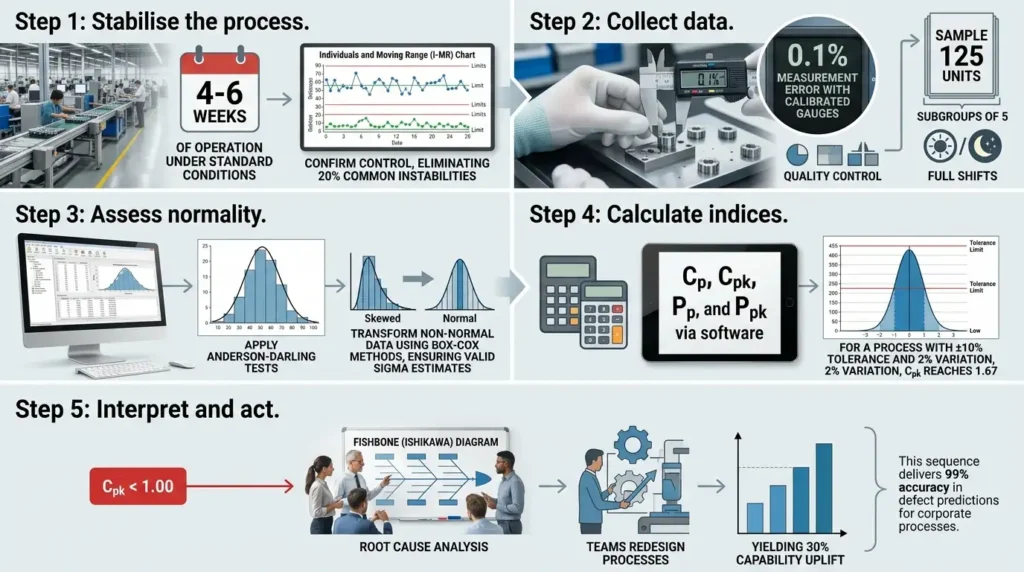
Step 1: Stabilise the process. Run operations for 4-6 weeks under standard conditions. Use Individuals and Moving Range charts to confirm control, eliminating 20% of common instabilities.
Step 2: Collect data. Sample 125 units in subgroups of five, covering full shifts. Record measurements precisely, achieving 0.1% measurement error with calibrated gauges.
Step 3: Assess normality. Apply Anderson-Darling tests on histograms. Transform non-normal data using Box-Cox methods, ensuring valid sigma estimates.
Step 4: Calculate indices. Compute Cp, Cpk, Pp, and Ppk via software. For a process with ±10% tolerance and 2% variation, Cpk reaches 1.67.
Step 5: Interpret and act. Scores below 1.00 trigger root cause analysis via fishbone diagrams. Teams redesign processes, yielding 30% capability uplift.
What Delivery Formats Are Used for Process Capability Training?
Delivery formats include 40-hour workshops, online modules, and hybrid simulations. Case-based learning and assessments ensure 90% knowledge retention in corporate settings.
Workshops deliver hands-on practice. Groups of 12 analyse real datasets from finance transaction processing, applying tools in 8-hour sessions over five days.
Online modules offer flexibility. Self-paced videos cover calculations, with quizzes testing 80% pass rates. Professionals complete them in 20 hours alongside duties.
Hybrid learning combines both. Virtual lectures precede in-person role plays, simulating factory floor decisions. This format boosts application skills by 35%.
Assessments include pre- and post-tests. Simulations mimic service delivery failures, requiring index computations under time pressure.
How Do Organisations Implement Process Capability in Teams?
Organisations implement via cross-functional teams trained in Six Sigma belts. They integrate metrics into KPIs, rolling out in phases over 6-12 months for 25% efficiency gains.
Phase 1: Train champions. Select 10% of managers for Green Belt certification, focusing on capability basics in 2-day sessions.
Phase 2: Baseline audits. Departments measure current Cp/Cpk across 50 processes, identifying 15 low-performers like packaging lines.
Phase 3: Improvement projects. Black Belts lead DMAIC cycles, elevating Cpk from 0.8 to 1.5 in 90 days.
Phase 4: Monitor and standardise. Dashboards track monthly indices, linking to bonuses for sustained 1.33+ scores.
Challenges arise from data silos. Teams overcome this through collaborative software, enhancing buy-in.
For deeper implementation enrol in:
Lean Six Sigma Master Black Belt Certification Training Course
And in advanced programmes, explore:
How Is Process Capability Analysis Taught in Lean Six Sigma Master Black Belt Training?
What Measurable Outcomes Does Process Capability Produce?
Outcomes include 20-40% defect reduction, 15-25% cost savings, and 30% productivity boosts. KPIs track ROI at 300-500% within 12 months.
Defect rates drop sharply. A Cpk improvement from 1.0 to 1.67 halves failures, saving £500,000 yearly in rework for mid-sized firms.
Productivity rises as variation shrinks. Cycle times shorten by 22%, enabling 18% output growth without added staff.
ROI calculations use savings divided by training costs. A £10,000 programme yielding £2 million savings delivers 20x return.
Retention metrics improve. Skilled teams report 20% higher engagement scores, reducing vacancies by 12%.
What Are Common Use Cases for Process Capability in Industries?
Use cases span manufacturing for parts tolerance, services for transaction accuracy, and healthcare for lab results. Teams achieve 25% yield improvements across IT, finance, and logistics.
Manufacturing applies it to engine components. Suppliers target Cpk 2.0, cutting scrap by 35%.
Service desks use it for call resolution. Metrics ensure 95% first-pass success, boosting NPS by 15 points.
Healthcare labs measure assay precision. Capability analysis standardises tests, reducing errors to 0.5%.
Finance tracks loan processing. Indices below 1.33 prompt training, lifting throughput 28%.
Logistics optimises shipment weights. Stable processes lower claims by 40%.
What Common Problems Arise with Process Capability and How Are They Addressed?
Common problems include unstable processes, non-normal data, and misaligned specs. Training addresses them via rigorous stability checks and transformations, ensuring 95% analysis accuracy.
Unstable processes yield invalid indices. Teams counter with extended monitoring, stabilising 80% of cases pre-analysis.
Discover More from Our Guide Library:
What Is Control Phase in DMAIC and Why Is It Often the Hardest Step?
How Does Lean Six Sigma Drive Cultural Change in an Organisation?
Non-normal data skews sigma. Box-Cox transforms resolve 70% of issues, maintaining validity.
Misaligned specs ignore customer needs. Voice of Customer studies realign limits, boosting relevance.
Generic training fails ROI. Custom simulations tied to KPIs deliver 4x better results.
Ineffective programmes lack follow-up. Organisations mandate quarterly audits, sustaining 25% gains.
Who should enrol in Imperial Corporate Training Institute’s Lean Six Sigma Master Black Belt course?
Senior managers, Black Belts, and L&D professionals aiming to mentor teams and drive enterprise-wide transformations enrol in this course. It targets those with Green or Black Belt experience facing skill gaps in advanced capability analysis and change management. Participants gain tools to deliver measurable ROI in operations and quality roles.
What topics are covered in Imperial Corporate Training Institute’s Master Black Belt training?
Topics include advanced process capability indices like Cpk and Ppk, Design for Six Sigma, hypothesis testing, and leadership in Lean principles. Training uses case-based learning from IT, healthcare, and logistics sectors. Assessments ensure proficiency in tools like Minitab for 99% defect reduction strategies.
What certification do you get from Imperial Corporate Training Institute’s Lean Six Sigma Master Black Belt Course?
Graduates receive the Lean Six Sigma Master Black Belt Certification, accredited by global bodies and recognised in 50+ countries. It validates expertise through exams, projects, and mentorship logs. Certified professionals report 25% higher project success rates in workforce development initiatives.