

Lean Six Sigma combines Lean principles for waste elimination with Six Sigma methods for defect reduction, driving cultural change by embedding data-driven decision-making and continuous improvement into organisational DNA, resulting in 20-30% productivity gains across teams.
Lean Six Sigma targets inefficiencies in corporate processes. It merges Lean’s focus on speed and flow with Six Sigma’s statistical precision. Organisations adopt it to shift from reactive firefighting to proactive problem-solving.
In workplaces, this methodology addresses employee skill gaps in process optimisation. HR managers notice teams stuck in silos or repeating errors. Lean Six Sigma trains staff to identify root causes using tools like DMAIC (Define, Measure, Analyse, Improve, Control).
Business impact appears in metrics. Companies report 15-25% reduction in cycle times after implementation. Cultural change emerges as employees embrace kaizen—daily continuous improvement—fostering accountability at all levels.
For L&D professionals, it aligns training with corporate goals. Decision-makers see it as a framework for workforce transformation, not just a certification. Industries like manufacturing, finance, and logistics apply it to standardise operations.
How Does Lean Six Sigma Work to Drive Cultural Change?
Lean Six Sigma works through structured DMAIC cycles delivered via workshops, online modules, and hybrid formats, training teams to map processes, eliminate waste, and sustain gains, achieving 25% error reduction and embedding a quality mindset in 6-12 months.
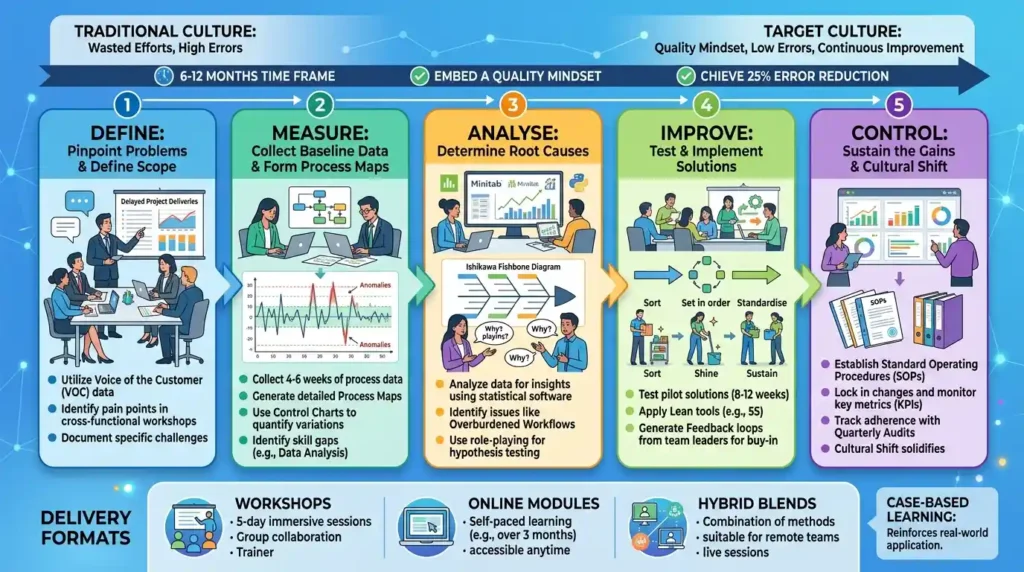
The process starts with Define. Teams pinpoint problems using voice of the customer data. In corporate settings, this involves cross-functional workshops where managers document pain points like delayed project deliveries.
Measure follows. Participants collect baseline data over 4-6 weeks. Tools such as process maps and control charts quantify variations. This step reveals skill gaps, such as inadequate data analysis in finance departments.
Analyse uncovers root causes. Statistical software like Minitab processes data, identifying issues like overburdened workflows. Role-playing simulations during training help teams practise hypothesis testing.
Improve phase tests solutions. Pilots run for 8-12 weeks, applying Lean tools like 5S (Sort, Set in order, Shine, Standardise, Sustain). Feedback loops ensure buy-in from team leaders.
Control locks in changes. Standard operating procedures and dashboards monitor KPIs. Cultural shift solidifies as organisations track adherence, with audits every quarter.
Delivery formats vary. Workshops span 5 days for immersion. Online modules allow self-paced learning over 3 months. Hybrid blends both, suiting remote corporate teams. Case-based learning reinforces real-world application.
What Are the Key Components of Lean Six Sigma Training?
Key components include DMAIC framework, Lean tools (value stream mapping, kanban), Six Sigma stats (control charts, DOE), plus delivery via 40-hour workshops, simulations, and assessments, building skills for 95% process capability.
DMAIC forms the core structure. Each phase equips teams with specific tools. Define uses SIPOC diagrams to scope projects.
Lean tools target waste types: overproduction, waiting, transport, overprocessing, inventory, motion, defects. Value stream mapping visualises entire processes, cutting lead times by 40% in IT services.
Six Sigma components add rigour. Control charts track stability. Design of Experiments (DOE) optimises variables. These demand statistical training, delivered through 20-hour modules.
Belts define roles: Yellow for basics (40 hours), Green for projects (80 hours), Black for leadership (160 hours), Master Black Belt for strategy (240+ hours). Assessments include exams and project submissions.
Delivery integrates methodologies. Simulations mimic factory floors. Role plays handle stakeholder resistance. Case studies from healthcare and banking illustrate applications.
Frameworks like Hoshin Kanri align goals organisation-wide. KPIs such as sigma levels (from 3.8 defects per million to 6 sigma) measure progress.
How Do Organisations Implement Lean Six Sigma for Cultural Change?
Organisations implement Lean Six Sigma by selecting belt-trained champions, launching 6–9-month pilot projects across departments, scaling via train-the-trainer models, and tracking ROI through dashboards, yielding 18-35% efficiency gains.
Implementation begins with leadership commitment. Executives form steering committees. They allocate budgets for training 10-20% of staff initially.
Champions emerge from Green and Black Belt programs. These leaders run pilots in high-impact areas like supply chain or customer service. Pilots last 3 months, delivering quick wins like 20% throughput increase.
Scaling uses train-the-trainer. Master Black Belts certify internals, reducing external costs by 50%. Hybrid delivery reaches global teams.
Integration addresses common problems. Misconception: it’s only for manufacturing. Reality: finance uses it for invoice processing, cutting errors by 30%.
Challenges include resistance. Overcome via change management town halls, and success stories build buy-in. Generic programs fail; bespoke aligns with KPIs.
For HR and L&D, track adoption via dashboards. Metrics cover project savings (£50,000-£500,000 per Black Belt project).
When evaluating advanced implementation, leaders explore:
How Master Black Belt training teaches them to build a quality-first culture. These shifts focus to strategic deployment and enrol in:
Lean Six Sigma Master Black Belt Certification Training Course.
What Benefits Does Lean Six Sigma Deliver to Organisations and Teams?
Lean Six Sigma delivers 20-40% productivity boosts, 15-25% cost savings, 10-20% retention improvements, and stronger leadership pipelines by standardising processes and empowering teams with data skills.
Productivity rises through waste elimination. Teams complete tasks 30% faster, as seen in logistics firms reducing delivery variances.
Cost savings materialise in defect reduction. Organisations cut rework by 25%, freeing budgets for innovation. ROI hits 5:1 within 12 months.
Retention improves. Employees gain confidence via skill-building, lowering turnover by 15%. Skill gaps close, with 90% reporting higher job satisfaction post-training.
Leadership pipelines strengthen. Black Belts mentor juniors, creating internal experts. This supports succession planning.
Team efficiency surges. Cross-functional projects break silos, improving collaboration. KPIs like on-time delivery reach 98%.
Organisational impact includes agility. Firms adapt faster to market shifts, with 35% better customer satisfaction scores.
What Use Cases Demonstrate Lean Six Sigma in Corporate Teams?
Use cases span manufacturing (50% inventory cuts), healthcare (30% patient wait reductions), finance (25% audit cycle shortening), and IT (40% deployment speed-ups), applied by managers in departmental pilots.
In manufacturing, teams use value stream mapping to slash inventory by 50%. A automotive supplier trained 50 Yellow Belts, achieving £2 million savings.
Healthcare applies DMAIC to throughput. Hospitals reduce patient waits by 30% via triage optimisation. Role plays train nurses on flow management.
Finance departments tackle compliance. Process mining cuts audit cycles by 25%. Banks train Green Belts for fraud detection, improving accuracy to 99%.
IT leverages kanban for deployments. Software firms speed releases by 40%, using control charts for stability. Agile hybrids enhance outcomes.
Team leaders deploy in sales: forecasting accuracy rises 20%. Departments like HR streamline onboarding, cutting time by 35%.
Industries such as retail and telecom report similar gains. Pilots scale to enterprise-wide, with Master Black Belts overseeing.
What Common Problems Arise in Lean Six Sigma Implementation?
Common problems include lack of leadership buy-in (causing 40% failure rate), inadequate training (leading to 25% improper tool use), resistance from staff (delaying ROI by 6 months), and measuring wrong KPIs (masking true gains).
Leadership gaps derail efforts. Without C-suite support, projects stall. Solution: tie to business KPIs from day one.
Inadequate training stems from generic programs. Off-the-shelf courses ignore industry needs, resulting in 25% tool misuse. Bespoke workshops with simulations fix this.
Staff resistance slows cultural change. Veterans fear job loss. Address via transparent communication and quick wins, boosting engagement by 30%.
Wrong KPIs mislead. Focusing on activity over outcomes hides issues. Use sigma levels and financial metrics instead.
Misconception: Lean Six Sigma replaces jobs. It reallocates talent, increasing efficiency without layoffs—evidenced by 10% headcount-neutral growth.
ROI absence plagues poor implementations. Track project savings rigorously; successful programs deliver 300-500% returns over 3 years.
How Do Organisations Measure Lean Six Sigma Outcomes?

Organisations measure outcomes via KPIs like sigma levels (target 4+), cost savings (£100,000+ per project), cycle time reductions (20-50%), defect rates (<3.4 DPMO), and employee engagement scores (up 25%), audited quarterly.
Sigma levels quantify quality. From 3 sigma (66,000 defects per million opportunities) to 4+ (over 99% perfection).
Financial metrics capture ROI. Track hard savings (reduced waste) and soft (downtime cuts). Dashboards aggregate data.
Discover More from Our Guide Library:
What Is a Lean Six Sigma Project Charter and Why Is It Important?
What Is Value Stream Mapping and Why Is It Critical in Lean Six Sigma?
Cycle times drop 20-50%. Baseline to post-implementation comparisons prove impact.
Defect rates fall below 3.4 DPMO. Control charts sustain gains.
Engagement surveys rise 25%. Retention rates climb 15%, linking to cultural shift.
Audits every quarter ensure control. L&D tracks belt certifications against business impact.
These metrics guide scaling, confirming workforce transformation.
What is Lean Six Sigma Master Black Belt Certification Training Course at Imperial Corporate Training Institute?
The Lean Six Sigma Master Black Belt Certification Training Course at Imperial Corporate Training Institute equips leaders with advanced skills in DMAIC, statistical analysis, and change management. It spans 240+ hours through hybrid workshops, simulations, and projects, targeting 95% process capability. Participants lead enterprise-wide transformations in industries like manufacturing and finance.
Who should take the Lean Six Sigma Master Black Belt course from Imperial Corporate Training Institute?
Black Belts, senior managers, and L&D professionals aiming to drive cultural change qualify for Imperial Corporate Training Institute’s Lean Six Sigma Master Black Belt Certification Training Course. It suits those with Green Belt experience facing skill gaps in strategic deployment. Organisations select candidates to build internal quality experts and leadership pipelines.
What are the benefits of Master Black Belt certification for organisations?
Master Black Belt certification from Imperial Corporate Training Institute yields 20-40% productivity gains, 15-25% cost savings, and improved retention via skilled champions. Graduates mentor teams, standardising processes with KPIs like sigma levels above 4. It fosters a quality-first culture across departments.
How does Imperial Corporate Training Institute deliver Lean Six Sigma Master Black Belt training?
Imperial Corporate Training Institute uses practical formats like case-based learning, role plays, and simulations in its Lean Six Sigma Master Black Belt Certification Training Course. Hybrid delivery combines 5-day workshops with self-paced modules. Real-world projects align with corporate KPIs for measurable ROI.