

Value stream mapping visualises the flow of materials and information required to deliver a product or service to customers. In Lean Six Sigma, organisations deploy it to identify waste, streamline processes, and boost efficiency by 20-50% in manufacturing and service sectors.
What Is Value Stream Mapping in Corporate Environments?
Value stream mapping documents every step in a process from start to finish, highlighting value-adding and non-value-adding activities to eliminate waste in corporate operations.
Teams in organisations create current-state maps that depict actual workflows. These maps reveal bottlenecks, excess inventory, and waiting times. Future-state maps then outline ideal processes with reduced cycle times.
In B2B contexts, HR managers and L&D professionals address employee skill gaps in process optimisation. Workers learn to spot inefficiencies that inflate costs by 15-30%. Training equips teams to map streams in departments like production, procurement, and customer service.
Lean Six Sigma integrates value stream mapping as a core tool. It aligns with DMAIC methodology: Define, Measure, Analyse, Improve, Control. Corporations apply it to cut lead times from weeks to days.
Business impact emerges through data-driven decisions. A manufacturing firm maps its assembly line and discovers 40% of time spent on unnecessary transport. Redesign slashes this, improving throughput by 25%.
Why Does Value Stream Mapping Matter in Lean Six Sigma for Businesses?
Value stream mapping drives Lean Six Sigma success by quantifying waste, enabling 30-40% productivity gains and reducing operational costs in corporate settings.
Lean Six Sigma targets variation and waste. Value stream mapping provides the visual blueprint. It shifts teams from reactive fixes to proactive redesigns.
In corporate environments, decision-makers face pressures like rising costs and tight deadlines. This tool delivers measurable ROI. Organisations report 20% defect reductions after mapping exercises.
L&D programs bridge skill gaps in process thinking. Employees master mapping to contribute to kaizen events, continuous improvement initiatives held quarterly.
Without it, Lean Six Sigma efforts falter. Generic process reviews miss hidden wastes like overproduction or defects. Mapping ensures 100% process visibility.
How Does Value Stream Mapping Work Step by Step in Organisations?
Value stream mapping follows a seven-step process: select product family, draw current-state map, identify wastes, design future-state map, create implementation plan, execute changes, and monitor with KPIs.
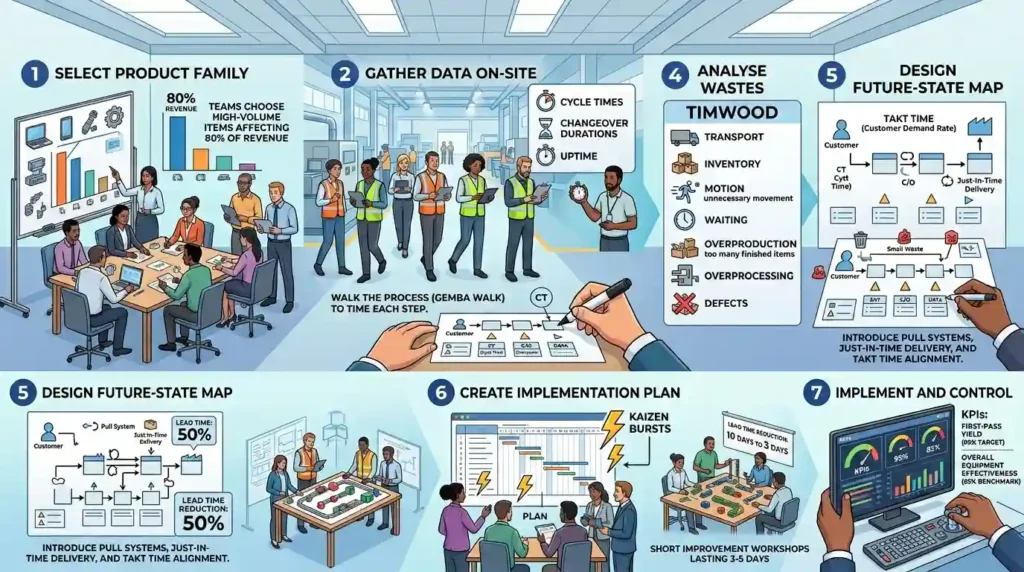
Step 1: Select a product family or service line. Teams choose high-volume items affecting 80% of revenue, per Pareto principle.
Step 2: Gather data on-site. Walk the process (gemba walk) to time each step. Record cycle times, changeover durations, and uptime.
Step 3: Draw the current-state map. Use standard symbols: process boxes, inventory triangles, data boxes for metrics like takt time (customer demand rate).
Step 4: Analyse wastes using TIMWOOD categories: Transport, Inventory, Motion, Waiting, Overproduction, Overprocessing, Defects.
Step 5: Design future-state map. Introduce pull systems, just-in-time delivery, and takt time alignment to cut lead times by 50%.
Step 6: Develop an implementation plan with kaizen bursts, short improvement workshops lasting 3-5 days.
Step 7: Implement and control. Track KPIs like first-pass yield (95% target) and overall equipment effectiveness (85% benchmark).
In corporate training, workshops deliver this via simulations. Participants map a fictional supply chain, reducing simulated cycle time from 10 days to 3.
What Are the Key Components of Value Stream Mapping?
Key components include current-state and future-state maps, standard symbols, metrics like cycle time and takt time, waste identification tools, and implementation roadmaps.
Current-state maps capture reality. They show supplier to customer flow, with timelines at the bottom indicating value-added versus non-value-added time ratios, often 5:95.
Future-state maps propose ideals. They feature supermarkets for kanban control and continuous flow cells.
Standard symbols standardise communication: kaizen bursts for improvements, push arrows for batch flows, electronic information flows.
Metrics drive precision. Cycle time measures step duration; process time sums value-adding activities; lead time spans order to delivery.
Waste tools apply Lean principles. Root cause analysis uses 5 Whys to drill into issues.
Roadmaps outline timelines: Week 1 mapping, Month 1 pilots, Quarter 1 full rollout.
Training incorporates these in hybrid formats: online modules for theory, in-person role plays for symbol practice, assessments testing map accuracy.
How Do Organisations Implement Value Stream Mapping Training?
Organisations implement value stream mapping training through 5-day workshops blending lectures, case studies, simulations, and team projects, targeting 20-30 participants per cohort.
HR and L&D select cross-functional teams: operators, supervisors, managers. Training addresses skill gaps in visual process analysis.
Delivery formats vary. Workshops span 40 hours: Day 1 theory, Days 2-3 mapping exercises, Days 4-5 future-state design.
Online modules cover basics: 10 hours of self-paced videos on symbols and metrics. Hybrid blends virtual simulations with on-site gemba walks.
Learning methodologies include case-based learning from industries like automotive (Toyota Production System) and healthcare (patient flow).
Simulations use software like Lucidchart or Minitab. Teams map a hospital admission process, cutting wait times by 40% in practice runs.
Assessments verify competence: 80% pass rate on map creation quizzes, capstone projects reviewed by Black Belts.
Post-training, organisations assign mentors. Monthly reviews track application, ensuring 70% of trainees lead kaizen events within six months.
For deeper insights into advanced teaching methods, explore:
How Is Value Stream Mapping Taught in Lean Six Sigma Master Black Belt Training?.
What Benefits Does Value Stream Mapping Deliver to Corporate Teams?
Value stream mapping yields 25-50% cycle time reductions, 15-30% cost savings, 20% productivity boosts, and 10-15% improvements in employee retention through skill development.
Teams gain process ownership. Mapping reveals quick wins, like rearranging layouts to eliminate 2 hours of daily walking.
Organisations see KPI uplifts. First-pass yield rises to 98%, inventory turns increase from 4 to 12 annually.
ROI calculates simply: Training costs £5,000 per cohort; savings hit £200,000 yearly from waste cuts.
Leadership pipelines strengthen. Managers apply mapping to strategic projects, building analytical skills.
Retention improves as employees engage in impactful work. Surveys show 12% higher satisfaction in mapped departments.
Scalability fits SMEs to enterprises. A 500-employee firm cuts overtime by 30%, freeing £150,000 annually.
What Are Common Use Cases for Value Stream Mapping Across Industries?

Use cases span manufacturing (assembly lines), healthcare (patient journeys), finance (loan processing), IT (software deployment), and logistics (order fulfilment), transforming department efficiencies.
In manufacturing, teams map welding-to-shipping flows. Results: 35% lead time drop, £500,000 inventory reduction.
Healthcare applies it to emergency rooms. Mapping identifies 45-minute delays; redesign achieves 20-minute throughput.
Finance streamlines approvals. A bank maps mortgage processes, slashing 15-day cycles to 5 days, boosting customer satisfaction scores by 25%.
IT uses it for DevOps pipelines. Mapping CI/CD streams cuts deployment time from 7 days to 4 hours.
Logistics maps warehouse picks. Firms like DHL reduce errors by 40%, lifting on-time delivery to 99%.
Corporate teams deploy it department-wide. Procurement maps vendor cycles, negotiating 10% faster contracts.
What Problems Arise Without Proper Value Stream Mapping Training?
Without proper training, organisations face 20-40% wasted improvement efforts, persistent bottlenecks, low ROI from generic programs, and unaddressed skill gaps leading to 15% higher turnover.
Ineffective training skips hands-on mapping. Employees return to silos, with zero process changes.
Misconceptions persist: Mapping seen as one-off charts, not living documents updated quarterly.
Generic programs ignore industry specifics. IT teams get manufacturing examples, yielding 10% adoption rates.
Lack of ROI tracking dooms initiatives. Without KPIs like OEE, gains evaporate within months.
Skill gaps widen. Untrained staff miss 30% of wastes, perpetuating overprocessing.
Corporate impacts compound: Team efficiency stalls at 60% capacity; leadership pipelines dry up.
How Do Organisations Measure Outcomes from Value Stream Mapping?
Organisations measure outcomes with KPIs: 30% cycle time reduction, 25% inventory cut, 98% first-pass yield, £100,000+ annual savings, tracked via dashboards updated monthly.
Pre-post audits compare maps. Baseline lead time versus post-implementation sets baselines.
Productivity metrics track output per hour, targeting 20% uplift.
Discover More from Our Guide Library:
How Are Lean Thinking and Six Sigma Methodology Combined in Practice?
What Mentoring Responsibilities Come with a Master Black Belt Certification?
Financial ROI uses net present value: Savings minus training costs over 12 months.
Employee metrics include training completion (95%) and kaizen participation (80% of staff).
Retention rates rise 12%; absenteeism drops 8%.
Dashboards in tools like Tableau visualise trends. Quarterly reviews adjust future states.
Sustained impact builds: Year 1 yields 25% gains; Year 2 scales to 45% enterprise-wide.
Enrol in:
Lean Six Sigma Master Black Belt Certification Training Course
What is covered in the Lean Six Sigma Master Black Belt Certification Training Course at Imperial Corporate Training Institute?
The course covers advanced Lean Six Sigma tools like value stream mapping, DMAIC at enterprise scale, statistical analysis, and change management. Participants gain skills in leading complex projects across departments. It includes simulations, case studies, and a certification exam aligned with industry standards.
How long does the Lean Six Sigma Master Black Belt Certification Training Course take at Imperial Corporate Training Institute?
The programme spans 10-15 days of intensive training, often delivered in hybrid format with workshops and online modules. It requires 160+ hours including pre-work and project application. Certification follows successful completion of exams and a real-world project.
What are the prerequisites for Imperial Corporate Training Institute’s Lean Six Sigma Master Black Belt Certification Training Course?
Candidates need Black Belt certification and 3-5 years of Lean Six Sigma project experience. Familiarity with Minitab or similar tools is essential. Imperial Corporate Training Institute assesses applications to ensure readiness for advanced topics.
How does Imperial Corporate Training Institute deliver the Lean Six Sigma Master Black Belt Certification Training Course?
Delivery combines in-person workshops, virtual simulations, and self-paced modules for flexibility. Learning uses case-based studies from industries like manufacturing and finance, plus role plays for leadership scenarios. Assessments include quizzes, projects, and peer reviews.