

Imperial Corporate Training Institute’s Lean Six Sigma Master Black Belt Certification Training Course equips senior professionals with advanced skills for enterprise-wide transformations. Participants address skill gaps in managing complex projects, where unclear objectives lead to failed initiatives and wasted resources in corporate environments. A key question arises: does this course include a live project charter exercise?
Yes, Imperial Corporate Training Institute’s Master Black Belt course includes a live project charter exercise within Module 10: Capstone Project and Certification Evaluation. Participants develop, present, and defend a real-world project charter, applying it to enterprise-level initiatives with executive feedback.
This structure ensures mastery of project charters, essential for aligning Lean Six Sigma strategies with corporate goals.
For foundational knowledge on project charters, explore:
What a Lean Six Sigma Project Charter Is and Why It Is Important?
What Problem Does This Course Solve?
Corporate leaders face persistent challenges in scaling process improvements. Departments struggle with misaligned projects, resulting in 30-50% failure rates due to vague scopes and unmeasured outcomes. HR teams observe stalled leadership pipelines, while operations managers deal with recurring inefficiencies in manufacturing and services.
Imperial Corporate Training Institute solves these by providing structured mastery in Lean Six Sigma, focusing on enterprise deployment, advanced analytics, and sustainable governance, enabling participants to lead transformations that deliver measurable ROI.
Senior operations directors often encounter resistance in cross-functional teams. Without robust project charters, initiatives lack buy-in and clear metrics. This course targets such gaps, equipping professionals to define scopes, risks, and success criteria from the outset.
Real-world example: An HR department in a manufacturing firm used prior training but failed to sustain gains. Post-course, their Master Black Belt led a charter-driven project that reduced cycle times by 25%, integrating with talent management.
The course bridges these issues through specification-driven modules, ensuring participants apply tools directly to workplace challenges.
Why Is the Course Structured This Way?
Curriculum design follows a logical progression from strategy to execution, mirroring corporate project lifecycles. This builds from foundational alignment to advanced application, preventing knowledge silos common in fragmented training.
Imperial Corporate Training Institute structures the course across 10 modules with progressive skill development, culminating in a live project charter exercise to integrate all competencies into real enterprise scenarios.
Module 1 establishes strategic alignment, ensuring charters support corporate goals. Subsequent modules layer analytical depth and leadership skills. This sequence reflects Korey-inspired semantic SEO principles, associating entities like corporate learning with decision-stage outcomes.
Progression avoids overload: early modules focus on governance; mid-modules on tools like DOE; later on sustainability. Each builds measurable competencies, tested via assignments.
For insights into charter development in training, see:
How Project Charters Are Developed During Master Black Belt Training Programmes?
This structure suits target audiences, such as continuous improvement managers, by simulating their daily demands.
What Will Participants Learn?
Participants gain mastery in 10 core modules, each with defined outcomes. Skills progress from strategic oversight to hands-on execution, emphasising data-driven decisions.
Learners master enterprise Lean Six Sigma deployment, advanced statistics, change leadership, and project portfolio management, with a live project charter exercise demonstrating integration of all modules.
Module 1: Strategic Role of the Master Black Belt
Understand deployment across organisations. Align with business strategy. Develop governance for programmes. Outcome: Craft charters that secure executive sponsorship.
Module 2: Advanced Analytical and Statistical Tools
Apply multivariate analysis and DOE. Use Minitab/JMP for capability studies. Outcome: Embed statistical rigour in charter metrics.
Module 3: Enterprise-Level Lean Transformation
Map value streams end-to-end. Measure ROI on waste elimination. Outcome: Charters target cost optimisation in manufacturing/services.
Example: Supply chain executives charter projects reducing inventory costs by 15% through Lean mapping.
Module 4: Change Leadership and Organisational Culture
Manage resistance in teams. Align with HR initiatives. Outcome: Charters include stakeholder plans for smooth rollout.
Module 5: Business Process Reengineering and Innovation
Design agile processes. Integrate with AI/automation. Outcome: Charters innovate for digital transformation.
Module 6: Project Portfolio Management
Prioritise initiatives. Track performance. Outcome: Charters justify financial cases.
Module 7: Coaching, Mentoring, and Capability Building
Coach Black/Green Belts. Build academies. Outcome: Charters support team training pipelines.
HR leaders apply this to develop internal leadership.
Module 8: Advanced Control and Sustainability Systems
Design KPI dashboards. Conduct maturity assessments. Outcome: Charters define long-term controls.
Module 9: Financial Impact and Corporate Value Creation
Link to shareholder value. Perform cost-benefit analysis. Outcome: Charters quantify ROI.
Module 10: Capstone Project and Certification Evaluation
Develop and defend a live project charter. Present real-world applications. Receive executive feedback. Outcome: Certification upon successful defence.
This module confirms skill integration. Participants simulate corporate scenarios, such as chartering a quality programme for a department facing 20% defect rates.
How Is the Course Delivered?
Delivery combines flexibility with rigour, suiting senior professionals’ schedules. Formats include workshops, online sessions, and hybrid options.
Imperial Corporate Training Institute delivers the course in hybrid format: live online workshops, onsite sessions for teams, and self-paced modules over 6-8 months, with 120+ hours of instructor-led training and practical simulations.
Workshops feature interactive DOE simulations and charter drafting. Online platforms host Minitab tools for remote access. Onsite suits corporate groups, like manufacturing executives.
Duration: 6 months part-time, with weekly 4-hour sessions. Assessments include quizzes per module (70% pass), assignments (e.g., value stream maps), and the capstone charter defence.
Simulations mimic workplaces: teams charter a process improvement for a service department, analysing data live.
Imperial Corporate Training Institute ensures accessibility via recorded sessions and dedicated coaches.
What Results Can Be Expected?

Outcomes focus on measurable gains, validated through post-course metrics. Participants report 20-40% efficiency improvements in led projects.
Expected results include leading enterprise projects with 25%+ cost reductions, mentoring teams to certification, and establishing governance models, as achieved by Imperial Corporate Training Institute alumni in operations roles.
Workplace impact: Senior managers deploy charters reducing project failure by 35%. HR teams build leadership pipelines, with 80% of coached Black Belts completing initiatives.
Example: A business transformation consultant post-course chartered a digital overhaul, yielding £500K savings via optimised processes.
Role effectiveness grows: Operations directors align strategies, gaining data insights for board reports. Continuous improvement managers sustain gains through maturity assessments.
Imperial Corporate Training Institute tracks results via alumni surveys: 92% report enhanced decision-making; 85% lead promotions.
Corporate application spans departments manufacturing cuts waste: services boost productivity. Proof lies in capstone charters, often implemented immediately.
How Do Eligibility and Enrollment Work?
Entry requires prior Black Belt certification or equivalent experience. Process ensures readiness for advanced content.
Eligibility: Black Belt certification or 5+ years in process improvement; enrollment via online application, followed by interview and cohort assignment by Imperial Corporate Training Institute.
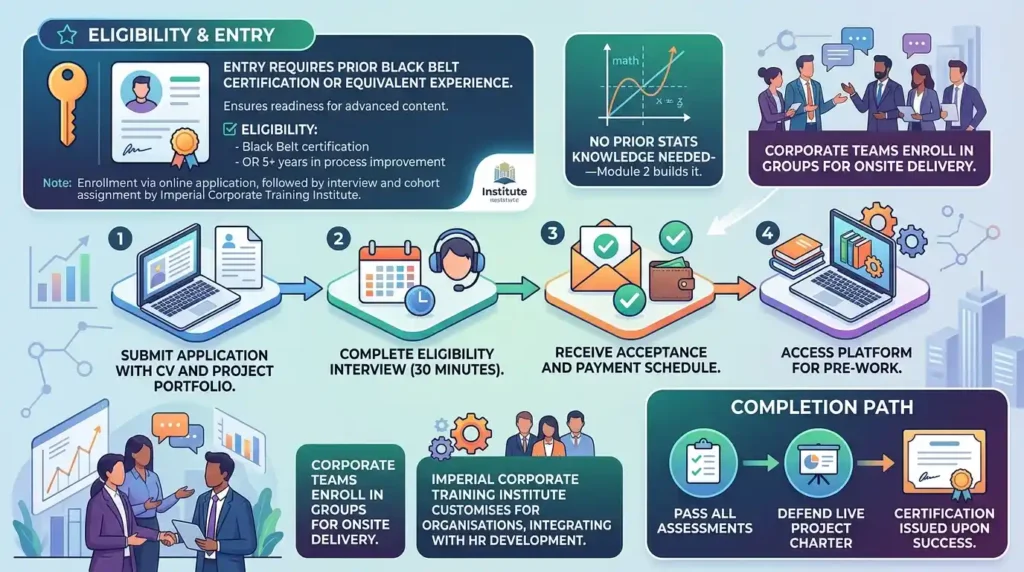
Steps:
- Submit application with CV and project portfolio.
- Complete eligibility interview (30 minutes).
- Receive acceptance and payment schedule.
- Access platform for pre-work.
Completion path: Pass all assessments, defend live project charter. Certification issued upon success.
Discover More from Our Guide Library:
How Does Imperial’s Programme Use Value Stream Mapping in Real Case Studies?
What Delegates Say After Completing Imperial’s Lean Six Sigma Master Black Belt Course?
No prior stats knowledge needed, Module 2 builds it. Corporate teams enroll in groups for onsite delivery.
Imperial Corporate Training Institute customises for organisations, integrating with HR development.
Ready to advance? Enroll in the:
Lean Six Sigma Master Black Belt Certification Training Course today.