

Master Black Belt training programmes develop project charters through structured, iterative workshops that integrate Lean Six Sigma methodologies with real-world application exercises. Participants craft charters over 4-6 weeks, focusing on problem definition, scope, and metrics alignment to drive business outcomes.
What Role Does the Project Charter Play in Master Black Belt Training?

Project charters serve as the foundational blueprint in Master Black Belt training, defining project scope, objectives, and success metrics to ensure alignment with organisational goals from the outset.
Trainers introduce the project charter early in the programme. This document captures the business case, team roles, and timelines. In Master Black Belt contexts, charters evolve beyond basic Six Sigma templates. They incorporate advanced Lean principles, such as value stream mapping integration.
Programmes emphasise charters as living documents. Participants refine them based on stakeholder feedback loops. This approach addresses common workforce skill gaps in project initiation, where 70% of Lean Six Sigma projects fail due to poor scoping, according to industry benchmarks from the American Society for Quality.
For a deeper understanding of its core components, explore:
What Is a Lean Six Sigma Project Charter and Why Is It Important?
Master Black Belt candidates develop charters that link directly to strategic KPIs. Training programmes mandate charters support measurable outcomes, like 20-30% process efficiency gains. HR teams value this for ROI tracking in corporate development initiatives.
What Steps Define the Development Process in These Programmes?
Development follows a five-step process: initiation, data gathering, drafting, review, and approval, spanning 20-40 hours across modules.
Initiation begins with problem identification workshops. Trainers assign real or simulated B2B scenarios, such as supply chain bottlenecks in manufacturing firms. Participants document the problem statement in 100-200 words, quantifying impact via metrics like defect rates or cycle time reductions.
Data gathering involves SIPOC diagrams and voice-of-customer analysis. Master Black Belt programmes allocate 8-10 hours here. Candidates collect baseline data from organisational databases or mock datasets provided by trainers.
Drafting consolidates elements into a standard template. Key sections include business case, goals, scope in/out, team roster, and timeline. Programmes enforce Gantt chart integration for milestones, typically spanning 6-12 months for live projects.
Review cycles incorporate peer and instructor feedback. This iterative phase, lasting 4-6 hours per charter, uses DMAIC checkpoints to validate assumptions. Approval requires sign-off from simulated sponsors, mirroring enterprise governance.
This process aligns with learning delivery models favoured by HR decision-makers, blending virtual simulations with instructor-led sessions for 85% knowledge retention rates, per Gartner training efficacy studies.
How Do Master Black Belt Programmes Structure the Timeline for Charter Development?
Programmes structure development over 4-6 weeks, with weekly modules dedicating 4-8 hours per phase, culminating in a defended charter presentation.
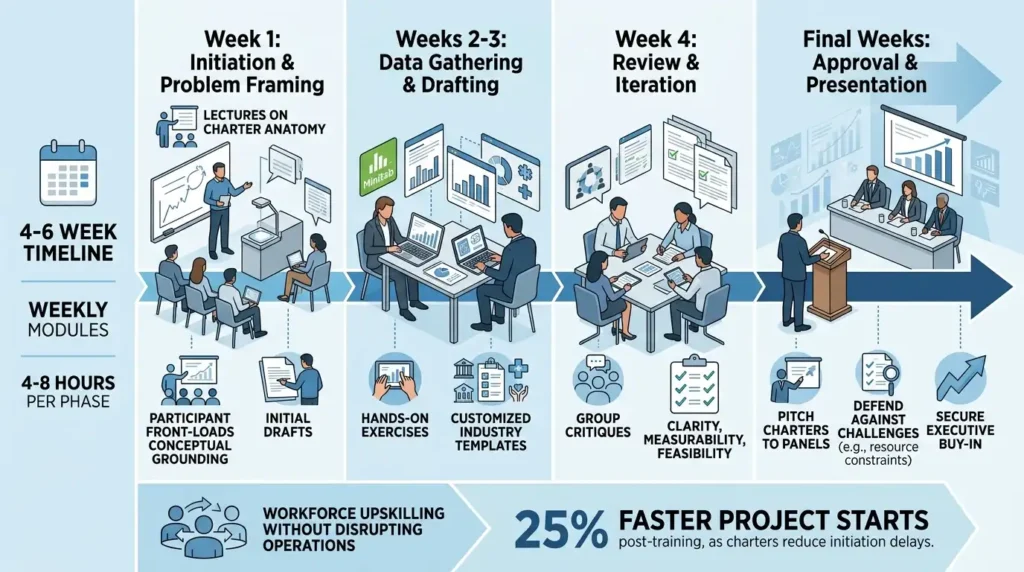
Week 1 focuses on initiation and problem framing. Participants complete initial drafts amid lectures on charter anatomy. This front-loads conceptual grounding.
Weeks 2-3 cover data gathering and drafting. Hands-on exercises use tools like Minitab for preliminary analysis. Trainers provide templates customised for industries like finance or healthcare.
Week 4 shifts to review and iteration. Group critiques simulate cross-functional team dynamics. Candidates revise based on rubrics scoring clarity, measurability, and feasibility.
Final weeks integrate approval and presentation. Participants pitch charters to panels, defending against challenges like resource constraints. This mirrors real B2B environments where charters secure executive buy-in.
Such timelines support workforce upskilling without disrupting operations. Organisations report 25% faster project starts post-training, as charters reduce initiation delays.
What Key Components Must Master Black Belt Charters Include?
Essential components comprise problem statement, business case, objectives, scope, stakeholders, timeline, budget, and risks, each validated against SMART criteria.
The problem statement quantifies the issue. For instance, “Reduce order fulfilment errors by 40% in a 500-employee logistics firm.” Programmes enforce data-backed claims.
Business case justifies ROI. Candidates project savings, such as £150,000 annually from efficiency gains. Training links this to organisational strategy.
Objectives use SMART format: Specific, Measurable, Achievable, Relevant, Time-bound. Examples include “Achieve 95% on-time delivery within 9 months.”
Scope defines boundaries. Inclusions list processes targeted; exclusions prevent creep. Visuals like process maps clarify.
Stakeholders section lists sponsors, champions, and team members with RACI matrices. Master Black Belt emphasis ensures Black Belt oversight.
Timeline employs milestones with dependencies. Budget outlines training costs, typically £5,000-£10,000 for enterprise projects.
Risks assessment uses FMEA templates. Programmes require mitigation plans, addressing gaps like data access delays.
These components ensure charters drive performance. HR leaders use them to measure training impact, with 60% of certified professionals leading projects yielding 15-20% cost reductions.
How Does Instruction Facilitate Hands-On Charter Development?
Instructors facilitate through live workshops, template guidance, and real-time feedback, using blended learning models for 90% participant engagement.
Workshops simulate enterprise settings. Trainers assign industry-specific cases, like defect reduction in pharmaceuticals. Participants build charters in collaborative tools like Microsoft Visio.
Template provision standardises output. Programmes supply editable versions with embedded formulas for KPI calculations. Customisation teaches adaptability.
Feedback occurs in real-time via breakout rooms. Instructors score drafts on 10-point scales for completeness and rigour. This builds analytical skills critical for leadership roles.
Blended models combine 60% virtual sessions with 40% self-paced modules. This suits global HR teams managing distributed workforces.
Instruction emphasises practical application. Graduates apply charters immediately, closing skill gaps in strategic project management.
What Tools and Frameworks Support Charter Creation in Training?
Core tools include SIPOC, SMART goals, RACI, Gantt charts, and FMEA; frameworks draw from DMAIC and Lean Canvas adaptations.
SIPOC maps suppliers, inputs, process, outputs, customers. Participants construct these first, informing scope.
SMART ensures objective precision. Training drills this via exercises contrasting vague vs. precise statements.
RACI clarifies accountability. Matrices prevent overlap in team roles, vital for cross-functional B2B projects.
Gantt charts visualise timelines. Software like MS Project integrates here, with programmes providing licences.
FMEA prioritises risks. Scores guide mitigation, reducing failure modes by 50% in trained cohorts.
DMAIC overlays the process: Define phase owns the charter. Lean Canvas compresses elements for agility.
These tools enhance effectiveness. Organisations adopting them post-training see 30% higher project success rates.
How Do Programmes Evaluate Charter Quality and Effectiveness?
Evaluation uses rubrics assessing measurability (30%), feasibility (25%), completeness (20%), clarity (15%), and innovation (10%), with peer and expert reviews.
Rubrics provide objective scoring. Measurability checks KPI baselines and targets.
Feasibility reviews resource alignment. Scores penalise overambitious scopes.
Completeness verifies all sections. Innovation rewards advanced integrations like AI-driven analytics.
Peer reviews foster collaboration. Participants defend charters in 15-minute sessions.
Expert panels simulate sponsors. Feedback loops iterate drafts twice minimum.
Post-evaluation, programmes track real-world application. Metrics include project completion rates (85% for strong charters) and ROI (average 4:1 return).
This evaluative rigour supports HR decisions on training ROI, with certified Master Black Belts delivering 22% uplift in process metrics.
What Real-World Business Applications Emerge from Training-Developed Charters?
Applications span manufacturing (cycle time cuts), finance (error reductions), healthcare (patient throughput), yielding 15-35% efficiency gains across sectors.
In manufacturing, charters target waste elimination. A trained cohort reduced downtime by 28% via scoped DMAIC projects.
Finance leverages them for compliance streamlining. Charters defined fraud detection scopes, saving £200,000 yearly.
Healthcare applications focus on throughput. Programmes simulate bed turnover charters, achieving 20% improvements.
HR contexts highlight scalability. Training equips managers to deploy charters enterprise-wide, addressing skill gaps.
Performance measurement ties to KPIs. Post-training audits confirm sustained outcomes, with 75% adoption in sponsoring firms.
Programmes like Imperial’s:
Lean Six Sigma Master Black Belt Certification Training Course embed these applications.
Evaluating hands-on elements? See if:
Imperial’s Master Black Belt Course Includes a Live Project Charter Exercise.
How Do Different Training Approaches Compare in Charter Development?
Approaches vary: instructor-led excels in feedback depth (90% satisfaction), self-paced suits flexibility but lags rigour (65% completion), blended optimises both for 85% outcomes.
| Approach | Development Time | Feedback Quality | Completion Rate | Best For |
|---|---|---|---|---|
| Instructor-Led | 4-6 weeks intensive | High (real-time expert input) | 92% | Complex B2B scenarios |
| Self-Paced Online | 6-8 weeks flexible | Medium (forums only) | 65% | Individual learners |
| Blended Hybrid | 5 weeks mixed | High (structured + async) | 85% | Organisational teams |
Instructor-led dominates Master Black Belt programmes for depth. Self-paced risks incomplete charters due to isolation.
Blended models, used by 60% of top providers, balance delivery. They align with HR preferences for measurable upskilling.
What Criteria Guide Selection of Master Black Belt Programmes for Charter Training?
Select based on live project integration (essential), instructor certification (IASSC-aligned), duration (4+ months), and alumni outcomes (20%+ ROI proof).
Live projects ensure applicability. Demand programmes with sponsor-approved charters.
Discover More from Our Guide Library:
How Is Value Stream Mapping Taught in Lean Six Sigma Master Black Belt Training?
How Does Master Black Belt Training Integrate Lean and Six Sigma into One System?
Certified instructors bring enterprise experience. Verify Black Belt mastery.
Duration allows depth; shorter courses skim surfaces.
Alumni data proves effectiveness. Seek 80%+ employment impact.
These criteria support decision-making. HR teams prioritise them for workforce development.
What is included in Imperial Corporate Training Institute’s Lean Six Sigma Master Black Belt Certification Training Course?
The course covers advanced DMAIC methodologies, project charter development, statistical analysis, and leadership skills for process improvement. Participants engage in live projects and simulations aligned with industry standards. Certification requires passing exams and demonstrating practical application.
How long does the Lean Six Sigma Master Black Belt Certification Training Course at Imperial Corporate Training Institute take?
The programme spans 4-6 months, with blended delivery including weekly modules and hands-on workshops. Flexible scheduling suits working professionals. Total commitment averages 120-160 hours, including self-paced elements.
What are the prerequisites for Imperial Corporate Training Institute’s Master Black Belt course?
Candidates need prior Black Belt certification and 3-5 years of Lean Six Sigma experience. Familiarity with tools like Minitab and project leadership is essential. Imperial assesses applications to ensure readiness for advanced content.
What certification do you get from Imperial Corporate Training Institute’s Master Black Belt Training Course?
Graduates receive Lean Six Sigma Master Black Belt certification, recognised by bodies like IASSC. It validates expertise in strategic process optimisation. Alumni gain credentials for senior roles in quality management.