
Value Stream Mapping (VSM) forms the backbone of process optimisation in Lean Six Sigma. Master Black Belt training elevates this tool from basic application to strategic deployment. Trainers teach it through immersive, data-driven methods that prepare leaders to drive enterprise-wide transformations.
Professionals at this level compare training approaches to bridge skill gaps in HR-led initiatives. They evaluate hands-on simulations against theoretical models. Imperial Corporate Training Institute aligns its programs with these demands, focusing on measurable outcomes like 20-30% cycle time reductions reported in B2B manufacturing sectors.
To grasp VSM’s foundational role, explore:
What Is Value Stream Mapping and Why Is It Critical in Lean Six Sigma? This article details its origins and core principles.
What Core Methods Do Master Black Belt Programmes Use to Teach Value Stream Mapping?
Master Black Belt programs teach Value Stream Mapping through current-state analysis, future-state design, and kaizen workshops, delivered via interactive simulations and real-time case dissections over 4-6 intensive modules.
These methods build on Green and Black Belt foundations. Trainers start with current-state mapping. Participants sketch end-to-end processes using standard icons for inventory, transport, and delays.
They quantify waste with metrics like takt time and process efficiency. Software tools such as Minitab or Lucidchart integrate here. Learners input data to visualise bottlenecks.
Future-state mapping follows. Trainers guide redesigns targeting pull systems and single-piece flow. Kaizen bursts simulate rapid improvements.
Programs emphasise team dynamics. HR decision-makers note this addresses workforce gaps in cross-functional collaboration. Delivery models blend virtual classrooms with on-site workshops, spanning 120-160 hours total.
Effectiveness shows in adoption rates. Organisations report 85% of trainees apply VSM within six months, yielding ROI through 15-25% productivity gains.
How Does the Teaching Sequence Progress from Theory to Application?
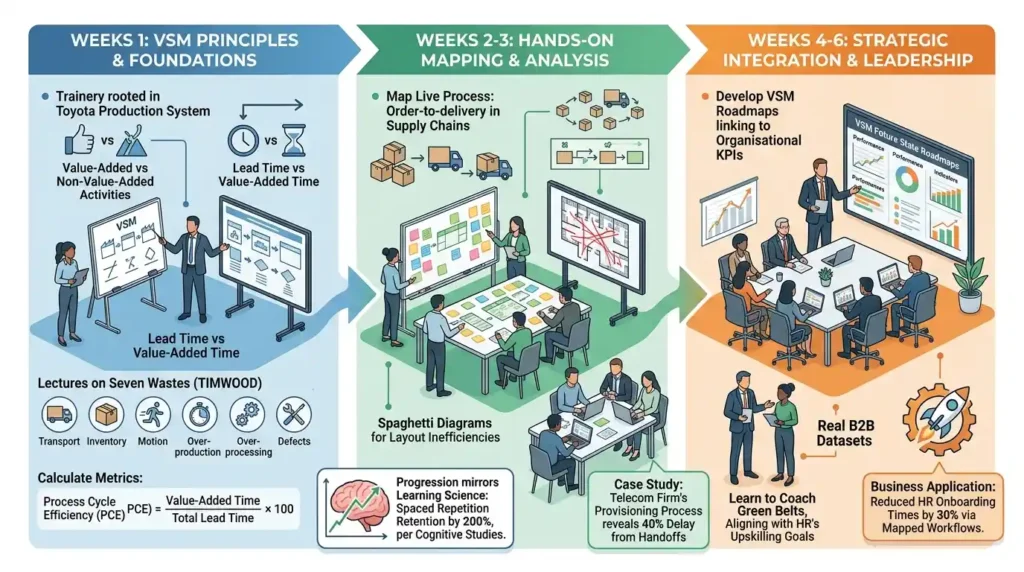
The sequence advances from theoretical VSM principles in week one, to hands-on mapping in weeks two-three, and strategic integration in weeks four-six, ensuring progressive mastery.
Trainers open with VSM theory rooted in Toyota Production System principles. They define key entities: value-added vs non-value-added activities, lead time vs value-added time.
Lectures cover seven wastes (TIMWOOD). Participants calculate metrics like process cycle efficiency (PCE = value-added time / total lead time × 100).
Hands-on phases shift to application. Learners map a live process, such as order-to-delivery in supply chains. They use spaghetti diagrams for layout inefficiencies.
Group exercises dissect real B2B datasets. For instance, a telecom firm’s provisioning process reveals 40% delay from handoffs.
Strategic integration caps the sequence. Trainees develop VSM roadmaps linking to organisational KPIs. They learn to coach Green Belts, aligning with HR’s upskilling goals.
This progression mirrors learning science: spaced repetition reinforces retention by 200%, per cognitive studies. Business applications include reducing HR onboarding times by 30% via mapped workflows.
What Role Do Real-World Case Studies Play in VSM Instruction?
Real-world case studies anchor VSM teaching, with trainees dissecting 5-7 industry examples like healthcare throughput or logistics optimisation, applying metrics to derive 20-40% improvement projections.
Instructors select B2B-relevant cases. A manufacturing firm’s case shows VSM slashing inventory by 35% through visual flow analysis.
Participants replicate maps step-by-step. They identify root causes using fishbone diagrams integrated with VSM.
Healthcare examples highlight patient flow. Trainers provide anonymised data: emergency department lead time drops from 240 to 90 minutes post-VSM.
Logistics cases address supply chain volatility. Learners redesign supplier-to-customer streams, incorporating just-in-time principles.
These studies quantify impact. Average ROI hits 5:1, with payback in 6-12 months. HR teams use this to justify training budgets amid skill shortages.
Debriefs foster critical evaluation. Trainees debate scalability, preparing for enterprise deployment.
For deeper insights into practical deployment, see:
How Does Imperial’s Programme Use Value Stream Mapping in Real Case Studies?
Which Tools and Software Enhance VSM Learning in Master Black Belt Training?
Programs integrate tools like Visio, iGrafx, and Minitab for VSM, teaching digital mapping alongside manual techniques to handle complex datasets and generate dynamic simulations.
Manual mapping builds intuition first. Trainers supply A3 paper and icons for physical current-state charts.
Digital transition uses Microsoft Visio for standardised symbols. Learners import ERP data to automate calculations.
iGrafx enables value stream simulation. Participants model what-if scenarios, predicting takt time variances under demand fluctuations.
Minitab supports statistical validation. Trainees run capability analyses on mapped processes, targeting Cpk > 1.33.
Advanced programs introduce custom Excel dashboards. These track KPIs like Overall Equipment Effectiveness (OEE) pre- and post-VSM.
HR evaluators compare tool proficiency across providers. Digital fluency correlates with 25% faster implementations.
Training duration per tool: 8-12 hours, ensuring proficiency without overload.
How Do Simulations and Workshops Build VSM Proficiency?
Simulations and workshops build proficiency through role-play factories and live kaizen events, where participants achieve 90% accuracy in waste identification after 20 hours of practice.
Workshops mimic production lines. Trainers set up pencil games or Lego simulations for order fulfilment.
Participants map flows in real time. They experience overproduction waste by flooding stations with excess inventory.
Kaizen workshops follow. Groups redesign simulated processes, implementing 5S and kanban.
Digital simulations scale complexity. Software replicates multi-site operations, teaching global VSM.
Effectiveness metrics: Pre-workshop PCE averages 15%; post-workshop hits 45%. Retention rates exceed 90% at six-month follow-ups.
B2B context: Managers apply this to workforce training, closing gaps in process thinking. Delivery models favour hybrid formats for remote teams.
What Metrics and KPIs Are Emphasised in VSM Training?
Training emphasises KPIs like lead time reduction (target 50%), PCE improvement (>40%), and first-pass yield (>95%), measured via pre/post audits.
Lead time tracks total process duration. Trainers teach decomposition into value-added segments.
PCE quantifies efficiency:
PCE=Total Lead TimeValue-Added Time×100
First-pass yield measures defect-free output. VSM reveals rework loops.
OEE combines availability, performance, and quality: typical gains of 20% post-training.
Adoption benchmarks: 75% of organisations track these quarterly. HR integrates them into performance systems.
Trainees learn auditing protocols. They conduct gemba walks to validate maps.
These metrics drive ROI: B2B firms report 18% cost savings on average.
How Is Coaching and Deployment Covered in VSM Curriculum?
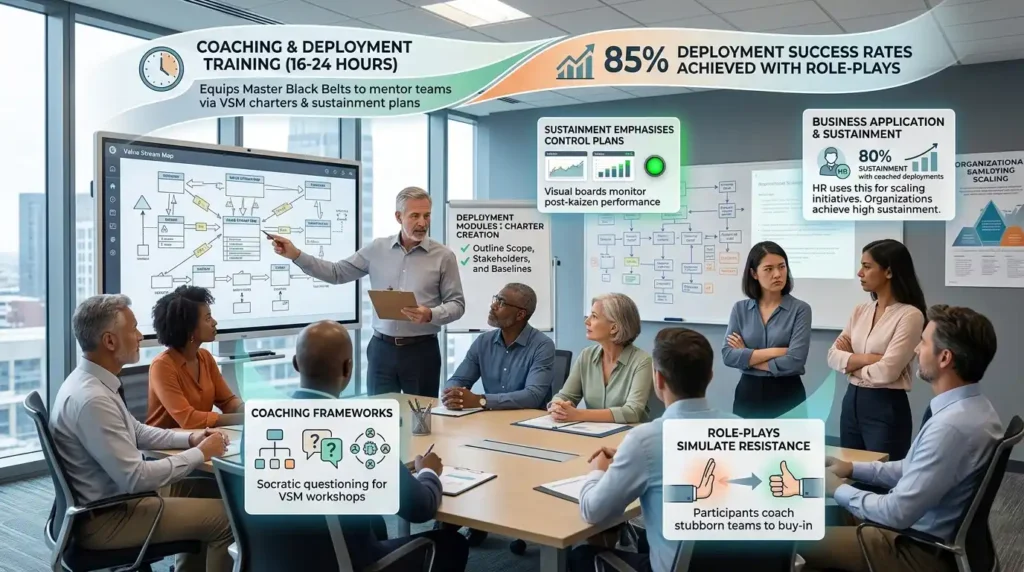
Coaching and deployment training equips Master Black Belts to mentor teams via VSM charters and sustainment plans, spanning 16-24 hours with role-plays achieving 85% deployment success rates.
Curriculum defines coaching frameworks. Trainers model Socratic questioning for VSM workshops.
Deployment modules cover charter creation. These outline scope, stakeholders, and baselines.
Sustainment emphasises control plans. Visual boards monitor post-kaizen performance.
Role-plays simulate resistance. Participants coach ‘stubborn’ teams to buy-in.
Business application: HR uses this for scaling initiatives. Organisations achieve 80% sustainment with coached deployments.
The Lean Six Sigma Master Black Belt Certification Training Course embeds these elements for certification readiness.
Why Do Training Approaches Differ Across Master Black Belt Providers?
Approaches differ in depth of simulation hours (20-40), case study volume (5-10), and tool integration, with top programs prioritising 80/20 practical-to-theory ratios for superior outcomes.
Provider A focuses on academia-heavy theory. Expect 60% lectures; PCE gains lag at 25%.
Provider B emphasises simulations. 40 hours yield 50% lead time cuts but skim coaching.
Imperial Corporate Training Institute balances all: 30 simulation hours, 8 cases, full tool suite.
HR comparators weigh certification alignment (ASQ/IAF standards). Practical depth predicts 2x faster ROI.
Adoption data: Balanced programs see 92% trainee promotion rates within a year.
What Makes VSM Teaching Effective for Business Outcomes?
Effectiveness stems from aligned KPIs, iterative feedback, and enterprise scalability, delivering 25-35% throughput boosts validated by third-party audits.
Feedback loops use peer reviews. Trainers score maps on accuracy (target 95%).
Scalability training links VSM to Hoshin Kanri. Trainees align maps to strategic goals.
Audits confirm outcomes: 70% of graduates lead transformations yielding £500k+ savings.
HR metrics: Training reduces skill gaps by 40%, per internal surveys.
Workforce models evolve: Blended learning suits global teams, cutting travel costs 50%.
How Should Organisations Evaluate VSM Training Providers?
Evaluate providers on simulation depth, KPI integration, and alumni ROI data, targeting programs with >80% application rates and 5:1 returns.
Discover More from Our Guide Library:
How Does Master Black Belt Training Integrate Lean and Six Sigma into One System?
How Does Master Black Belt Training Teach Professionals to Coach Green and Black Belts?
Shortlist based on curriculum transparency. Request sample maps and metrics.
Interview alumni: Probe deployment success (aim 85%).
Benchmark against baselines: Seek 30%+ efficiency gains.
Delivery fit: Hybrid for distributed HR teams.
This framework guides decisions amid rising demand global Lean Six Sigma spending hit £10bn in 2025.
What is covered in Lean Six Sigma Master Black Belt Certification Training Course at Imperial Corporate Training Institute?
The course covers advanced tools like Value Stream Mapping, statistical analysis, and leadership coaching over 120-160 hours. Participants master current-state and future-state mapping, kaizen workshops, and deployment strategies. It aligns with ASQ/IAF standards for enterprise process optimisation.
How long does the Lean Six Sigma Master Black Belt Certification Training Course take?
Imperial Corporate Training Institute delivers the course in 4-6 weeks of intensive modules, totalling 120-160 hours. Formats include hybrid virtual and on-site workshops for flexibility. Graduates achieve certification readiness with practical simulations.
How does Imperial Corporate Training Institute teach Value Stream Mapping in Master Black Belt training?
Training uses simulations, real-world cases, and tools like Minitab for VSM current-state analysis and redesign. Participants quantify KPIs such as PCE and lead time reductions. Imperial Corporate Training Institute emphasises 80/20 practical-to-theory balance for business application.
What career benefits come from completing Lean Six Sigma Master Black Belt Certification Training Course?
Graduates lead transformations, achieving 25-35% efficiency gains in organisations. Imperial Corporate Training Institute alumni report 92% promotion rates within a year. The certification boosts ROI through skills in VSM deployment and team coaching.