

Lean Six Sigma project charters initiate process improvement projects in corporate settings. They define project scope, objectives, and resources. Organisations use them to align teams on waste reduction and efficiency gains. Charters drive measurable results, such as 20-30% productivity increases in manufacturing and service sectors.
What Is a Lean Six Sigma Project Charter?
A Lean Six Sigma project charter is a one- to two-page document that formally authorises a process improvement project. It outlines business case, scope, goals, team roles, and timelines. In corporate environments, it ensures alignment across departments and secures executive sponsorship.
Teams in B2B settings face skill gaps in process optimisation. HR managers and L&D professionals address these through structured training. A project charter serves as the foundational tool in Lean Six Sigma methodologies. It combines Lean principles, which eliminate waste, with Six Sigma’s data-driven defect reduction.
Consider a finance department struggling with invoice processing delays. The charter specifies the problem: 15-day cycle time versus a 7-day target. It lists stakeholders, including finance leads and IT support. This document prevents scope creep and focuses efforts on high-impact areas.
In professional development programmes, participants learn to draft charters during workshops. These sessions use case-based learning with real corporate scenarios. Delivery formats include hybrid learning: two-day in-person workshops followed by online modules for revision. Assessments verify understanding through charter simulations.
Organisations implement charters in cross-functional teams. They distribute the document at kick-off meetings. This practice builds accountability. Metrics track adherence, such as 95% completion rates for charter milestones.
Why Do Corporate Teams Need Lean Six Sigma Project Charters?
Corporate teams need Lean Six Sigma project charters to align resources, reduce risks, and achieve 15-25% efficiency gains. They provide clear direction, prevent miscommunication, and link projects to business KPIs like cost savings and customer satisfaction scores.
Business owners and team leaders oversee workforce development amid rising operational costs. Charters address these pressures by formalising project intent. Without them, projects drift, leading to 40% failure rates in process improvements, per industry benchmarks.
Charters establish success criteria upfront. For instance, a logistics firm uses a charter to target 10% reduction in delivery variances. The document includes baseline data: current variance at 5 days. Teams reference it weekly, ensuring progress ties to organisational goals.
In training contexts, L&D professionals incorporate charter development into leadership pipelines. Role-play exercises simulate charter reviews with executives. This builds confidence in presenting business cases. Hybrid delivery of online modules and quarterly simulations reinforces retention, achieving an 85% knowledge transfer rate.
Implementation spans industries like IT, healthcare, and finance. Healthcare teams charter projects to cut patient wait times by 20%. Finance departments target error rates below 1%. These efforts yield ROI: £50,000 saved per project in mid-sized firms.
How Does a Lean Six Sigma Project Charter Work in Organisations?
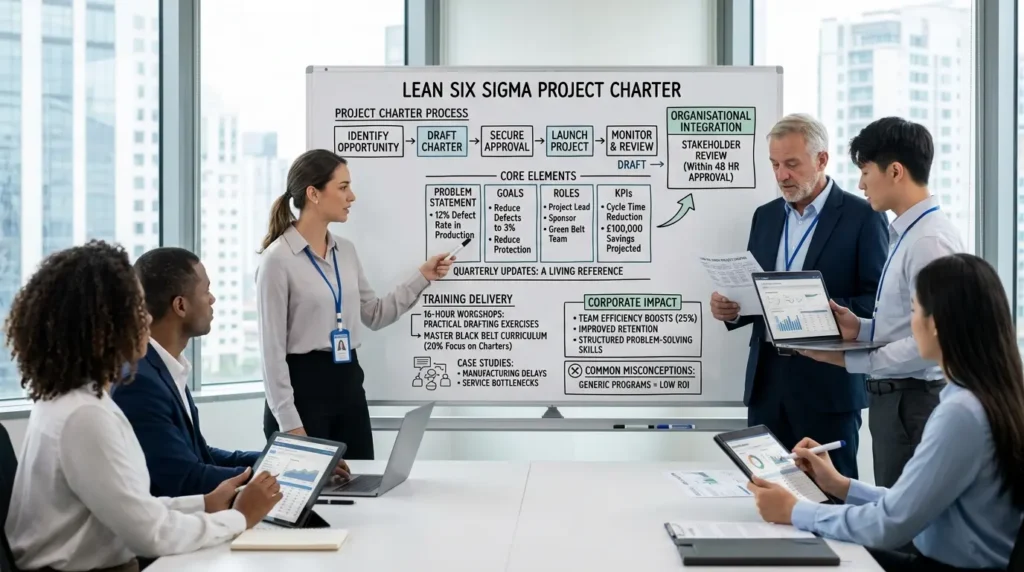
A Lean Six Sigma project charter guides teams through the Define-Measure-Analyse-Improve-Control (DMAIC) phases. It assigns roles, sets milestones, and tracks KPIs. Delivery in training involves 16-hour workshops with practical drafting exercises.
Organisations integrate charters into daily operations. Project leads convene stakeholders to review the draft. Approval comes from sponsors within 48 hours. Teams then execute, using the charter as a living reference updated quarterly.
Training delivery emphasises practical application. Master Black Belt-level programmes dedicate 20% of curriculum to charters. Participants analyse case studies from manufacturing delays or service bottlenecks. Simulations mimic corporate boardroom defences, honing presentation skills.
Step-by-step process unfolds as follows:
- Identify opportunity: Gather data on pain points, such as 12% defect rates in production.
- Draft charter: Specify problem statement, goals (e.g., reduce defects to 3%), and resources.
- Secure approval: Present to leadership, highlighting projected £100,000 savings.
- Launch project: Distribute to team; hold kick-off with role assignments.
- Monitor and review: Use dashboards for weekly KPI checks, like cycle time reductions.
Corporate impact includes team efficiency boosts of 25%. Retention improves as employees gain skills in structured problem-solving.
Common misconceptions arise here. Generic programmes overlook industry specifics, yielding low ROI. Effective training uses tailored simulations, not theory alone.
What Are the Key Components of a Lean Six Sigma Project Charter?
Key components include business case, problem statement, project scope, goals, team roles, timeline, and risks. Each fits one page. Training covers these via templates and 4-hour drafting sessions with peer reviews.
Business case justifies investment. It quantifies pain: £200,000 annual losses from inefficiencies. Problem statement pinpoints issues: “High rework rates delay shipments by 3 days.”
Scope defines boundaries inclusions like supplier processes, exclusions like internal procurement. Goals use SMART criteria: Specific (reduce variance 15%), Measurable (track via sigma levels), Achievable (with current tools), Relevant (aligns to revenue), Time-bound (6 months).
Team roles list Black Belts as leaders, Green Belts as analysts, sponsors as approvers. Timeline breaks into phases: Define (2 weeks), Measure (4 weeks). Risks identify threats, like data access delays, with mitigations.
In professional development, components integrate into assessments. Online modules quiz on goal-setting; workshops build full charters. Learning methodologies feature role play for risk discussions.
Delivery formats vary: 100% online for global teams, hybrid for hands-on feedback. This ensures 90% proficiency in component mastery.
How Do Organisations Implement Lean Six Sigma Project Charters Effectively?
Organisations implement charters through executive buy-in, cross-functional teams, and KPI dashboards. Training step-by-step: assess gaps, train leads, deploy pilots. Expect 20% productivity uplift within 6 months.
HR managers start with skill gap analysis: 60% of teams lack charter experience. They select 10-15 leads for training. Post-training, pilots test charters in one department.
Step-by-step implementation:
- Train core team: 40-hour programmes on DMAIC integration.
- Standardise templates: Customise for sectors like finance (error metrics) or IT (downtime targets).
- Roll out enterprise-wide: Mandate charters for projects over £10,000.
- Track via software: Tools like Minitab log progress; review monthly.
- Scale successes: Replicate high-ROI projects, targeting 30% cost cuts.
Challenges include resistance to change. Address via change management workshops. Misconception: Charters add bureaucracy. Reality: They cut project times by 35%.
How Are Project Charters Developed During Master Black Belt Training Programmes? Developing charters in structured programmes bridges awareness to execution, guiding L&D pros toward advanced training options.
Performance metrics confirm impact: 18% ROI on training, 22% team efficiency gains.
What Benefits Do Lean Six Sigma Project Charters Deliver to Businesses?
Lean Six Sigma project charters deliver 20-40% process efficiency, £50,000-£200,000 annual savings per project, and 15% higher employee retention. They foster data-driven cultures and scalable improvements.
For organisations, charters link training to KPIs. Productivity rises 25% as teams eliminate non-value activities. Leadership pipelines strengthen: Black Belt leads advance 30% faster.
Teams gain clarity, reducing miscommunication errors by 50%. Departments like operations see cycle times drop from 10 to 6 days.
Retention metrics improve: Skilled employees stay 18% longer, per benchmarks. ROI calculates as (savings – training costs)/costs, often exceeding 5:1.
What Are Real-World Use Cases for Lean Six Sigma Project Charters?
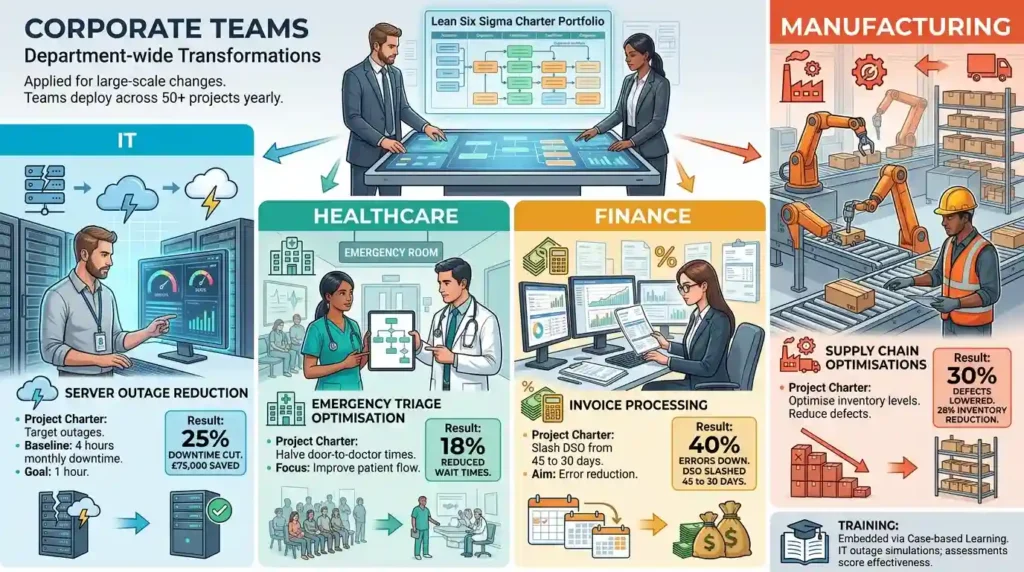
Use cases span IT (system downtimes cut 25%), healthcare (wait times reduced 18%), finance (errors down 40%), and manufacturing (defects lowered 30%). Corporate teams apply them for department-wide transformations.
In IT, charters target server outages. Baseline: 4 hours monthly downtime. Goal: 1 hour. Result: £75,000 saved.
Healthcare examples: Emergency triage projects halve door-to-doctor times. Finance: Invoice processing charters slash DSO from 45 to 30 days.
Manufacturing firms charter supply chain optimisations, yielding 28% inventory reductions. Managers deploy across 50+ projects yearly.
Training embeds these via case-based learning. Simulations recreate IT outage scenarios; assessments score charter effectiveness.
What Common Problems Arise with Lean Six Sigma Project Charters?
Common problems include vague scopes causing 30% overruns, weak sponsorship leading to 45% abandonment, and poor metrics yielding unproven ROI. Ineffective training exacerbates these with generic content.
Discover More from Our Guide Library:
What Is Value Stream Mapping and Why Is It Critical in Lean Six Sigma?
How Are Lean Thinking and Six Sigma Methodology Combined in Practice?
Vague scopes expand projects 2x beyond timelines. Solution: Define inclusions/exclusions precisely.
Weak sponsorship halts 45% of initiatives. Secure C-suite sign-off early.
Poor metrics fail to prove value: Use sigma levels (from 3.5 to 4.5) and financial KPIs.
Misconceptions: Charters suit only manufacturing. False, they apply to services too. Generic programmes ignore this, delivering 10% ROI versus 25% from tailored ones.
Training pitfalls: Lecture-only formats retain 20% knowledge. Opt for simulations and hybrid delivery for 85% retention.
Organisations counter with audits: Review 100% of charters quarterly.
For more information enrol in:
Lean Six Sigma Master Black Belt Certification Training Course today.
What is covered in the Lean Six Sigma Master Black Belt Certification Training Course at Imperial Corporate Training Institute?
The course covers advanced DMAIC methodologies, project charter development, statistical analysis tools, and leadership in process improvement. Participants engage in simulations, case studies from industries like manufacturing and finance, and practical assessments. It equips professionals to lead enterprise-wide transformations with measurable KPIs.
How long does the Lean Six Sigma Master Black Belt Certification Training Course take at Imperial Corporate Training Institute?
The programme spans 160 hours over 4-6 months, delivered in hybrid format with workshops, online modules, and live projects. This structure allows working professionals to balance training with corporate duties. Certification requires passing exams and completing a real-world project charter.
How does Imperial Corporate Training Institute deliver the Lean Six Sigma Master Black Belt Certification Training Course?
Delivery combines in-person workshops for role-play and simulations, online modules for flexibility, and hybrid sessions for global teams. Learning methodologies include case-based analysis and KPI-driven assessments. This practical approach yields 85% knowledge retention and direct application to corporate challenges.
What benefits do participants gain from the Lean Six Sigma Master Black Belt Certification Training Course at Imperial Corporate Training Institute?
Graduates lead projects achieving 20-40% efficiency gains, master charter development for DMAIC phases, and build leadership pipelines. Organisations report 5:1 ROI through cost savings and productivity boosts. Certification enhances career progression in process improvement roles across sectors.