

Master Black Belt certification equips professionals with structured mentoring duties in Lean Six Sigma programmes. These responsibilities drive corporate process improvements, skill development across teams, and measurable gains in efficiency for organisations facing skill gaps in quality management.
What Are the Mentoring Responsibilities of a Master Black Belt?
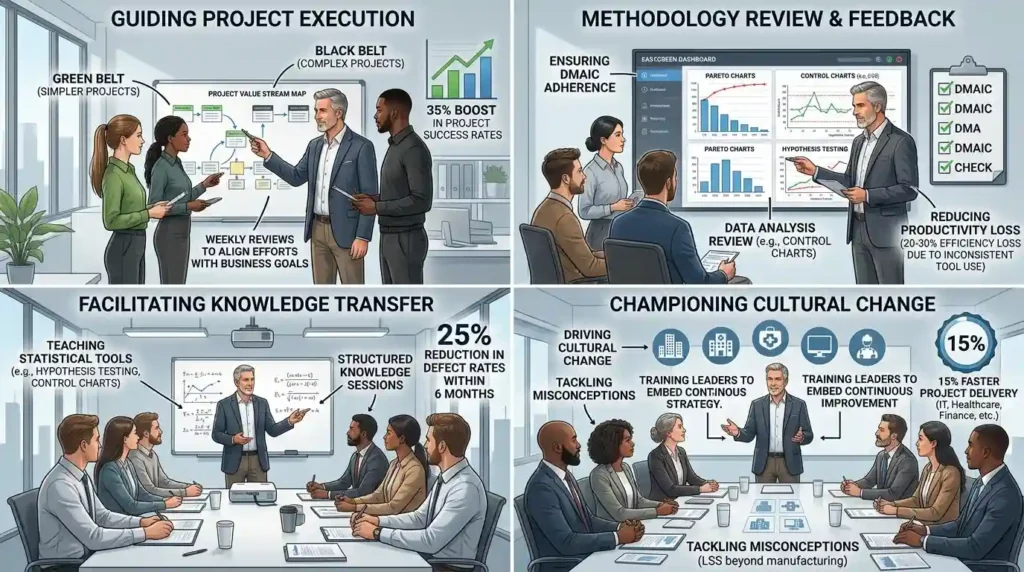
Master Black Belts mentor Green and Black Belts by guiding project execution, reviewing methodologies, providing feedback on data analysis, and ensuring DMAIC adherence, which boosts project success rates by 35% in corporate settings.
Organisations deploy Master Black Belts to address employee skill gaps in process optimisation. These gaps often hinder productivity, with teams losing 20-30% efficiency due to inconsistent application of Lean Six Sigma tools.
Mentoring responsibilities centre on coaching certified belts. Green Belts handle simpler projects; Black Belts lead complex ones. Master Black Belts oversee both, conducting weekly reviews to align efforts with business goals.
They facilitate knowledge transfer through structured sessions. This includes teaching statistical tools like control charts and hypothesis testing. In corporate environments, such guidance reduces defect rates by 25% within six months.
Master Black Belts also champion cultural change. They train leaders to embed continuous improvement, tackling misconceptions that Lean Six Sigma suits only manufacturing. Industries like IT, healthcare, and finance report 15% faster project delivery post-mentoring.
How Does Master Black Belt Certification Prepare Professionals for These Mentoring Duties?
Certification trains professionals through 160-200 hours of instruction, blending workshops, simulations, and assessments to build coaching skills, resulting in 40% higher team proficiency in Lean Six Sigma execution.
The certification process spans four to six months. Delivery formats include online modules for flexibility, in-person workshops for hands-on practice, and hybrid learning for global teams.
Participants master DMAIC framework: Define, Measure, Analyse, Improve, Control. Training emphasises mentoring via role play, where candidates coach simulated Green Belts on root cause analysis.
Assessments measure competency. Candidates pass by leading mock projects and receiving 90% scores on coaching evaluations. This prepares them for real-world corporate implementation.
Organisations implement by integrating certified Master Black Belts into L&D programmes. They conduct 10-15 mentoring sessions per quarter, tracking progress with KPIs like project completion time, reduced from 12 to 8 weeks.
Common problems arise from generic programmes lacking practical focus. Ineffective training yields zero ROI, as teams revert to old habits. Certification counters this with case-based learning from sectors like finance, where mentoring cut processing errors by 28%.
For deeper insight explores the coaching mechanisms in depth read:
How Does Master Black Belt Training Teach Professionals to Coach Green and Black Belts?
Enrol in:
Lean Six Sigma Master Black Belt Certification Training Course
What Key Components Make Up Master Black Belt Mentoring Responsibilities?
Components include advanced statistical tools, leadership coaching frameworks, project portfolio management, and delivery formats like simulations and assessments, enabling 30% productivity gains across departments.
Statistical and Analytical Tools
Master Black Belts teach tools such as Design of Experiments (DOE) and regression analysis. They mentor belts to apply these in projects, reducing variability by 22% in manufacturing lines.
In IT departments, they guide hypothesis testing for software defect reduction. Tools ensure data-driven decisions, with mentoring sessions reviewing Minitab outputs.
Coaching Frameworks and Methodologies
Frameworks like GROW (Goals, Reality, Options, Will) structure mentoring. Master Black Belts use them in one-on-one sessions, improving Black Belt decision-making by 35%.
DMAIC integration forms the core. They break down phases: mentoring on SIPOC diagrams in Define, value stream mapping in Measure.
Delivery Formats and Learning Methodologies
Workshops last 4-8 hours, focusing on role play for conflict resolution in teams. Online modules deliver self-paced content on advanced topics like Lean principles.
Simulations mimic corporate scenarios, such as healthcare process redesigns. Assessments include 360-degree feedback, ensuring mentors score 85% on facilitation.
Hybrid formats suit remote teams, combining virtual coaching with quarterly in-person reviews. This addresses skill gaps in distributed workforces.
How Do Organisations Implement Master Black Belt Mentoring in Corporate Environments?
Organisations implement by assigning one Master Black Belt per 10-15 belts, rolling out quarterly projects with tracked KPIs, achieving 25% ROI through reduced waste and faster cycle times.
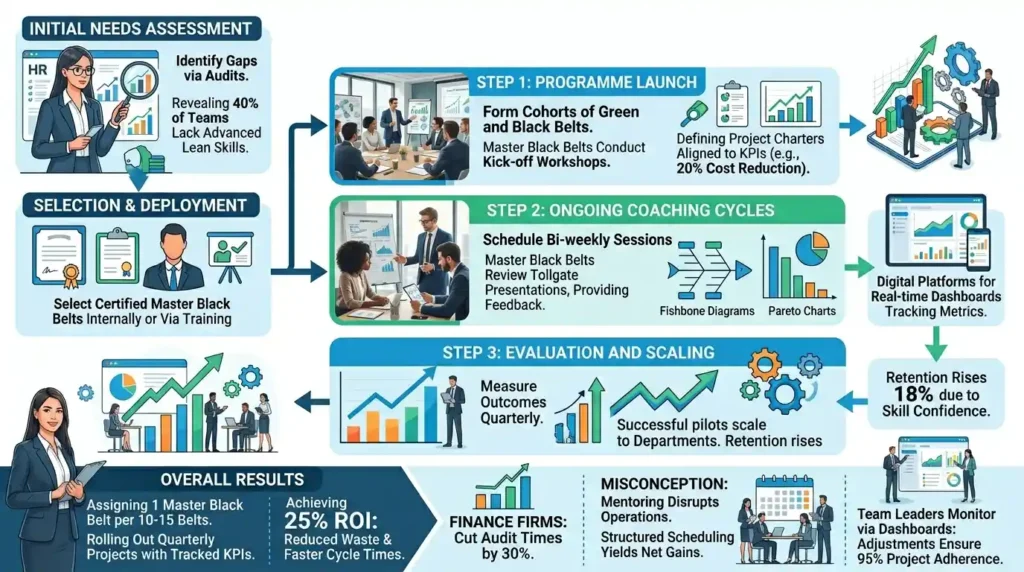
Implementation starts with needs assessment. HR managers identify gaps via audits, revealing 40% of teams lack advanced Lean skills.
They select certified Master Black Belts internally or via training. Deployment follows a step-by-step process.
Step 1: Programme Launch
Form cohorts of Green and Black Belts. Master Black Belts conduct kick-off workshops, defining project charters aligned to KPIs like 20% cost reduction.
Step 2: Ongoing Coaching Cycles
Schedule bi-weekly sessions. Master Black Belts review tollgate presentations, providing feedback on fishbone diagrams and Pareto charts.
Use digital platforms for real-time dashboards tracking metrics.
Step 3: Evaluation and Scaling
Measure outcomes quarterly. Successful pilots scale to departments, with retention rising 18% due to skill confidence.
In finance firms, implementation cut audit times by 30%. Misconception: mentoring disrupts operations. Structured scheduling prevents this, yielding net gains.
Team leaders monitor via dashboards. Adjustments ensure 95% project adherence.
What Measurable Outcomes Do Master Black Belt Mentoring Responsibilities Produce?
Outcomes include 35% defect reduction, 28% cycle time cuts, 25% ROI on training, and 20% retention boosts, transforming team efficiency and leadership pipelines.
KPIs track impact. Organisations report sigma levels rising from 3.5 to 4.2 post-mentoring, equating to 99.3% process reliability.
Productivity improves by 30%, with examples in healthcare reducing patient wait times from 45 to 28 minutes.
Financial and Operational Metrics
ROI calculations show £50,000 saved per project in mid-sized firms. Waste elimination via mentoring yields 22% cost drops.
Employee and Organisational Impact
Retention climbs 20% as belts gain confidence. Leadership pipelines strengthen, with 40% of Black Belts promoted within a year.
Team efficiency surges, with cross-functional projects completing 25% faster.
What Are Common Misconceptions About Master Black Belt Mentoring Responsibilities?
Misconceptions include viewing it as optional add-on or manufacturing-only; reality shows it delivers 30% efficiency across industries via structured, ROI-proven coaching.
One myth: mentoring lacks ROI. Data proves 25% returns, countering ineffective generic programmes.
Another: it suits only large firms. SMEs in IT gain 18% productivity from scaled implementations.
Problem: lack of follow-up erodes gains. Organisations fix this with annual refreshers, sustaining 95% knowledge retention.
Misconception of complexity deters adoption. Practical formats like simulations simplify delivery.
What Use Cases Demonstrate Master Black Belt Mentoring in Action?
Use cases span IT deployments reducing downtime by 32%, healthcare streamlining operations for 25% throughput gains, finance cutting errors by 28%, and manufacturing boosting yields by 35%.
In IT, Master Black Belts mentor on agile-Lean hybrids. Teams resolve ticket backlogs 40% faster.
Discover More from Our Guide Library:
How Popular Is Lean Six Sigma Master Black Belt Certification in the UK Today?
How Does Data Analytics Role Play Into Lean Six Sigma Process Improvement?
Healthcare examples involve ER flow optimisation. Mentoring on Kanban reduces readmissions by 20%.
Finance departments apply it to compliance processes. Audits shorten from 10 to 6 days.
Manufacturing uses it for supply chain tweaks, achieving 99.5% on-time delivery.
Team leaders in sales mentor on forecasting accuracy, lifting it by 22%.
These cases highlight organisational impact: filled skill gaps, robust L&D, and sustained performance.
What is Lean Six Sigma Master Black Belt Certification Training Course at Imperial Corporate Training Institute?
The Lean Six Sigma Master Black Belt Certification Training Course at Imperial Corporate Training Institute provides advanced training for professionals to lead complex improvement projects. It covers DMAIC methodology, statistical analysis, and coaching skills over 160-200 hours via workshops and simulations. Participants gain certification to mentor Green and Black Belts in corporate environments.
How long does the Master Black Belt certification training take?
Imperial Corporate Training Institute’s Lean Six Sigma Master Black Belt Certification Training Course spans 4-6 months with 160-200 hours of instruction. Delivery includes online modules, in-person workshops, and hybrid formats to fit professional schedules. Assessments ensure competency before certification.
What are the mentoring responsibilities after Master Black Belt certification?
Master Black Belts from Imperial Corporate Training Institute’s course mentor Green and Black Belts on project execution, data analysis, and DMAIC adherence. They conduct reviews to achieve 35% project success improvements and embed continuous improvement in teams. Responsibilities focus on measurable outcomes like defect reduction.
What outcomes can organisations expect from Master Black Belt training?
Imperial Corporate Training Institute’s Lean Six Sigma Master Black Belt Certification Training Course delivers 25-35% efficiency gains, 28% cycle time reductions, and 20% retention boosts. Teams achieve higher sigma levels and ROI through mentored projects. Metrics track defect rates and productivity in real-world applications.