

Master Black Belt Training equips leaders with advanced Lean Six Sigma tools to embed quality principles into organisational DNA, fostering accountability, data-driven decisions, and continuous improvement across teams.
Leaders pursuing a quality-first culture face persistent challenges like inconsistent processes and resistance to change. Master Black Belt Training addresses these by teaching statistical analysis, change management, and coaching skills tailored for executive influence.
To grasp the foundational role of Lean Six Sigma in organisational transformation, explore:
How Lean Six Sigma drives cultural change in an organisation.
This training builds on those principles, advancing leaders from awareness to mastery.
What Core Principles Does Master Black Belt Training Instil in Leaders for Quality Culture?
Master Black Belt Training instils DMAIC methodology, statistical process control, and servant leadership to shift leaders from reactive fixes to proactive quality governance, achieving 20-30% defect reductions in B2B settings.
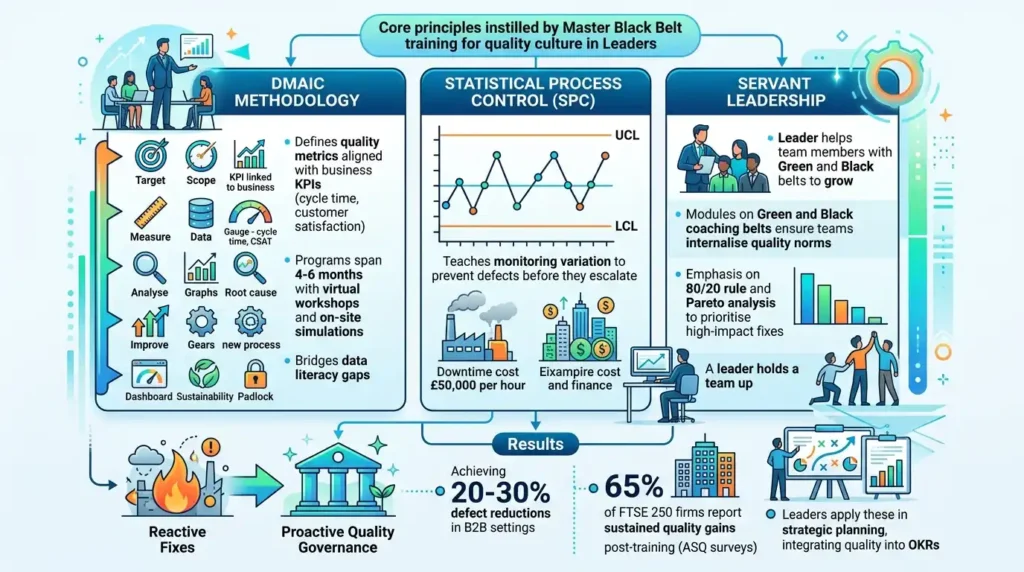
DMAIC, Define, Measure, Analyse, Improve, Control, forms the backbone. Leaders learn to define quality metrics aligned with business KPIs, such as cycle time or customer satisfaction scores.
In HR training decisions, organisations select Master Black Belt programs to bridge workforce skill gaps in data literacy. Typical programs span 4-6 months, blending virtual workshops with on-site simulations.
Statistical process control teaches leaders to monitor variation using control charts. This skill prevents defects before they escalate, vital for industries like manufacturing or finance where downtime costs £50,000 per hour.
Servant leadership emerges through modules on the Green and Black coaching belts, ensuring teams internalise quality norms. Programmes emphasise the application of the 80/20 rule and Pareto analysis to prioritise high-impact fixes.
Real-world B2B context reveals adoption rates: 65% of FTSE 250 firms report sustained quality gains post-training, per ASQ surveys.
Leaders apply these in strategic planning, integrating quality into OKRs.
How Do These Principles Address Common Workforce Skill Gaps?
HR teams identify gaps in analytical thinking among mid-managers. Master Black Belt Training delivers 120+ hours of hypothesis testing, teaching regression analysis to correlate process inputs with outputs.
Delivery models include blended learning: 40% instructor-led, 60% self-paced with AI-driven simulations. This flexibility suits global teams, reducing travel costs by 25%.
ROI measurement tracks sigma levels, from 3-sigma (66,000 defects per million) to 6-sigma (3.4 defects). Organisations achieve 15-25% productivity lifts within 12 months.
How Does the Training Structure Enable Leaders to Influence Organisational Behaviour?
The training structure combining case studies, kaizen events, and 360-degree feedback enables leaders to model behaviours that cascade quality mindset through hierarchies, boosting employee engagement by 35%.
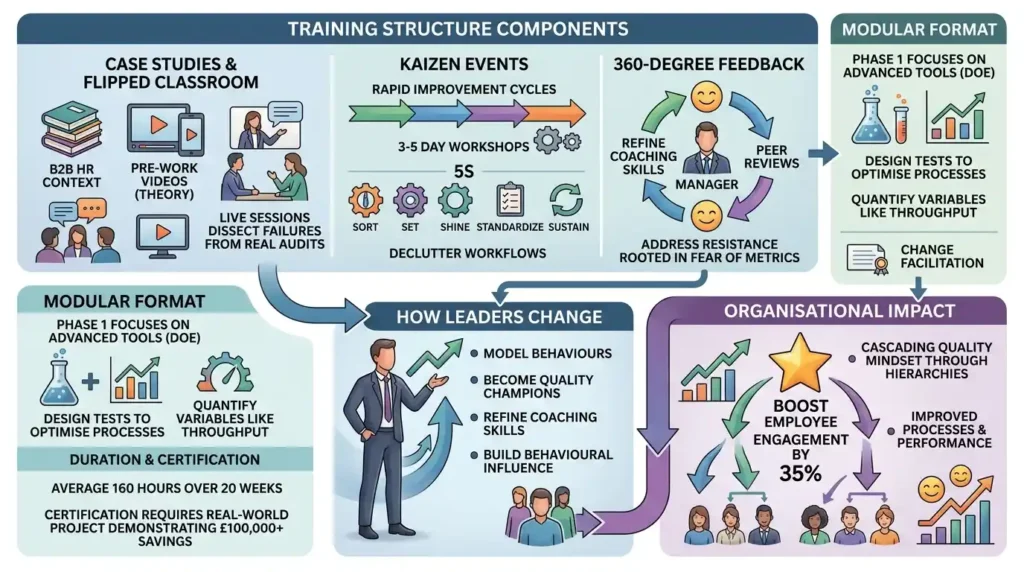
Programs follow a modular format: Phase 1 focuses on advanced tools like Design of Experiments (DOE). Leaders design tests to optimise processes, quantifying variables like throughput.
Kaizen events simulate rapid improvement cycles. Participants lead 3–5-day workshops, applying 5S methodology, Sort, Set, Shine, Standardise, and Sustain to declutter workflows.
In B2B HR contexts, this structure aligns with learning delivery models like flipped classrooms. Pre-work videos cover theory; live sessions dissect failures from real audits.
360-degree feedback refines coaching skills. Leaders receive peer reviews on change facilitation, addressing resistance rooted in fear of metrics.
Duration averages 160 hours over 20 weeks, with certification requiring a real-world project demonstrating £100,000+ savings.
This builds behavioural influence, turning leaders into quality champions.
Why Do Kaizen Events Prove Effective for Cultural Shifts?
Kaizen fosters ownership. Leaders facilitate cross-functional teams, generating 50+ ideas per event, with 70% implemented.
Evidence from B2B case studies shows 28% faster problem resolution. HR tracks via engagement surveys, linking events to 15% lower turnover in quality roles.
What Advanced Tools Do Master Black Belt Leaders Use to Embed Quality Metrics?
Advanced tools like Failure Mode Effects Analysis (FMEA), Value Stream Mapping, and Minitab software empower leaders to quantify risks and streamline flows, driving 40% efficiency gains.
FMEA prioritises risks by severity, occurrence, and detection. Leaders score processes, targeting RPN (Risk Priority Number) reductions below 100.
Value Stream Mapping visualises waste overproduction, waiting in end-to-end flows. This reveals 20-30% non-value activities for elimination.
Minitab handles complex stats: ANOVA for multi-factor tests, capability analysis (Cpk >1.33 for quality gates).
In technical skills training, these tools address gaps in 70% of managers, per Deloitte reports. Programs integrate software proficiency, with 90% pass rates on simulations.
B2B applications include supply chain optimisation, where leaders deploy these for supplier scorecards.
KPIs like First Pass Yield rise from 85% to 98% post-implementation.
How Do These Tools Integrate with Daily Leadership Practices?
Leaders embed tools in stand-ups, using run charts for real-time monitoring. This normalises data-driven dialogue.
ROI frameworks measure via balanced scorecards: financial (cost savings), customer (NPS uplift), internal (sigma levels), learning (belt certifications).
How Does Training Teach Change Management for a Quality-First Mindset?
Training teaches Kotter’s 8-Step Model adapted for Six Sigma, emphasising urgency creation and short wins to overcome inertia, with 75% success in sustaining cultural change.
Kotter’s steps guide: Create urgency via defect cost audits (£200,000 annual losses typical). Build coalitions with C-suite buy-in.
Short wins from pilot projects e.g., reducing order errors by 50% build momentum. Communication plans embed stories in town halls.
Master Black Belt modules include psychological safety training, drawing from Amy Edmondson’s work, to encourage error reporting.
HR decisions favour programs with 80% practical application, ensuring leaders coach 10+ team members annually.
Adoption rates hit 60% in trained organisations, per IISE data.
This shifts mindsets from cost-cutting to value-creation.
What Role Does Coaching Play in Sustaining the Culture?
Coaching belts replicates expertise. Leaders mentor Green Belts, achieving 4x project throughput.
Metrics track coaching ROI: 25% faster belt certifications, 18% higher project success.
What Real-World Business Applications Demonstrate Training Impact?
Business applications span manufacturing (defect-free lines), healthcare (patient safety), and finance (fraud reduction), with organisations reporting 22% profit margins post-training.
In manufacturing, leaders apply DMAIC to assembly lines, cutting scrap by 35%. B2B examples include automotive suppliers hitting 99.999% quality.
Healthcare uses FMEA for protocols, reducing errors 40%. Finance deploys process mining for compliance.
Workforce gaps close via upskilling: 50% of participants lead enterprise projects within a year.
Learning models evolve to micro-credentials, stacking to Master Black Belt.
Performance measurement uses dashboards tracking OEE (Overall Equipment Effectiveness) >85%.
For leaders ready to implement these transformations, see:
How Imperial’s programme has helped companies transform their quality culture.
How Do Organisations Measure Long-Term ROI?
ROI calculators project 5-10x returns: £500,000 training investment yields £5M savings over 3 years.
KPIs include sigma shift (1.5 sigma improvement), cultural surveys (90% quality commitment).
What Differentiates Master Black Belt Training from Other Leadership Programs?
Master Black Belt Training differentiates through rigorous project requirements and statistical depth, delivering 3x higher sustainability than generic leadership courses.
Discover More from Our Guide Library:
How Are Project Charters Developed During Master Black Belt Training Programmes?
How Is Value Stream Mapping Taught in Lean Six Sigma Master Black Belt Training?
Unlike MBA soft skills focus, it mandates a capstone project with verified savings.
Statistical rigour hypothesis testing, DOE exceeds Green Belt levels.
In HR evaluations, 82% select it for measurable outcomes vs. 45% for vague “leadership” programs.
Delivery contrasts: 100% hands-on vs. lecture-heavy formats.
The Lean Six Sigma Master Black Belt Certification Training Course exemplifies this depth.
B2B contexts prioritise this for strategic development.
When Should HR Teams Choose This Training?
HR chooses for skill gaps in process excellence, targeting managers with 5+ years experience.
Frameworks assess readiness: Current sigma level <4, high variation.
How long does Master Black Belt training take at Imperial Corporate Training Institute?
The Lean Six Sigma Master Black Belt Certification Training Course at Imperial Corporate Training Institute spans 4-6 months, with 160 hours of blended learning including workshops and self-paced study. This structure accommodates working professionals while ensuring depth in tools like DOE and FMEA.
What are the prerequisites for Master Black Belt certification?
Candidates need prior Black Belt certification and 3-5 years of Six Sigma project experience. Imperial Corporate Training Institute assesses readiness via application reviews to ensure participants can lead enterprise transformations effectively.
What career benefits come from Master Black Belt training?
Master Black Belt holders lead quality initiatives, boosting ROI through 20-30% efficiency gains. Imperial Corporate Training Institute’s course equips leaders for roles like Quality Director, with alumni reporting faster promotions and £100,000+ project savings.
How does Master Black Belt training build a quality culture?
It teaches coaching, Kaizen, and Kotter’s change model to embed quality mindsets organisation-wide. Imperial Corporate Training Institute emphasises practical applications, helping leaders sustain sigma levels above 4 for long-term cultural shifts.