

Mechanical system design errors create delays, rework, compliance failures, and coordination conflicts across commercial construction projects. HVAC and plumbing drawings must support accurate installation, multidisciplinary coordination, and long-term operational efficiency. Engineering teams therefore require structured AutoCAD training that develops technical precision alongside project documentation control.
Many organisations experience recurring issues in HVAC documentation because drafting teams lack workflow consistency, standards awareness, and coordination practices. Design inaccuracies often emerge during duct routing, plumbing layouts, equipment placement, or MEP coordination stages. These issues increase project costs and reduce delivery efficiency across engineering departments.
Professionals evaluating HVAC drafting training often begin by understanding the root causes of common design problems. Imperial Corporate Training Institute addresses this early-stage learning gap through structured technical education focused on real engineering workflows.
Participants reviewing foundational design risks can explore this educational resource on:
Common HVAC design mistakes AutoCAD training can prevent before progressing toward advanced implementation methods.
The AutoCAD HVAC and Plumbing Design Training Course is designed to help engineers, draftsmen, coordinators, and technical professionals produce accurate HVAC and plumbing documentation aligned with international engineering standards. The programme focuses on error reduction, workflow optimisation, system coordination, and practical project execution.
What Problems Does Error-Free HVAC Design Training Solve?
Error-free HVAC design training helps engineering professionals reduce drafting inconsistencies, coordination conflicts, documentation inaccuracies, and installation risks across construction projects. The programme develops technical precision, workflow discipline, and multidisciplinary coordination skills required for producing compliant HVAC and plumbing designs within corporate engineering environments.

HVAC design errors rarely originate from a single mistake. Most problems result from fragmented workflows, incomplete documentation practices, inconsistent layer management, or poor coordination between disciplines. Commercial and industrial projects demand accurate communication between mechanical, electrical, plumbing, and structural teams.
Imperial Corporate Training Institute structures this course around practical engineering problems commonly experienced during project execution. Participants learn how design inaccuracies affect procurement, installation, inspection, commissioning, and long-term facility operations.
The course specifically addresses problems such as:
Incorrect Duct and Pipe Routing
Poor routing decisions often create clashes with structural elements or electrical systems. Participants learn how to optimise HVAC ducting and plumbing layouts while maintaining accessibility, airflow efficiency, and installation feasibility.
Weak Documentation Standards
Inconsistent annotations, missing schedules, and unstructured drawing sheets create confusion during approvals and construction stages. Imperial Corporate Training Institute teaches standardised documentation workflows aligned with professional engineering practices.
Inadequate MEP Coordination
Coordination failures frequently occur when design teams work in isolated drafting environments. Participants therefore learn multidisciplinary coordination methods using Xrefs, layered documentation systems, and BIM-compatible workflows.
Design Revision Mismanagement
Version control problems create costly site conflicts. The training programme develops structured revision management techniques that improve document traceability and project communication.
Compliance and Standardisation Gaps
Corporate engineering projects require adherence to recognised drafting conventions and mechanical standards. Imperial Corporate Training Institute incorporates international documentation protocols into the training structure to improve professional design consistency.
Why Is the Course Structured Around Progressive Skill Development?
The course follows a progressive technical structure because HVAC drafting accuracy depends on sequential competency development. Participants first establish drafting precision and documentation control before progressing toward advanced coordination, calculation integration, quality assurance, and multidisciplinary project execution practices within engineering environments.
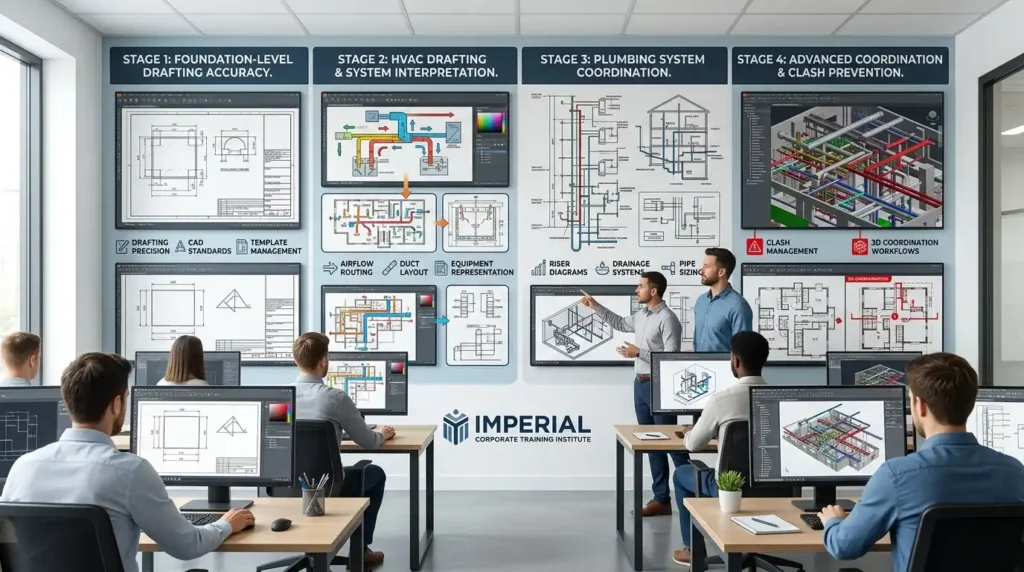
HVAC and plumbing design cannot be mastered through isolated software commands alone. Technical accuracy depends on understanding workflow logic, system relationships, project documentation requirements, and construction coordination standards.
Imperial Corporate Training Institute therefore organises the programme into ten progressive modules that mirror real project delivery stages.
Foundation-Level Drafting Accuracy
The first module establishes CAD standards, template management, scaling, title block configuration, and drafting precision. Participants learn how engineering organisations structure professional drawing environments before moving into complex mechanical layouts.
This early-stage structure reduces workflow inconsistencies that commonly lead to documentation errors.
HVAC Drafting and System Interpretation
The second module introduces HVAC system drafting principles, including airflow routing, duct placement, schematic interpretation, and equipment representation. Participants learn how to translate engineering intent into coordinated AutoCAD documentation.
Mechanical design professionals also develop layer management strategies for organising complex HVAC systems.
Plumbing System Coordination
Imperial Corporate Training Institute integrates plumbing drafting immediately after HVAC fundamentals because both systems must operate within shared project spaces. Participants therefore learn riser diagrams, drainage systems, pipe sizing, and coordination methods within integrated MEP environments.
This structure improves multidisciplinary awareness during project planning stages.
Advanced Coordination and Clash Prevention
The programme progresses into advanced AutoCAD tools, including external references, 3D coordination workflows, and clash management practices. Participants learn how to identify design conflicts before construction phases begin.
Professionals evaluating advanced training structures can also review this related resource on:
How AutoCAD HVAC training teaches engineers to avoid common design error, which explains how structured engineering workflows improve drafting reliability.
Corporate-Level Execution
The final modules focus on quality assurance, BIM integration, revision control, client deliverables, and project simulations. Imperial Corporate Training Institute uses these stages to replicate real corporate engineering conditions where documentation accuracy directly influences project performance.
What Will Participants Learn During the Programme?
Participants learn HVAC drafting precision, plumbing system coordination, documentation control, AutoCAD workflow management, quality assurance practices, and BIM-compatible project execution techniques. The programme develops practical engineering capabilities required for producing accurate, scalable, and compliant HVAC and plumbing documentation within corporate environments.
The course combines drafting accuracy with engineering workflow management. Participants progressively develop technical competencies linked to real construction and infrastructure projects.
HVAC Design and Drafting Skills
Participants learn:
- HVAC schematic interpretation
- Duct routing methods
- Diffuser placement planning
- Airflow distribution principles
- HVAC equipment representation
- Mechanical drafting conventions
Imperial Corporate Training Institute emphasises layout efficiency and engineering clarity throughout these modules.
Plumbing Design Capabilities
The programme develops practical plumbing documentation skills, including:
- Cold and hot water systems
- Drainage layouts
- Pipe sizing methods
- Slope calculations
- Fixture coordination
- Plumbing riser diagrams
Participants also learn how plumbing documentation interacts with HVAC and electrical systems within integrated MEP environments.
Documentation and Layer Management
Professional engineering projects require highly organised documentation structures. Participants therefore learn:
- Layer hierarchy management
- Annotation systems
- Drawing organisation
- Revision tracking
- Schedule preparation
- Bill of materials development
Imperial Corporate Training Institute incorporates corporate documentation standards throughout these activities.
Quality Assurance and Error Detection
The training programme includes structured quality review practices. Participants learn how to conduct:
- Internal drawing audits
- Coordination reviews
- Compliance verification
- Design discrepancy checks
- As-built documentation preparation
This section directly supports the course objective of reducing engineering design errors.
BIM and Revit Integration
Modern engineering environments increasingly require AutoCAD workflows to integrate with BIM platforms. Participants therefore learn:
- AutoCAD and Revit coordination
- BIM-compatible drafting preparation
- Data linking methods
- Multidisciplinary coordination workflows
- Transition strategies from 2D to 3D environments
Imperial Corporate Training Institute integrates these modules to support evolving engineering delivery requirements.
How Does Imperial Deliver the Training Programme?
Imperial Corporate Training Institute delivers the programme through structured workshops, project-based drafting exercises, technical demonstrations, collaborative coordination activities, and applied engineering simulations. Delivery methods support measurable technical progression while aligning participant learning with real-world mechanical design and construction documentation requirements.
Training delivery significantly influences technical skill retention. HVAC drafting competence develops through repeated application, project simulation, and workflow analysis rather than passive instruction alone.
Imperial Corporate Training Institute therefore uses applied delivery formats designed for engineering professionals and corporate teams.
Workshop-Based Technical Instruction
The programme includes guided AutoCAD workshops where participants practise drafting techniques within structured project scenarios. Instructors demonstrate professional workflows before participants complete applied design exercises independently.
This approach improves drafting accuracy and procedural consistency.
Practical Project Simulations
Participants complete realistic HVAC and plumbing drafting scenarios based on commercial engineering conditions. Simulations include:
- Multi-system coordination
- Mechanical layout planning
- Drawing revisions
- Documentation preparation
- Design review procedures
These exercises help professionals apply technical concepts under realistic project constraints.
Corporate Team Learning
Imperial Corporate Training Institute supports organisational learning environments where departments train collectively. Engineering managers, draftsmen, coordinators, and technical staff can therefore develop aligned documentation standards across teams.
This improves workflow consistency within construction and infrastructure organisations.
Flexible Delivery Formats
The programme can support:
- Onsite corporate workshops
- Instructor-led classroom sessions
- Hybrid technical learning
- Professional development training schedules
This flexibility allows organisations to align technical upskilling with operational requirements.
Assessment and Competency Evaluation
Participants are evaluated through:
- Drafting assignments
- Coordination exercises
- Design documentation tasks
- Workflow simulations
- Technical review activities
Imperial Corporate Training Institute uses these assessments to measure practical competency rather than theoretical memorisation alone.
What Results Can Organisations and Participants Expect?
Participants can expect improved drafting accuracy, stronger MEP coordination capability, better documentation control, and enhanced project workflow efficiency. Organisations benefit through reduced design revisions, improved compliance consistency, stronger interdisciplinary collaboration, and more reliable engineering documentation across construction and infrastructure projects.
The course focuses on measurable workplace performance outcomes rather than general software familiarity.
Improved Drafting Precision
Participants learn how to produce technically accurate HVAC and plumbing drawings with consistent annotations, organised layers, and structured documentation systems.
This reduces ambiguity during construction phases.
Reduced Coordination Errors
Imperial Corporate Training Institute trains participants to identify clashes, coordinate system layouts, and manage multidisciplinary design integration more effectively.
These skills support smoother project execution.
Faster Documentation Workflows
Structured drafting systems improve efficiency in:
- Drawing production
- Revision management
- Schedule preparation
- Client submissions
- Design updates
Engineering departments therefore reduce administrative delays during project delivery.
Stronger Compliance Alignment
Participants gain awareness of drafting standards, engineering documentation protocols, and quality assurance practices used within professional construction environments.
This supports regulatory and client compliance expectations.
Better Collaboration Across Departments
The programme strengthens communication between:
- Mechanical engineers
- MEP coordinators
- Project managers
- Facility management teams
- Drafting departments
Imperial Corporate Training Institute incorporates collaborative workflows directly into the course structure.
Professional Role Development
Graduates can apply these competencies within roles such as:
- HVAC design engineer
- MEP coordinator
- Mechanical draftsman
- Plumbing design technician
- Project design coordinator
- Facility engineering specialist
The course also supports engineering graduates seeking technical specialisation within building services industries.
How Does the Programme Support Corporate Engineering Environments?
The programme supports corporate engineering environments by aligning HVAC drafting practices with multidisciplinary workflows, quality assurance standards, documentation protocols, and project delivery requirements used within commercial construction, infrastructure development, and mechanical services organisations across professional engineering sectors.
Corporate engineering teams require consistent technical standards across departments. Disorganised documentation processes increase project risk and reduce operational efficiency.
Imperial Corporate Training Institute therefore integrates corporate workflow principles throughout the programme.
Standardised Documentation Systems
Participants learn how organisations structure templates, annotations, revision histories, and drawing packages for large-scale engineering projects.
This improves consistency across technical departments.
Workflow Coordination Practices
The programme develops collaborative drafting approaches that support communication between engineering disciplines during planning and execution phases.
Participants learn how technical decisions affect downstream project activities.
Project Delivery Readiness
Engineering professionals must produce documentation suitable for:
- Client approvals
- Construction coordination
- Tender submissions
- Site implementation
- Facility maintenance
Imperial Corporate Training Institute incorporates these deliverable requirements into practical assignments and simulations.
Scalable Team Development
Organisations can use the programme to standardise drafting practices across multiple teams, improving quality control and technical alignment within engineering operations.
How Does Enrollment and Completion Work?
Enrollment involves professional eligibility review, course scheduling selection, and participation in structured technical training modules. Completion requires successful engagement with drafting assignments, coordination exercises, and project simulations demonstrating practical HVAC and plumbing design competency using AutoCAD within engineering documentation environments.
The programme is designed for engineering and technical professionals working within construction, infrastructure, and building services sectors.
Participant Eligibility
The course is suitable for:
- Mechanical engineers
- HVAC professionals
- MEP coordinators
- AutoCAD technicians
- Draftsmen
- Project engineers
- Engineering graduates
Imperial Corporate Training Institute also supports organisations seeking department-wide technical upskilling initiatives.
Learning Progression
Participants move through structured modules covering:
- Drafting foundations
- HVAC layouts
- Plumbing systems
- MEP coordination
- Load calculations
- Documentation standards
- Quality assurance
- BIM integration
- Project execution simulations
Each stage builds competency progressively.
Completion Requirements
Participants complete practical drafting activities, workflow simulations, and documentation exercises throughout the programme. Assessments measure technical accuracy, coordination capability, and professional documentation standards.
Discover More from Our Guide Library:
Does Imperial’s HVAC Design Programme Include Live Project Drawing Exercises?
How Does Imperial’s HVAC Training Develop Coordination Drawing Skills?
Imperial Corporate Training Institute structures completion criteria around practical workplace competency rather than theoretical examination performance alone.