

Mechanical design errors in HVAC projects increase construction costs, delay commissioning, and reduce system efficiency. AutoCAD HVAC training focuses on structured drafting standards, clash prevention, load coordination, and technical validation methods that help engineers produce accurate and compliant building services layouts from the beginning of a project lifecycle.
Engineering firms increasingly evaluate training quality based on measurable drafting accuracy, coordination capability, and BIM readiness.
Teams reviewing foundational knowledge often begin with educational resources explaining:
Common HVAC Design Mistakes That AutoCAD Training Can Prevent, before assessing structured technical programmes designed to reduce these recurring project errors.
Why Do HVAC Design Errors Happen During Mechanical Drafting Projects?
HVAC design errors usually originate from poor coordination, incorrect sizing calculations, inconsistent drafting standards, and limited understanding of real construction constraints. AutoCAD HVAC training teaches engineers how to identify these risks early through workflow standardisation, layered documentation methods, and multidisciplinary coordination exercises.
HVAC projects involve interconnected mechanical, electrical, plumbing, and architectural systems. A single drafting inconsistency affects duct routing, airflow performance, equipment access, and installation sequencing. Engineers entering commercial projects without structured CAD workflows often rely on manual corrections rather than systematic validation processes.
Training programmes focused on HVAC drafting introduce engineers to project lifecycle thinking. Instead of drawing isolated components, participants learn how systems interact across ceiling spaces, risers, shafts, and equipment rooms. This operational perspective reduces downstream design conflicts.
Common design errors include:
- Incorrect duct sizing
- Poor air distribution layouts
- Clash conflicts with plumbing or electrical systems
- Inadequate maintenance clearance
- Missing annotations and symbols
- Improper equipment placement
- Faulty airflow balancing assumptions
- Weak layer management and documentation structure
These issues affect project delivery directly. Industry studies from MEP contracting environments show that rework caused by coordination errors can account for 10–15% of total project labour hours in complex infrastructure developments.
Training reduces these inefficiencies through repeatable drafting frameworks.
How Does AutoCAD HVAC Training Improve Technical Coordination Skills?
AutoCAD HVAC training develops coordination skills by teaching engineers how to integrate HVAC layouts with architectural, structural, plumbing, and electrical systems using layered drafting methods, spatial planning techniques, and clash detection principles that improve installation accuracy during construction phases.

Coordination represents one of the largest operational gaps in junior mechanical engineering teams. Engineers often understand HVAC theory but struggle to position systems within practical building constraints.
Structured technical training addresses this problem through multidisciplinary modelling exercises.
Understanding Spatial Coordination
Engineers learn how ceiling voids, structural beams, cable trays, sprinkler systems, and plumbing lines compete for limited installation space. HVAC layouts must support airflow efficiency without interfering with other building services.
Training environments simulate these conditions using coordinated project files.
Participants learn:
- Layer discipline
- Equipment zoning
- Vertical clearance planning
- Shaft allocation
- Access space management
- Diffuser positioning standards
This structured exposure improves design awareness before engineers enter live projects.
Learning Clash Prevention Workflows
Modern HVAC drafting requires proactive conflict reduction rather than reactive correction.
Training teaches engineers how to:
- Separate service layers correctly
- Apply standard naming conventions
- Review intersections systematically
- Validate routing before documentation submission
- Coordinate duct and pipe elevations
These methods reduce site modifications and improve installation sequencing.
At the implementation stage, organisations evaluating structured technical development pathways often review programmes focused on:
How does Imperial Help Participants Apply Error-Free HVAC Design Techniques to determine workforce readiness for large-scale MEP projects?
How Does AutoCAD HVAC Training Improve Drafting Accuracy?
AutoCAD HVAC training improves drafting accuracy by teaching standardised drawing methods, consistent annotation, precise measurement, scaling practices, and documentation validation procedures, thereby reducing interpretation errors during procurement, fabrication, and construction activities.
Drafting accuracy affects every stage of project execution. Even small documentation inconsistencies generate procurement mistakes, fabrication delays, and commissioning failures.
Training focuses heavily on standardisation because inconsistent drafting creates confusion across multidisciplinary teams.
Standardised Layer Management
Layer management forms the foundation of organised HVAC documentation.
Training programmes teach:
- Layer naming conventions
- Colour coding systems
- Object classification
- Visibility control
- Printing standards
These practices improve drawing readability for contractors and consultants.
Precision in Equipment Placement
Incorrect equipment positioning creates operational and maintenance problems.
Engineers learn how to:
- Define service clearances
- Maintain accessibility zones
- Position diffusers accurately
- Align duct routing with structural constraints
- Apply manufacturer installation standards
This reduces redesign requirements during construction.
Annotation and Documentation Control
Incomplete documentation increases RFIs (Requests for Information) during project execution.
Training addresses:
- Symbol libraries
- Dimensioning standards
- Equipment schedules
- Airflow notation
- Revision management
- Sheet organisation
Accurate documentation improves communication between stakeholders.
For engineers seeking structured practice in these workflows, the:
AutoCAD HVAC and Plumbing Design Training Course introduces drafting standards aligned with practical MEP coordination requirements.
What Role Does Real-World Project Simulation Play in HVAC Training?
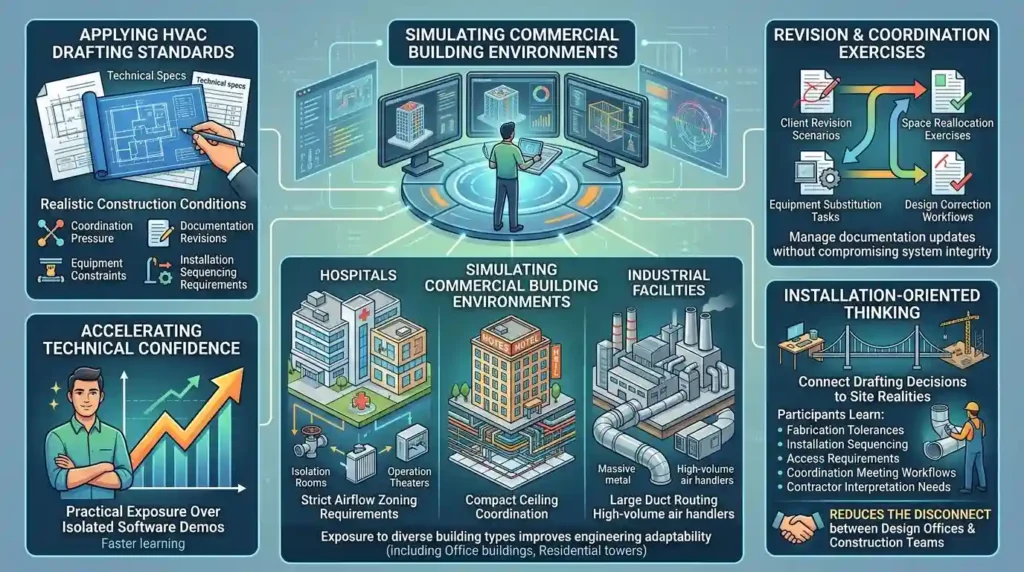
Project simulation teaches engineers how to apply HVAC drafting standards under realistic construction conditions, including coordination pressure, documentation revisions, equipment constraints, and installation sequencing requirements that mirror commercial and industrial building projects.
Training quality depends heavily on practical exposure.
Engineers develop technical confidence faster when exercises replicate actual project workflows rather than isolated software demonstrations.
Simulating Commercial Building Environments
Advanced training environments typically include:
- Office buildings
- Hospitals
- Hotels
- Industrial facilities
- Residential towers
Each building type introduces unique HVAC coordination challenges.
For example:
- Hospitals require strict airflow zoning
- Hotels require compact ceiling coordination
- Industrial facilities require large duct routing strategies
Exposure to multiple environments improves engineering adaptability.
Revision and Coordination Exercises
Real projects change continuously.
Training often includes:
- Client revision scenarios
- Space reallocation exercises
- Equipment substitution tasks
- Design correction workflows
These exercises help engineers manage documentation updates without compromising system integrity.
Installation-Oriented Thinking
Effective HVAC training connects drafting decisions to site execution realities.
Participants learn:
- Fabrication tolerances
- Installation sequencing
- Access requirements
- Coordination meeting workflows
- Contractor interpretation needs
This reduces the disconnect between design offices and construction teams.
How Does HVAC Training Help Engineers Reduce Rework Costs?
AutoCAD HVAC training reduces rework costs by improving first-time drafting accuracy, coordination validation, documentation consistency, and installation feasibility assessment, allowing engineering teams to minimise costly design revisions during procurement and construction phases.
Rework represents a major operational expense in MEP construction.
Poorly coordinated HVAC layouts generate:
- Material waste
- Site delays
- Fabrication errors
- Installation conflicts
- Commissioning failures
Training improves preventative quality control processes.
Early Error Detection Methods
Engineers learn systematic review procedures such as:
- Layer auditing
- Routing validation
- Airflow verification
- Equipment clearance checks
- Cross-disciplinary review workflows
Early correction reduces downstream project impact.
Standardisation Across Teams
Organisations managing multiple engineers require consistent drafting methods.
Training introduces shared:
- CAD templates
- Annotation systems
- File structures
- Documentation standards
- Revision protocols
Consistency improves collaboration and reduces interpretation mistakes.
Measuring Operational ROI
HR and operations teams increasingly evaluate technical training through measurable KPIs.
Common performance indicators include:
| Training Outcome | Operational Impact |
|---|---|
| Reduced drawing revisions | Faster project approvals |
| Improved coordination | Fewer site clashes |
| Better documentation quality | Lower contractor RFIs |
| Standardised workflows | Improved team scalability |
| Accurate equipment layouts | Reduced commissioning delays |
This performance-based evaluation model aligns training investment with operational efficiency goals.
How Does AutoCAD HVAC Training Compare with Traditional Learning Methods?
AutoCAD HVAC training provides structured, application-focused technical development compared with theory-heavy traditional learning methods that often lack project simulation, multidisciplinary coordination exposure, and practical drafting validation exercises required in commercial engineering environments.
Engineering education traditionally focuses on thermodynamics, heat transfer, and airflow calculations. These fundamentals remain important, but employers increasingly prioritise applied drafting capability.
Practical training bridges this gap.
Comparison Between Learning Approaches
| Learning Method | Primary Focus | Practical Coordination Exposure | Error Prevention Training |
|---|---|---|---|
| University engineering theory | Technical principles | Limited | Low |
| Self-learning CAD tutorials | Software commands | Minimal | Inconsistent |
| Workplace observation | Real projects | Moderate | Reactive |
| Structured AutoCAD HVAC training | Applied HVAC drafting workflows | High | Systematic |
Structured training creates repeatable competency development.
Why Organisations Prefer Structured Technical Training
HR departments increasingly evaluate technical training based on:
- Speed of skill acquisition
- Reduced onboarding time
- Lower supervision requirements
- Standardised engineering quality
- Improved project delivery consistency
Structured HVAC training supports these organisational priorities because it combines software operation with engineering application.
Reducing Dependency on Senior Staff
Junior engineers without structured drafting knowledge rely heavily on senior review cycles.
Training reduces:
- Excessive revision loops
- Coordination dependency
- Documentation inconsistencies
- Workflow bottlenecks
This improves department scalability.
What Technical Skills Are Most Important for Error-Free HVAC Design?
Error-free HVAC drafting depends on coordinated technical skills including airflow planning, duct routing, equipment placement, layer management, documentation control, and multidisciplinary spatial coordination within complex building environments.
Technical proficiency involves more than software navigation.
Effective HVAC engineers combine engineering logic with drafting discipline.
Core Skills Developed During Training
Duct Routing and Air Distribution
Engineers learn:
- Airflow zoning principles
- Static pressure considerations
- Balanced diffuser placement
- Space-efficient routing methods
Poor routing directly affects energy efficiency and occupant comfort.
HVAC Equipment Layout Planning
Training develops competency in:
- AHU positioning
- FCU placement
- Pump room coordination
- Mechanical room spacing
Incorrect layouts increase maintenance difficulty and operational inefficiency.
Plumbing and HVAC Integration
Mechanical systems increasingly overlap in commercial construction.
Training addresses:
- Pipe routing coordination
- Shared service zones
- Ceiling congestion management
- Combined service documentation
Integrated coordination reduces construction delays.
Documentation Quality Control
High-performing engineering teams maintain:
- Consistent title blocks
- Standard symbols
- Accurate schedules
- Clear annotations
- Structured revisions
Training reinforces these operational standards.
How Does HVAC Training Support Large Infrastructure and Commercial Projects?
HVAC training supports large infrastructure projects by preparing engineers to manage complex service coordination, standardised documentation systems, multidisciplinary collaboration, and scalable drafting workflows required in high-density commercial and industrial developments.
Large projects increase coordination complexity significantly.
Hospitals, airports, data centres, and commercial towers require extensive HVAC integration across multiple disciplines.
Managing Large-Scale Coordination
Complex projects involve:
- Hundreds of coordinated drawings
- Multiple engineering consultants
- Strict documentation standards
- Sequenced construction packages
Training teaches engineers how to work within these structured environments.
Supporting BIM and Digital Construction Workflows
Modern construction increasingly depends on digital coordination.
AutoCAD HVAC training introduces:
- Layer discipline for BIM compatibility
- Coordination-ready file organisation
- Standardised documentation practices
- Data consistency principles
These skills support digital project delivery frameworks.
Improving Workforce Readiness
Engineering managers frequently identify workforce readiness gaps in:
- Drawing coordination
- Documentation standards
- Real-world drafting application
- Cross-disciplinary communication
Structured training reduces these gaps and shortens operational onboarding timelines.
Why Are Error Prevention Skills Becoming More Important in HVAC Engineering?
Error prevention skills are becoming essential because modern buildings involve tighter service coordination, stricter energy regulations, accelerated construction schedules, and higher operational performance expectations that leave minimal tolerance for drafting inaccuracies or installation conflicts.
Discover More from Our Guide Library:
How Does AutoCAD HVAC Training Cover Sanitary and Stormwater Design?
How Does AutoCAD HVAC Training Handle Fire Pump Room Design and Documentation?
Commercial construction environments have changed significantly during the last decade.
Projects now involve:
- Dense ceiling coordination
- Sustainability compliance targets
- Fast-track delivery schedules
- Integrated digital workflows
- High-efficiency mechanical systems
These conditions increase the cost of engineering errors.
Impact of Sustainability Requirements
Energy-efficient buildings require highly accurate HVAC layouts.
Poor coordination affects:
- Air balancing
- Thermal performance
- Energy consumption
- Occupant comfort
Training improves engineering precision in these regulated environments.
Faster Construction Cycles
Compressed construction schedules reduce time available for redesign.
Engineering teams must deliver:
- Accurate documentation
- Coordinated layouts
- Installation-ready drawings
Structured HVAC training supports this operational requirement.
Workforce Development Priorities
Technical workforce development increasingly focuses on:
- Error reduction
- Productivity improvement
- Cross-functional coordination
- Digital drafting competency
This shift reflects broader industry demand for implementation-ready engineering talent.
What does the AutoCAD HVAC and Plumbing Design Training Course cover?
The AutoCAD HVAC and Plumbing Design Training Course by Imperial Corporate Training Institute covers HVAC drafting, plumbing layouts, duct routing, piping systems, and MEP coordination. Participants also learn technical drawing standards, equipment placement, and clash-free design workflows used in commercial projects.
Who should attend an AutoCAD HVAC and Plumbing Design Training Course?
This course is suitable for mechanical engineers, HVAC technicians, MEP professionals, CAD drafters, and engineering graduates. Imperial Corporate Training Institute structures the training to support both entry-level learners and professionals improving HVAC and plumbing design skills.
How does AutoCAD HVAC training help reduce design errors?
AutoCAD HVAC training teaches engineers how to apply drafting standards, layer management, and coordinated MEP layouts to reduce common design mistakes. The AutoCAD HVAC and Plumbing Design Training Course also focuses on airflow planning, equipment spacing, and multidisciplinary coordination.
Why is HVAC and plumbing coordination important in building projects?
HVAC and plumbing coordination prevents clashes between ductwork, pipes, electrical systems, and structural elements during construction. Imperial Corporate Training Institute includes practical coordination exercises in its AutoCAD HVAC and Plumbing Design Training Course to improve installation accuracy and project efficiency.