

The progression from draughtsman to senior HVAC designer is not driven by software familiarity alone. It is shaped by how effectively technical drafting evolves into system-level design thinking, coordination responsibility, and engineering decision capability. AutoCAD-based HVAC training plays a central role in this transition by restructuring how professionals interpret drawings, spatial constraints, and mechanical systems.
Modern construction environments demand draughtsmen who understand more than drawing production. Senior roles require interpretation of design intent, integration of multidisciplinary systems, and the ability to resolve spatial and technical conflicts before execution begins on site. This shift is where structured training becomes a defining factor in career advancement.
For a broader understanding of career progression stages in this field, the pathway is mapped in detail through the analysis of entry-to-senior transitions in the:
What Are the Career Steps from AutoCAD Draughtsman to Senior MEP Designer? It establishes how responsibilities evolve across technical maturity levels and why structured learning becomes essential at each stage.
How does AutoCAD HVAC training bridge the gap to senior design roles?
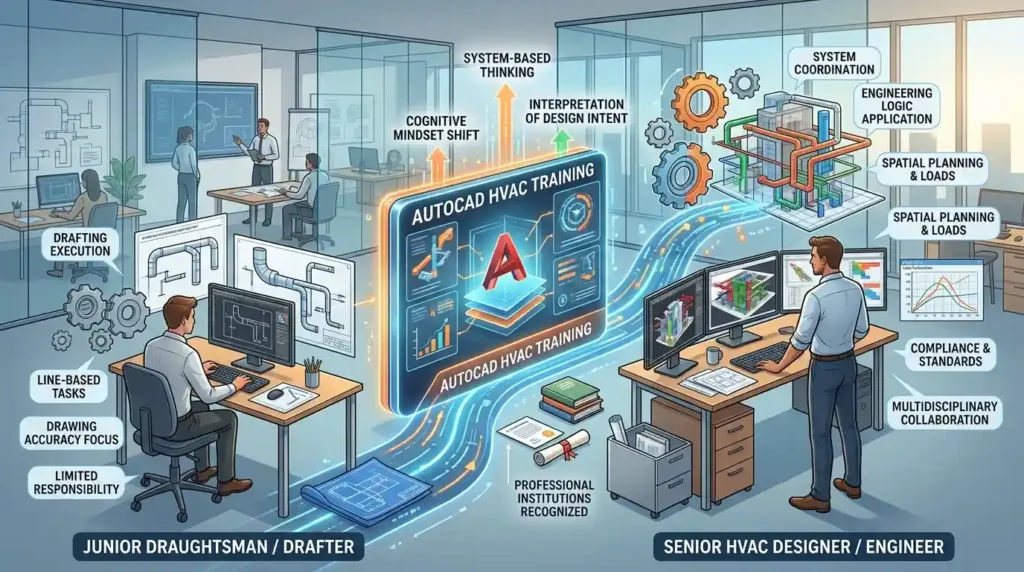
AutoCAD HVAC training bridges the gap by shifting draughtsmen from drafting execution to design interpretation, system coordination, and engineering logic application, enabling progression into senior roles that require responsibility for spatial planning, load considerations, compliance, and multidisciplinary coordination across projects.
The transition from junior drafting roles to senior HVAC design positions depends on cognitive shift rather than tool usage. AutoCAD HVAC training restructures how professionals interpret mechanical drawings, moving them from line-based drafting tasks to system-based thinking. This shift is essential in environments where HVAC systems must integrate with architectural layouts, structural constraints, and electrical routing.
At senior level, the expectation extends beyond drawing accuracy. Professionals must interpret design intent, evaluate feasibility, and ensure compliance with mechanical standards. Training introduces this layer by exposing draughtsmen to load distribution concepts, airflow logic, and equipment placement strategy.
A key aspect of this development is structured progression frameworks offered through professional institutions. For example, Imperial Corporate Training Institute delivers structured progression pathways in HVAC education through its roadmap system outlined in:
How Does Imperial’s HVAC Training Provide a Career Development Roadmap? This type of structured learning ensures that progression is not accidental but competency driven.
By integrating real project scenarios into training, draughtsmen begin to understand how decisions affect downstream construction stages. This includes coordination delays, material conflicts, and redesign risks. As a result, learners develop anticipatory thinking, which is a defining capability of senior design professionals.
What technical competencies are developed through AutoCAD HVAC training?
AutoCAD HVAC training develops competencies in duct and pipe drafting, airflow design interpretation, load estimation fundamentals, equipment layout planning, drawing standards compliance, and coordination practices, preparing draughtsmen to handle technical documentation and design validation tasks in advanced MEP environments projects.
Technical competence in HVAC design is not limited to software commands. It includes understanding how mechanical systems behave within physical spaces. AutoCAD HVAC training builds this competency by linking drafting output with engineering principles such as airflow distribution, pressure balance, and thermal load interpretation.
Draughtsmen are trained to produce accurate ducting layouts that reflect system efficiency rather than visual representation alone. This includes understanding routing efficiency, minimising pressure losses, and ensuring maintenance accessibility. These competencies directly align with senior design expectations in MEP consultancy and construction environments.
Load estimation fundamentals are also introduced to support early-stage design validation. While senior engineers perform final calculations, draughtsmen must understand how loads influence system sizing and equipment selection. This enables more meaningful contribution during design reviews.
Standards compliance is another critical competency. Training introduces international and regional drafting standards, ensuring that outputs remain consistent across multidisciplinary teams. This reduces revision cycles and improves coordination efficiency.
The AutoCAD HVAC and Plumbing Design Training Course integrates these competencies into structured modules, ensuring that learners progress from basic drafting to applied design understanding. This progression is essential for organisations seeking predictable skill development outcomes in technical teams.
Ultimately, these competencies enable draughtsmen to transition from production roles into validation-support roles, where their output directly contributes to engineering accuracy and project efficiency.
How does AutoCAD HVAC training improve design coordination in MEP projects?
AutoCAD HVAC training strengthens design coordination by teaching draughtsmen to align HVAC layouts with electrical and plumbing systems, reduce spatial clashes, interpret coordination drawings, and apply standardised workflows that support integrated MEP project delivery across complex construction environments efficiently projects.
Coordination is the most critical challenge in modern MEP projects due to increasing system density and reduced spatial tolerance in building designs. AutoCAD HVAC training addresses this by introducing draughtsmen to coordination logic across mechanical, electrical, and plumbing systems.
At senior level, coordination is not reactive. It is predictive. Draughtsmen trained in HVAC coordination learn to anticipate clashes before they occur by understanding spatial hierarchy, service routing priorities, and ceiling void management. This reduces redesign cycles and improves construction efficiency.
Training also focuses on interpreting coordination drawings. These drawings represent integrated system layouts where multiple disciplines overlap. Understanding these documents allows draughtsmen to contribute meaningfully to coordination meetings and revision cycles.
Workflow discipline is another key element. Standardised layering systems, naming conventions, and revision tracking ensure that multiple stakeholders can work on the same project without data conflict. This is essential in large-scale commercial developments where coordination teams may include multiple consultants.
As coordination capability improves, draughtsmen begin to take ownership of model integrity rather than just output generation. This shift is a defining marker of readiness for senior design responsibilities.
What role does industry workflow simulation play in preparation for senior roles?
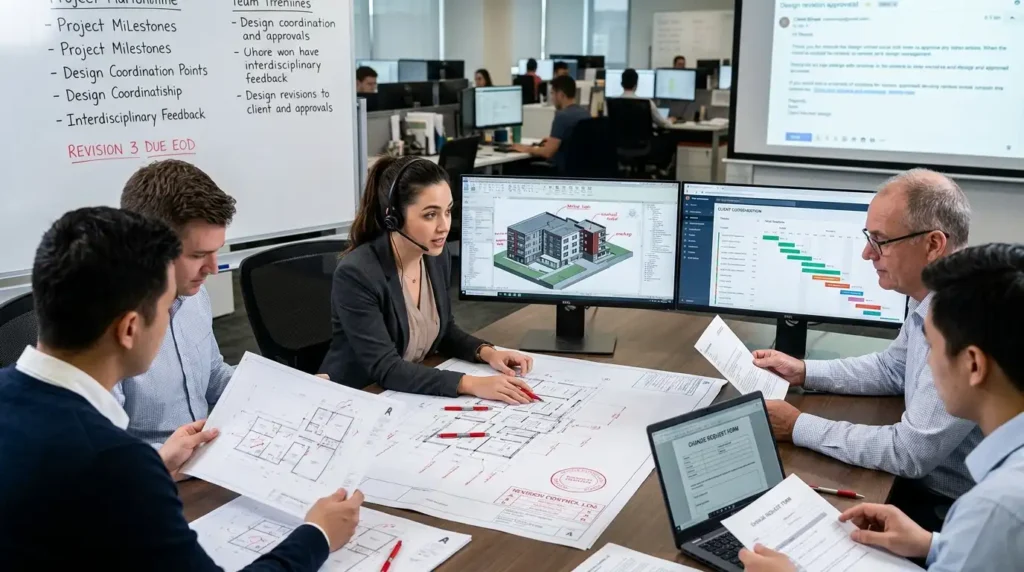
Industry workflow simulation exposes draughtsmen to real project cycles, including design development, revision control, client coordination, and documentation standards, enabling them to operate at senior-level expectations where accuracy, timeline adherence, and interdisciplinary communication define performance outcomes in delivery roles.
Workflow simulation is a critical training method because it replicates the pressure, structure, and decision cycles of real project environments. Instead of isolated drafting exercises, trainees work through complete project lifecycles.
This includes initial design interpretation, iterative revisions, coordination feedback integration, and final documentation preparation. Each stage introduces decision-making pressure that mirrors real consultancy environments.
Revision control is particularly important. Senior designers spend significant time managing revisions across multiple stakeholders. Simulation training builds discipline in version tracking, change documentation, and design justification.
Client coordination scenarios are also introduced to simulate communication workflows. Draughtsmen learn how design changes are requested, reviewed, and implemented across hierarchical approval systems.
This exposure reduces the learning curve when transitioning into senior roles. Instead of adapting to workflow pressure after promotion, professionals enter senior roles with pre-built operational familiarity.
How does AutoCAD HVAC and Plumbing Design Training Course support progression into senior roles?
Structured training programmes accelerate progression by aligning draughtsmen with senior-level design expectations through advanced drafting standards, coordination exercises, real project simulations, and competency-based assessments that measure readiness for leadership roles in HVAC and plumbing design environments within technical organisations globally.
Progression into senior design roles is not determined by tenure alone. It is defined by measurable capability in design accuracy, coordination effectiveness, and system-level understanding. Structured training ensures these competencies are developed systematically rather than informally.
This integrates progressive learning stages that begin with drafting fundamentals and advance toward integrated system design. Each stage introduces increasing complexity, ensuring skill alignment with senior responsibilities.
Competency-based assessments play a key role in progression validation. These assessments measure not only technical output but also decision logic, coordination accuracy, and compliance understanding. This creates a transparent benchmark for readiness evaluation.
Simulation-based learning further reinforces readiness by exposing trainees to real-world constraints such as time pressure, design conflicts, and client-driven revisions. These conditions reflect actual senior design environments.
As professionals progress through structured frameworks, they develop the confidence and technical depth required for supervisory and design leadership roles. This reduces dependency on external experience accumulation and accelerates internal promotion pathways.
How do employers evaluate readiness for senior design roles?
Employers evaluate readiness through technical accuracy, design coordination capability, software proficiency, understanding of HVAC systems, adherence to standards, communication skills, and ability to manage project constraints, ensuring draughtsmen can transition into senior responsibilities with measurable performance consistency in design roles.
Evaluation for senior HVAC roles is based on applied performance rather than theoretical knowledge. Employers focus on how effectively professionals translate design intent into coordinated, buildable solutions.
Technical accuracy remains the first benchmark. Errors in duct sizing, routing, or system alignment indicate gaps in foundational understanding. Senior candidates must demonstrate consistency across complex drawings without supervision.
Discover More from Our Guide Library:
How Are Residential and Commercial HVAC Drawing Requirements Covered in Training?
How Does AutoCAD HVAC Training Help Engineers Prepare Design Basis Documentation?
Coordination capability is equally important. Employers assess how well candidates integrate multiple systems and resolve spatial conflicts during design stages rather than during construction.
Software proficiency in AutoCAD is expected, but it is no longer a differentiator. What matters is how effectively the software is used to support engineering decisions, not just drawing production.
Communication skills also influence evaluation. Senior roles require interaction with architects, structural engineers, and project managers. Clear justification of design decisions is essential.
Ultimately, employers prioritise consistency under real project constraints. Candidates who demonstrate stable performance across simulated and real environments are considered ready for senior responsibility.
Frequently Asked Questions
How does AutoCAD HVAC training help in becoming an MEP designer?
AutoCAD HVAC training develops core skills in mechanical drafting, HVAC system layout interpretation, and MEP coordination. At Imperial Corporate Training Institute, learners progress from basic drafting to design-level understanding required for senior MEP designer roles.
Who should take AutoCAD HVAC and Plumbing Design training?
This training is suitable for civil, mechanical, and architectural draughtsmen, as well as entry-level MEP professionals. Imperial Corporate Training Institute designs the course for individuals aiming to move into HVAC design and plumbing coordination roles.
What skills are required before joining AutoCAD HVAC training?
Basic AutoCAD knowledge and understanding of technical drawings are recommended before joining. Imperial Corporate Training Institute builds on these fundamentals to develop HVAC design, plumbing system drafting, and coordination competencies.
Is AutoCAD HVAC training useful for career advancement in MEP engineering?
Yes, AutoCAD HVAC training supports career advancement by improving technical drafting, system design understanding, and coordination skills. At Imperial Corporate Training Institute, it prepares professionals for mid to senior-level MEP design responsibilities.