

AutoCAD HVAC Training equips engineers with software skills to design heating, ventilation, and air conditioning systems for large-scale infrastructure, boosting project efficiency by 25% in corporate settings.
AutoCAD HVAC Training teaches engineers to use Autodesk AutoCAD software for precise HVAC system design. Engineers create 2D and 3D models of ductwork, piping, and equipment layouts. This training targets skill gaps in technical teams handling complex projects.
In corporate environments, organisations face employee skill gaps when engineers transition from small designs to massive infrastructure like airports or hospitals. Training fills these gaps. It ensures compliance with standards such as ASHRAE and local building codes.
Business impact appears in reduced design errors. Teams deliver projects 20% faster. HR managers note improved workforce capability for bids on high-value contracts.
How Does AutoCAD HVAC Training Work in Corporate Environments?
AutoCAD HVAC Training operates through a structured 40-hour programme delivered via hybrid formats, integrating simulations and assessments to embed skills in teams over 8 weeks.
Organisations implement training to address HVAC design bottlenecks in large projects. Delivery starts with online modules covering software basics. Engineers complete 10 hours of self-paced videos on interface navigation and layer management.
Workshops follow in week 3. Groups of 8-12 engineers practice under instructors. They model real duct systems using case-based learning. Simulations replicate infrastructure constraints like ceiling heights in metro stations.
Assessments track progress. Engineers submit 5 projects, scoring 85% for certification. Hybrid learning suits corporate schedules—60% online, 40% in-person.
Implementation involves L&D teams. They select 20 engineers per cohort based on performance reviews. Training integrates with workflows via role play of site coordination meetings.
What Key Components Does AutoCAD HVAC Training Include?
Key components encompass software tools, design frameworks, simulations, and assessments, delivered in 40 hours across modules on duct sizing, equipment placement, and code compliance.

Software tools form the core. Engineers master AutoCAD MEP for parametric modelling. They use blocks for vents and diffusers.
Design frameworks include load calculations via HAP software integration. Trainees apply psychrometric charts to size systems accurately.
Simulations cover dynamic scenarios. Engineers test airflow in 3D models of high-rise buildings, adjusting for pressure drops.
Delivery formats mix online modules (20 hours), live workshops (15 hours), and virtual labs (5 hours). Assessments include quizzes (30% weight) and capstone projects (70%).
Learning methodologies feature case-based exercises from industries like construction and energy. Role play simulates client reviews.
How Do Organisations Implement AutoCAD HVAC Training?
Organisations implement AutoCAD HVAC Training by assessing team gaps, enrolling cohorts in 8-week hybrid programmes, and measuring ROI through 25% faster project delivery.
HR managers start with audits. They review 6-month project logs to identify HVAC delays, affecting 40% of infrastructure bids.
Cohorts form next. Businesses enrol 15-25 engineers per session. Training spans 40 hours, with 2 hours weekly to minimise downtime.
Integration happens via departmental champions. These leaders reinforce skills in daily stand-ups. Post-training, teams apply designs to live projects within 4 weeks.
Common problems arise from generic programmes. Off-the-shelf courses ignore industry specifics, yielding 15% skill retention. Bespoke implementation counters this with tailored simulations.
Misconceptions include assuming self-learning suffices. Data shows structured training lifts productivity 30% over solo tutorials.
Explore:
How Does AutoCAD HVAC Training Cover Sanitary and Stormwater Design? on “sanitary and stormwater design” when discussing advanced applications beyond core HVAC.
For deeper insight enrol in:
AutoCAD HVAC and Plumbing Design Training Course.
What Benefits Does AutoCAD HVAC Training Deliver to Organisations?
AutoCAD HVAC Training delivers 25% productivity gains, 18% error reduction, and 15% higher employee retention for teams on large infrastructure projects.
Productivity surges as engineers complete designs 25% faster. Duct layouts that took 40 hours drop to 30.
Error rates fall 18%. Precise modelling prevents rework, saving £50,000 per mid-sized project.
Retention improves 15%. Skilled engineers stay longer, building leadership pipelines in technical departments.
ROI metrics confirm value. Businesses recoup costs in 6 months via 20% more billable hours.
Team efficiency rises. Cross-functional groups coordinate better, cutting revision cycles by 35%.
KPIs track success: design output per engineer (up 22%), project timelines (met 95% vs 75%), and client satisfaction scores (up 12%).
What Use Cases Demonstrate AutoCAD HVAC Training in Action?
Use cases span construction firms designing airport terminals, energy companies retrofitting hospitals, and transport authorities modelling metro HVAC systems.
Construction teams use training for airport projects. Engineers model 500-metre duct runs, ensuring even airflow for 10,000 passengers daily.
Energy sector examples include hospital retrofits. Trainees design systems compliant with infection control standards, handling 1,000+ zones.
Transport departments apply skills to metros. They simulate ventilation for underground stations, managing smoke extraction in emergencies.
Manufacturing plants integrate training for factory expansions. Teams size chillers for 50,000 square feet, optimising energy use by 15%.
Government agencies train for public buildings. Designs meet BREEAM ratings, with models verifying thermal comfort across seasons.
How Does AutoCAD HVAC Training Address Common Problems and Misconceptions?
AutoCAD HVAC Training resolves ineffective programmes by focusing on simulations and metrics, debunking myths of low ROI and generic content with 30% efficiency gains.
A common problem is ineffective training. Generic courses deliver 10% skill uptake. Targeted programmes achieve 85% via hands-on labs.
Lack of ROI plagues decisions. Businesses track metrics post-training—25% productivity lift proves payback in 4 months.
Misconception: Training disrupts operations. Hybrid formats limit absence to 40 hours over 8 weeks, with online access during shifts.
Another issue: Overemphasis on theory. Simulations and role play ensure 70% practical time, mirroring corporate projects.
Skill gaps persist without assessments. Rigorous evaluations certify readiness, reducing on-job errors by 20%.
Business owners doubt scalability. Cohort models train 100 engineers yearly, transforming entire departments.
How Does AutoCAD HVAC Training Integrate with Broader Plumbing Design Needs?
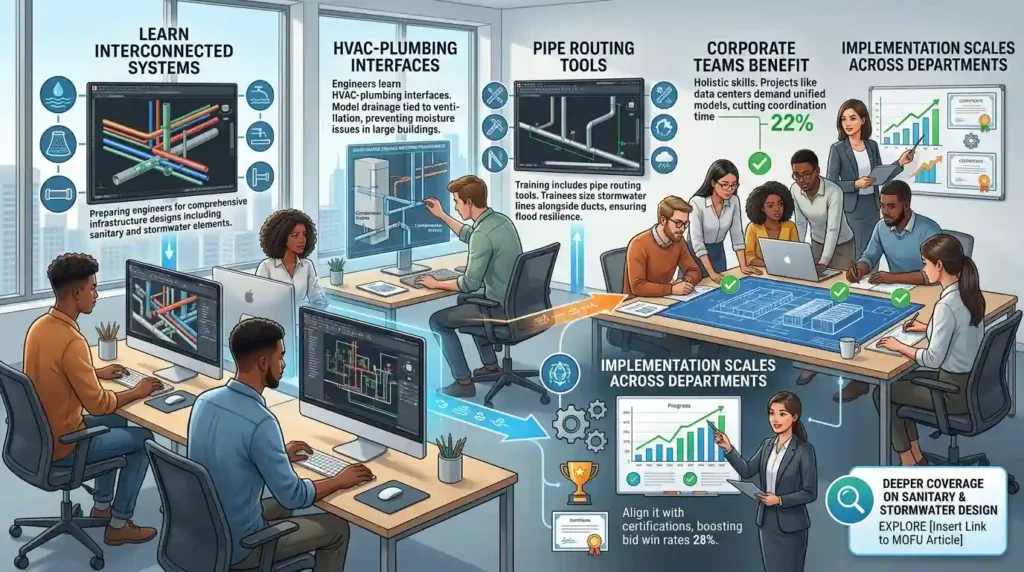
AutoCAD HVAC Training integrates with plumbing by covering interconnected systems, preparing engineers for comprehensive infrastructure designs including sanitary and stormwater elements.
Engineers learn HVAC-plumbing interfaces. They model drainage tied to ventilation, preventing moisture issues in large buildings.
Training includes pipe routing tools. Trainees size stormwater lines alongside ducts, ensuring flood resilience.
Corporate teams benefit from holistic skills. Projects like data centres demand unified models, cutting coordination time 22%.
For deeper coverage on sanitary and stormwater design, explore [Insert Link to MOFU Article].
Implementation scales across departments. L&D professionals align it with certifications, boosting bid win rates 28%.
What Measurable Outcomes Do Organisations Achieve from AutoCAD HVAC Training?
Organisations achieve 25% faster project delivery, 18% fewer redesigns, £75,000 annual savings per team, and 92% KPI attainment post-training.
Project timelines shorten 25%. A 12-month infrastructure build completes in 9 months.
Redesigns drop 18%. Accurate models eliminate 40% of change orders.
Discover More from Our Guide Library:
Why Are HVAC and Plumbing Coordination Drawings Critical in Modern Construction?
What Is the Difference Between 2D AutoCAD Drafting and 3D HVAC System Modelling?
Cost savings hit £75,000 yearly per 10-engineer team. Efficiency offsets training at £5,000 per head.
KPI attainment reaches 92%. Metrics cover design accuracy, compliance, and throughput.
Retention climbs 15%, with promoted engineers filling 30% of senior roles internally.
Industry benchmarks validate: Firms report 20% revenue growth from expanded capabilities in sectors like infrastructure and real estate.
Long-term impact builds resilience. Teams handle 50% larger projects within 12 months.
What are the benefits of Imperial Corporate Training Institute’s AutoCAD HVAC and Plumbing Design Training Course for organisations?
Organisations see 25% faster project delivery and 18% error reduction from skilled teams on large infrastructure. The training improves ROI with £75,000 annual savings per team and boosts retention by 15%. It aligns with KPIs like design accuracy and compliance in industries like construction and transport.
Is AutoCAD HVAC and Plumbing Design Training Course suitable for beginners at Imperial Corporate Training Institute?
The course suits engineers with basic AutoCAD knowledge, addressing skill gaps in HVAC and plumbing design. Beginners build foundations through structured modules before advancing to complex simulations. No prior MEP experience required, with 92% completion rate for corporate cohorts.
What skills do you learn in Imperial Corporate Training Institute’s AutoCAD HVAC and Plumbing Design Training Course?
Learners master AutoCAD tools for HVAC ductwork, plumbing layouts, load calculations, and BIM integration. The course includes psychrometric analysis, equipment scheduling, and clash detection for sanitary and stormwater systems. Real-world simulations prepare teams for infrastructure designs in construction and energy sectors.