
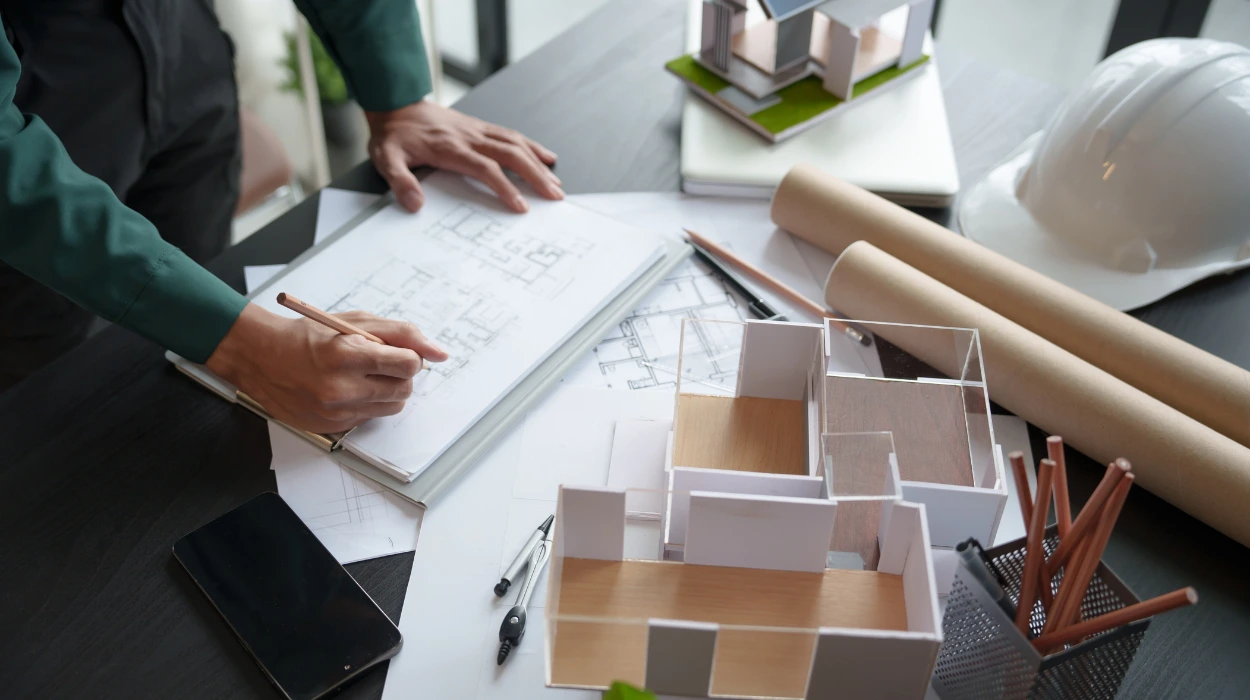
HVAC and plumbing coordination drawings integrate heating, ventilation, air conditioning, and plumbing systems within architectural plans. In corporate construction projects, they prevent clashes, ensure compliance, and cut costs by 15-20% through precise spatial planning.
What Are HVAC and Plumbing Coordination Drawings?
HVAC and plumbing coordination drawings are detailed 2D or 3D plans that overlay HVAC ducts, pipes, equipment, and structural elements to identify and resolve conflicts before construction starts.
These drawings form the backbone of multi-trade coordination in large-scale builds. Construction firms use them to map routes for ductwork, refrigerant lines, drainage pipes, and fire suppression systems against beams, walls, and electrical conduits.
In B2B training contexts, professionals learn this skill to address employee skill gaps in BIM (Building Information Modelling) workflows. HR managers deploy such training to equip teams with tools that reduce on-site rework, which accounts for 10-15% of project budgets in complex facilities like hospitals or data centres.
Corporate environments demand these drawings for MEP (Mechanical, Electrical, and Plumbing) integration. Without them, teams face delays from spatial interferences, leading to 25% higher change orders.
Why Do Modern Construction Projects Demand HVAC and Plumbing Coordination Drawings?
Modern projects demand these drawings because they eliminate 90% of field conflicts, saving organisations 12-18% in total costs and accelerating timelines by 20-30 days per phase.
Scale drives this need. Skyscrapers, commercial complexes, and industrial plants pack dense MEP networks into tight spaces. Coordination drawings use clash detection software to flag overlaps, such as a plumbing stack intersecting an HVAC diffuser.
From a workforce development view, L&D professionals train teams on these drawings to bridge gaps in interdisciplinary knowledge. Generic CAD skills fall short; targeted training covers Revit or Navisworks for 3D coordination, boosting team efficiency by 25%.
Business owners see direct ROI. Projects without coordination suffer 5-10% productivity losses from trade disputes. Training ensures departments like engineering and procurement align early.
How Do HVAC and Plumbing Coordination Drawings Work in Corporate Construction Environments?
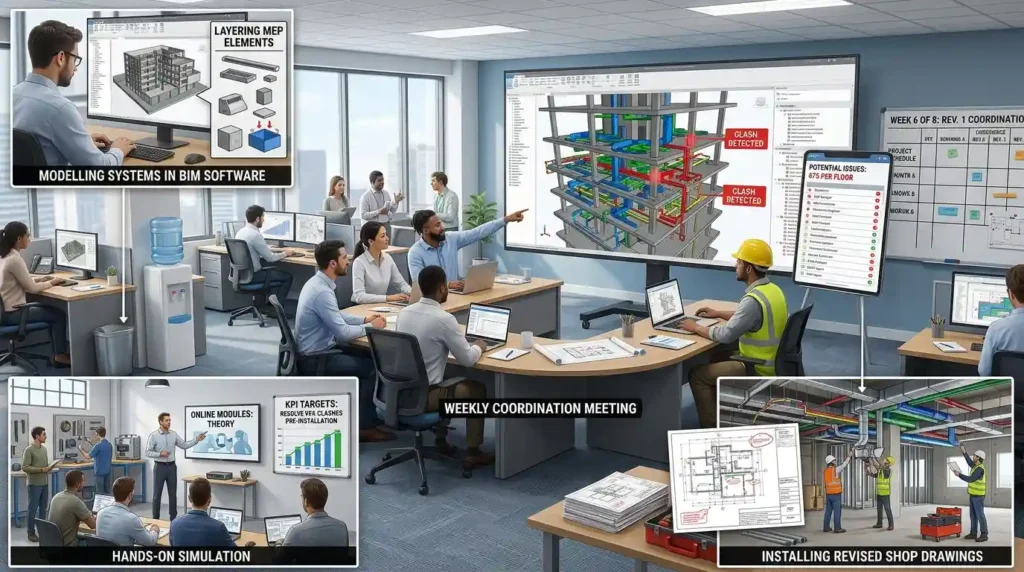
These drawings work through a sequential process: modelling systems in BIM software, running automated clash tests, manually resolving issues, and issuing revised shop drawings for fabrication and installation.
Organisations implement this in phased workflows. Engineers import architectural models into tools like AutoCAD MEP or Revit. They layer HVAC elements—diffusers, VAV boxes, chillers—and plumbing—riser diagrams, fixture units, vents.
Clash detection scans produce reports listing 500-1000 potential issues per floor. Teams prioritise by severity: critical clashes halt work; minor ones adjust routes.
In corporate settings, team leaders conduct weekly coordination meetings. Training programmes teach this via hybrid formats: online modules for theory, workshops for hands-on simulations. Assessments measure proficiency through KPI targets, like resolving 95% of clashes pre-installation.
Delivery spans 40-60 hours over 8 weeks, blending case-based learning with role play of trade negotiations.
What Key Components Make Up Effective HVAC and Plumbing Coordination Drawings?
Key components include layered BIM models, clash detection reports, annotated shop drawings, riser diagrams, and compliance checklists aligned with standards like ASHRAE 90.1 and IPC (International Plumbing Code).
BIM models form the core, with HVAC sections detailing air handlers (capacity in CFM), duct sizing (friction loss under 0.08 in.wg/100ft), and plumbing specifying pipe diameters (e.g., 4-inch soil stacks).
Clash reports categorise issues: hard clashes (physical overlaps), clearance violations (minimum 50mm gaps), and zoning errors (e.g., wet pipes near electrical).
Shop drawings incorporate revisions, scaling 1:50 for plans and 1:20 for details. Checklists verify flow rates (e.g., 2.5 GPM per fixture) and pressure drops.
Training covers these via structured modules. Online segments explain frameworks like LOD (Level of Development) 300-400. Workshops simulate builds in industries like manufacturing, hospitality, and pharmaceuticals.
How Are HVAC and Plumbing Coordination Drawings Delivered Step by Step in Organisations?
Delivery follows five steps: 1) Import base models; 2) Model MEP systems; 3) Run clash detection; 4) Resolve and iterate; 5) Federate and approve final drawings.
Step 1 involves loading IFC files into coordination platforms. Teams spend 20% of time here ensuring geometric accuracy.
Step 2 requires modelling: HVAC ducts routed with 2-3 velocity feet per minute; plumbing with proper venting (every 100 feet horizontally).
Step 3 uses Navisworks for automated tests, generating navigable 3D views of 200-500 clashes.
Step 4 demands collaboration: RFIs (Requests for Information) issued within 48 hours, resolutions logged in shared drives.
Step 5 finalises with stamps from lead engineers, distributed via cloud BIM 360.
Corporate training mirrors this. Hybrid programmes use simulations for steps 3-4, with assessments tracking resolution times under 72 hours. This builds leadership pipelines for project managers.
How Do Organisations Implement HVAC and Plumbing Coordination Training?
Organisations implement training through needs assessments, blended delivery (60% online, 40% in-person), post-training pilots, and KPI tracking over 6 months.
HR starts with skill audits, identifying gaps via surveys: 70% of teams lack 3D coordination proficiency.
Delivery formats include workshops (4-hour sessions on clash resolution), online modules (self-paced Revit tutorials), and hybrid cohorts for remote teams.
Implementation integrates into workflows: pilot on one project, scaling to full departments. Simulations use real cases from retail or office fit-outs.
Metrics track adoption: 80% certification pass rate, 15% faster coordination cycles.
For deeper execution enril in:
AutoCAD HVAC and Plumbing Design Training Course on specific applications like fire pump room layouts, explore:
How Does AutoCAD HVAC Training Handle Fire Pump Room Design and Documentation?
What Measurable Outcomes Do HVAC and Plumbing Coordination Drawings Produce?
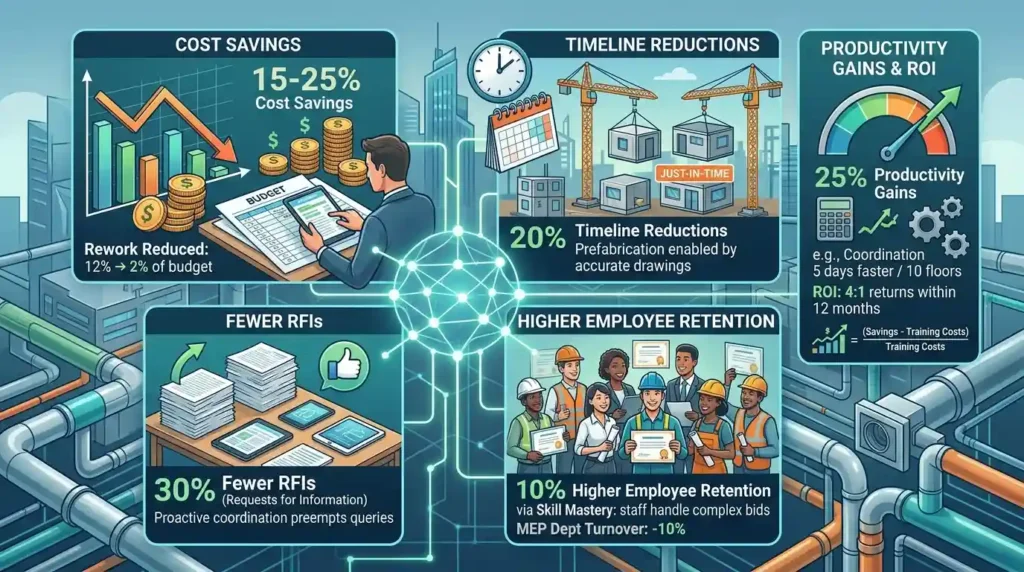
Outcomes include 15-25% cost savings, 20% timeline reductions, 30% fewer RFIs, and 10% higher employee retention through skill mastery.
Costs drop as rework falls from 12% to 2% of budgets. Timelines compress with prefabrication enabled by accurate drawings modules arrive just-in-time.
RFIs decrease because proactive coordination preempts queries. Retention rises as trained staff handle complex bids, reducing turnover by 10% in MEP departments.
Productivity metrics show 25% gains: teams complete coordination 5 days faster per 10 floors.
ROI calculations use formulas like (savings – training costs)/training costs, yielding 4:1 returns within 12 months.
What Are Common Problems with HVAC and Plumbing Coordination Drawings?
Common problems stem from siloed teams causing 40% unresolved clashes, outdated 2D tools leading to 15% errors, and skipped training resulting in 20% budget overruns.
Siloed workflows ignore inter-trade impacts: HVAC ignores plumbing sleeves, inflating change orders.
Outdated tools like plain AutoCAD miss 3D dynamics, unlike BIM’s automation.
Ineffective training—generic programmes without simulations—yields low retention: only 50% apply skills post-course.
Misconceptions include viewing coordination as optional; it prevents 90% of issues.
What Misconceptions Surround HVAC and Plumbing Coordination Training?
Misconceptions include believing generic CAD covers coordination (it misses 70% of BIM clashes), assuming in-house expertise suffices (external gaps hit 60% of firms), and expecting instant ROI without pilots (true returns build over 3-6 months).
Many think basic drafting equals coordination. It does not; specialised training teaches federated models.
In-house assumptions overlook evolving codes: 25% of firms retrain yearly.
ROI myths ignore pilots: 6-month tracking reveals 18% gains after initial dips.
What Use Cases Demonstrate HVAC and Plumbing Coordination in Corporate Teams?
Use cases span hospital expansions (coordinating medical gas with HVAC), data centre builds (cooling pipes avoiding cable trays), and hotel retrofits (plumbing risers through existing ducts).
Discover More from Our Guide Library:
What Is the Difference Between 2D AutoCAD Drafting and 3D HVAC System Modelling?
What UK Building Regulations Apply to HVAC and Plumbing Design Drawings?
Hospital teams coordinate oxygen lines with exhaust ducts, cutting downtime by 15%.
Data centres align CRAC units with chilled water loops, ensuring 99.999% uptime.
Hotels resolve legacy clashes, speeding renovations by 25%.
Training equips managers in these via case-based learning: role play trade-offs, assessments on 50-clash scenarios.
Departments like facilities management apply skills firm-wide, enhancing cross-team collaboration.
What does the AutoCAD HVAC and Plumbing Design Training Course from Imperial Corporate Training Institute cover?
The course covers BIM modelling for ducts, pipes, and equipment, clash detection in MEP coordination, and compliance with standards like ASHRAE and IPC. Participants learn 2D/3D drafting, riser diagrams, and shop drawing production. It equips teams with practical skills for construction projects in industries like healthcare and commercial builds.
Who should take the AutoCAD HVAC and Plumbing Design Training Course at Imperial Corporate Training Institute?
MEP engineers, CAD technicians, and construction coordinators facing skill gaps in HVAC/plumbing integration benefit most. Team leaders in architecture firms and L&D managers training corporate teams find it ideal. It targets those handling complex builds like data centres or hospitals.
What software skills are taught in Imperial Corporate Training Institute’s AutoCAD HVAC training?
Trainees master AutoCAD MEP, Revit, and Navisworks for 3D modelling, clash resolution, and federated drawings. Key skills include duct sizing, pipe routing, and automated detection of spatial conflicts. These tools reduce on-site errors by 90% in practice.
What are the benefits of Imperial Corporate Training Institute’s AutoCAD HVAC and Plumbing Design Course for organisations?
Organisations gain 15-25% cost savings from reduced rework and 20% faster project timelines via skilled staff. Training improves team efficiency in coordination drawings and boosts retention through measurable KPI improvements. It aligns with corporate needs for precise MEP documentation.