

Modern HVAC design workflows are no longer driven by software proficiency alone. They are defined by compliance accuracy, international standard alignment, and the ability to translate engineering codes into precise CAD outputs. AutoCAD-based HVAC training sits at the intersection of technical drafting and regulatory interpretation, where ASHRAE and BS EN standards shape how systems are designed, documented, and validated.
In most organisations, the challenge is not software usage but standard integration into design thinking. Engineers and draftsmen must understand how international codes influence airflow calculations, duct sizing, equipment selection, and schematic representation inside AutoCAD environments.
A detailed foundation of how these standards are structured in design practice is explained in this resource:
What International Drawing Standards Apply to AutoCAD HVAC Design Work? This provides the awareness layer needed before evaluating structured training approaches.
How are international standards integrated into AutoCAD HVAC training workflows?
International standards are integrated into AutoCAD HVAC training through structured mapping of ASHRAE and BS EN rules into drafting layers, system design logic, annotation practices, and symbol libraries. Trainees learn how each standard influences airflow design, duct sizing, load calculations, and documentation consistency across project deliverables in engineering environments.
In practice, integration happens at multiple levels. The first level is conceptual understanding of standards such as ASHRAE 62.1 for ventilation and ASHRAE 55 for thermal comfort. These define design parameters rather than drawings themselves.
The second level is translation into CAD workflows. This includes layer naming conventions, system categorisation (supply, return, exhaust), and annotation standards that ensure drawings remain readable across international project teams.
The third level is validation. Engineers must ensure that the final AutoCAD output reflects compliance logic, not just visual accuracy. This is where BS EN standards, particularly those related to mechanical services documentation, become critical.
Training environments simulate real project conditions where learners must convert regulatory requirements into deliverable-ready CAD drawings. This ensures that compliance is embedded into design thinking rather than added at the end of the workflow.
Why do ASHRAE standards play a central role in HVAC design interpretation?
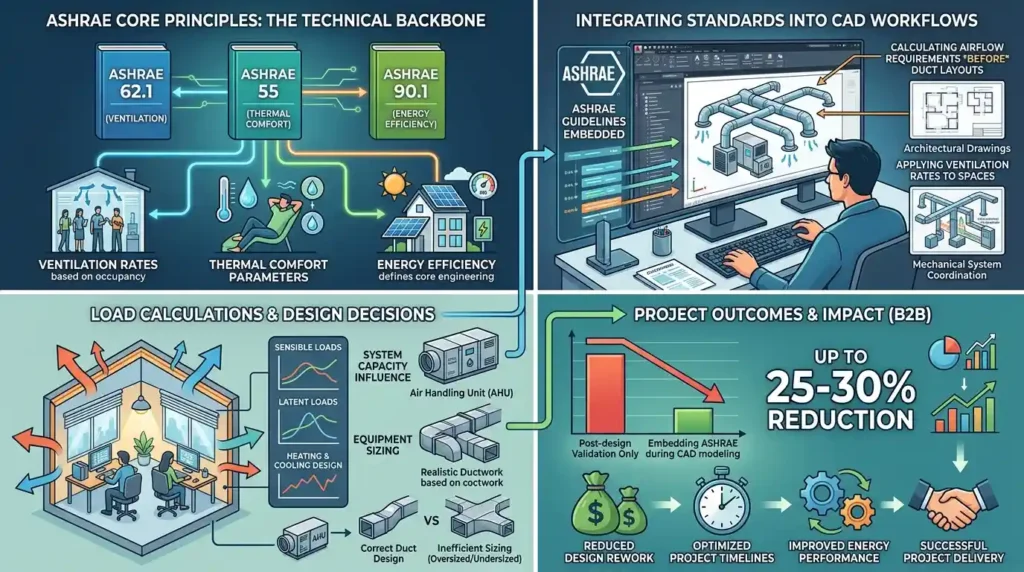
ASHRAE standards play a central role because they define the core engineering principles for ventilation, thermal comfort, and energy efficiency, which directly influence HVAC system design decisions in AutoCAD. Training uses these standards to shape load calculations, airflow distribution, and mechanical system coordination across architectural drawings.
ASHRAE standards function as the technical backbone of HVAC engineering. They are not optional references but mandatory frameworks in most international projects.
In AutoCAD HVAC training, ASHRAE 62.1 is used to determine ventilation rates based on occupancy and space type. ASHRAE 55 guides temperature and humidity comfort parameters, which influence system capacity design.
These standards also affect equipment sizing. For example, incorrect interpretation of ASHRAE guidelines leads to oversizing or undersizing of ductwork, which impacts energy consumption and system efficiency.
From a training perspective, learners are taught how to embed ASHRAE logic into AutoCAD workflows. This includes calculating airflow requirements before drawing duct layouts and ensuring that system balancing aligns with standard thresholds.
In B2B environments, this directly impacts project outcomes. Organisations report up to 25–30% reduction in design rework when ASHRAE principles are correctly embedded during CAD modelling rather than post-design validation.
For structured technical learning pathways, decision-stage evaluation is often supported by programmes such as the analysis here:
Does Imperial’s HVAC Programme Teach International Drawing Standards? This helps organisations assess whether training aligns with compliance-driven design requirements.
How does BS EN influence technical accuracy in HVAC drafting and documentation?
BS EN standards influence HVAC drafting by establishing European-aligned rules for mechanical system documentation, symbol usage, and technical presentation. In AutoCAD training, these standards ensure drawings remain consistent, interoperable, and compliant with international engineering communication expectations across multi-disciplinary project environments.
BS EN standards are essential in projects involving European stakeholders or multinational engineering teams. Unlike ASHRAE, which focuses heavily on performance criteria, BS EN standards are more documentation-centric.
In AutoCAD HVAC training, BS EN guidelines define how mechanical symbols are represented, how notes are structured, and how system hierarchies are documented in drawings.
This ensures that a duct system drawn in one region can be interpreted accurately in another without ambiguity. It also reduces coordination errors between mechanical, electrical, and architectural teams.
A key application is in cross-border project execution. When multiple consultants contribute to a single BIM or CAD environment, BS EN compliance ensures uniform interpretation of design intent.
Training also covers revision control practices aligned with BS EN expectations. This includes proper versioning, annotation updates, and change tracking within AutoCAD files.
The impact is measurable in project delivery efficiency. Organisations using BS EN-aligned drafting frameworks report fewer coordination clashes and faster approval cycles during design reviews.
How do training programmes convert international standards into practical AutoCAD workflows?
Training programmes convert international standards into AutoCAD workflows by embedding ASHRAE and BS EN rules into step-by-step drafting exercises, project simulations, and system design tasks. Learner’s practise translating theoretical compliance requirements into real HVAC layouts, ensuring technical accuracy and operational readiness for construction documentation.
The transition from theory to practice is the most critical phase in HVAC training. Many professionals understand standards conceptually but fail to implement them in CAD environments.
Structured programmes address this gap through workflow-based learning. Instead of teaching ASHRAE and BS EN as isolated topics, they are embedded into design tasks such as duct routing, load estimation, and equipment placement.
For example, a trainee may be given a commercial building layout and required to design a ventilation system that complies with ASHRAE airflow requirements while documenting it according to BS EN standards.
This approach ensures that compliance is not memorised but applied repeatedly until it becomes procedural knowledge.
In advanced training structures such as the:
AutoCAD HVAC and Plumbing Design Training Course, learners progress from basic drafting to full system design execution. The course integrates international standards into each module, ensuring that compliance is part of the design logic rather than an external checklist.
How do organisations evaluate HVAC training effectiveness for compliance and performance?

Organisations evaluate HVAC training effectiveness by measuring compliance accuracy, reduction in design errors, project delivery speed, and adherence to ASHRAE and BS EN standards in real-world AutoCAD outputs. Performance is assessed through post-training CAD audits, workflow efficiency, and coordination success across engineering teams.
Evaluation in HVAC training is increasingly data-driven. Companies no longer assess training based on completion rates but on measurable project outcomes.
One key metric is compliance accuracy. This measures how often designs align with ASHRAE and BS EN requirements without requiring revision.
Another metric is design efficiency. Organisations track how quickly trained engineers produce ready-to-submit CAD drawings compared to untrained staff.
A third metric is coordination performance. HVAC systems must integrate with architectural and electrical designs. Training effectiveness is measured by reduction in inter-disciplinary clashes.
In B2B environments, these metrics directly influence project profitability. A 15–20% improvement in drafting efficiency can significantly reduce consultancy costs in large-scale construction projects.
Organisations also conduct CAD audits. These involve reviewing sample drawings for standard compliance, layer consistency, and annotation accuracy.
Training programmes that include real-world simulation exercises tend to outperform theory-heavy models in these evaluations.
How does AutoCAD HVAC training support long-term workforce capability in engineering teams?
AutoCAD HVAC training strengthens workforce capability by developing engineers who can independently interpret international standards, apply them in CAD environments, and deliver compliant HVAC designs consistently. This improves organisational scalability, reduces dependency on senior engineers, and enhances project execution reliability.
Workforce capability in HVAC engineering is defined by autonomy and consistency. Engineers must be able to interpret standards without supervision and apply them directly in design environments.
AutoCAD HVAC training builds this capability by combining technical drafting with regulatory interpretation. Over time, engineers develop pattern recognition for compliance requirements.
This reduces dependency on senior design reviewers. Teams become more self-sufficient, which improves project turnaround time.
Discover More from Our Guide Library:
How Are VRF Refrigerant Pipe Layouts Drawn and Annotated in AutoCAD Training?
How Does AutoCAD HVAC Training Prepare Draughtsmen for Senior Design Roles?
It also supports scalability. Organisations can expand project volume without proportionally increasing senior engineering staff.
From a strategic perspective, this capability becomes a competitive advantage. Firms with standardised HVAC training frameworks deliver more predictable project outcomes and experience fewer compliance-related delays.
Training programmes aligned with international standards ensure that workforce skills remain transferable across regions, projects, and regulatory environments.
Frequently Asked Questions
Why are ASHRAE standards important in AutoCAD HVAC design training?
ASHRAE standards define ventilation rates, thermal comfort, and energy efficiency requirements used in HVAC design. In the AutoCAD HVAC and Plumbing Design Training Course, these standards guide load calculations and airflow distribution to ensure compliant and efficient system layouts.
How are BS EN standards applied in HVAC and plumbing AutoCAD drawings?
BS EN standards ensure consistency in mechanical symbols, drawing conventions, and documentation structure. Imperial Corporate Training Institute teaches learners to apply these standards in AutoCAD drawings for clear, internationally aligned HVAC and plumbing designs.
What skills are developed in AutoCAD HVAC and Plumbing Design Training Course?
The course develops HVAC drafting, plumbing system design, duct routing, and CAD documentation skills. Learners also gain the ability to interpret international standards such as ASHRAE and BS EN in practical AutoCAD project workflows.
Who should take AutoCAD HVAC and Plumbing Design Training Course?
This course is suitable for HVAC engineers, mechanical designers, draftsmen, and construction professionals working with building services design. It helps professionals improve AutoCAD proficiency while applying international HVAC and plumbing design standards in real projects.