

International drawing standards provide a structured framework for creating, reviewing, and maintaining HVAC drawings in AutoCAD. These standards establish consistent rules for symbols, dimensions, documentation, equipment representation, ductwork layouts, pipework systems, and technical communication. In corporate environments, they support collaboration between engineering teams, contractors, consultants, facility managers, and regulatory authorities.
For organisations managing construction, manufacturing, healthcare, commercial real estate, and infrastructure projects, standardised HVAC drawings reduce design errors, improve project coordination, and accelerate approval processes. As projects increasingly involve multinational teams and outsourced engineering services, compliance with recognised standards has become a workforce capability requirement rather than a purely technical preference.
Why do international drawing standards matter in AutoCAD HVAC projects?
International drawing standards create consistency, improve communication among stakeholders, reduce design rework, support regulatory compliance, and enable engineering teams to deliver HVAC projects with predictable quality, accurate documentation, and measurable operational efficiency.
Large construction projects involve multiple disciplines. Mechanical engineers, electrical engineers, architects, structural consultants, contractors, and commissioning teams all interact with the same project documentation. Standardised drawings ensure every stakeholder interprets technical information in the same way.
Without standardisation, organisations experience documentation inconsistencies, conflicting design interpretations, duplicated work, and increased project costs. Research across engineering and construction environments shows that design coordination issues account for a significant percentage of project delays and change orders.
From a workforce development perspective, organisations increasingly assess technical employees on their ability to produce drawings that align with recognised international standards. This competency improves collaboration across geographically distributed teams and supports global project delivery models.
What international standards influence AutoCAD HVAC design work?
AutoCAD HVAC design work is influenced by standards from ASHRAE, BS EN, ISO, CIBSE, SMACNA, and local building regulations that govern documentation practices, engineering calculations, drafting conventions, and system performance requirements.
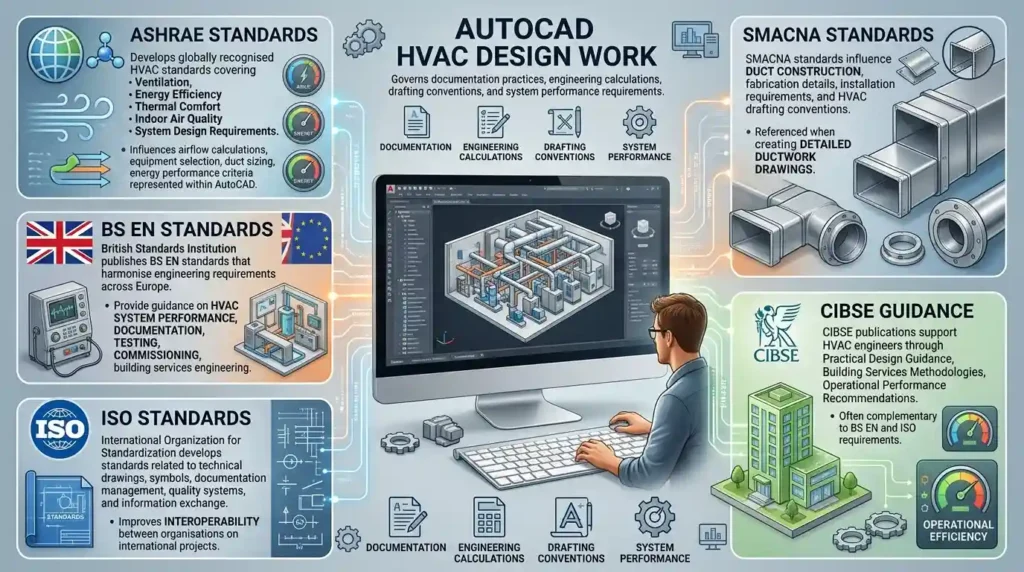
Several standards affect HVAC drawing production and engineering documentation.
ASHRAE standards
The ASHRAE develops globally recognised HVAC standards covering ventilation, energy efficiency, thermal comfort, indoor air quality, and system design requirements.
ASHRAE standards influence airflow calculations, equipment selection, duct sizing, ventilation rates, and energy performance criteria represented within AutoCAD drawings.
BS EN standards
British Standards Institution publishes BS EN standards that harmonise engineering requirements across Europe.
These standards provide guidance on HVAC system performance, documentation requirements, testing procedures, commissioning activities, and building services engineering practices.
ISO standards
The International Organization for Standardization develops standards related to technical drawings, symbols, documentation management, quality systems, and information exchange.
ISO standards improve interoperability between organisations working on international projects.
SMACNA standards
SMACNA standards influence duct construction, fabrication details, installation requirements, and HVAC drafting conventions.
Many engineering organisations reference SMACNA standards when creating detailed ductwork drawings.
CIBSE guidance
CIBSE publications support HVAC engineers through practical design guidance, building services methodologies, and operational performance recommendations.
These resources often complement BS EN and ISO requirements.
How do these standards affect HVAC drawing production?
International standards define how HVAC systems are represented, documented, dimensioned, coordinated, reviewed, and communicated throughout the project lifecycle from conceptual design through commissioning and facility operation.
Drawing production follows a structured workflow.
The first stage involves project planning and design criteria development. Engineers establish applicable standards, client requirements, building regulations, and project specifications.
The second stage focuses on system design. HVAC engineers calculate cooling loads, heating loads, ventilation requirements, equipment capacities, and airflow distribution.
The third stage involves technical drafting. Engineers create floor plans, sections, schematics, equipment schedules, riser diagrams, and coordination drawings using approved symbols and documentation conventions.
The fourth stage includes interdisciplinary coordination. Mechanical drawings are reviewed alongside architectural, structural, electrical, and plumbing documentation.
The final stage consists of quality assurance, revision control, approval processes, and construction documentation issuance.
Each stage relies on standardised documentation practices that reduce ambiguity and support efficient project delivery.
What drawing elements are standardised in HVAC documentation?
International standards standardise symbols, line types, equipment schedules, ductwork representations, pipework layouts, annotations, dimensions, revision records, title blocks, and technical references used throughout HVAC drawings.
Consistency in technical drawings depends on standardised visual communication.
Symbols and equipment representation
HVAC drawings use recognised symbols for components such as:
- Air handling units
- Fan coil units
- Chillers
- Boilers
- Pumps
- Diffusers
- Dampers
- Exhaust fans
- Control devices
Standard symbols improve interpretation across multidisciplinary teams.
Layer management
AutoCAD layer structures support organised documentation.
Typical layer categories include:
- Ductwork
- Pipework
- Equipment
- Architectural references
- Electrical services
- Annotations
- Dimensions
Structured layer management improves collaboration and revision control.
Annotation standards
Annotation requirements define:
- Text sizes
- Font styles
- Drawing scales
- Dimension formats
- Equipment labels
- Reference notes
Consistent annotations improve readability and reduce interpretation errors.
Documentation control
Standards also govern:
- Revision numbering
- Drawing issue status
- Approval signatures
- Change tracking
- Document naming conventions
These controls support project governance and quality assurance processes.
How do organisations implement standard-compliant HVAC drafting practices?
Organisations implement standard-compliant HVAC drafting through competency frameworks, technical training programmes, quality assurance procedures, documented workflows, and performance measurement systems aligned with project requirements.
Implementation begins with workforce capability assessment.
Engineering managers identify skill gaps related to drafting standards, HVAC design principles, documentation control, and interdisciplinary coordination.
Training programmes typically combine multiple learning methods:
- Instructor-led workshops
- Online learning modules
- Practical design exercises
- CAD simulations
- Technical assessments
- Project-based assignments
Learning activities focus on real engineering scenarios rather than theoretical concepts alone.
Quality assurance teams then establish review procedures. Drawings undergo technical verification before project release.
Performance indicators often include:
- Drawing error rates
- Revision frequency
- Approval cycle times
- Coordination issue counts
- Design rework percentages
- Project delivery accuracy
These metrics allow organisations to measure the effectiveness of technical capability development initiatives.
When organisations begin evaluating how technical development programmes address recognised engineering requirements, understanding how international engineering frameworks are incorporated into structured learning becomes important.
This transition from awareness to implementation is explored in:
How Does AutoCAD HVAC Training Cover International Standards Like ASHRAE and BS EN?
For more information, enrol in:
AutoCAD HVAC and Plumbing Design Training Course.
What skills are required to apply international standards in AutoCAD HVAC work?

Applying international standards requires technical drafting expertise, HVAC engineering knowledge, document control skills, coordination capabilities, quality assurance awareness, and proficiency with industry-standard software platforms.
Technical competency extends beyond software operation.
Employees must understand HVAC engineering principles including:
- Air distribution systems
- Ventilation design
- Heating systems
- Cooling technologies
- Hydronic networks
- Energy efficiency requirements
They must also understand documentation frameworks that govern engineering communication.
In corporate learning environments, skill development commonly follows a progression model.
Level 1 focuses on drafting fundamentals.
Level 2 develops HVAC system knowledge.
Level 3 introduces standard compliance requirements.
Level 4 applies standards to multidisciplinary projects.
Level 5 focuses on quality assurance and project leadership responsibilities.
This structured approach improves knowledge retention and workplace application.
What business outcomes result from standardised HVAC design practices?
Standardised HVAC design practices improve project consistency, reduce design errors, shorten approval timelines, strengthen quality management, increase productivity, and support scalable engineering operations across multiple projects and locations.
Business value appears in several measurable areas.
Improved productivity
Engineering teams spend less time correcting documentation inconsistencies.
Standard templates, symbols, and workflows accelerate drawing production activities.
Many organisations track productivity improvements through drawing completion rates and project delivery timelines.
Reduced rework
Design rework consumes engineering resources and project budgets.
Standardised documentation reduces coordination conflicts and technical misunderstandings.
Lower rework rates improve operational efficiency.
Stronger quality assurance
Consistent standards simplify review processes.
Quality teams can verify compliance more efficiently because documentation follows predictable structures.
Better cross-functional collaboration
Large projects require coordination between departments such as facilities management, engineering, procurement, operations, and construction management.
Standardised documentation creates a common technical language across these functions.
Enhanced scalability
Organisations operating across regions benefit from unified documentation standards.
Engineering teams can collaborate on projects regardless of location because drawing conventions remain consistent.
What common misconceptions affect HVAC drafting standards adoption?
Many organisations incorrectly assume standards limit creativity, apply only to large projects, focus solely on compliance, or eliminate the need for technical judgement and engineering expertise.
One misconception is that standards reduce engineering flexibility.
In practice, standards provide a framework for communication while allowing engineers to design solutions appropriate to project requirements.
Another misconception is that standards only matter for multinational projects.
Even local projects involve multiple stakeholders who benefit from consistent documentation.
A third misconception is that software automatically ensures compliance.
AutoCAD provides drafting capabilities, but compliance depends on user knowledge, organisational procedures, and quality assurance processes.
Some organisations also treat standards as documentation requirements rather than workforce capabilities.
Successful implementation depends on employee knowledge, structured learning pathways, and continuous competency development.
How does workforce development support international HVAC drafting standards?
Workforce development transforms international standards from static documents into operational capabilities by combining technical education, practical application, assessment frameworks, and performance measurement systems.
Engineering standards evolve continuously.
New technologies, sustainability requirements, digital construction methods, and building performance expectations introduce updated requirements into industry practice.
Organisations address this challenge through ongoing professional development.
Training programmes frequently combine:
- Classroom instruction
- Virtual learning
- Practical design exercises
- Case-based learning
- Simulation activities
- Competency assessments
This blended approach improves knowledge transfer and workplace application.
Discover More from Our Guide Library:
How Does AutoCAD HVAC Training Cover Refrigerant Pipe Design for VRF Systems?
What Are the Career Steps From AutoCAD Draughtsman to Senior MEP Designer?
From an organisational perspective, workforce development supports operational excellence, technical consistency, innovation, and long-term capability building. Teams equipped with standard-compliant drafting skills contribute to more efficient project execution, improved quality outcomes, and stronger collaboration across engineering disciplines.
International drawing standards therefore represent more than technical documentation requirements. They establish a foundation for effective HVAC design communication, organisational consistency, project governance, and workforce capability development within modern engineering environments.
Frequently Asked Questions
How does AutoCAD HVAC training help in understanding international standards?
The AutoCAD HVAC and Plumbing Design Training Course at Imperial Corporate Training Institute integrates standards such as ASHRAE, BS EN, and ISO into design workflows. Learners understand how these standards influence HVAC drawings, symbols, and documentation in engineering projects.
Who should take AutoCAD HVAC and Plumbing Design Training Course?
This course is designed for HVAC engineers, mechanical designers, CAD technicians, and fresh graduates in building services engineering. It is also suitable for professionals in construction, MEP consultancy, and facility management sectors.
What skills are developed in AutoCAD HVAC and Plumbing training?
The AutoCAD HVAC and Plumbing Design Training Course at Imperial Corporate Training Institute develops skills in HVAC system drafting, plumbing design layouts, AutoCAD tools, and technical documentation. It also strengthens understanding of coordination between mechanical and architectural drawings.
Why is AutoCAD important for HVAC and plumbing design work?
AutoCAD is widely used in HVAC and plumbing design because it enables precise drafting, standardised documentation, and efficient project coordination. The AutoCAD HVAC and Plumbing Design Training Course at Imperial Corporate Training Institute helps professionals produce accurate, industry-compliant engineering drawings.