

Organisations across industries such as construction, real estate development, facilities management, manufacturing, and engineering depend on accurate HVAC design documentation to support project delivery, compliance, budgeting, and operational efficiency. AutoCAD HVAC training develops the technical capability required to create, interpret, and manage heating, ventilation, and air conditioning drawings across different building types.
The distinction between residential and commercial HVAC projects creates a significant workforce development challenge. Residential projects focus on smaller systems, simplified layouts, and limited occupancy requirements. Commercial projects involve larger mechanical systems, complex zoning strategies, higher regulatory obligations, and coordination with multiple disciplines. AutoCAD HVAC and Plumbing Design Training Course programmes address these differences through structured learning that reflects real-world project environments and measurable business requirements.
What Is AutoCAD HVAC Training and Why Does the Residential–Commercial Difference Matter?
AutoCAD HVAC training teaches professionals how to create, modify, coordinate, and document HVAC systems using computer-aided design tools while addressing the distinct technical, operational, and compliance requirements found in residential and commercial building projects.
AutoCAD HVAC training is a technical learning programme focused on HVAC drafting, system layout development, equipment placement, duct routing, ventilation planning, and construction documentation.
In workplace environments, HVAC drawings function as communication tools between engineers, architects, contractors, project managers, procurement teams, and maintenance departments. Accurate drawings reduce design errors, support compliance, improve project coordination, and minimise rework costs.
The residential and commercial distinction matters because both project types require different design methodologies.
Residential projects typically involve:
- Single-family homes
- Villas
- Apartments
- Small residential developments
Commercial projects typically involve:
- Office buildings
- Hospitals
- Educational facilities
- Hotels
- Shopping centres
Each environment requires different HVAC calculations, equipment selection criteria, duct sizing approaches, and documentation standards.
How Do Residential HVAC Projects Shape Training Requirements?
Residential HVAC training focuses on simplified system design, standard duct layouts, basic load calculations, equipment placement, and practical drafting techniques used in houses, apartments, and small residential developments.
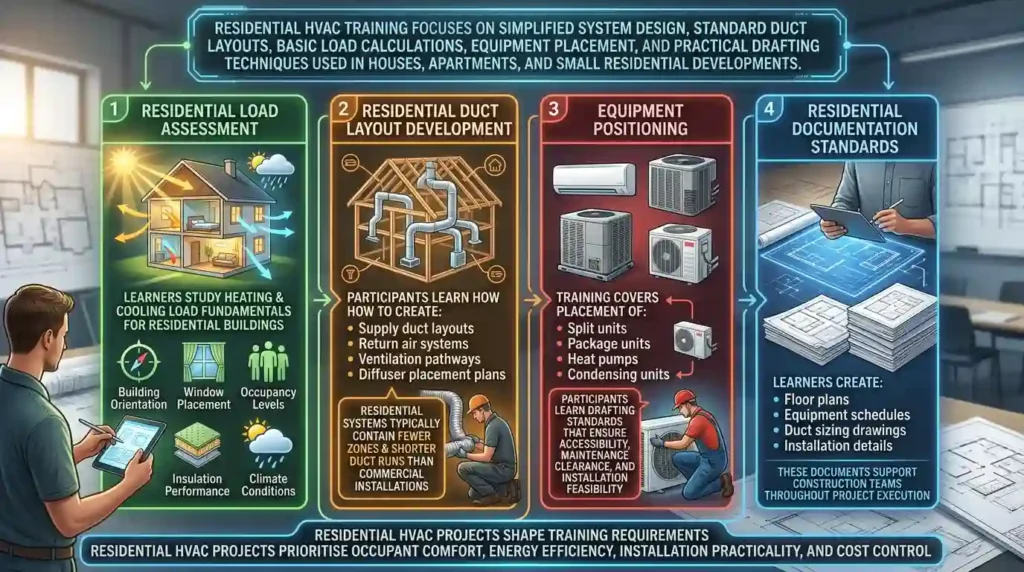
Residential HVAC projects prioritise occupant comfort, energy efficiency, installation practicality, and cost control.
Training modules commonly introduce participants to:
Residential Load Assessment
Learners study heating and cooling load fundamentals for residential buildings.
Factors include:
- Building orientation
- Window placement
- Occupancy levels
- Insulation performance
- Climate conditions
Residential Duct Layout Development
Participants learn how to create:
- Supply duct layouts
- Return air systems
- Ventilation pathways
- Diffuser placement plans
Residential systems typically contain fewer zones and shorter duct runs than commercial installations.
Equipment Positioning
Training covers placement of:
- Split units
- Package units
- Heat pumps
- Condensing units
Participants learn drafting standards that ensure accessibility, maintenance clearance, and installation feasibility.
Residential Documentation Standards
Learners create:
- Floor plans
- Equipment schedules
- Duct sizing drawings
- Installation details
These documents support construction teams throughout project execution.
How Do Commercial HVAC Projects Change the Learning Process?
Commercial HVAC training introduces larger systems, advanced coordination requirements, multiple occupancy zones, complex airflow strategies, and regulatory compliance standards that demand higher levels of technical drafting and design accuracy.
Commercial projects involve significantly greater design complexity.
Buildings often contain hundreds or thousands of occupants with varying environmental requirements.
Multi-Zone HVAC Systems
Commercial training addresses zoning strategies for spaces such as:
- Conference rooms
- Offices
- Laboratories
- Retail units
- Healthcare facilities
Participants learn how separate HVAC zones operate independently while remaining integrated within the overall building system.
Large-Scale Air Distribution
Commercial environments require detailed understanding of:
- Main ducts
- Branch ducts
- Air handling units
- Variable air volume systems
- Exhaust systems
Training includes detailed drafting procedures for large-scale airflow distribution networks.
Mechanical Coordination
Commercial HVAC systems must integrate with:
- Electrical systems
- Plumbing systems
- Fire protection systems
- Structural components
Coordination skills become a major learning objective because design clashes create delays, cost overruns, and construction conflicts.
Compliance and Standards
Commercial projects must satisfy stricter regulations related to:
- Ventilation
- Fire safety
- Indoor air quality
- Accessibility
- Energy efficiency
Training therefore includes documentation standards required for approvals and inspections.
How Is AutoCAD HVAC Training Delivered in Corporate Learning Environments?
Organisations implement AutoCAD HVAC training through structured learning pathways that combine technical instruction, practical drafting exercises, simulations, assessments, and project-based learning aligned with workplace performance objectives.
Corporate training programmes are designed to address specific capability gaps.
Learning pathways often begin with skills assessments that identify current drafting proficiency levels.
Instructor-Led Workshops
Workshop sessions focus on:
- AutoCAD tools
- HVAC drafting workflows
- Industry standards
- Project documentation
Participants complete guided exercises using realistic project examples.
Online Learning Modules
Digital learning components support flexible workforce development.
Modules often include:
- Video demonstrations
- Interactive exercises
- Knowledge assessments
- Software practice activities
Simulation-Based Training
Simulated projects allow participants to apply technical knowledge within realistic project scenarios.
Examples include:
- Residential villa HVAC design
- Commercial office floor planning
- Retail building ventilation layouts
Competency Assessments
Organisations measure learning outcomes through:
- Drawing accuracy scores
- Project completion rates
- Technical knowledge tests
- Drafting productivity metrics
Assessment results provide measurable evidence of skill development.
What Skills Are Developed Differently for Residential and Commercial Projects?
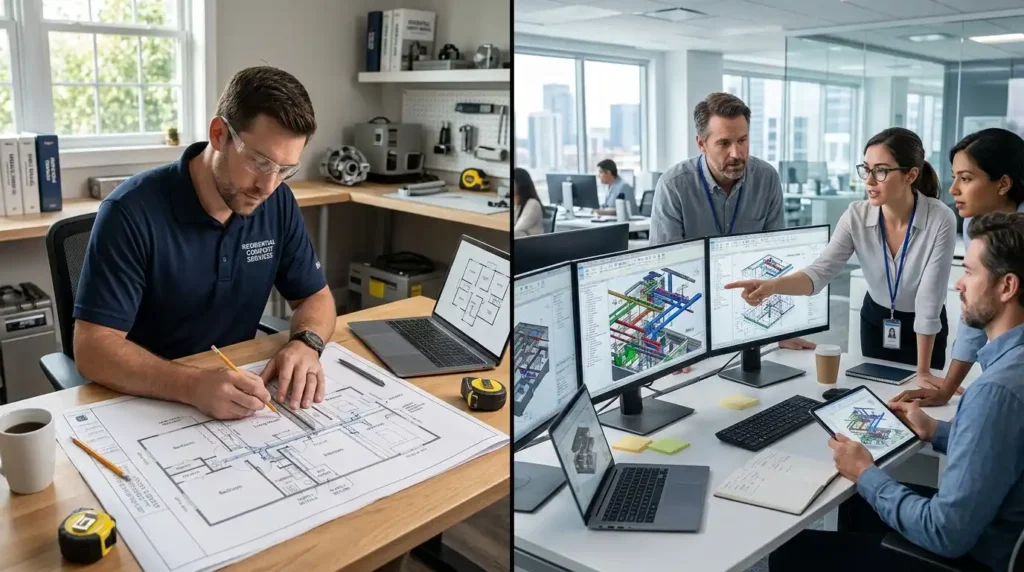
Residential and commercial HVAC projects require different technical competencies, drawing standards, coordination methods, and problem-solving approaches that influence how training programmes are structured and delivered.
Although core AutoCAD functionality remains consistent, project requirements vary substantially.
Residential Skill Development
Residential-focused training develops:
- Basic HVAC drafting
- Equipment scheduling
- Duct routing
- Residential load understanding
- Installation drawing preparation
Project scope remains relatively contained.
Commercial Skill Development
Commercial-focused training develops:
- System coordination
- Complex airflow planning
- Mechanical room layouts
- Multi-floor documentation
- Advanced annotation standards
Participants work with larger drawing sets and more complex project data.
Cross-Functional Collaboration Skills
Commercial projects require extensive interaction between departments.
Training therefore introduces collaboration practices involving:
- Architects
- Mechanical engineers
- Electrical engineers
- Construction managers
- Facilities teams
These competencies improve project coordination and communication efficiency.
What Components Are Included in an AutoCAD HVAC and Plumbing Design Training Course?
Comprehensive training programmes combine software skills, HVAC design principles, plumbing coordination, documentation standards, project workflows, and quality control processes required for modern building projects.
Training extends beyond software operation.
Participants learn how design decisions influence project outcomes.
AutoCAD Fundamentals
Core modules include:
- Drawing creation
- Layer management
- Blocks and symbols
- Annotation techniques
- Sheet setup
HVAC Drafting Practices
Participants develop skills in:
- Duct design
- Equipment layouts
- Airflow planning
- Ventilation documentation
Plumbing Coordination
Integrated building services require HVAC and plumbing systems to coexist efficiently.
Training addresses:
- Pipe routing
- Equipment coordination
- Space allocation
- Construction documentation
Quality Assurance Processes
Drawing quality directly affects project success.
Learners study:
- Error detection
- Revision management
- Drawing review procedures
- Documentation control
These practices support organisational quality objectives.
How Do Organisations Measure the Impact of HVAC Drafting Training?
Training effectiveness is measured through productivity indicators, drawing accuracy metrics, project efficiency improvements, reduced rework levels, and enhanced coordination performance across project teams.
Training investment requires measurable business outcomes.
Organisations frequently track performance indicators before and after programme completion.
Productivity KPIs
Common metrics include:
- Drawings completed per week
- Revision cycle reductions
- Documentation turnaround times
- Project delivery speed
Quality KPIs
Quality indicators often include:
- Drafting error rates
- Design clash frequency
- Compliance issues identified
- Rework percentages
Operational KPIs
Operational performance measurements include:
- Project schedule adherence
- Team collaboration efficiency
- Resource utilisation rates
- Client approval turnaround times
These metrics demonstrate organisational value generated through workforce development.
What Common Misconceptions Affect HVAC Training Decisions?
Many organisations assume software proficiency alone creates HVAC drafting competence, yet effective performance depends on design understanding, system coordination knowledge, documentation standards, and project-specific application skills.
Several misconceptions reduce training effectiveness.
Misconception 1: AutoCAD Skills Equal HVAC Expertise
AutoCAD is a drafting platform.
HVAC expertise includes:
- Airflow concepts
- System design principles
- Equipment applications
- Building services coordination
Training must address both technical domains.
Misconception 2: Residential and Commercial Skills Are Identical
Both environments share drafting fundamentals.
However, commercial projects introduce substantially greater complexity, coordination requirements, and compliance obligations.
Misconception 3: Generic Training Delivers Consistent ROI
Training aligned with organisational project requirements produces stronger performance outcomes.
Project-specific learning activities improve knowledge transfer and workplace application.
Misconception 4: Learning Ends After Course Completion
Skill retention depends on continuous practice, project application, and performance feedback.
Organisations achieve stronger outcomes when learning is integrated into ongoing development strategies.
How Are Residential and Commercial HVAC Drawing Requirements Covered in Training?
Training programmes address residential and commercial drawing requirements through progressive learning stages that build technical competence, project understanding, and documentation accuracy across increasingly complex design environments.
Training often begins with residential projects because they introduce fundamental drafting concepts in a manageable format.
Commercial projects are introduced after learners demonstrate proficiency in core workflows.
The progression typically follows:
- Basic HVAC drafting principles
- Residential system layouts
- Equipment documentation
- Multi-zone planning
- Commercial coordination workflows
- Compliance-focused documentation
- Integrated building services projects
At this stage, readers evaluating implementation approaches often seek deeper understanding of how residential and commercial documentation standards are addressed within structured learning programmes.
For a detailed examination of this topic, see:
How are residential and commercial HVAC drawing requirements covered in training?
This awareness-to-evaluation transition helps decision-makers compare training structures, curriculum coverage, and organisational learning outcomes before selecting an appropriate development pathway.
What Organisational Benefits Result from Understanding Both Project Types?
Teams trained in both residential and commercial HVAC drafting demonstrate broader project flexibility, stronger resource allocation capability, improved collaboration efficiency, and enhanced operational resilience across diverse project portfolios.
Businesses increasingly manage mixed project pipelines.
Engineering consultancies, contractors, property developers, and facilities management companies often work across multiple building categories.
Training that covers both residential and commercial environments creates workforce versatility.
Benefits include:
- Improved project assignment flexibility
- Reduced dependency on specialist resources
- Faster onboarding into new projects
- Better cross-functional collaboration
- Greater documentation consistency
These outcomes support long-term workforce capability development and organisational performance objectives.
Discover More from Our Guide Library:
What Is a Design Basis Report and How Does HVAC AutoCAD Work Support It?
How Is Underfloor Heating System Design Represented in AutoCAD Drawings?
Understanding how AutoCAD HVAC training differs between residential and commercial projects allows organisations to align learning initiatives with operational requirements, project complexity levels, and measurable business outcomes. Training becomes a structured capability-building process rather than a software education exercise, producing practical skills that support quality, efficiency, and project delivery performance across diverse built environments.
Frequently Asked Questions
What is covered in an AutoCAD HVAC and Plumbing Design Training Course?
The AutoCAD HVAC and Plumbing Design Training Course covers HVAC drafting, plumbing layouts, duct design, piping systems, equipment placement, and construction documentation. Imperial Corporate Training Institute includes practical drawing exercises aligned with industry design standards and project requirements.
Who should attend an AutoCAD HVAC and Plumbing Design Training Course?
This course is suitable for HVAC engineers, mechanical engineers, CAD technicians, designers, and building services professionals. Imperial Corporate Training Institute structures the training to support both new learners and experienced professionals seeking advanced drafting skills.
How does AutoCAD HVAC training support commercial and residential projects?
The AutoCAD HVAC and Plumbing Design Training Course covers drafting techniques for both residential and commercial buildings. Participants learn how system layouts, equipment schedules, ventilation requirements, and documentation standards differ between project types.
What skills can participants gain from an AutoCAD HVAC and Plumbing Design Training Course?
Participants develop skills in HVAC drafting, plumbing design coordination, duct routing, piping layouts, drawing annotation, and project documentation. Imperial Corporate Training Institute focuses on practical applications that support workplace performance and project delivery efficiency.