

The AutoCAD HVAC and Plumbing Design Training Course at Imperial Corporate Training Institute is a structured corporate learning programme designed to standardise HVAC and plumbing drawing practices, with a strong focus on disciplined layer management, documentation control, and MEP coordination accuracy for real engineering environments.
In most engineering teams, inconsistent layer usage leads to design conflicts, delayed approvals, and errors during coordination with other disciplines. This course solves that issue by enforcing structured CAD standards across HVAC ducting, plumbing systems, and mechanical layouts.
The programme builds a controlled drawing environment where every layer has a defined purpose, naming logic, and documentation rule. Participants learn how structured layer systems directly improve project delivery speed and reduce revision cycles.
For early-stage understanding of why layer discipline matters in HVAC workflows, refer to the resource here:
Why Is Proper Layer Management Critical in AutoCAD HVAC Drawings?
Imperial Corporate Training Institute integrates these principles into every training module to ensure learners transition from general AutoCAD users into structured MEP drafting professionals.
Why is Imperial’s HVAC programme structured around layer discipline and CAD standardisation for corporate MEP projects?
The structure of Imperial’s HVAC programme is designed around progressive skill development, starting from AutoCAD fundamentals and advancing into HVAC, plumbing, coordination, and BIM integration, ensuring learners build consistent layer management habits aligned with corporate engineering standards and multi-disciplinary project environments.
Imperial Corporate Training Institute structures this programme to reflect real project workflows used in construction and engineering firms. Layer management is not taught as a separate concept but embedded into every drafting stage.
The logic is simple. HVAC and plumbing systems do not exist in isolation. They must coordinate with electrical systems, structural drawings, and architectural layouts. Without strict layer control, coordination becomes inconsistent and error-prone.
Each module reinforces disciplined CAD behaviour. Learners repeatedly apply naming conventions, colour standards, annotation rules, and layer grouping strategies while working on HVAC ducting, pipe networks, and equipment layouts.
This structure ensures that Imperial Corporate Training Institute does not only teach AutoCAD commands. It builds workplace-ready drafting habits that support engineering accuracy and project consistency.
What will participants learn in Imperial’s HVAC programme in terms of layer management, HVAC design, and plumbing coordination?
Participants of Imperial Corporate Training Institute’s AutoCAD HVAC and Plumbing Design Training Course develop practical competencies in HVAC duct design, plumbing system drafting, load calculations, CAD layer management, and MEP coordination workflows that directly support corporate engineering project delivery and technical documentation standards.
The learning outcomes are structured across progressive technical domains.
HVAC Design and Drafting Competence
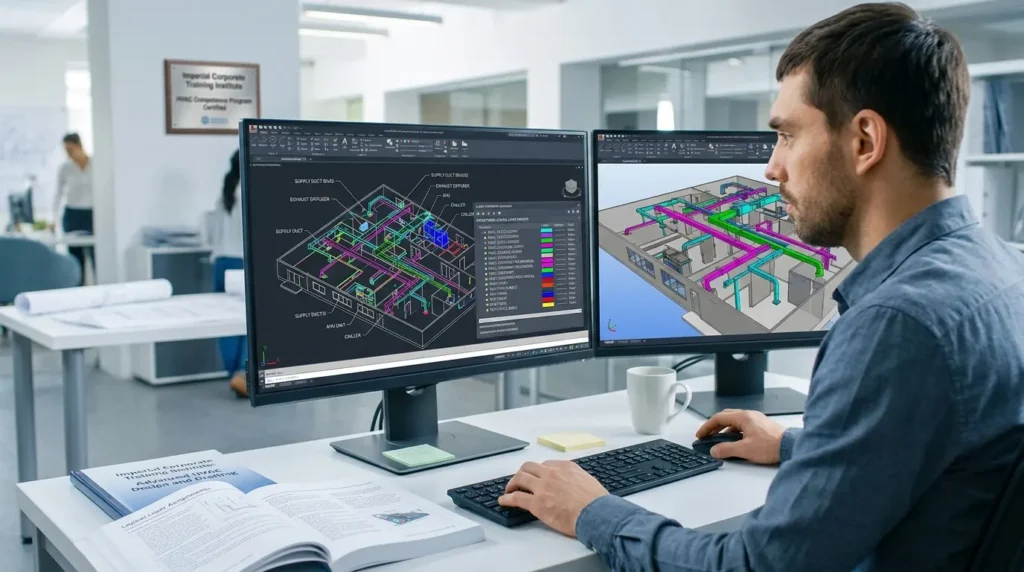
Learners understand HVAC system layouts used in commercial and industrial environments. They create duct routing systems, diffuser placements, and air distribution models using structured CAD layers. Imperial Corporate Training Institute ensures each HVAC element is assigned to a logical layer group for clarity and coordination.
Plumbing System Design Skills
Participants develop detailed plumbing layouts for cold water, hot water, and drainage systems. They work on riser diagrams, slope calculations, and pipe sizing. Layer discipline is applied to separate system types and avoid drawing conflicts.
Layer Management and CAD Standardisation
A core focus of Imperial Corporate Training Institute is disciplined layer architecture. Learners define layer naming conventions, colour standards, and visibility controls. This ensures drawings remain readable and scalable across project revisions.
MEP Coordination and Integration
Participants learn to coordinate HVAC and plumbing systems with architectural and structural drawings. External references (Xrefs) and structured layer groups are used to maintain alignment between disciplines.
Technical Documentation and Sheet Management
Learners produce structured drawing sets, including legends, schedules, and annotations. Imperial Corporate Training Institute trains participants to maintain consistent layer visibility for printing, review, and submission stages.
These outcomes ensure learners move from basic drafting knowledge to structured engineering documentation capability.
How does Imperial deliver HVAC training with real-world layer management application and CAD workflow simulation?
Imperial Corporate Training Institute delivers this programme through practical, project-based training sessions that simulate real corporate MEP workflows, ensuring participants apply HVAC and plumbing layer management standards directly within AutoCAD environments used in engineering firms and construction project teams.
The delivery format is structured around applied learning rather than theoretical instruction.
Training sessions are conducted through guided AutoCAD workshops where learners actively build HVAC duct systems and plumbing layouts using real engineering scenarios. Each task includes layer creation, assignment, and validation based on industry standards.
Imperial Corporate Training Institute incorporates live demonstration of corporate CAD standards, including template setup, title block configuration, and sheet organisation. Learners are required to maintain consistent layer discipline throughout each drawing cycle.
Hybrid learning formats may include instructor-led sessions combined with supervised practice tasks. This ensures that learners continuously apply structured layer logic while building design outputs.
Discover More from Our Guide Library:
Does Imperial’s AutoCAD HVAC Programme Include As-Built Drawing Techniques?
Does Imperial’s HVAC Course Teach Equipment Schedule Production in AutoCAD?
Assessment is conducted through practical evaluations. Participants are required to submit complete HVAC and plumbing drawing sets with correct layer organisation, annotation clarity, and coordination accuracy.
This ensures that Imperial Corporate Training Institute evaluates not only technical skills but also consistency in professional CAD behaviour.
What measurable results can be expected from Imperial’s HVAC programme in corporate engineering environments?
After completing Imperial Corporate Training Institute’s AutoCAD HVAC and Plumbing Design Training Course, participants demonstrate improved accuracy in HVAC and plumbing drafting, structured CAD layer management, faster project delivery timelines, reduced design errors, and enhanced capability to work within corporate MEP coordination frameworks and engineering documentation standards.
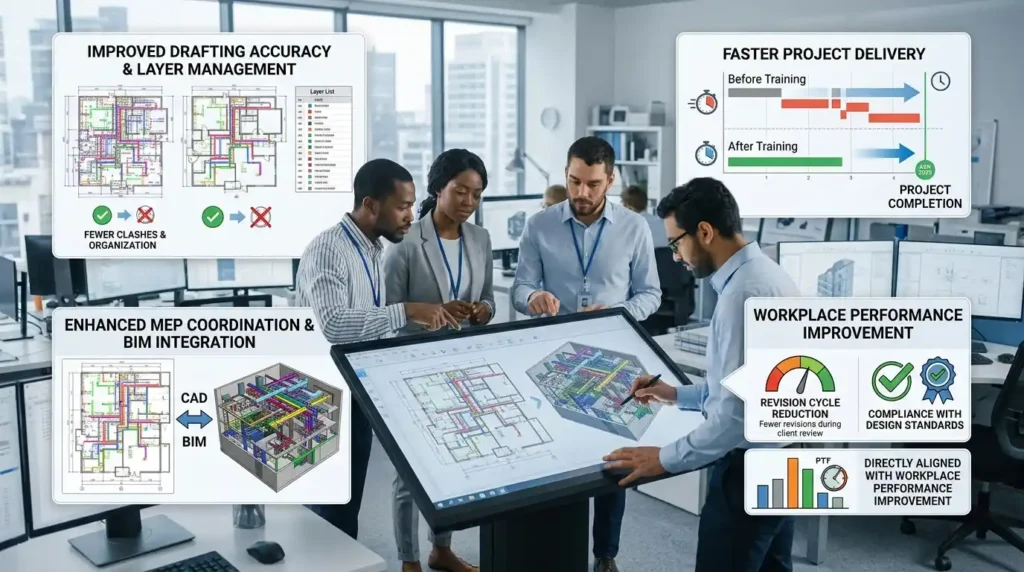
The results are directly aligned with workplace performance improvement.
Participants become capable of producing coordinated HVAC and plumbing drawings that align with multi-disciplinary project requirements. This reduces revision cycles during client review stages.
Layer management discipline improves drawing readability and reduces confusion in large-scale engineering documentation sets. Teams can isolate systems, manage revisions, and maintain clarity across multiple project versions.
Imperial Corporate Training Institute also prepares learners for integration into BIM-supported environments. This allows professionals to transition from isolated CAD drafting to collaborative engineering workflows.
In corporate environments, these skills improve project efficiency. Engineering teams experience fewer coordination delays, better documentation accuracy, and stronger compliance with design standards.
The programme is particularly valuable for HR departments and technical managers building structured skill pipelines for engineering teams and design departments.
How does enrollment in Imperial’s HVAC programme work and what is the learning pathway structure?
Enrollment at Imperial Corporate Training Institute for the AutoCAD HVAC and Plumbing Design Training Course follows a structured entry process designed for engineering professionals, draftsmen, and corporate teams seeking formal CAD skill development, with a clear progression from foundational AutoCAD understanding to advanced HVAC and plumbing system design competency.
Participants typically enter with basic AutoCAD knowledge or engineering drafting experience. The programme is structured to support gradual progression from interface familiarity to advanced system design.
Imperial Corporate Training Institute begins with foundational CAD workflow alignment. Learners are introduced to corporate standards, layer systems, and drawing setup procedures before advancing into HVAC and plumbing design modules.
As training progresses, participants move into advanced coordination, load calculation integration, and multi-disciplinary design workflows. Each stage reinforces layer management discipline as a continuous practice rather than a standalone topic.
The final stage focuses on corporate project simulation. Learners complete full HVAC and plumbing design packages with structured documentation, coordinated layers, and submission-ready drawing sets.
Completion leads to measurable readiness for engineering roles requiring structured CAD expertise and disciplined design workflows.
For detailed evaluation of course structure and learning design, refer to the resource:
How Does AutoCAD HVAC Training Teach Layer Standards for MEP Drawings?