

HVAC design projects depend on accurate, organised, and coordinated technical drawings. In modern construction environments, AutoCAD drawings contain thousands of design elements representing ductwork, piping systems, equipment layouts, architectural features, electrical systems, and structural components. Proper layer management provides the framework that keeps these elements organised, visible, and controllable throughout the project lifecycle.
For organisations managing building services projects, layer management directly influences design quality, project delivery speed, interdisciplinary coordination, and operational efficiency. Teams that follow structured layer standards reduce drafting errors, improve collaboration between departments, and maintain consistency across multiple projects. As organisations invest in workforce development through technical training programmes, understanding layer management becomes an essential competency within HVAC and MEP design environments.
What Is Proper Layer Management in AutoCAD HVAC Drawings?
Proper layer management is the structured organisation of drawing elements into predefined categories that control visibility, editing permissions, plotting standards, and coordination requirements, enabling HVAC teams to create accurate, scalable, and maintainable technical documentation throughout project execution.
Layer management is a drafting methodology used within AutoCAD to separate different types of information into distinct layers. Each layer contains specific drawing objects that share common characteristics.
For example, HVAC drawings typically include separate layers for:
- Supply air ducts
- Return air ducts
- Exhaust systems
- Chilled water piping
- Drainage systems
- HVAC equipment
- Annotations
- Dimensions
- Architectural references
Each layer receives a unique name, colour, line type, and plotting configuration.
From a business perspective, layer management functions as a quality control system. It establishes consistency across projects and ensures that multiple designers can work within the same drawing environment without creating confusion or duplication.
Organisations delivering large-scale projects such as hospitals, airports, commercial towers, and manufacturing facilities depend on layer standards to maintain drawing accuracy across hundreds of design files.
Why Do Organisations Need Layer Standards in HVAC Projects?
Organisations require layer standards because standardisation improves coordination, reduces design errors, accelerates project delivery, and creates consistent documentation across departments, teams, locations, and project phases while supporting quality assurance and regulatory compliance requirements.
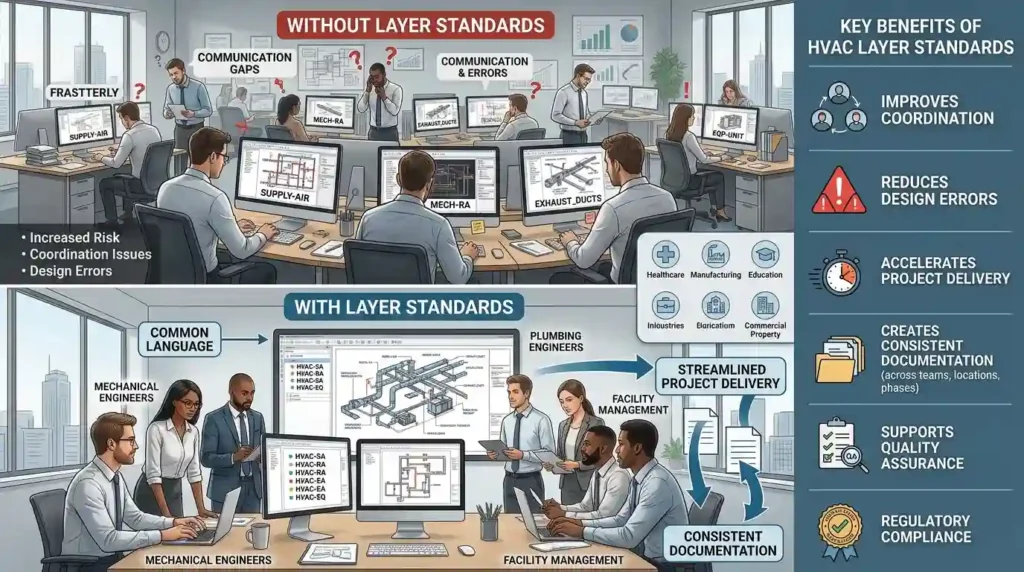
Large organisations rarely rely on a single designer. Multiple stakeholders contribute to HVAC projects.
These stakeholders include:
- Mechanical engineers
- HVAC designers
- Plumbing engineers
- Electrical engineers
- BIM coordinators
- Project managers
- Facility management teams
Without standardised layers, each designer may create different naming conventions and drawing structures. This inconsistency increases project risk.
Layer standards provide a common language.
For example, a company may establish the following standards:
- HVAC-SA for supply air systems
- HVAC-RA for return air systems
- HVAC-EA for exhaust air systems
- HVAC-EQ for equipment
When every team member follows identical standards, drawings remain understandable regardless of who created them.
This consistency becomes particularly valuable when organisations operate across multiple offices in industries like construction, healthcare, manufacturing, education, and commercial property development.
How Does Layer Management Work in Corporate HVAC Design Workflows?
Layer management works through a structured process involving standard creation, drawing setup, object allocation, visibility control, quality verification, and documentation management to ensure all project stakeholders work within a consistent and coordinated design environment.
The implementation process follows several stages.
Establishing Layer Standards
Engineering managers and CAD administrators define approved layer structures before project commencement.
These standards specify:
- Layer names
- Colour assignments
- Line weights
- Plot styles
- Layer descriptions
Standardisation eliminates subjective decisions during drafting.
Creating Template Files
Organisations develop drawing templates containing predefined layer structures.
Every project begins using the same template.
This approach reduces setup time and improves consistency.
Assigning Design Elements
Designers place each object onto its designated layer.
Examples include:
- Ducts on HVAC layers
- Pipes on plumbing layers
- Equipment on mechanical layers
- Notes on annotation layers
Proper assignment improves drawing organisation.
Controlling Visibility
Teams activate or deactivate layers based on project requirements.
A designer reviewing duct layouts can temporarily hide plumbing systems.
This improves clarity and reduces visual clutter.
Conducting Quality Reviews
Quality assurance teams verify compliance with company standards.
Review procedures identify:
- Incorrect layer assignments
- Duplicate objects
- Naming inconsistencies
- Plotting errors
Structured reviews improve document quality.
What Components Make Layer Management Effective?
Effective layer management combines naming conventions, colour coding, plotting standards, visibility controls, documentation procedures, governance frameworks, and workforce competency development to create a repeatable and scalable drafting system across projects.

Several interconnected components contribute to successful implementation.
Layer Naming Conventions
Naming conventions establish consistency.
A structured naming system identifies:
- Discipline
- System type
- Drawing category
- Function
Clear naming improves navigation and project understanding.
Colour Standards
Colours provide visual differentiation.
Design teams quickly identify system categories when colours remain consistent.
Examples include:
- Blue for chilled water systems
- Green for supply air systems
- Red for fire protection systems
Colour coding accelerates design reviews.
Line Type Standards
Different line types communicate different design conditions.
Examples include:
- Continuous lines for visible objects
- Dashed lines for hidden services
- Centre lines for alignment references
Consistent usage improves interpretation.
Plotting Configurations
Plot styles control printed output.
Standard plotting ensures drawings remain readable across digital and printed formats.
Documentation Procedures
Organisations maintain written standards documents.
These documents provide guidance for:
- New employees
- Contractors
- External consultants
- Design partners
Documentation supports long-term consistency.
How Is Layer Management Taught Through Professional Training Programmes?
Professional training programmes teach layer management through structured learning pathways that combine theoretical standards, software demonstrations, guided exercises, project simulations, assessments, and workplace application scenarios aligned with real engineering workflows.
Technical skill gaps remain a significant challenge for engineering organisations.
Many new designers understand drafting tools but lack standardisation knowledge.
Training programmes address this gap through structured delivery formats.
Instructor-Led Workshops
Workshops provide direct instruction on:
- Layer creation
- Layer properties
- Visibility controls
- Plotting standards
Participants complete practical exercises during training sessions.
Online Learning Modules
Digital modules support self-paced learning.
Organisations often deliver modules ranging from 2 to 8 hours per topic.
Online formats improve accessibility for distributed teams.
Project Simulations
Simulation-based learning replicates workplace conditions.
Participants create HVAC drawings using predefined standards.
For deeper insight, enrol in:
AutoCAD HVAC and Plumbing Design Training Course.
Simulations reinforce practical application.
Competency Assessments
Assessments evaluate technical understanding.
Typical evaluation areas include:
- Layer compliance
- Drawing organisation
- Documentation quality
- Coordination accuracy
Assessment results provide measurable performance data.
As organisations move from understanding the importance of layer management towards evaluating structured implementation methods, readers often seek deeper insight into how training programmes establish MEP drafting standards.
This transition aligns naturally with a detailed discussion in:
How Does AutoCAD HVAC Training Teach Layer Standards for MEP Drawings? which explores training methodologies used to teach layer standards within professional MEP environments.
What Business Benefits Does Proper Layer Management Produce?
Proper layer management improves productivity, reduces rework, strengthens interdisciplinary coordination, supports quality assurance, accelerates project delivery, and creates measurable operational efficiencies that contribute directly to organisational performance objectives.
Business outcomes extend beyond drafting efficiency.
Reduced Rework
Incorrect drawing organisation increases correction requirements.
Structured layer management reduces errors before project submission.
Many organisations track rework as a key performance indicator.
Lower rework rates improve profitability.
Faster Project Delivery
Designers locate information more quickly within organised drawings.
Reduced search time improves productivity.
Project teams complete deliverables faster.
Improved Coordination
Mechanical, electrical, and plumbing teams frequently work on shared projects.
Layer standards improve visibility and communication.
Coordination meetings become more efficient.
Better Quality Assurance
Quality teams review drawings against standardised criteria.
Standardisation simplifies auditing processes.
Consistent documentation supports compliance requirements.
Enhanced Knowledge Transfer
Employee turnover affects many technical organisations.
Standardised drawings remain understandable when staff changes occur.
Knowledge retention improves organisational resilience.
Which Industries Depend Most on Layer Management in HVAC Drawings?
Industries with complex building services infrastructure depend heavily on layer management because accurate documentation supports coordination, compliance, operational continuity, lifecycle maintenance, and efficient project execution across multidisciplinary teams.
Several sectors rely extensively on structured HVAC documentation.
Healthcare
Hospitals contain complex HVAC systems supporting infection control and environmental management.
Layer organisation improves design accuracy.
Commercial Real Estate
Office towers require coordination between numerous building systems.
Layer standards improve interdisciplinary collaboration.
Manufacturing
Industrial facilities depend on precise HVAC and process utility layouts.
Structured documentation supports operational continuity.
Education
Universities and research facilities contain diverse mechanical systems.
Consistent drawing standards simplify long-term maintenance.
Data Centres
Data centres require highly reliable cooling infrastructure.
Accurate drawings support system performance and risk management.
What Common Problems Occur When Layer Management Is Poor?
Poor layer management creates drawing confusion, coordination failures, duplicated work, inefficient reviews, increased rework costs, inconsistent documentation, reduced productivity, and higher project risks throughout design, construction, and operational phases.
Many organisations underestimate the consequences of inadequate standards.
Mixed Layer Usage
Designers place unrelated objects on the same layer.
Drawings become difficult to manage.
Visibility controls lose effectiveness.
Inconsistent Naming
Different naming conventions create confusion.
Project teams spend additional time locating information.
Duplicate Objects
Poor organisation increases duplication.
Duplicate elements create coordination errors.
Plotting Problems
Incorrect plotting settings produce inconsistent outputs.
Construction teams receive unclear documentation.
Reduced Collaboration
Teams struggle to interpret drawings created by others.
Communication efficiency declines.
These issues often increase project costs and reduce operational performance.
How Can Organisations Measure the Success of Layer Management Practices?
Organisations measure layer management success through productivity metrics, quality indicators, coordination outcomes, compliance rates, training performance data, and project delivery results that demonstrate operational improvements over time.
Performance measurement supports continuous improvement.
Common KPIs include:
Drawing Error Rate
This metric tracks drafting mistakes identified during reviews.
Lower error rates indicate stronger standards adoption.
Rework Percentage
Rework measures the volume of corrections required after submission.
Reduced rework demonstrates process effectiveness.
Review Time
Quality assurance teams track review duration.
Organised drawings reduce inspection time.
Training Assessment Scores
Training programmes evaluate technical competency.
Higher assessment scores indicate improved workforce capability.
Coordination Issue Counts
Project teams monitor interdisciplinary clashes and documentation conflicts.
Lower issue counts reflect stronger drawing organisation.
These metrics provide objective evidence of workforce development outcomes and process maturity.
Why Does Layer Management Remain a Core Competency in Modern HVAC Design?
Layer management remains a core competency because it enables scalable collaboration, supports digital transformation initiatives, improves documentation quality, enhances workforce productivity, and establishes the foundation for consistent MEP design execution across complex projects.
Modern construction projects generate large volumes of technical information.
Digital workflows continue expanding through BIM integration, cloud collaboration, and multidisciplinary project delivery. Within these environments, organised drawing structures remain essential.
Discover More from Our Guide Library:
How Do AutoCAD HVAC Designers Produce As-Built Drawings After Construction?
What Is a Schedule of Equipment and How Is It Generated in AutoCAD HVAC?
Layer management provides the framework that supports communication, consistency, and operational efficiency. It transforms drawings from collections of lines into structured information assets that organisations can manage throughout design, construction, commissioning, and facility operation.
For HR managers, learning and development professionals, engineering leaders, and business decision-makers, layer management represents more than a drafting technique. It functions as a workforce capability that improves project outcomes, supports quality standards, and strengthens organisational performance across the entire project lifecycle.
Frequently Asked Questions
How does AutoCAD HVAC training improve MEP design accuracy in engineering projects?
AutoCAD HVAC training improves MEP design accuracy by teaching structured drafting methods, including layer control, system separation, and annotation standards. The Imperial Corporate Training Institute programme focuses on reducing drawing errors and improving coordination between mechanical and plumbing systems. This leads to more precise and reliable project documentation.
Why is layer management important in AutoCAD HVAC and plumbing drawings?
Layer management is essential in AutoCAD HVAC and plumbing drawings because it organises different building systems into structured, manageable categories. It helps engineers control visibility, reduce drafting errors, and maintain consistency across MEP designs. This improves collaboration and overall project efficiency.
Who should take the AutoCAD HVAC and Plumbing Design Training Course?
The Imperial Corporate Training Institute AutoCAD HVAC and Plumbing Design Training Course is suitable for HVAC designers, mechanical engineers, plumbing technicians, and CAD professionals. It is also useful for beginners entering the MEP design field. The training supports skill development for roles in construction and building services industries.
What skills are developed in AutoCAD HVAC and Plumbing Design training?
This training develops skills in HVAC system drafting, plumbing layout design, layer standards, and AutoCAD tool usage for MEP drawings. Learners also gain knowledge of project coordination and technical documentation practices. These skills are essential for efficient and accurate building services design work.