

Organisations involved in construction, facility management, engineering consultancy, and MEP project delivery rely on accurate as-built drawings to document completed HVAC and plumbing installations. These documents serve as the final record of installed systems and support maintenance, renovations, compliance reviews, and future engineering decisions. Many professionals evaluating technical training programmes want to know whether an AutoCAD HVAC course develops the practical skills required to create, update, and manage as-built documentation after construction activities are complete.
Understanding the role of as-built drawings begins with understanding how construction changes are captured and reflected in final engineering documentation.
Professionals seeking foundational knowledge can first explore:
How AutoCAD HVAC designers produce as-built drawings after construction.
For decision-stage learners, the key consideration is whether a structured training programme provides the workflow knowledge, drafting techniques, documentation standards, and quality assurance processes required for real project handovers.
The AutoCAD HVAC and Plumbing Design Training Course delivered by Imperial Corporate Training Institute addresses this requirement through a curriculum that combines HVAC drafting, plumbing design, documentation control, revision management, quality assurance procedures, and final project handover practices. The programme is designed for professionals who need practical competency in producing engineering documentation that aligns with corporate and project delivery standards.
What Is the AutoCAD HVAC and Plumbing Design Training Course and What Problem Does It Solve?
The programme addresses the skills gap between producing design-stage HVAC drawings and delivering accurate final project documentation. Participants learn how engineering drawings evolve throughout construction, how modifications are recorded, and how final documentation supports operational, maintenance, and compliance requirements.
Many engineers and CAD technicians can produce HVAC layouts during design phases but have limited experience managing drawing revisions throughout construction. This often creates challenges when projects reach completion and stakeholders require accurate records of installed systems.
Corporate engineering environments require more than drafting capability. Teams must understand document control procedures, revision workflows, quality checks, coordination processes, and client deliverable requirements. Without these competencies, inaccuracies can enter project records and affect future maintenance activities.
Imperial Corporate Training Institute structures the course to close this gap. Participants develop technical drafting skills alongside project documentation capabilities that support real-world HVAC and plumbing project execution. The curriculum places significant emphasis on engineering documentation standards because these standards directly influence project quality and operational continuity.
The programme also addresses coordination challenges between HVAC, plumbing, architectural, and electrical disciplines. Accurate as-built documentation depends on multidisciplinary collaboration, making coordination workflows an important component of technical training.
Why Is the Course Structured to Include As-Built Drawing Techniques?
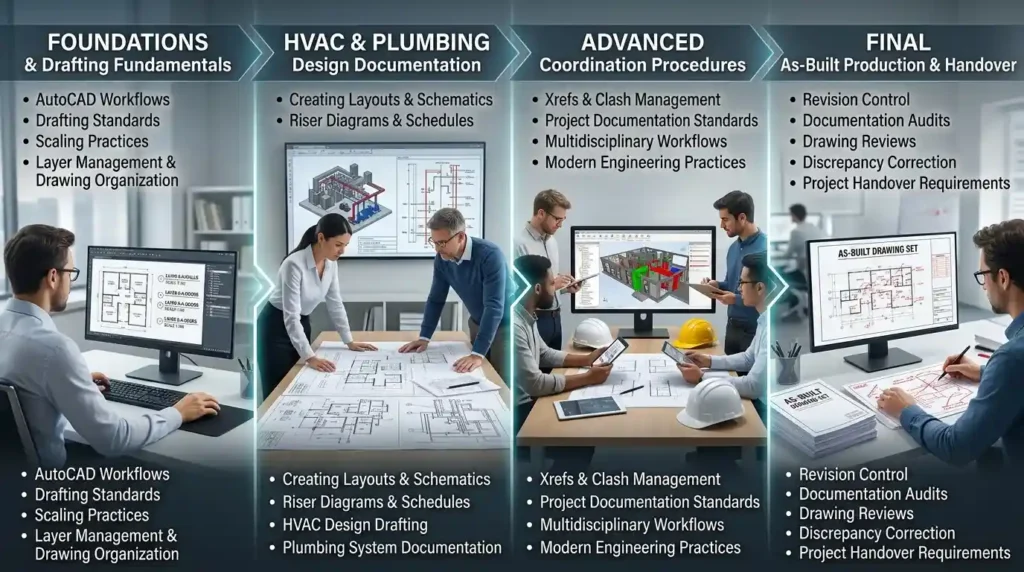
The curriculum follows the same progression used in engineering projects. Participants begin with drafting fundamentals, progress through design development and coordination activities, and conclude with documentation control, quality assurance, revision management, and final as-built drawing delivery processes.
As-built drawing production is not an isolated task. It represents the final stage of a broader engineering documentation lifecycle. For this reason, Imperial Corporate Training Institute incorporates learning modules that build the knowledge required before participants reach final documentation activities.
The course begins with AutoCAD workflows, drafting standards, scaling practices, layer management, and drawing organisation. These foundations support consistency throughout project development.
Participants then move into HVAC design drafting and plumbing system documentation. During these modules, learners develop the ability to create layouts, schematics, riser diagrams, schedules, and engineering details. These skills become essential when modifications must later be reflected in final documentation.
Advanced modules introduce coordination procedures, Xrefs, clash management, project documentation standards, and multidisciplinary workflows. These elements mirror the realities of modern construction projects where design changes frequently occur during implementation.
Professionals evaluating curriculum depth may also review:
How AutoCAD HVAC training covers as-built drawing production and mark-up to understand the relationship between design documentation, field modifications, and final project records.
The final stages of the programme focus on revision control, documentation audits, drawing reviews, discrepancy correction, and project handover requirements. This structure reflects the sequence used by engineering teams when delivering completed projects.
What Will Participants Learn About As-Built Drawing Production?
Participants learn how to manage revisions, update engineering layouts, document field modifications, maintain drawing standards, conduct quality reviews, and prepare final HVAC and plumbing documentation suitable for project handover and long-term facility management purposes.
The course contains several modules directly related to as-built drawing workflows.
Understanding Design Revisions and Documentation Changes
Construction projects rarely follow original drawings without modification. Equipment relocation, site constraints, coordination requirements, and client requests often require adjustments.
Imperial Corporate Training Institute teaches participants how these changes are documented and incorporated into engineering drawings. Learners understand the relationship between design intent and actual installation outcomes.
Managing Layer Standards and Drawing Organisation
As-built drawings must remain clear and traceable. Poor layer management often creates confusion during future maintenance or renovation activities.
Participants learn structured approaches to layer organisation, annotation management, title block updates, and drawing standard compliance. These practices support consistency across large engineering projects.
Producing Accurate HVAC and Plumbing Documentation
The programme develops practical skills in documenting ductwork, piping systems, equipment layouts, riser diagrams, schedules, and engineering details.
These competencies enable learners to update drawings accurately when construction changes occur and final documentation must reflect installed conditions.
Quality Assurance and Drawing Review
One of the most important aspects of as-built documentation is verification.
Imperial Corporate Training Institute includes quality assurance procedures that teach participants how to identify inconsistencies, validate drawing information, and correct documentation errors before project submission.
Final Project Handover Documentation
Module 8 specifically addresses final as-built drawing delivery. Participants learn how completed documentation supports facility management teams, maintenance personnel, project owners, and future engineering consultants.
This practical focus ensures that learning outcomes extend beyond drafting and include complete project documentation workflows.
How Is the Training Delivered and Assessed?
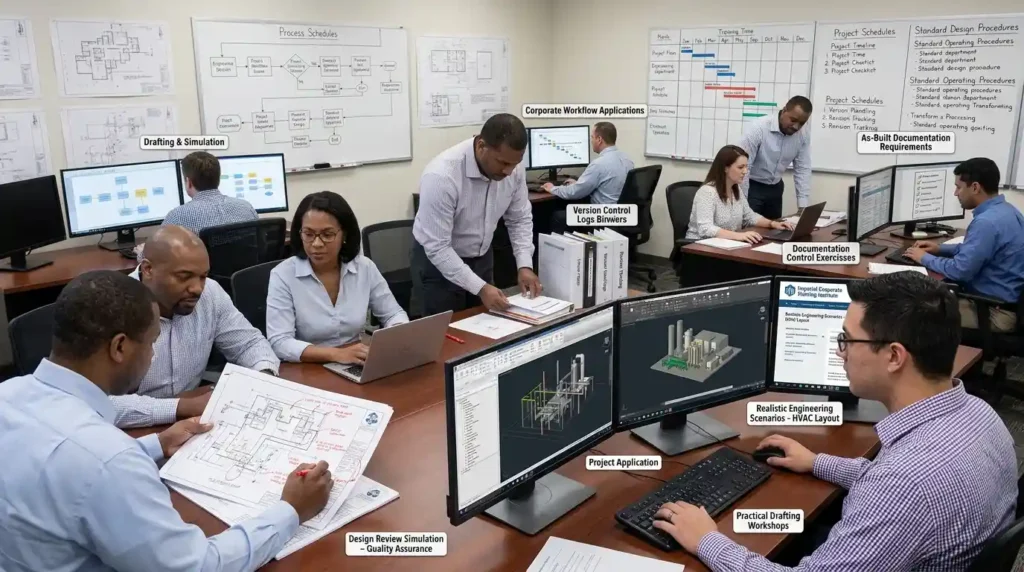
The programme combines technical instruction, practical drafting exercises, project-based learning, engineering simulations, documentation assignments, and review activities. Assessment focuses on applied competency rather than theoretical understanding, ensuring participants demonstrate measurable drafting and documentation skills.
Imperial Corporate Training Institute designs the programme for professional learners who require workplace-relevant outcomes.
Training delivery can support corporate teams, engineering departments, technical professionals, and organisations seeking workforce capability development. Learning activities are structured around realistic engineering scenarios rather than isolated software exercises.
Practical Drafting Workshops
Participants complete drafting exercises that simulate HVAC and plumbing design activities commonly encountered in commercial and industrial projects.
These exercises reinforce technical accuracy while building familiarity with professional drawing standards.
Project-Based Assignments
Assignments require learners to apply AutoCAD tools within realistic engineering contexts.
Participants create layouts, coordinate systems, organise documentation, and manage project information using structured workflows.
Design Review Simulations
Engineering documentation often undergoes multiple review cycles before approval.
The programme incorporates review activities that expose participants to correction procedures, quality assurance requirements, and revision management techniques.
Documentation Control Exercises
Imperial Corporate Training Institute includes documentation-focused activities that teach version control, revision tracking, drawing updates, and project record management.
These exercises support competencies required for final as-built documentation.
Corporate Workflow Applications
The programme aligns learning activities with corporate engineering environments. Participants gain exposure to workflows commonly used by consultants, contractors, facility management teams, and engineering departments responsible for project delivery.
What Learning Outcomes Can Participants Expect?
Participants gain measurable competency in HVAC drafting, plumbing design documentation, project coordination, drawing management, quality assurance procedures, engineering documentation standards, and final project handover requirements including the preparation and verification of as-built drawings.
Learning outcomes focus on workplace performance rather than software familiarity alone.
By completing the programme, participants can produce structured HVAC and plumbing drawings that meet engineering documentation requirements.
They can organise projects using recognised CAD standards and maintain consistency across drawing packages.
They can coordinate HVAC and plumbing systems with other building services while reducing documentation conflicts and design discrepancies.
Imperial Corporate Training Institute also develops participants’ ability to manage engineering documentation throughout project lifecycles. This includes revision control, drawing updates, document verification, and project record maintenance.
Another important outcome involves quality assurance capability. Participants learn how to review documentation systematically and identify issues before project submission.
For professionals involved in project delivery, these competencies support improved accuracy, reduced rework, and stronger compliance with organisational standards.
How Does the Course Support Corporate Engineering and Construction Teams?
The programme aligns technical drafting skills with organisational documentation requirements. Teams develop standardised workflows, improve project coordination, strengthen quality assurance processes, and create engineering documentation that supports long-term operational and maintenance objectives.
Engineering projects depend on consistent documentation practices across multiple stakeholders.
Mechanical engineers require accurate layouts.
Project managers require controlled documentation processes.
Facility management teams require reliable records of installed systems.
Maintenance personnel require accurate reference information for future interventions.
Imperial Corporate Training Institute addresses these requirements through a curriculum that integrates technical drafting with documentation governance principles.
For HR departments responsible for workforce development, the programme provides a structured pathway for technical upskilling. Employees gain practical competencies that can be applied immediately within project environments.
For engineering managers, the course supports standardisation of drafting practices and documentation procedures across project teams.
For organisations delivering large-scale construction projects, improved documentation quality contributes to more effective project handovers and operational continuity.
What Are the Entry Requirements and Who Should Enrol?
The programme is suitable for engineering professionals, MEP specialists, CAD technicians, project coordinators, facility management personnel, and graduates seeking structured development in HVAC and plumbing design documentation using AutoCAD within corporate environments.
Imperial Corporate Training Institute has designed the course for professionals who require practical application rather than introductory awareness.
Mechanical design engineers benefit from enhanced drafting and documentation capabilities.
HVAC specialists strengthen their understanding of project documentation workflows.
MEP engineers improve coordination skills across building services disciplines.
CAD technicians develop greater competency in producing structured engineering deliverables.
Project engineers gain knowledge of documentation standards that support project execution and handover requirements.
Facility management professionals benefit from understanding how engineering documentation is created, updated, and maintained throughout asset lifecycles.
Graduates seeking specialisation in building services engineering can use the programme to develop industry-relevant technical competencies.
How Does Enrollment Work and How Can Learners Make a Final Decision?
Prospective participants should evaluate the curriculum against their professional responsibilities, documentation requirements, project delivery objectives, and technical development goals. The programme provides a structured pathway from drafting fundamentals to advanced engineering documentation and as-built drawing production.
Decision-stage learners typically assess three factors before selecting a training programme.
The first factor is curriculum relevance. The AutoCAD HVAC and Plumbing Design Training Course addresses HVAC drafting, plumbing design, project coordination, documentation management, quality assurance, BIM integration, and final project handover requirements.
The second factor is workplace applicability. Imperial Corporate Training Institute aligns learning outcomes with real engineering workflows used in construction, infrastructure, consultancy, and facility management environments.
The third factor is measurable skill development. The programme develops competencies that can be demonstrated through drafting exercises, project simulations, documentation assignments, and engineering review activities.
Discover More from Our Guide Library:
Does Imperial’s HVAC Course Teach Equipment Schedule Production in AutoCAD?
Does Imperial’s HVAC Programme Include Pipe Sizing and Annotation Exercises?
For professionals specifically asking whether Imperial Corporate Training Institute includes as-built drawing techniques, the answer is yes. The curriculum addresses revision management, documentation control, quality assurance processes, project handover standards, and the preparation of final as-built drawings as part of its structured learning pathway.
Professionals seeking a course that combines HVAC drafting, plumbing system documentation, project coordination, and final engineering deliverable preparation can review programme requirements and apply for course access.