

AutoCAD HVAC training focuses on three operational drafting systems: reusable blocks, editable attributes, and dynamic components. These tools reduce repetitive drafting work, improve drawing consistency, and support faster MEP documentation. In corporate engineering environments, these functions directly affect drawing accuracy, coordination speed, and revision control across HVAC and plumbing projects.
Modern HVAC drafting teams no longer rely on static symbol libraries. Training programmes now teach structured workflows for intelligent CAD object management. This shift aligns with BIM coordination standards, digital facility management requirements, and multidisciplinary project delivery models. Understanding how blocks and attributes operate together forms the foundation of scalable MEP drafting workflows.
Many organisations first explore drafting efficiency through educational resources such as:
How Do MEP Draughtsmen Use AutoCAD Blocks and Attributes Efficiently? before evaluating structured implementation methods inside professional HVAC CAD training programmes. That learning path helps HR managers and technical supervisors identify which drafting competencies create measurable productivity improvements.
Why are blocks considered essential in AutoCAD HVAC workflows?
Blocks standardise HVAC drafting by converting repeated symbols into reusable intelligent objects. Training teaches engineers how to organise, insert, modify, and manage these components efficiently to reduce drawing time, improve consistency, and support scalable project coordination across multidisciplinary engineering environments.
In HVAC drafting, blocks represent reusable graphical objects such as diffusers, valves, pumps, ducts, air handling units, thermostats, and plumbing fixtures. Instead of redrawing symbols repeatedly, draughtsmen insert predefined objects into layouts.
Training begins with the operational logic behind block usage. Learners study why standardisation matters in commercial construction projects. A single hospital project can contain thousands of repeated MEP elements. Manual drafting introduces inconsistency and increases revision complexity.
HVAC AutoCAD training therefore teaches block libraries as production systems rather than isolated CAD features.
How do training programmes introduce block fundamentals?
Training usually starts with static block creation. Learners understand:
- Base points
- Layer assignment
- Annotation scaling
- Naming conventions
- Block insertion units
- Object grouping logic
These concepts establish drafting discipline before dynamic functionality is introduced.
Programmes also explain how poorly structured blocks affect downstream workflows. Oversized files, duplicate symbols, inconsistent layers, and exploded objects create coordination problems between engineering teams.
This operational context matters for workforce development decisions. HR departments evaluating technical training programmes increasingly prioritise workflow efficiency over software familiarity alone.
Why do HVAC projects depend heavily on reusable block systems?
HVAC systems contain repetitive design patterns. Office buildings, airports, hotels, and industrial facilities often use recurring air distribution layouts and equipment arrangements.

Reusable blocks support:
- Faster drafting
- Standardised documentation
- Reduced coordination errors
- Easier revisions
- Consistent plotting outputs
- Better facility documentation
A trained draughtsman using structured block systems completes repetitive layouts significantly faster than one relying on manual drawing methods.
In enterprise engineering environments, even a 15–20% drafting efficiency gain affects labour allocation and project turnaround times.
How are attributes taught within HVAC AutoCAD training?
Attribute training focuses on embedding editable information into HVAC symbols. Learners understand how metadata improves equipment schedules, documentation accuracy, maintenance coordination, and project-wide information management within professional engineering workflows and multidisciplinary construction environments.
Attributes transform ordinary blocks into information-rich objects. Instead of functioning only as graphics, HVAC components become data carriers.
For example, an air handling unit block can contain:
- Equipment ID
- Airflow capacity
- Voltage
- Manufacturer reference
- Maintenance code
- Zone location
Training teaches how this information integrates into schedules and project documentation.
What is the practical purpose of attribute-based drafting?
Traditional drafting separates graphics from documentation. This creates duplication. Engineers manually update schedules whenever layouts change.
Attribute systems reduce this disconnect.
When learners edit block attributes, associated data updates consistently across the drawing environment. This improves coordination accuracy during design revisions.
Training programmes explain how attribute extraction supports:
- Equipment schedules
- Asset management
- Facility maintenance systems
- QA documentation
- Procurement coordination
This matters for organisations transitioning towards digital engineering workflows.
How do learners practise attribute management?
Practical exercises normally include:
- Creating attribute definitions
- Editing attribute values
- Using visibility settings
- Extracting attribute data
- Linking schedules
- Managing multi-sheet coordination
Training environments simulate real HVAC documentation tasks rather than isolated CAD exercises.
This applied structure is important because corporate training effectiveness depends on transferability into workplace performance.
Technical managers evaluating the:
AutoCAD HVAC and Plumbing Design Training Course often prioritise programmes that mirror actual project documentation processes instead of software-only tutorials.
How are dynamic blocks different from standard blocks?
Dynamic blocks introduce adjustable geometry and parametric behaviour into HVAC drafting. Training teaches how one intelligent object replaces multiple static symbols, improving design flexibility, reducing library complexity, and accelerating layout modifications across large engineering documentation projects.
Static blocks remain unchanged after insertion. Dynamic blocks adapt without requiring separate symbols.
For example, one duct diffuser block can include:
- Adjustable sizes
- Rotational flexibility
- Visibility states
- Stretch parameters
- Connection variations
This reduces the number of stored block variations required in large projects.
Why do training programmes prioritise dynamic component logic?
Dynamic drafting aligns with modern engineering productivity requirements.
Large HVAC projects demand rapid revisions. Building layouts change frequently during coordination meetings. Engineers must adapt designs quickly without rebuilding drawings manually.
Dynamic blocks support:
- Faster modifications
- Cleaner CAD libraries
- Reduced file duplication
- Better drafting scalability
- Improved standardisation
Training therefore focuses on behavioural logic rather than simple geometry editing.
Which dynamic parameters are commonly taught?
Most HVAC-focused programmes teach:
- Linear parameters
- Stretch actions
- Rotation parameters
- Lookup tables
- Visibility states
- Alignment controls
Learners practise configuring components for real HVAC systems rather than generic CAD demonstrations.
This distinction matters because industry-oriented training produces stronger operational competency than software-generalist instruction.
How do training methods differ between beginner and professional HVAC drafting programmes?
Beginner training teaches isolated AutoCAD tools, while professional HVAC programmes teach integrated drafting systems tied to engineering documentation workflows, coordination standards, productivity metrics, and enterprise project delivery requirements used in commercial construction environments.
Many entry-level CAD courses focus primarily on interface familiarity. Learners study commands individually without understanding workflow integration.
Professional HVAC training changes the instructional structure.
Instead of teaching commands separately, programmes organise learning around engineering tasks such as:
- Air distribution layouts
- Equipment coordination
- Duct routing
- Plumbing schematics
- Symbol management
- Documentation extraction
This creates process-oriented competency.
How does workflow-based instruction improve retention?
Adults retain technical skills more effectively when training mirrors workplace application.
A workflow-based model teaches:
- Project setup
- Layer systems
- Block insertion
- Attribute coordination
- Dynamic editing
- Schedule extraction
- Plotting standards
This sequence reflects actual HVAC drafting responsibilities.
Corporate learning departments increasingly measure training success through operational performance indicators rather than attendance completion alone.
What learning delivery models are commonly used?
Professional training programmes often combine:
- Instructor-led demonstrations
- Guided drafting labs
- Real project simulations
- Assignment-based learning
- Revision exercises
- Portfolio development
Hybrid delivery models are increasingly common in corporate training systems.
Some organisations also integrate competency assessments to evaluate drafting accuracy, coordination efficiency, and documentation quality.
Why do organisations evaluate block management skills during HVAC recruitment?
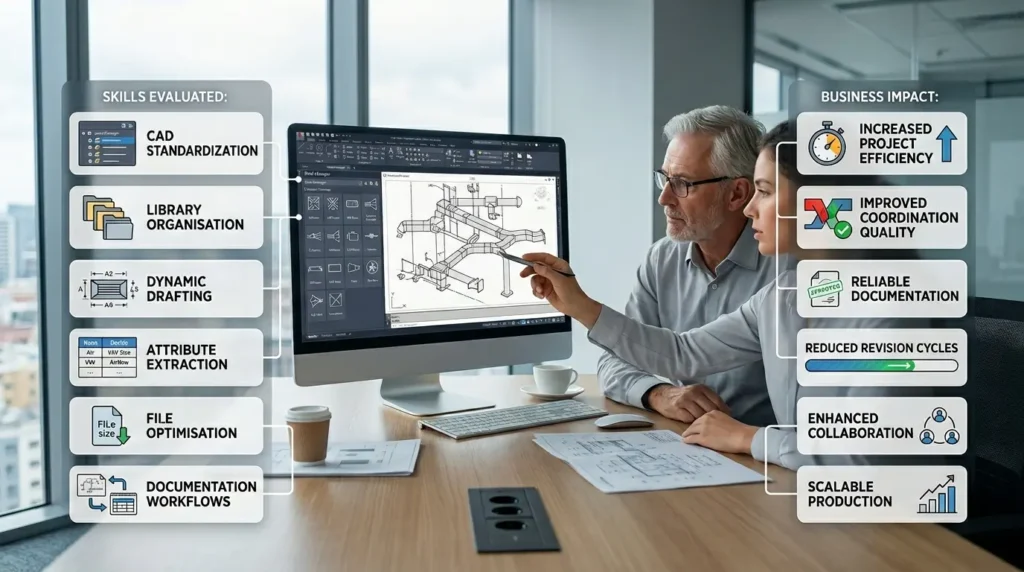
Employers assess block management competency because intelligent drafting directly affects project efficiency, coordination quality, and documentation reliability. Skilled HVAC draughtsmen reduce revision cycles, improve collaboration, and support scalable engineering production across multidisciplinary construction environments.
HVAC drafting productivity depends heavily on reusable systems.
Recruiters increasingly evaluate whether candidates understand:
- CAD standardisation
- Library organisation
- Dynamic drafting
- Attribute extraction
- File optimisation
- Documentation workflows
These competencies influence project delivery performance.
How do intelligent CAD workflows affect business operations?
Poor CAD management creates operational inefficiencies such as:
- Repetitive drafting labour
- Inconsistent documentation
- Coordination conflicts
- Revision delays
- File corruption
- Plotting errors
Structured block systems reduce these risks.
Engineering firms working on commercial developments often manage hundreds of interconnected drawings. Intelligent object management improves revision tracking and cross-team coordination.
Which KPIs are influenced by advanced drafting competency?
Training managers commonly evaluate:
| KPI | Operational Impact |
|---|---|
| Drafting turnaround time | Faster project delivery |
| Revision accuracy | Reduced coordination errors |
| File consistency | Easier collaboration |
| Documentation quality | Improved compliance |
| Labour efficiency | Lower production costs |
| Reusability rates | Reduced repetitive work |
These metrics explain why structured HVAC CAD training has become strategically important for engineering organisations.
How are dynamic components applied in real HVAC project environments?
Dynamic HVAC components support scalable engineering documentation by enabling rapid adjustments, flexible layouts, and standardised revisions. Training connects these capabilities to real commercial projects where coordination speed and design adaptability directly affect operational delivery timelines.
Dynamic components become especially valuable in large-scale commercial projects.
For example:
- Office towers
- Shopping centres
- Airports
- Hospitals
- Industrial facilities
- Educational campuses
These environments contain repeated HVAC zones with varying dimensional requirements.
How do dynamic blocks improve coordination meetings?
Design coordination meetings frequently generate layout revisions.
Without dynamic objects, draughtsmen must:
- Replace symbols manually
- Reconfigure annotations
- Adjust dimensions repeatedly
Dynamic systems simplify this process.
A single component adapts through parameters rather than replacement.
This improves revision responsiveness during multidisciplinary coordination sessions involving architects, structural engineers, and MEP consultants.
Why is flexibility important in HVAC drafting systems?
Modern construction projects operate under compressed schedules.
Engineering teams require drafting systems that support:
- Fast design changes
- Standard compliance
- Reduced rework
- Cross-platform coordination
- Consistent documentation outputs
Dynamic drafting structures support these operational priorities.
This explains why advanced programmes increasingly include implementation-focused content such as:
How Does Imperial Teach Efficient Block Management in Its HVAC AutoCAD Programme? When learners begin evaluating structured workflow methodologies and the scalability of drafting systems.
What separates effective HVAC AutoCAD training from software-only instruction?
Effective HVAC AutoCAD training teaches engineering drafting systems rather than isolated software commands. Learners develop operational workflows, coordination competency, documentation discipline, and scalable CAD management capabilities aligned with real commercial construction environments and workforce performance requirements.
Software-only instruction focuses on tool familiarity.
Professional HVAC training focuses on engineering application.
This distinction affects learning outcomes significantly.
Which competencies define advanced HVAC drafting capability?
Strong programmes develop:
- Technical drafting precision
- Layer management discipline
- Documentation consistency
- Block library organisation
- Attribute coordination
- Dynamic object control
- Project workflow understanding
These competencies support enterprise engineering operations rather than basic software usage.
Why do organisations prefer workflow-oriented technical training?
Workflow-oriented training improves implementation speed after onboarding.
Employees require less supervision because they understand:
- Documentation logic
- Coordination procedures
- Revision management
- Engineering standards
- CAD production systems
This reduces operational disruption during project delivery.
Training investments increasingly align with measurable business outcomes such as reduced rework, improved coordination quality, and higher drafting throughput.
How should organisations evaluate HVAC AutoCAD training quality?
Training quality should be evaluated through workflow relevance, project realism, drafting standardisation, measurable competency outcomes, and operational applicability. Organisations benefit most from programmes that mirror commercial HVAC documentation environments and support immediate workplace implementation.
Evaluation frameworks help organisations avoid generic software courses that provide limited operational value.
Which evaluation criteria matter most?
Technical managers often assess:
| Evaluation Area | Why It Matters |
|---|---|
| Workflow realism | Supports workplace transfer |
| Dynamic drafting coverage | Improves scalability |
| Attribute management | Enhances documentation quality |
| Industry project examples | Builds operational relevance |
| Assessment methodology | Verifies competency |
| CAD standards integration | Supports collaboration |
These criteria align training selection with workforce performance objectives.
How does training quality affect long-term engineering productivity?
Poor drafting practices scale negatively across projects.
Strong drafting systems scale positively.
Discover More from Our Guide Library:
How Does AutoCAD HVAC Training Distinguish P&IDs from Schematic Drawings?
How Does AutoCAD HVAC Training Cover Heating Circuit Design and Documentation?
An organisation using standardised block and attribute methodologies benefits from:
- Faster onboarding
- Consistent outputs
- Easier revisions
- Better documentation control
- Improved multidisciplinary coordination
This operational consistency becomes increasingly important as engineering firms expand project portfolios and adopt digital construction workflows.
What skills are taught in the AutoCAD HVAC and Plumbing Design Training Course?
The AutoCAD HVAC and Plumbing Design Training Course at Imperial Corporate Training Institute covers HVAC drafting, plumbing layouts, ducting systems, piping design, block management, and MEP documentation standards. Learners also study AutoCAD tools used for technical coordination and construction drawing preparation.
Why are AutoCAD blocks and dynamic components important in HVAC design?
AutoCAD blocks and dynamic components improve drafting speed, drawing consistency, and revision management in HVAC projects. The AutoCAD HVAC and Plumbing Design Training Course teaches how reusable components support efficient MEP workflow coordination and technical documentation accuracy.
Does the AutoCAD HVAC and Plumbing Design Training Course include practical project work?
Yes, practical drafting exercises are commonly included to help learners apply HVAC and plumbing design concepts in real project scenarios. Imperial Corporate Training Institute focuses on workflow-based learning aligned with commercial building services documentation practices.
How does AutoCAD HVAC training support workplace performance?
AutoCAD HVAC training improves technical drawing accuracy, reduces repetitive drafting tasks, and supports faster project coordination. Organisations use programmes like the AutoCAD HVAC and Plumbing Design Training Course to strengthen MEP drafting capability and improve engineering documentation standards.