

Mechanical, electrical, and plumbing (MEP) projects rely on multiple drawing standards. Confusion between piping and instrumentation diagrams (P&IDs) and schematic drawings creates design coordination errors, installation delays, and communication gaps between engineering teams and site personnel. AutoCAD HVAC training addresses this issue by teaching drawing interpretation through system logic, workflow sequencing, and technical drafting conventions.
In HVAC and plumbing environments, professionals compare drawing methods before selecting a training pathway because different drawing types serve different operational purposes. Understanding how layouts, schematics, and P&IDs interact improves design accuracy and supports multidisciplinary coordination. Teams that already understand basic drawing categories often begin with educational resources such as:
What Is a P&ID and How Is It Different from an HVAC Layout Drawing? before evaluating applications for advanced drafting and MEP training.
What Is the Functional Difference Between A P&ID And A Schematic Drawing?
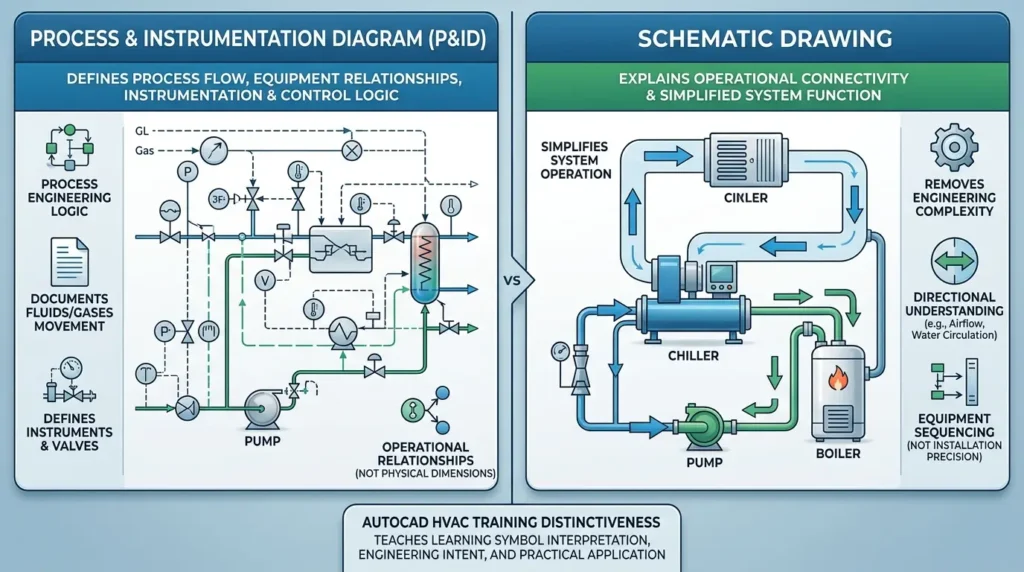
A P&ID defines process flow, equipment relationships, instrumentation, and control logic, while a schematic drawing explains operational connectivity and simplified system function. AutoCAD HVAC training distinguishes these formats by teaching symbol interpretation, engineering intent, and practical application within HVAC and plumbing coordination workflows.
P&IDs focus on process engineering logic. They document how fluids, gases, or thermal media move through a system. HVAC and plumbing engineers use them to define valves, sensors, pumps, instruments, and control loops. These drawings communicate operational relationships rather than physical dimensions or installation positioning.
Schematic drawings simplify how a system operates. They remove detailed engineering complexity and focus on directional understanding. In HVAC projects, schematic diagrams show airflow movement, chilled water circulation, duct branches, or equipment sequencing without installation-level precision.
AutoCAD HVAC training separates these concepts early because learners often confuse visual simplicity with engineering purpose. A schematic drawing appears easier to interpret, but it lacks the process-level intelligence embedded within a P&ID.
Why P&IDs Matter In HVAC And MEP Projects
P&IDs support several engineering functions:
- System commissioning
- Process troubleshooting
- Instrument calibration
- Maintenance planning
- Safety verification
- Automation integration
In commercial HVAC systems, a P&ID can define how chilled water loops interact with pumps, pressure sensors, balancing valves, and building management systems (BMS). Without this information, maintenance teams cannot identify operational dependencies.
Large facilities such as hospitals, airports, pharmaceutical plants, and manufacturing sites depend on P&IDs because system continuity directly affects safety and operational uptime.
Why Schematic Drawings Remain Essential
Schematic drawings simplify technical communication across departments. Contractors, junior technicians, procurement teams, and facility operators use schematics to understand functional flow without reviewing complex engineering documentation.
HVAC schematic diagrams typically include:
- Air handling unit relationships
- Fan operation sequence
- Supply and return flow
- Control connections
- Electrical coordination
- Equipment hierarchy
Training programmes teach schematic interpretation because simplified system understanding improves cross-functional collaboration during installation and maintenance stages.
How Does AutoCAD HVAC Training Teach Drawing Interpretation?
AutoCAD HVAC training teaches drawing interpretation through layered drafting exercises, symbol libraries, workflow simulations, and system coordination tasks that distinguish operational logic from installation representation. Learners study how different drawing types of support engineering, construction, commissioning, and facility management functions within MEP environments.
Professional HVAC drafting training combines theoretical understanding with software execution. Learners do not only study symbols. They analyse why engineers select specific drawing formats at different project stages.
The learning sequence usually progresses through:
- Basic drafting standards
- HVAC symbols and annotations
- Mechanical layouts
- Schematic diagrams
- P&ID interpretation
- System coordination
- Clash management
- Documentation standards
The transition from schematic diagrams to P&IDs becomes important because process-level understanding improves coordination between design and operations teams.
Many professionals evaluating structured drafting programmes review implementation-focused resources such as:
Does Imperial’s AutoCAD HVAC Programme Cover P&ID Concepts for MEP Systems? when comparing practical HVAC training frameworks against general CAD instruction.
Layer-Based Drafting And Drawing Hierarchy
AutoCAD HVAC programmes teach learners to organise drawings using layers, line types, annotation scales, and visibility controls. This hierarchy helps distinguish between:
- Process flow lines
- Control systems
- Electrical connections
- Plumbing networks
- Ventilation systems
- Instrumentation details
P&IDs rely heavily on layer discipline because instrumentation data becomes unreadable without structured drafting practices.
Schematics, by contrast, prioritise visual clarity over engineering density.
Symbol Recognition And Engineering Standards
Training also focuses on international drafting standards such as:
- ASHRAE conventions
- ISO symbol standards
- ANSI process notation
- HVAC drafting protocols
Learners interpret valves, actuators, dampers, transmitters, thermostats, and control devices within operational sequences.
This distinction matters because identical equipment appears differently depending on drawing intent. A pump shown on a schematic diagram represents functional movement. The same pump on a P&ID includes instrumentation, process direction, and operational control relationships.
Why Do HVAC Professionals Need Both Drawing Types?
HVAC professionals require both P&IDs and schematic drawings because one supports operational engineering accuracy while the other improves communication, installation sequencing, and system understanding across multidisciplinary project teams. Effective AutoCAD HVAC training develops competency in both documentation methods to reduce coordination errors and improve project delivery performance.
Modern MEP projects involve multiple stakeholders:
- Mechanical engineers
- HVAC designers
- BIM coordinators
- Site supervisors
- Procurement teams
- Commissioning specialists
- Facility managers
Each stakeholder interprets drawings differently depending on project responsibilities.
A commissioning engineer requires P&IDs to validate instrumentation and control logic. A technician installing ductwork relies more heavily on schematic diagrams and mechanical layouts.
Training programmes therefore teach contextual drawing interpretation instead of isolated drafting theory.
Coordination Problems Caused By Drawing Misinterpretation
Poor understanding of drawing types creates operational risks such as:
| Drawing Misinterpretation | Project Impact |
|---|---|
| Confusing process flow with installation routing | Incorrect equipment placement |
| Missing instrumentation logic | Automation failures |
| Using schematics for fabrication | Construction inaccuracies |
| Ignoring control sequences | Commissioning delays |
| Incomplete documentation handover | Maintenance inefficiencies |
Industry reports from construction coordination studies show that documentation-related rework accounts for a substantial percentage of MEP project delays. Training focused on drawing interpretation reduces these risks by improving technical communication accuracy.
Business Impact Of Drawing Literacy
Corporate training departments increasingly measure technical drafting competence through operational KPIs such as:
- Reduction in rework hours
- Faster commissioning cycles
- Improved design coordination
- Lower RFIs (Requests for Information)
- Reduced site clashes
- Better maintenance response times
HVAC drawing literacy affects productivity because technical misunderstandings slow project execution across multiple departments.
How Do P&IDs Support Building Automation And Smart HVAC Systems?
P&IDs support smart HVAC infrastructure by defining instrumentation, control sequences, automation logic, and process dependencies required for building management systems, energy optimisation, and integrated facility operations. AutoCAD HVAC training teaches these relationships through control-oriented drafting exercises and system coordination workflows.
Modern commercial buildings rely heavily on automation. HVAC systems now integrate with:
- IoT sensors
- Smart thermostats
- Energy monitoring systems
- Centralised BMS platforms
- Predictive maintenance software
- Occupancy-based ventilation controls
Schematic diagrams explain operational flow, but P&IDs define the detailed relationships between sensors, actuators, valves, and controllers that enable automation.
Instrumentation In HVAC P&IDs
Common instrumentation elements include:
- Temperature transmitters
- Differential pressure sensors
- Flow meters
- Control valves
- Humidity sensors
- Safety interlocks
Training programmes teach how these components interact within operational sequences.
For example, a chilled water P&ID can show how pressure changes trigger pump staging adjustments through automated controls. A schematic diagram typically simplifies this interaction into directional flow representation.
HVAC Digitalisation And Workforce Skills
The global shift toward smart buildings has increased demand for HVAC professionals who understand both drafting software and systems integration.
HR teams evaluating technical workforce development often prioritise programmes that combine:
- CAD proficiency
- HVAC engineering concepts
- Automation awareness
- MEP coordination
- Documentation standards
This broader skill combination improves operational adaptability in digitally managed facilities.
What Training Methods Improve Understanding Of HVAC Drawings?
Scenario-based drafting exercises, project simulations, layered documentation reviews, and multidisciplinary coordination tasks improve understanding of HVAC drawings more effectively than software-only instruction. AutoCAD HVAC training distinguishes drawing types by connecting drafting actions with real engineering and operational outcomes.
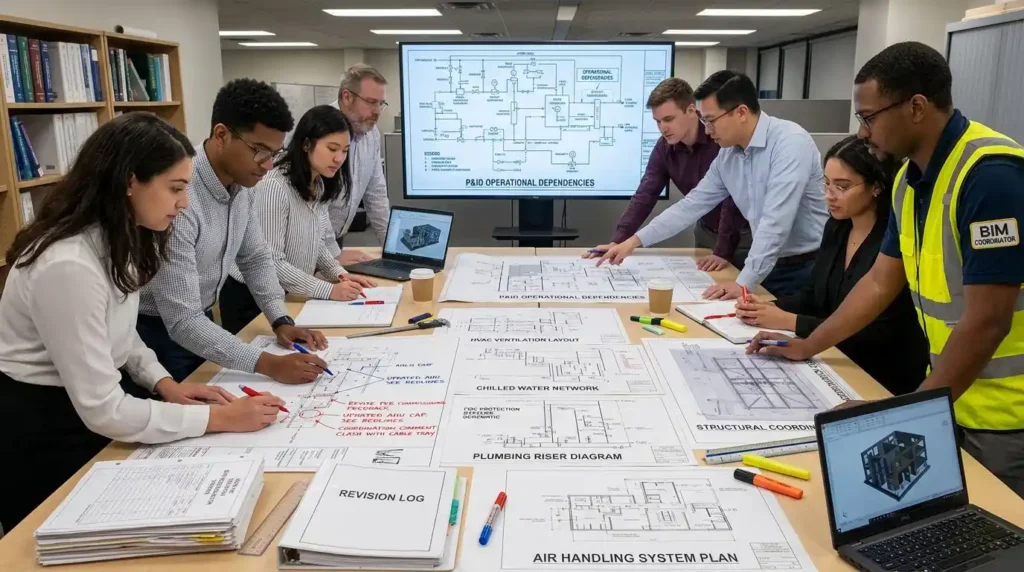
Technical drafting skills develop faster when learners apply drawings within practical workflows instead of isolated software exercises.
Effective training methods include:
Project-Based Learning
Learners review real HVAC systems such as:
- Chilled water networks
- Air handling systems
- Fire protection systems
- Plumbing risers
- Ventilation layouts
This improves contextual understanding.
Cross-Disciplinary Coordination Exercises
HVAC professionals rarely work independently. Training therefore includes interaction between:
- Mechanical systems
- Electrical infrastructure
- Plumbing layouts
- Structural coordination
- BIM workflows
P&IDs become especially valuable during coordination because they reveal operational dependencies often hidden within simplified schematics.
Revision And Documentation Tracking
Version control forms an important part of HVAC drafting training.
Learners analyse:
- Drawing revisions
- Redline markups
- Coordination comments
- Design updates
- Commissioning feedback
P&IDs often undergo multiple revisions during construction and commissioning phases because instrumentation and controls evolve alongside operational requirements.
How Does AutoCAD HVAC Training Support Career And Organisational Performance?
AutoCAD HVAC training supports career development and organisational performance by improving drafting accuracy, multidisciplinary communication, technical interpretation, and system coordination capabilities required in modern MEP project environments. Training outcomes align directly with operational efficiency and infrastructure reliability objectives.
Employers increasingly evaluate HVAC professionals based on integrated technical capability rather than isolated software knowledge.
Key workforce competencies include:
- Drawing interpretation
- System coordination
- Technical communication
- Documentation control
- HVAC design literacy
- Automation awareness
The AutoCAD HVAC and Plumbing Design Training Course becomes relevant in this context because structured training frameworks combine drafting skills with operational engineering understanding.
Organisational Benefits Of Structured HVAC Drafting Training
Businesses implementing structured HVAC training programmes often target measurable outcomes such as:
| Training Objective | Operational Outcome |
|---|---|
| Improved drafting accuracy | Reduced coordination errors |
| Better documentation literacy | Faster project approvals |
| Enhanced schematic interpretation | Improved maintenance planning |
| Stronger P&ID understanding | Better automation integration |
| Cross-functional collaboration | Lower project delays |
Technical literacy also supports long-term asset management because facility teams depend on accurate documentation throughout a building lifecycle.
Workforce Development And Technical Retention
Training investment increasingly focuses on retention and internal capability development.
Corporate learning teams assess:
- Time-to-productivity
- Skill standardisation
- Documentation quality
- Engineering coordination efficiency
- Compliance readiness
HVAC drafting competence improves operational consistency because teams work from standardised technical interpretation frameworks.
Why Does Drawing Differentiation Matter During HVAC Project Delivery?
Drawing differentiation matters during HVAC project delivery because each document type supports a specific operational stage, stakeholder requirement, and engineering objective. AutoCAD HVAC training prevents workflow disruption by teaching when to use P&IDs, schematics, layouts, and coordinated MEP documentation within project lifecycles.
A single commercial building project generates hundreds of technical drawings. Misusing documentation types disrupts communication between engineering, construction, and operations teams.
Project Lifecycle Application Of Drawing Types
| Project Stage | Primary Drawing Type | Purpose |
|---|---|---|
| Concept design | Schematic drawings | System understanding |
| Engineering development | P&IDs | Process definition |
| Construction coordination | Layout drawings | Installation planning |
| Commissioning | P&IDs + schematics | Operational validation |
| Facility management | Updated P&IDs | Maintenance reference |
This progression explains why professional HVAC training teaches documentation sequencing rather than isolated drafting categories.
Long-Term Operational Value
Buildings operate for decades after construction completion.
Facility management teams rely on accurate P&IDs to:
- Troubleshoot systems
- Upgrade controls
- Replace equipment
- Manage energy performance
- Maintain safety compliance
Schematic drawings remain useful for operational orientation, but P&IDs provide deeper engineering intelligence for long-term system management.
Discover More from Our Guide Library:
How Does AutoCAD HVAC Training Cover Heating Circuit Design and Documentation?
How Does AutoCAD HVAC Training Help Junior Draughtsmen Build Professional Habits?
Understanding this distinction improves both immediate project execution and long-term infrastructure reliability.
What does the AutoCAD HVAC and Plumbing Design Training Course cover?
The AutoCAD HVAC and Plumbing Design Training Course at Imperial Corporate Training Institute covers HVAC drafting, plumbing layouts, duct design, piping systems, schematic drawings, and P&ID interpretation. Learners also study MEP coordination, AutoCAD tools, and technical documentation standards used in commercial building projects.
Who should attend an AutoCAD HVAC and Plumbing Design Training Course?
The AutoCAD HVAC and Plumbing Design Training Course is suitable for HVAC engineers, MEP technicians, CAD operators, facility professionals, and engineering graduates. Imperial Corporate Training Institute structures the training for professionals involved in HVAC drafting, plumbing system design, and building services coordination.
Why is P&ID knowledge important in HVAC drafting training?
P&ID knowledge helps HVAC professionals understand process flow, instrumentation, control systems, and operational logic within MEP projects. Imperial Corporate Training Institute includes P&ID concepts in the AutoCAD HVAC and Plumbing Design Training Course to improve technical drawing interpretation and system coordination skills.
How does AutoCAD HVAC training improve MEP project coordination?
AutoCAD HVAC training improves MEP coordination by teaching accurate drafting practices, layer management, schematic interpretation, and clash identification. The AutoCAD HVAC and Plumbing Design Training Course helps professionals create clearer HVAC and plumbing drawings that support construction, commissioning, and maintenance workflows.