

Imperial Corporate Training Institute structures this programme to address a common MEP skills gap: professionals often understand drafting tools or mechanical systems separately, but struggle to integrate HVAC layouts, plumbing coordination, and P&ID interpretation into complete corporate engineering workflows and documentation standards.
Mechanical and MEP professionals frequently work with multiple drawing environments during a project lifecycle. HVAC layouts, plumbing schematics, equipment schedules, and P&ID documentation all contribute to project coordination. In many organisations, engineers and draftsmen can produce isolated drawings but face difficulty when interpreting process relationships between systems.
This issue becomes more visible in commercial and industrial construction projects where HVAC, plumbing, and process systems must operate together. Teams often encounter coordination problems because schematic intent is not properly translated into detailed drafting outputs. Misinterpretation of valves, flow paths, equipment symbols, or control sequences can delay approvals and increase revision cycles.
The AutoCAD HVAC and Plumbing Design Training Course from Imperial Corporate Training Institute addresses this operational challenge through structured MEP-focused drafting education. The programme develops technical competency in HVAC drafting, plumbing system documentation, schematic interpretation, and multidisciplinary coordination.
Participants who need introductory clarification about the difference between P&IDs and HVAC layouts can first review:
What Is a P&ID and How Is It Different from an HVAC Layout Drawing? before evaluating this programme’s advanced workflow structure.
The course specifically supports professionals involved in mechanical design production, technical documentation, facility coordination, and engineering deliverables. This includes MEP engineers, AutoCAD technicians, project coordinators, facility management professionals, and engineering graduates entering corporate project environments.
Imperial Corporate Training Institute aligns the training with real engineering documentation requirements rather than isolated software instruction. Participants therefore learn how drawings support approvals, procurement, construction coordination, and maintenance operations.
Does the programme actually cover P&ID concepts for MEP systems?
The programme covers P&ID-related concepts through schematic interpretation, plumbing system detailing, MEP coordination workflows, and HVAC documentation practices. It does not function as a dedicated process engineering P&ID certification course, but it develops practical competency in reading and applying schematic logic within MEP environments.
Many professionals misunderstand the role of P&IDs within mechanical building services. A Process and Instrumentation Diagram primarily communicates system relationships, process flow direction, equipment interaction, valves, instrumentation, and control logic. HVAC layout drawings, meanwhile, focus on physical installation and routing.
In MEP projects, engineers often need both perspectives. They must interpret schematic intent while producing coordinated installation drawings. Imperial Corporate Training Institute incorporates this relationship directly into the programme structure.
Module 2 introduces schematic conventions in HVAC drafting. Participants learn how design intent is represented through symbolic systems and how those concepts translate into AutoCAD layouts. This creates a practical bridge between conceptual process representation and detailed engineering drawings.
Module 3 expands this understanding into plumbing and drainage systems. Plumbing riser diagrams, flow coordination, and piping relationships are taught alongside drafting standards. These competencies are directly relevant to professionals working with simplified P&ID-style references in building services engineering.
Module 6 develops schematic layout preparation for corporate plumbing systems. Participants work with legends, schedules, and coordinated documentation structures that mirror many organisational principles used in P&ID environments.
The training also addresses coordination between HVAC, plumbing, and electrical systems. This multidisciplinary integration is essential because many corporate engineering projects rely on interconnected schematic references during design review and implementation.
Imperial Corporate Training Institute positions the course around applied MEP drafting workflows rather than standalone theoretical process engineering. As a result, participants learn how P&ID concepts influence real-world HVAC and plumbing design documentation without shifting the programme into a pure instrumentation engineering course.
Why is the curriculum structured around workflow progression instead of isolated software lessons?
Imperial Corporate Training Institute organises the curriculum according to corporate engineering workflows because technical drafting competency depends on sequential project understanding, coordination logic, documentation control, and multidisciplinary communication rather than isolated command-level AutoCAD software knowledge alone within engineering environments.
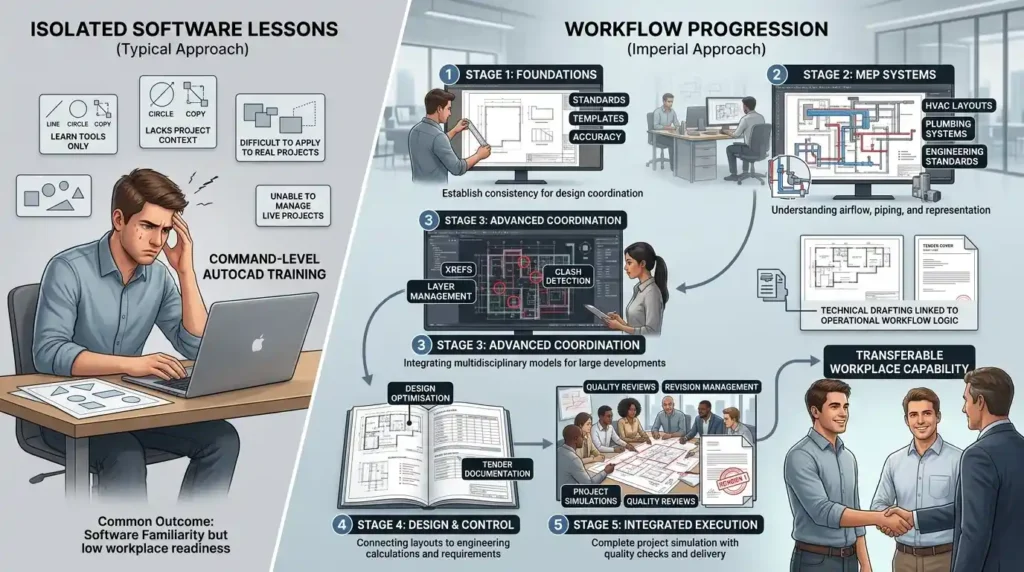
Many AutoCAD training programmes focus heavily on software commands. Participants learn drawing tools but remain unable to manage live engineering projects. Corporate employers typically require more than drafting capability. They expect professionals to understand design sequence, revision management, coordination procedures, and deliverable standards.
This programme uses progressive module sequencing to simulate realistic project development.
The first stage focuses on AutoCAD standards, templates, scaling practices, and drafting accuracy. These fundamentals establish consistency for later design coordination tasks. Participants learn how corporate engineering environments standardise documentation.
The second stage introduces HVAC layouts and plumbing drafting systems. Here, participants move beyond simple line drawing and begin understanding airflow paths, duct routing, pipe systems, and engineering representation standards.
The third stage expands into advanced coordination workflows. Xrefs, layer management, clash detection, annotations, and multidisciplinary referencing are integrated into project-style exercises. This reflects real MEP coordination environments used in large commercial developments.
The fourth stage addresses design optimisation, calculations, and documentation control. Participants learn how layouts connect with engineering calculations, tender requirements, and approval documentation.
The final stage focuses on integrated project execution. Learners complete project simulations involving HVAC and plumbing layouts, quality reviews, revision management, and final drawing delivery.
Imperial Corporate Training Institute uses this staged structure because engineering performance improves when technical drafting is linked to operational workflow logic. Participants therefore develop transferable workplace capability rather than isolated software familiarity.
What specific technical skills and competencies will participants develop?
Participants develop measurable competencies in HVAC drafting, plumbing layout design, schematic interpretation, MEP coordination, AutoCAD documentation management, design review processes, BIM integration, and corporate engineering workflow execution for commercial, industrial, and infrastructure-based mechanical project environments.
The programme develops both technical production skills and coordination-based engineering competencies.
HVAC Drafting and Mechanical Layout Skills
Participants learn how to produce HVAC duct layouts, airflow routing systems, diffuser placement strategies, and coordinated mechanical drawings. They also work with block creation, annotations, and layer organisation for professional engineering documentation.
The course introduces HVAC load calculation integration and equipment placement planning. Participants therefore understand not only drafting procedures but also system performance considerations affecting layout design.
Plumbing and Drainage Documentation Skills
Plumbing design training includes hot water systems, cold water systems, drainage coordination, riser diagrams, and slope calculations. Participants also learn pipe sizing principles and fixture coordination.
Corporate plumbing documentation standards are integrated throughout the exercises. Imperial Corporate Training Institute therefore prepares participants to produce documentation suitable for construction and facilities environments.
MEP Coordination Competencies
One of the strongest technical outcomes involves multidisciplinary coordination.
Participants learn:
- Clash detection workflows
- Space management procedures
- Xref coordination methods
- Annotation management
- Layer standardisation
- Documentation sequencing
- Revision control systems
These skills are essential in projects involving multiple engineering disciplines and coordinated approval procedures.
BIM and Revit Integration Understanding
The programme also addresses coordination between AutoCAD and BIM-based environments. Participants learn how 2D drafting integrates into larger digital engineering workflows involving Revit and multidisciplinary modelling systems.
This integration is increasingly important in organisations transitioning toward BIM-supported project delivery.
Quality Assurance and Review Skills
Imperial Corporate Training Institute includes design review and quality assurance procedures within the curriculum. Participants conduct audits for drawing accuracy, compliance verification, and discrepancy identification.
This creates practical competency for engineering review environments where technical accuracy directly affects procurement, installation, and project delivery timelines.
How does the programme distinguish P&IDs from schematic drawings and HVAC layouts?
The programme differentiates P&IDs, schematic drawings, and HVAC layouts by teaching their separate engineering purposes, documentation logic, coordination functions, and drafting outputs within corporate MEP project workflows and multidisciplinary building services design environments requiring technical precision and communication clarity.
Confusion between these drawing categories often creates operational inefficiencies in engineering teams. Professionals may incorrectly treat schematic diagrams as installation drawings or misinterpret layout drawings as process documentation.
Imperial Corporate Training Institute addresses this issue through structured drawing interpretation and documentation exercises.
P&IDs are presented as process-oriented communication tools. Their role involves illustrating system relationships, equipment functions, control devices, instrumentation paths, and operational sequences.
Schematic drawings simplify system logic and design relationships. These drawings focus on conceptual system understanding rather than physical installation accuracy.
HVAC layout drawings differ because they represent physical positioning, routing dimensions, duct placement, equipment location, and installation coordination within actual building spaces.
The programme helps participants understand how these documentation layers interact during real engineering projects. This distinction becomes especially important during project reviews, multidisciplinary coordination meetings, and construction implementation stages.
Professionals evaluating the relationship between schematic workflows and AutoCAD drafting structures can review:
How Does AutoCAD HVAC Training Distinguish P&IDs from Schematic Drawings? for additional technical comparison context.
Imperial Corporate Training Institute uses practical drafting exercises to reinforce these distinctions. Participants therefore move beyond theoretical definitions and apply documentation logic within coordinated MEP workflows.
How is the training delivered and assessed in practical corporate learning environments?
Imperial Corporate Training Institute delivers the programme through structured technical workshops, guided drafting exercises, project simulations, coordinated assignments, and engineering review activities designed to replicate corporate MEP documentation environments and measurable professional performance expectations across multidisciplinary teams.
The programme is designed for professional learners rather than academic engineering theory audiences. Training delivery therefore prioritises application, coordination, and documentation accuracy.
Participants engage in practical AutoCAD drafting sessions aligned with HVAC and plumbing project scenarios. Exercises simulate real corporate engineering outputs involving layout production, system coordination, documentation preparation, and drawing revisions.
The training can support multiple delivery formats depending on organisational requirements:
- Instructor-led workshops
- Corporate onsite delivery
- Online guided technical training
- Hybrid learning structures
- Team-based engineering exercises
Imperial Corporate Training Institute uses structured progression so participants develop competency incrementally instead of encountering disconnected software demonstrations.
Assessment activities are integrated throughout the programme.
Technical Assignments
Participants complete drafting tasks involving:
- HVAC layouts
- Plumbing system documentation
- Schematic coordination
- Annotation management
- Drawing standard implementation
These assignments test practical drafting accuracy and documentation consistency.
Simulation-Based Exercises
Project simulations replicate engineering coordination environments. Participants work with layered documentation, design revisions, and multidisciplinary coordination processes similar to live MEP projects.
Quality Review Activities
The course includes design audit exercises where participants identify documentation discrepancies and apply corrective drafting procedures.
Documentation and Presentation Tasks
Participants also prepare professional deliverables including:
- Legend sheets
- Pipe schedules
- Bills of materials
- Coordinated drawing packages
- Final as-built documentation
Imperial Corporate Training Institute uses these assessment structures because engineering competency must be measurable through practical deliverable quality rather than theoretical examination alone.
What workplace results can organisations and professionals expect after completion?
Participants completing the programme typically improve drafting accuracy, coordination efficiency, documentation consistency, MEP communication capability, and project workflow management while organisations benefit from reduced design revisions, improved interdisciplinary collaboration, and stronger engineering documentation performance across corporate construction environments.
The programme supports operational performance improvement across several engineering functions.
Improved Technical Documentation Quality
Participants develop stronger control over layer management, annotation systems, standards implementation, and coordinated documentation structures. This reduces inconsistencies in engineering submissions.
Better Coordination Between Departments
MEP projects require coordination between HVAC engineers, plumbing specialists, electrical teams, consultants, and project managers. Participants therefore gain practical communication competency through shared documentation understanding.
Imperial Corporate Training Institute structures the programme to support collaboration within multidisciplinary engineering teams.
Reduced Design Revision Cycles
Many revision delays occur because schematic intent is incorrectly translated into installation layouts. Improved understanding of drawing relationships helps reduce coordination errors during review stages.
Stronger Engineering Workflow Management
Participants learn version control procedures, document management methods, and review workflows aligned with corporate engineering operations.
This is particularly valuable for:
- Construction companies
- Infrastructure development firms
- Facilities management departments
- Engineering consultancies
- Corporate maintenance teams
Increased Professional Capability in BIM-Linked Environments
The integration of AutoCAD workflows with BIM and Revit coordination improves adaptability for organisations transitioning toward digital engineering delivery systems.
Imperial Corporate Training Institute therefore supports both immediate drafting competency and long-term workflow development within evolving engineering environments.
How does enrollment work, and who should apply for this programme?
The programme is designed for engineering professionals, MEP specialists, technical draftsmen, project coordinators, facility management personnel, and graduates seeking structured HVAC and plumbing drafting competency aligned with corporate engineering documentation standards and multidisciplinary mechanical system coordination requirements.
The course is appropriate for professionals already working within construction, engineering, facilities, or infrastructure sectors.
Suitable participants include:
- Mechanical design engineers
- HVAC drafting professionals
- MEP coordinators
- AutoCAD technicians
- Plumbing system designers
- Engineering consultants
- Facility management teams
- Engineering graduates entering corporate roles
Imperial Corporate Training Institute structures the programme for participants requiring operational drafting capability rather than introductory software familiarity alone.
Discover More from Our Guide Library:
Does Imperial’s HVAC Programme Include Hot Water System Drawing Exercises?
How Does Imperial’s HVAC Programme Accelerate Junior Engineer Development?
Applicants benefit most when they need to:
- Improve MEP drafting accuracy
- Understand schematic coordination
- Work with HVAC and plumbing documentation
- Support BIM-linked workflows
- Produce corporate engineering deliverables
- Strengthen multidisciplinary project communication
The completion path includes progressive module participation, practical drafting exercises, project simulations, and technical review activities. Participants who complete the programme gain structured competency aligned with corporate MEP documentation requirements.
Professionals seeking structured technical training in HVAC and plumbing drafting workflows can apply for course access through the: