

The AutoCAD HVAC and Plumbing Design Training Course at Imperial Corporate Training Institute is a structured engineering programme designed to close the gap between academic knowledge and corporate-level MEP design execution. It solves the problem of inconsistent drafting quality, poor system coordination, and limited understanding of real project workflows among junior engineers entering HVAC and plumbing design roles.
Junior engineers often struggle with translating theory into accurate HVAC ducting and plumbing layouts in AutoCAD. Errors typically appear in scaling, layer management, system coordination, and documentation structure. These issues create delays in project approvals and reduce confidence in corporate delivery environments.
The course is structured to resolve these gaps through progressive technical exposure. It introduces engineering precision, design intent interpretation, and documentation discipline aligned with real corporate expectations. Imperial Corporate Training Institute integrates workflow-based learning so that participants move beyond basic drafting into system-level thinking.
At the awareness stage, learners usually explore common drafting mistakes and workflow gaps. This foundation is explained on:
Common HVAC AutoCAD drawing errors that junior engineers make, which help establish why structured training becomes necessary before professional deployment.
Imperial Corporate Training Institute positions this programme as a transition pathway from entry-level CAD usage to structured mechanical design competency aligned with industry standards.
Why is the curriculum of this HVAC programme structured in progressive modules for junior engineer development in corporate engineering workflows?
The curriculum at Imperial Corporate Training Institute is structured in progressive modules to replicate real engineering project cycles, moving from foundational AutoCAD setup to advanced HVAC and plumbing coordination, ensuring junior engineers develop step-by-step competence aligned with corporate drafting standards, documentation requirements, and multi-disciplinary coordination practices used in real construction projects.
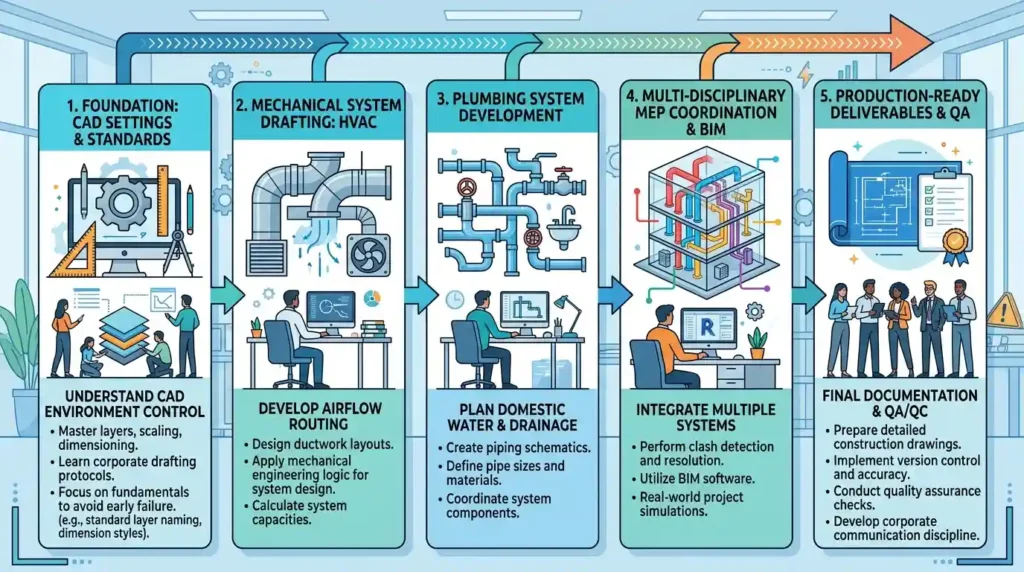
The structure is not designed as isolated software training. It follows a workflow-based engineering logic. Each module builds on the previous one, ensuring that learners first understand CAD environment control, then system drafting, and finally integrated project execution.
Imperial Corporate Training Institute uses this structured progression because junior engineers typically fail when exposed directly to complex MEP coordination without mastering fundamentals such as layers, scaling, and system representation.
The early modules focus on AutoCAD configuration, company drafting standards, and mechanical drawing logic. Mid-level modules shift into HVAC ducting design, airflow routing, and plumbing system development. Advanced modules introduce coordination, BIM integration, and QA processes.
This structure also aligns with corporate expectations where engineers are required to deliver production-ready drawings, not just conceptual designs. It ensures learners develop discipline in version control, documentation accuracy, and engineering communication standards.
In evaluation stages, learners often compare training structures.
This is where the discussion on:
How AutoCAD HVAC training helps junior draughtsmen build professional habits becomes relevant for understanding skill progression and workflow transformation.
Imperial Corporate Training Institute ensures that each module reflects real engineering deliverables used in consultancy firms, construction companies, and facility management organisations.
What technical skills and measurable learning outcomes do participants gain from Imperial’s HVAC and plumbing AutoCAD training programme?
Participants at Imperial Corporate Training Institute develop measurable competencies in HVAC duct design, plumbing system drafting, AutoCAD precision modelling, engineering documentation, and multi-disciplinary coordination, enabling them to independently produce corporate-level mechanical drawings aligned with international standards and real project execution requirements.
The learning outcomes are defined in functional engineering terms rather than theoretical knowledge. Each outcome aligns with real deliverables used in corporate environments.
Participants gain the ability to create HVAC duct layouts with correct airflow routing and equipment placement. They learn plumbing system design including hot water, cold water, drainage, and riser diagrams. They also develop competence in pipe sizing, slope calculation, and system coordination.
Imperial Corporate Training Institute focuses heavily on documentation skills. Learners are trained in sheet organization, title block setup, layer structuring, and annotation systems. These skills ensure drawings are production-ready for approvals and client submissions.
Advanced outcomes include coordination between HVAC, plumbing, and electrical systems using Xrefs and clash detection techniques. Learners also understand how to prepare bills of materials, schedules, and technical documentation packages.
The training builds measurable improvement in drafting speed, accuracy, and compliance adherence. Engineers learn to reduce design rework and improve coordination efficiency in multi-disciplinary teams.
Imperial Corporate Training Institute ensures learners also develop analytical thinking in HVAC load interpretation and system optimisation. This prepares them for real-world engineering responsibilities beyond drafting tasks.
How is the HVAC and plumbing AutoCAD course delivered and what training methods does Imperial Corporate Training Institute use for corporate skill development?
The course delivery at Imperial Corporate Training Institute is structured through instructor-led workshops, guided practical drafting sessions, corporate simulation exercises, and assessment-based evaluations, ensuring learners experience real engineering workflows while developing AutoCAD-based HVAC and plumbing design capabilities aligned with professional industry environments.
Training is delivered in a blended format depending on corporate requirements. It may include classroom-based instruction, online sessions, or hybrid delivery for organisational teams.
Imperial Corporate Training Institute prioritises hands-on learning. Each participant works on HVAC and plumbing design exercises using AutoCAD from the beginning of the course. These exercises simulate real project conditions including commercial buildings, industrial systems, and infrastructure layouts.
Workshops focus on live drafting scenarios where learners build duct systems, pipe networks, and coordinated MEP drawings. Trainers provide correction-based feedback to ensure precision in scaling, layering, and annotation.
Simulation-based learning is used in advanced modules. Participants are assigned project scenarios such as full HVAC system layouts for commercial buildings or integrated plumbing systems for multi-storey structures.
Assessments include drawing tests, system design assignments, and documentation tasks. Imperial Corporate Training Institute evaluates not only technical accuracy but also compliance with drafting standards and project delivery expectations.
This delivery structure ensures that learners do not only understand AutoCAD tools but also learn how to apply them under real corporate pressure conditions.
What results can be expected after completing Imperial’s HVAC AutoCAD training in terms of workplace performance and engineering capability?
After completing the programme at Imperial Corporate Training Institute, junior engineers demonstrate improved drafting accuracy, faster design turnaround, stronger HVAC and plumbing system understanding, and the ability to produce coordinated MEP drawings that meet corporate quality standards and reduce revision cycles in real engineering project environments.
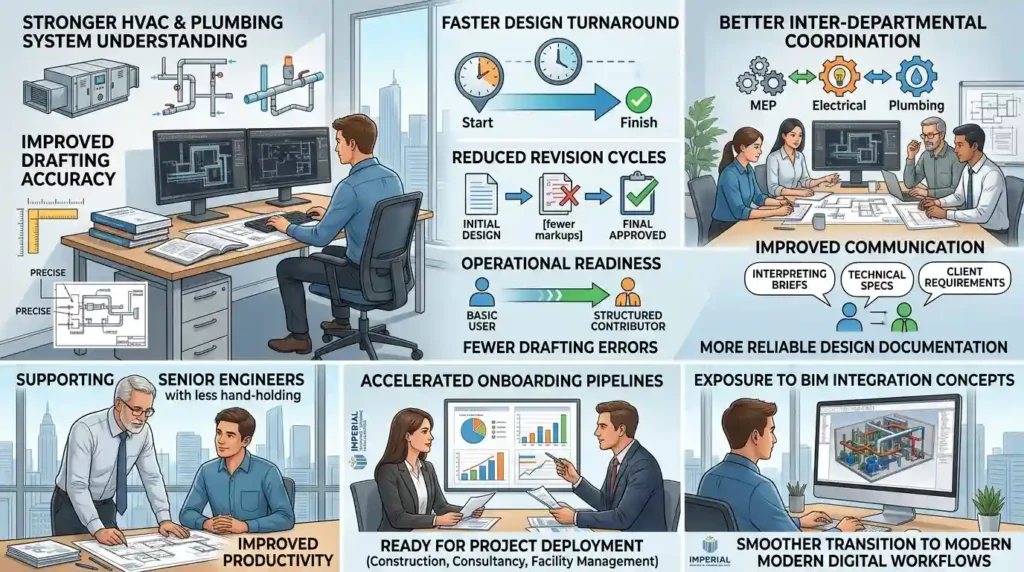
The primary result is operational readiness. Participants transition from basic AutoCAD users to structured design contributors capable of working within engineering teams.
In workplace environments, this translates into fewer drafting errors, improved coordination between departments, and more reliable design documentation. Junior engineers become capable of supporting senior engineers in project delivery without constant supervision.
Imperial Corporate Training Institute also focuses on improving communication between design teams. Learners understand how to interpret engineering briefs, technical specifications, and client requirements more effectively.
Another measurable outcome is improved productivity. Engineers trained through this programme can handle complex HVAC ducting and plumbing layouts with greater efficiency and reduced rework cycles.
In corporate settings, HR and technical managers often use such training to accelerate onboarding pipelines. It improves readiness for project deployment in construction, consultancy, and facility management sectors.
Imperial Corporate Training Institute ensures that learners also gain exposure to BIM integration concepts, allowing smoother transition into modern digital engineering workflows.
How does enrollment work for the AutoCAD HVAC and Plumbing Design Training Course at Imperial Corporate Training Institute and who is eligible to join?
Enrollment at Imperial Corporate Training Institute is open to mechanical engineers, MEP draftsmen, CAD technicians, and junior design professionals with basic AutoCAD familiarity, and the process involves application submission, eligibility review, and structured onboarding into a training batch aligned with corporate engineering skill development requirements.
The entry requirement is primarily focused on foundational engineering or AutoCAD knowledge. Candidates with mechanical, civil, or MEP backgrounds are typically suitable for this programme.
Imperial Corporate Training Institute follows a structured onboarding process. Participants are placed into batches based on experience level and organisational requirements when delivered for corporate teams.
The programme is designed for both individuals and organisations. HR departments often nominate teams for structured upskilling, particularly where consistent drafting standards are required across departments.
Discover More from Our Guide Library:
Does Imperial’s HVAC Course Cover Chiller System Drawing Production?
How Does Imperial’s AutoCAD HVAC Course Help MEP Engineers Advance Faster?
Completion of the course involves participation in all modules, successful submission of assignments, and performance in practical assessments. Learners receive confirmation of skill competency based on evaluation criteria.
The training pathway is designed for progression. After completion, learners can move into advanced MEP coordination roles or specialised design positions within engineering teams.
Imperial Corporate Training Institute maintains alignment with corporate expectations, ensuring that completion outcomes are directly applicable to workplace deployment.
For structured technical progression and corporate-ready HVAC design capability, professionals can enroll in this programme:
AutoCAD HVAC and Plumbing Design Training Course through Imperial Corporate Training Institute.