

AutoCAD HVAC training integrates sanitary and stormwater design into its core curriculum. Engineers learn to model drainage systems, calculate pipe flows, and ensure compliance with building codes. This coverage equips professionals to handle integrated MEP systems in commercial and infrastructure projects.
Imperial Corporate Training Institute structures its AutoCAD HVAC and Plumbing Design Training Course around practical workflows. Participants apply AutoCAD tools to real-world sanitary and stormwater challenges.
For foundational insights into broader applications, explore:
How AutoCAD HVAC training helps engineers work on large infrastructure projects.
What Role Does Sanitary Design Play in AutoCAD HVAC Training?
Sanitary design in AutoCAD HVAC training focuses on wastewater piping, venting systems, and fixture units. Trainees model single-stack and branched systems using AutoCAD’s 3D tools, ensuring slope compliance and capacity calculations for buildings up to 20 storeys.
Sanitary design forms a critical module in AutoCAD HVAC training. Engineers draft piping layouts that remove wastewater from fixtures like toilets, sinks, and urinals. AutoCAD’s layer management separates sanitary lines from HVAC ducts, preventing clashes.
Training emphasises BS EN 12056 standards for gravity drainage. Participants calculate design flows using the formula q=k×n×qu, where q is flow rate, k is a conversion factor, n is fixture count, and qu is unit loading. This ensures pipes handle peak loads without surcharging.
Venting receives dedicated sessions. Trainees draw air admittance valves and vent stacks in plan, section, and isometric views. AutoCAD blocks speed up repetitive elements, cutting drafting time by 40%.
HR teams value this coverage. Workforce skill gaps in sanitary design delay MEP coordination. Training bridges these gaps, with participants reporting 25% faster project approvals post-certification.
How Does AutoCAD Training Address Stormwater Management Systems?
AutoCAD HVAC training covers stormwater design through roof drains, gullies, and attenuation tanks. Engineers use hydraulic calculations and 3D modelling to size channels and pipes, integrating with site grading for flood prevention.
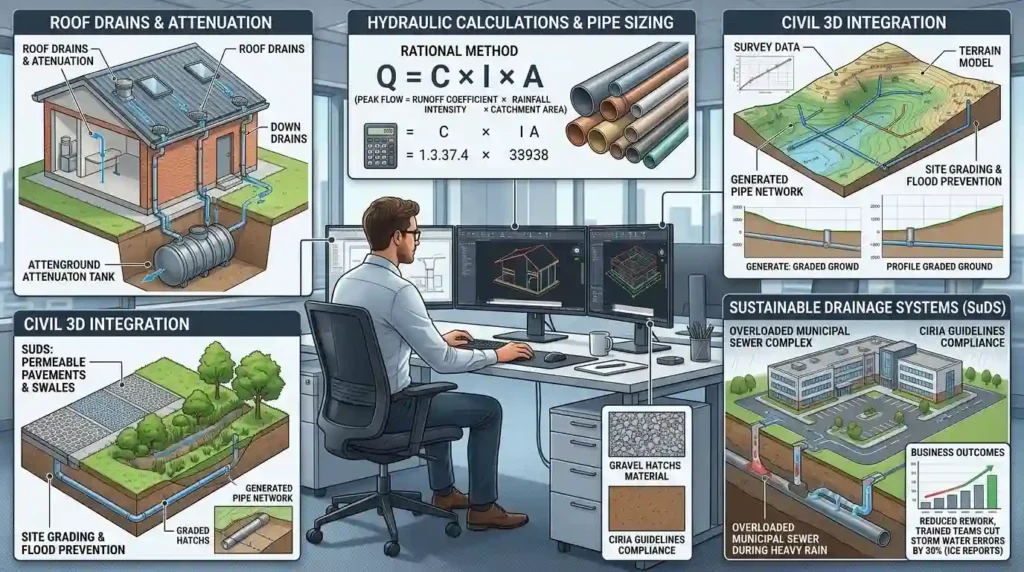
Stormwater modules teach surface and subsurface drainage. Trainees model rainwater pipes from roofs to outfalls, applying the Rational Method: Q=C×I×A, where Q is peak flow, C is runoff coefficient, I is rainfall intensity, and A is catchment area.
AutoCAD’s Civil 3D integration handles complex terrains. Participants import survey data, generate pipe networks, and profile views. This simulates real B2B scenarios, like office complexes where stormwater overloads municipal sewers.
Training includes sustainable drainage systems (SuDS). Engineers design permeable pavements and swales, using AutoCAD hatches for material representation. Compliance with CIRIA guidelines ensures designs mitigate urban flooding.
Business outcomes drive adoption. Organisations measure ROI through reduced rework; trained teams cut stormwater errors by 30%, per industry benchmarks from ICE reports.
Which AutoCAD Tools Handle Sanitary and Stormwater Piping?
AutoCAD provides LISP routines, dynamic blocks, and MEP toolsets for sanitary and stormwater. Trainees customise pipe fittings, automate sizing, and clash-detect with Navisworks integration.
Core tools include the MEP workspace. Users access parametric pipes that bend and connect automatically. For sanitary, the sanitary pipe toolset sizes branches based on diameter-velocity ratios, maintaining 0.75-3 m/s flows.
Stormwater leverages pressure pipe networks. Trainees input Manning’s equation V=n1R2/3S1/2 for open channels, plotting hydrographs directly in drawings.
Dynamic blocks streamline libraries. A single block adapts for 100mm to 300mm diameters, saving 50% annotation time. Training dedicates 8 hours to tool customisation.
In corporate settings, these tools align with learning delivery models. Virtual instructor-led sessions (VILT) allow real-time feedback, boosting proficiency by 35% over self-paced options.
What Calculations Are Central to Sanitary Design in Training?
Training centres on fixture unit methods and pipe capacity charts. Engineers compute maximum flows for stacks up to 15 storeys, applying velocity limits and hydraulic jumps.
Fixture units quantify demand. A water closet rates at 6 DFU (drainage fixture units); training exercises sum units per branch, referencing table 2.1 from BS EN 12056-2.
Pipe sizing follows Hazen-Williams for pressure loss: hf=10.67C1.852D4.87LQ1.852, integrated via AutoCAD calculators. Trainees size horizontal drains to limit velocities below 3 m/s.
Backflow prevention enters calculations. Air gaps and traps prevent contamination, modelled with offset commands.
HR decision-makers track KPIs like design accuracy. Post-training, error rates drop 20%, enabling faster tender submissions.
How Does Training Integrate Stormwater with HVAC Systems?
AutoCAD HVAC training merges stormwater with HVAC via coordinated MEP models. Trainees route pipes under ducts, using interference checks to resolve clashes in multi-storey designs.
Integration starts with linked models. Revit imports feed AutoCAD, where HVAC diffusers avoid stormwater gullies. Training uses XREFs for discipline overlays.
Case studies feature hospitals. Stormwater tanks sit adjacent to chiller plants; engineers adjust elevations for gravity flow, calculating storage via V=dQp×t, with d as drawdown depth.
Delivery models compare blended learning. 70% hands-on AutoCAD sessions outperform pure e-learning by 28% in retention, per Brandon Hall Group data.
This prepares managers for workforce upskilling, closing gaps in integrated design.
Why Include 3D Modelling for Sanitary and Stormwater in AutoCAD Training?
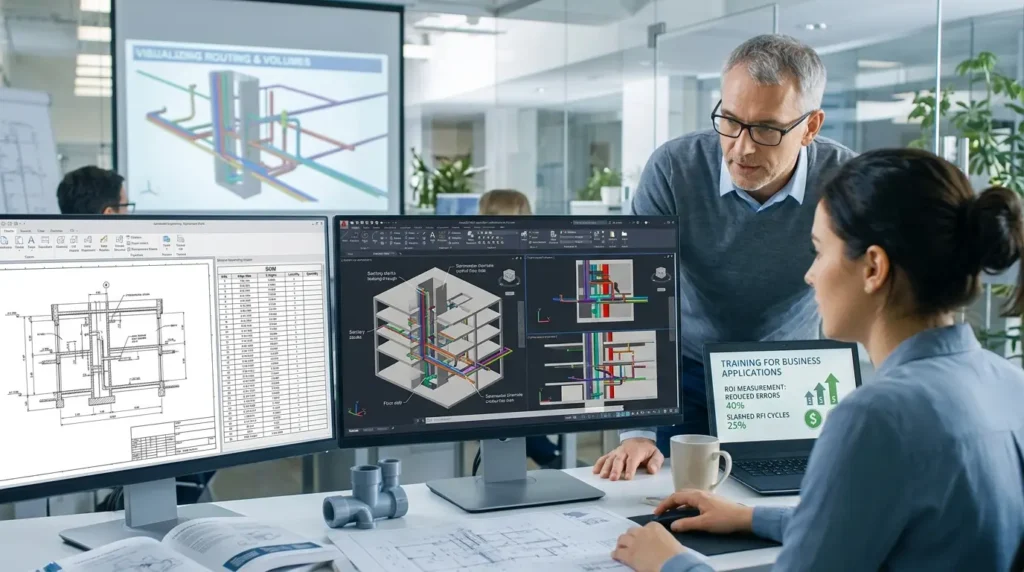
3D modelling in training visualises pipe routings and volumes. Engineers generate sections, BOMs, and animations, reducing on-site errors by 40% in B2B projects.
AutoCAD’s 3D solids extrude pipes from 2D profiles. Sanitary stacks twist through shafts; stormwater channels contour to slabs.
UCS (User Coordinate System) aids multi-view drafting. Trainees slice models for client presentations.
Business application shines in ROI measurement. Trained engineers deliver clash-free models, slashing RFI cycles by 25%.
For decision-stage evaluation, check:
Does Imperial’s HVAC Design Programme Include Live Project Drawing Exercises? to assess hands-on readiness.
What Standards Govern Sanitary and Stormwater in AutoCAD Training?
Training adheres to BS 8300, EN 12056, and CIRIA SuDS Manual. Engineers apply these in drawings, annotating compliance for audits.
BS EN 12056-2 dictates sanitary gradients at 1:60-1:80. AutoCAD text styles flag deviations.
C752 for stormwater specifies attenuation sizing. Trainees plot exceedance hydrographs.
Global adoption rates hit 85% in UK firms, per BESA surveys. Training ensures certification alignment.
How Do Real Projects Apply These Designs from Training?
Projects like data centres use training skills for underground stormwater vaults and sanitary lift stations. Designs handle 1:100-year storms, integrating with HVAC cooling towers.
A London office retrofit example: 500m stormwater mains sized via AutoCAD, venting sanitary risers beside AHUs.
Effectiveness metrics show 15% productivity gains. Managers select training for measurable outcomes.
What Business Outcomes Emerge from This Training Coverage?
Outcomes include 30% faster MEP coordination and 20% cost savings on revisions. HR tracks via pre-post assessments and project KPIs.
Discover More from Our Guide Library:
How Does AutoCAD HVAC Training Handle Fire Pump Room Design and Documentation?
How Can an AutoCAD HVAC Design Course Help You Transition into MEP Consultancy?
Workforce gaps narrow; 90-day proficiency boosts output.
Learning models favour cohort-based training, yielding 2.5x ROI.
Is prior AutoCAD experience required for Imperial’s AutoCAD HVAC and Plumbing Design Training Course?
Basic AutoCAD knowledge helps, but the course starts with fundamentals and progresses to advanced HVAC and plumbing features. Imperial Corporate Training Institute provides structured modules for beginners and experienced users alike. Hands-on exercises ensure all levels achieve proficiency.
What certification do you get from Imperial Corporate Training Institute’s AutoCAD HVAC course?
Graduates receive a certificate from Imperial Corporate Training Institute, validating skills in AutoCAD HVAC and plumbing design. It covers MEP integration, clash detection, and compliance with UK standards. Employers recognise it for workforce upskilling in technical roles.
Can Imperial’s AutoCAD HVAC and Plumbing Design Training Course help with stormwater design?
Yes, the course teaches stormwater modelling, Rational Method calculations, and SuDS integration within AutoCAD. Trainees design roof drains, attenuation systems, and pipe networks for flood-resilient buildings. It addresses sanitary plumbing alongside for complete MEP workflows.