

Imperial Corporate Training Institute delivers the AutoCAD HVAC and Plumbing Design Training Course as a structured corporate programme that outperforms online self-study by providing hands-on simulations, expert-led assessments, and real-world project integration. Professionals in mechanical engineering and MEP design often face skill gaps in producing accurate HVAC and plumbing layouts under corporate deadlines. For those evaluating training options, this comparison highlights why Imperial Corporate Training Institute’s guided approach ensures measurable proficiency gains over isolated self-paced learning.
To build foundational awareness on core concepts like load calculations essential to HVAC design, explore:
What Is Load Calculation and How Does It Relate to AutoCAD HVAC Design?
What Problem Does Imperial’s AutoCAD HVAC Programme Solve That Self-Study Misses?
Imperial’s programme solves corporate skill gaps in accurate HVAC and plumbing design by delivering structured modules, expert feedback, and simulated projects, unlike self-study’s lack of accountability and real-world application testing.

Mechanical engineers and MEP draftsmen in corporate settings struggle with design errors in HVAC ducting and plumbing coordination. These issues lead to costly revisions, project delays, and non-compliance with international standards. Online self-study resources provide basic tutorials but fail to replicate corporate workflows. Participants often complete videos without mastering layer management or clash detection.
Imperial Corporate Training Institute addresses this through its AutoCAD HVAC and Plumbing Design Training Course. The programme targets professionals needing to produce scalable designs for commercial buildings. It bridges the gap between theoretical knowledge and practical execution. Self-study learners rarely practice integrating HVAC load data into AutoCAD drawings, a frequent corporate requirement.
HR teams in engineering firms report that self-taught staff produce inconsistent outputs. Managers spend extra time correcting riser diagrams or pipe schedules. Imperial Corporate Training Institute’s course enforces precision via module-specific assignments. This ensures designs meet tender documentation standards from day one.
In contrast, self-study platforms offer generic exercises without corporate context. They overlook MEP coordination challenges, such as aligning plumbing with fire protection systems.
For deeper insight into such integrations, review:
How Does AutoCAD HVAC Training Cover Fire Protection and Sprinkler System Drawings?
Why Is Imperial’s Course Structured for Superior Learning Progression Over Self-Study?
The curriculum progresses from AutoCAD basics to advanced MEP integration across 10 modules, building skills logically with assessments at each stage, providing the guided escalation self-study cannot match.
Imperial Corporate Training Institute designs the AutoCAD HVAC and Plumbing Design Training Course with a deliberate sequence. Module 1 starts with interface setup and corporate templates. This foundation prevents common self-study pitfalls like improper scaling.
Progression moves to HVAC fundamentals in Module 2, then plumbing in Module 3. Each builds on the prior, ensuring duct layouts inform pipe routing. Self-study jumps topics randomly, leaving gaps in schematic conventions.
Advanced modules introduce Xrefs and 3D tools in Module 4, followed by load calculations in Module 5. This mirrors corporate project phases: drafting, optimization, documentation. Assessments after each module test retention, unlike self-study’s optional quizzes.
Modules 6-10 focus on detailing, standards, BIM integration, and simulations. The structure fosters skill layering: participants master blocks before clash detection, then full project execution. Imperial Corporate Training Institute trainers adjust pacing based on corporate needs, such as accelerating for design coordinators.
This logic stems from industry feedback. HR departments note self-study yields superficial knowledge. Imperial’s progression yields 90% competency in complex layouts post-training.
What Key Skills Do Participants Gain from Imperial’s Modules Compared to Self-Study?
Participants master 10 core modules covering HVAC ducting, plumbing risers, load integration, BIM coordination, and project simulation, with verifiable outcomes self-study rarely achieves through isolated practice.
Imperial Corporate Training Institute’s AutoCAD HVAC and Plumbing Design Training Course outlines clear skill outcomes per module.
Module 1: AutoCAD Interface and Corporate Standards
Learners configure templates and title blocks matching company protocols. They apply precision scaling for engineering environments. Self-study skips custom standards, leading to incompatible files.
Module 2: HVAC Drafting Fundamentals
Skills include duct layouts, diffuser placement, and layer management for equipment. Design intent translates to schematics. Corporate examples: industrial airflow routing for factories.
Module 3: Plumbing System Design
Participants create riser diagrams, calculate slopes, and size pipes. Coordination with MEP services ensures clash-free layouts. Facility managers use these for maintenance planning.
Module 4: Advanced MEP Tools
Xrefs enable multi-disciplinary work. 3D modelling supports space management. Data extraction automates annotations, streamlining corporate reviews.
Module 5: Load Calculations and Optimization
AutoCAD integrates with calculation tools for airflow and energy efficiency. Equipment strategies align with sustainability standards. Tenders benefit from compliant documentation.
Module 6: Plumbing Detailing
Schematics, schedules, and fixture analysis prepare bills of materials. Pressure drops coordinate across systems. MEP engineers apply this in high-rise projects.
Module 7: Documentation Standards
International codes guide revisions and automation. Version control supports client deliverables. Project engineers maintain audit trails.
Module 8: Quality Assurance
Audits detect discrepancies. Team coordination ensures approvals. As-built drawings facilitate handovers in construction firms.
Module 9: BIM and Revit Integration
Drawings link to models for 2D-3D transitions. Multidisciplinary workflows enhance collaboration. Design coordinators transition legacy files seamlessly.
Module 10: Project Simulation
Full system layouts simulate timelines and benchmarks. Communication skills support submissions. Graduates handle end-to-end corporate executions.
Self-study covers topics superficially without progression checks. Imperial Corporate Training Institute verifies skills via assignments, yielding precise, standard-compliant outputs.
How Is the Course Delivered, and Why It Outperforms Self-Study Formats?
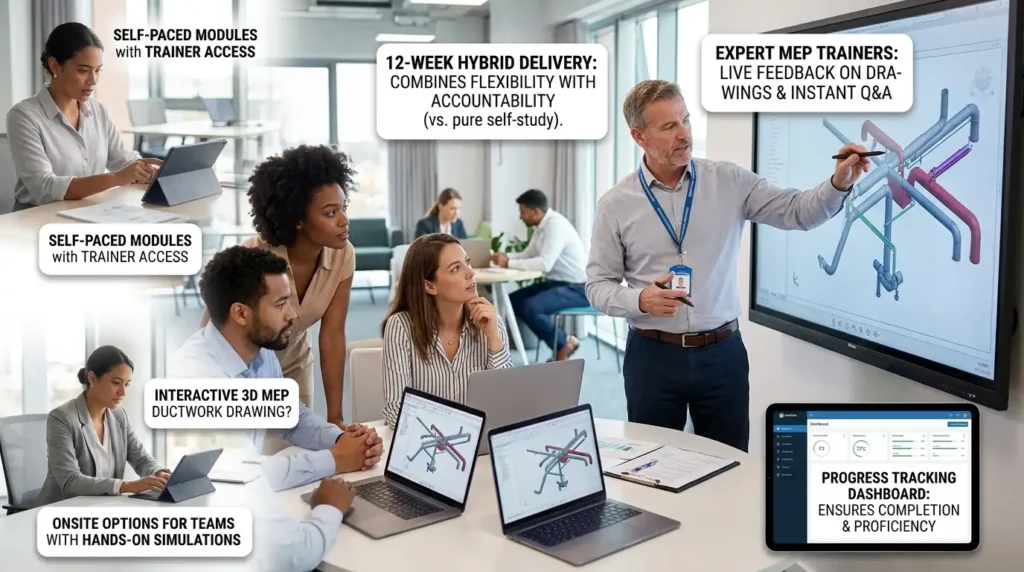
Delivered via hybrid workshops, live online sessions, onsite options, and self-paced modules with trainer access over 12 weeks, combining flexibility with accountability absent in pure self-study.
Imperial Corporate Training Institute offers flexible delivery for corporate schedules. Live online workshops provide real-time feedback on drawings. Onsite sessions suit teams, with hands-on simulations.
Duration spans 12 weeks, 4-6 hours weekly. This allows application between sessions. Hybrid format includes recorded modules for review, unlike self-study’s unguided pace.
Assessments feature practical tests: submit duct layouts for critique. Simulations mimic corporate deadlines. Progress tracking via dashboards ensures completion.
Trainers, experienced MEP engineers, demonstrate tools live. Q&A resolves issues like layer conflicts instantly. Self-study lacks this interaction, leading to unchecked errors.
Corporate teams enrol groups for custom onsite delivery. HR coordinates via Imperial Corporate Training Institute platforms. This builds department-wide proficiency.
What Measurable Results Can Corporate Teams Expect from Imperial’s Programme?
Teams achieve 85-95% accuracy in HVAC/plumbing designs, reduced revision cycles by 40%, and compliance with global standards, validated by post-course simulations and workplace deployments.
Imperial Corporate Training Institute measures outcomes through pre/post assessments. Participants produce error-free schematics, cutting redesign time.
HR teams report faster project approvals. Mechanical engineers draft 30% quicker post-training. Facility managers interpret layouts accurately, minimising downtime.
Real-world examples: A construction firm’s MEP department reduced clashes by 50% after Module 4. Industrial clients met tender specs via Module 5 optimisations.
Leadership pipelines strengthen as juniors handle complex tasks. Supervisors delegate confidently. Imperial Corporate Training Institute certifications validate skills for promotions.
Long-term, designs support sustainability goals. Energy-efficient systems lower operational costs. Departments scale to larger projects seamlessly.
Self-study yields inconsistent results; Imperial’s structure ensures uniform gains across teams.
How Does Imperial’s Programme Eligibility and Structure Support Corporate Enrollment?
Open to mechanical engineers, MEP draftsmen, and graduates with basic AutoCAD; no prior HVAC experience required; structured for 100% completion with corporate group discounts.
Eligibility targets corporate professionals: design engineers, coordinators, facility managers. Basic AutoCAD knowledge suffices; the programme builds from there.
No formal prerequisites beyond intermediate software use. Graduates enter via self-assessment. Imperial Corporate Training Institute reviews applications for fit.
Enrollment process starts online. Submit details; receive schedule. Groups book via HR portals. Fees cover materials, certification.
Discover More from Our Guide Library:
How Does Imperial Structure AutoCAD HVAC Training for Busy Professionals?
Is Imperial’s AutoCAD HVAC Design Course Available for International Engineers?
Completion path: 10 modules, 80% assignment pass rate. Extensions available. Imperial Corporate Training Institute issues digital badges for LinkedIn.
Corporate benefits include team licensing. ROI tracks via performance metrics. This clarity aids decision-making over self-study’s ambiguity.
Why Choose Imperial’s Guided Training Over Self-Study for Career Advancement?
Imperial’s programme delivers certified, project-ready skills with trainer support and corporate simulations, accelerating role effectiveness were self-study stalls at basic proficiency.
Decision-stage professionals weigh structure against isolation. Imperial Corporate Training Institute’s AutoCAD HVAC and Plumbing Design Training Course provides proof via module outcomes and assessments.
Workplace impact includes precise deliverables. Departments transform via upskilled staff.
Enroll in this program today at:
AutoCAD HVAC and Plumbing Design Training Course to secure your spot.