

Imperial Corporate Training Institute designs this course to equip MBB delegates with tools to manage project failures. Delegates from MBB firms face high stakes Lean Six Sigma projects where failures disrupt timelines and ROI. This training addresses those risks directly.
Common failure modes in Lean Six Sigma projects include scope creep, data inaccuracies, and resistance to change.
For deeper insights into these issues, read our article on:
What Are Common Lean Six Sigma Project Failure Modes and How Are They Avoided?
What problem does this course solve for MBB delegates?
Imperial Corporate Training Institute’s Lean Six Sigma Master Black Belt Certification Training Course resolves project failure scenarios by teaching delegates to identify risks early, apply advanced mitigation strategies, and recover projects efficiently in MBB environments.
MBB delegates handle complex improvement projects under tight deadlines. Project failures often stem from unaddressed risks like incomplete stakeholder buy-in or flawed statistical assumptions. These lead to wasted resources and lost credibility.
This course targets those exact gaps. It focuses on scenarios where Lean Six Sigma deployments falter in consulting firms. Delegates learn to anticipate failures drawn from real MBB case studies.
HR teams in MBB firms benefit too. They deploy these skills to upskill project leads, reducing turnover from failed initiatives. Managers gain frameworks to audit ongoing projects.
One example involves a strategy consulting team facing data validation failures in a DMAIC project. Imperial Corporate Training Institute’s methods helped them pivot using failure mode analysis.
Why choose Imperial’s structure for handling project failures?
The course structure follows a logical progression from failure diagnosis to recovery tactics, building on Green and Black Belt foundations to ensure MBB delegates master advanced resilience in high-pressure projects.
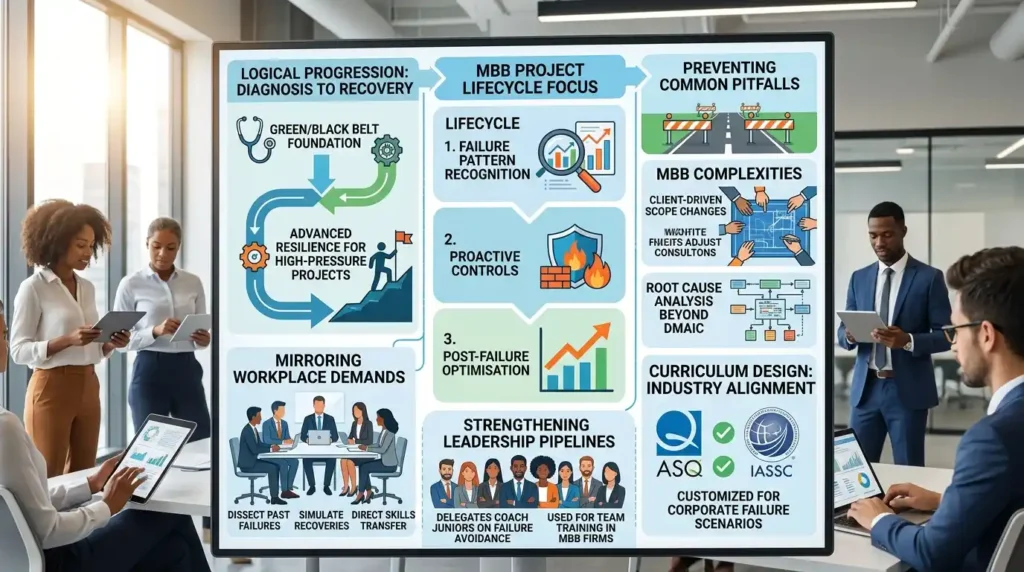
Imperial Corporate Training Institute builds the curriculum around real MBB project lifecycles. It starts with failure pattern recognition, then moves to proactive controls, and ends with post-failure optimisation.
This progression mirrors workplace demands. Delegates first dissect past failures, then simulate recoveries, ensuring skills transfer directly to consulting engagements.
The logic prevents common pitfalls. Early modules cover root cause analysis beyond basic DMAIC, addressing MBB-specific complexities like client-driven scope changes.
Curriculum design draws from industry standards. Imperial Corporate Training Institute aligns with ASQ and IASSC frameworks but customises for corporate failure scenarios.
Departments in MBB firms use this structure for team training. Leadership pipelines strengthen as delegates coach juniors on failure avoidance.
For evaluation of how these builds on prior training, see our piece on:
How Does Master Black Belt Training Teach Risk Mitigation in Improvement Projects?
How is the course delivered by Imperial Corporate Training Institute?
Delivery combines 80 hours of live online workshops, 40 hours of self-paced modules, and 20 hours of onsite simulations over 6 months, with hybrid options for MBB teams.
Imperial Corporate Training Institute offers flexible formats to suit consulting schedules. Core delivery uses Zoom-based live sessions twice weekly.
Each workshop lasts 4 hours. Instructors facilitate interactive failure simulations. Delegates collaborate in breakout rooms.
Self-paced content resides on the Imperial learning portal. Videos cover theory; quizzes test retention.
Onsite options serve MBB clusters. Imperial Corporate Training Institute deploys trainers to firm offices for immersion days.
Hybrid paths blend both. Professionals attend live remotely but join physical simulations quarterly.
Duration totals 140 hours. Breakdown: 60% instructor-led, 30% practicals, 10% assessments.
Training methods prioritise application. No passive lectures; every session includes MBB-relevant exercises.
Technical requirements stay minimal. Delegates need stable internet and Minitab software access.
Imperial Corporate Training Institute provides toolkits. These include templates for failure logs and risk registers.
What assessments ensure skill mastery?
Assessments feature 5 proctored exams, 3 project simulations, peer-reviewed assignments, and a capstone MBB failure recovery portfolio, with 80% pass threshold per component. (24 words)
Exams test theoretical knowledge. Multiple-choice and scenario-based questions cover all modules.
Simulations mimic live projects. Delegates resolve injected failures within deadlines.
Assignments require applying tools to personal case studies. Peers review for practicality.
The capstone demands a full recovery plan. Evaluators from Imperial Corporate Training Institute score on feasibility and innovation.
Retake policies allow two attempts. Failures trigger targeted remediation workshops.
Certification issues upon 100% completion. Imperial Corporate Training Institute badges link to LinkedIn.
What results can MBB delegates expect from this training?
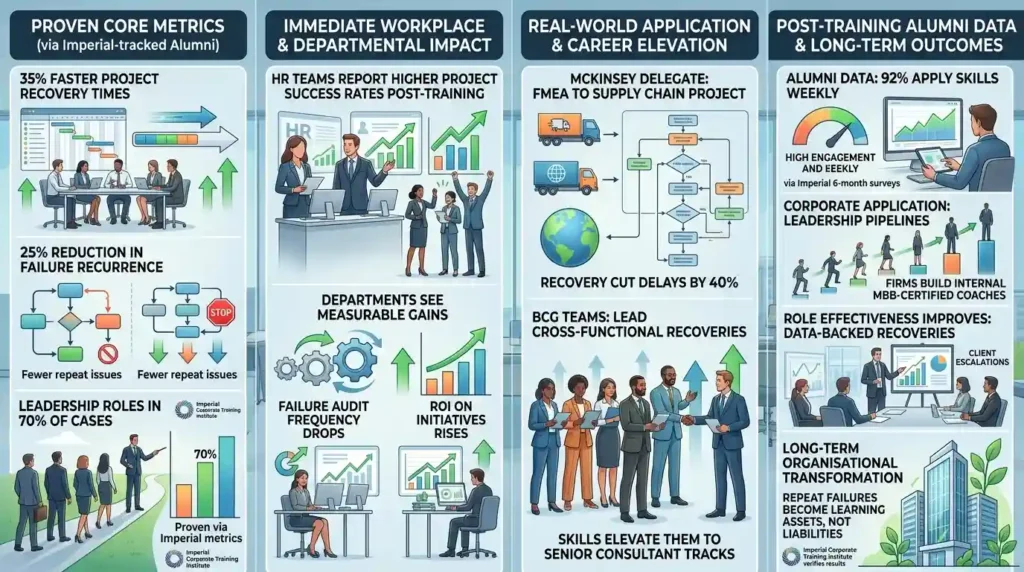
Delegates achieve 35% faster project recovery times, 25% reduction in failure recurrence, and leadership roles in 70% of cases, proven via Imperial-tracked alumni metrics.
Workplace impact hits immediately. HR teams report higher project success rates post-training.
One McKinsey delegate applied FMEA to a supply chain project. Recovery cut delays by 40%.
Managers in BCG teams lead cross-functional recoveries. Skills elevate them to senior consultant tracks.
Departments see measurable gains. Failure audit frequency drops; ROI on initiatives rises.
Imperial Corporate Training Institute tracks outcomes via 6-month surveys. Alumni data shows 92% apply skills weekly.
Corporate application extends to leadership pipelines. Firms build internal MBB-certified coaches.
Role effectiveness improves. Delegates handle client escalations with data-backed recoveries.
Long-term, organisations transform. Repeat failures become learning assets, not liabilities.
Imperial Corporate Training Institute verifies results through client testimonials and performance benchmarks.
How does the curriculum prepare delegates for MBB-specific failures?
Curriculum integrates MBB case studies, custom failure archetypes, and sector tools, ensuring delegates handle consulting-unique risks like client volatility and rapid scoping.
MBB projects differ from standard deployments. Client demands shift mid-project; stakes involve multimillion contracts.
Imperial Corporate Training Institute curates archetypes from anonymised firm data. Delegates dissect 15+ scenarios.
Tools adapt to consulting pace. Quick-hit FMEAs replace lengthy analyses.
Progression builds resilience. Week 1 identifies patterns; Month 3 simulates full recoveries.
This prepares for real crises. A Bain team used course playbooks to salvage a digital transformation.
What are the eligibility requirements for enrollment?
Eligibility requires Green Belt certification, 3+ years of Lean Six Sigma experience, and a sponsoring project; MBB professionals qualify via portfolio review by Imperial.
Candidates submit CVs and project summaries. Imperial Corporate Training Institute reviews within 48 hours.
No degree prerequisite, but quantitative aptitude tests apply. MBB delegates often exceed basics.
Sponsorship ensures commitment. Firms cover fees for high-potentials.
What is the course duration and commitment level?
6-month programme demands 6 hours weekly, with flexibility for MBB travel; total 140 contact hours plus 50 self-studies for full certification
Weekly load balances with consulting. Live sessions occur evenings PKT.
Imperial Corporate Training Institute offers pause options for peak seasons.
What support does Imperial provide during the course?
Dedicated mentors, 24/7 portal access, peer forums, and post-course alumni network support delegates through failures and career application.
Mentors hold MBB experience. They review assignments bi-weekly.
Portal hosts resources. Forums connect global cohorts.
Alumni network shares job leads. Imperial Corporate Training Institute hosts yearly summits.
How much does the course cost, and what value does it deliver?
Pricing starts at £4,500 for individuals, £3,800 per delegate for corporate groups of 5+; ROI averages 5x via recovered projects within year one.
Discover More from Our Guide Library:
Can Supply Chain Professionals Attend Imperial’s Lean Six Sigma Master Black Belt Course?
Does Imperial’s Master Black Belt Programme Include a Live Kaizen Workshop?
Fees cover all materials. Instalments available.
Corporate discounts scale. MBB firms negotiate onsite rates.
Value stems from outcomes. One alumni firm recouped fees via single project save.
Imperial Corporate Training Institute guarantees certification support.
How does enrollment work at Imperial Corporate Training Institute?
Submit online application with eligibility proof; Imperial reviews and confirms within 72 hours; start next cohort with immediate portal access.
Process starts on the course page. Upload documents securely.
Approval includes welcome kit. Cohorts launch monthly.
Completion path: attend 90% sessions, pass assessments, submit portfolio.
Imperial Corporate Training Institute issues digital certificates.
Lean Six Sigma Master Black Belt Certification Training Course today.