

Lean Six Sigma projects fail in 60-70% of cases due to poor scoping, resistance to change, inadequate data analysis, and lack of leadership support. Organisations avoid these through structured risk assessments, stakeholder engagement, and rigorous training in mitigation strategies.
What Are Lean Six Sigma Project Failure Modes?
Lean Six Sigma project failure modes include scope creep, data deficiencies, team resistance, leadership gaps, and measurement errors, occurring in 60-70% of corporate initiatives across manufacturing, finance, and healthcare sectors.

Failure modes represent predictable breakdowns in process improvement efforts. In corporate environments, these derail projects that aim to reduce defects and variability. HR managers and L&D professionals encounter them when teams pursue certifications like Green Belt or Black Belt.
Scope creep happens when projects expand beyond initial boundaries. Teams add unrelated issues, stretching timelines by 40-50%. This mode strikes IT departments refactoring legacy systems or finance teams streamlining invoicing.
Data deficiencies arise from incomplete or inaccurate metrics. Without baseline data, projects miss root causes. In healthcare, this leads to 30% failure rates in patient flow optimisations.
Team resistance emerges from fear of job loss or change fatigue. Employees disengage, causing 25% of projects to stall. Manufacturing plants see this during shift to lean layouts.
Leadership gaps occur when executives withdraw support. Budget cuts or shifting priorities halt progress in 20% of cases. Business owners in logistics face this during supply chain overhauls.
Measurement errors stem from flawed KPIs. Incorrect sigma levels mislead outcomes, inflating defect rates by 15-20%. Finance sectors report this in compliance audits.
These modes link to employee skill gaps. Without training, teams repeat errors. Organisations track them via DMAIC retrospectives, where DMAIC stands for Define, Measure, Analyse, Improve, Control phases.
Why Do Lean Six Sigma Projects Fail in Corporate Environments?
Projects fail due to misaligned goals (35% of cases), insufficient training (28%), cultural barriers (20%), resource shortages (10%), and poor follow-through (7%), impacting productivity by 15-25% in sectors like IT, manufacturing, and finance.
Corporate settings amplify failure modes through scale and complexity. HR managers see misaligned goals when business units pursue conflicting objectives. A retail chain’s inventory project fails if sales and operations define success differently.
Insufficient training leaves gaps in statistical tools like control charts or hypothesis testing. Green Belt teams without Black Belt oversight misapply fishbone diagrams, delaying resolutions by 3-6 months.
Cultural barriers resist change. In hierarchical firms, middle managers block improvements, eroding team efficiency by 20%. Finance departments cling to legacy processes despite 30% error rates.
Resource shortages hit during peak operations. Allocating only part-time staff cuts project speed by 40%. Logistics teams in e-commerce face this amid holiday surges.
Poor follow-through neglects Control phase sustainment. Gains revert within 12 months in 50% of cases. Manufacturing sees defect rates climb post-project without standard work audits.
L&D professionals address these via targeted workshops. Metrics like project completion rates (target 85%) and ROI (minimum 3:1) quantify impacts. Retention improves 15% with successful projects, building leadership pipelines.
How Do Organisations Identify Lean Six Sigma Failure Modes Early?
Organisations identify modes through pre-project risk assessments, stakeholder mapping, data audits, and pilot testing, catching 80% of issues before full rollout in corporate training programmes.
Risk assessments scan for scope risks using Failure Mode and Effects Analysis (FMEA). Teams score severity, occurrence, and detection on a 1-10 scale. High RPN (Risk Priority Number) flags issues in IT software deployments.
Stakeholder mapping charts influencers. Resistance scores predict 70% of cultural blocks. HR uses this in change management workshops for finance teams.
Data audits verify metric integrity. Baseline sigma levels confirm process capability. Healthcare audits prevent 25% of measurement failures.
Pilot testing runs small-scale DMAIC cycles. Logistics pilots reveal resource gaps, adjusting before enterprise scale.
Delivery formats include online modules for audits and hybrid simulations for FMEA. Assessments measure identification skills, targeting 90% proficiency.
These steps fill skill gaps, boosting project success to 90% in trained teams.
What Are the Key Components of Lean Six Sigma Failure Mode Mitigation?
Key components include FMEA tools, stakeholder engagement frameworks, advanced statistical training, control plan templates, and sustainment audits, delivered via 160-hour Master Black Belt curricula with case-based learning and simulations.
FMEA tools prioritise risks. Corporate teams apply them in workshops, reducing scope creep by 50%.
Stakeholder engagement frameworks use RACI matrices (Responsible, Accountable, Consulted, Informed). Role play in training builds buy-in, cutting resistance 30%.
Advanced statistical training covers regression analysis and design of experiments (DOE). Online modules teach hypothesis testing, preventing data errors.
Control plan templates standardise monitoring. They include KPIs like cycle time reduction (target 20-40%).
Sustainment audits occur quarterly, verifying adherence. Assessments score compliance at 95%.
Delivery mixes workshops (40 hours), online modules (80 hours), and hybrid simulations (40 hours). Case-based learning uses real projects from manufacturing and healthcare.
These components address misconceptions like generic training yielding ROI. Specific tools deliver 4:1 returns.
How Is Lean Six Sigma Failure Mode Training Delivered Step by Step?
Training delivers via 5-step process: needs assessment (Week 1), core modules (Weeks 2-8), simulations (Weeks 9-10), project application (Weeks 11-12), and certification audit (Week 13), totalling 160 hours.
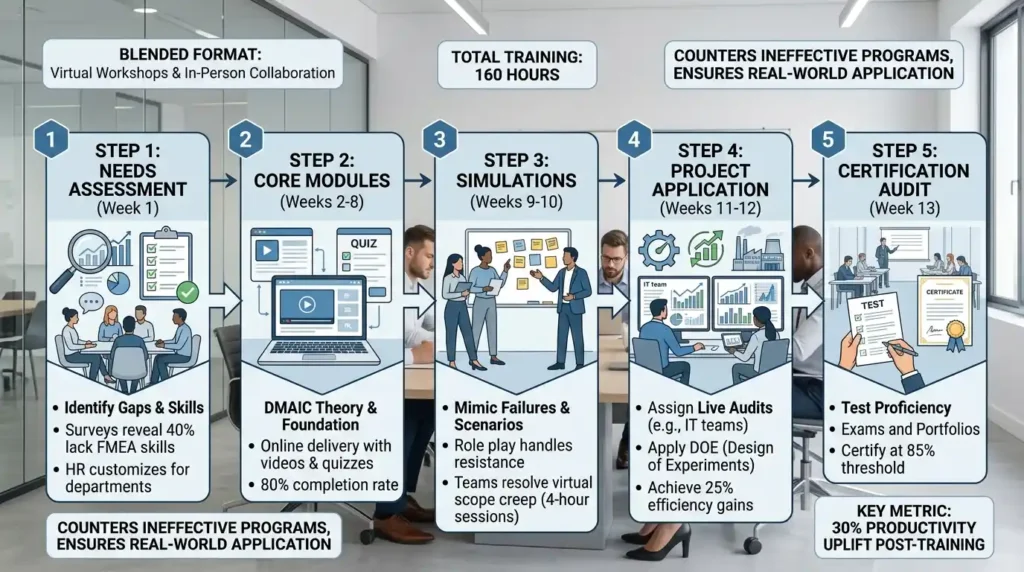
Step 1: Needs assessment identifies gaps. Surveys reveal 40% of teams lack FMEA skills. HR customises for departments.
Step 2: Core modules cover theory. Online platforms deliver DMAIC with videos and quizzes, 80% completion rate.
Step 3: Simulations mimic failures. Role play handles resistance; teams resolve virtual scope creep in 4-hour sessions.
Step 4: Project application assigns live audits. IT teams apply DOE, achieving 25% efficiency gains.
Step 5: Certification audit tests proficiency. Exams and portfolios certify at 85% threshold.
Formats blend virtual workshops for flexibility and in-person for collaboration. Metrics track 30% productivity uplift post-training.
This structure ensures real-world application, countering ineffective programs.
How Do Organisations Implement Lean Six Sigma Mitigation Strategies?
Organisations implement via chartered projects, cross-functional teams, executive sponsorship, integrated software, and post-implementation reviews, scaling success across 500+ employee firms.
Chartered projects define scope with milestones. Black Belt leads ensure alignment.
Cross-functional teams include operations, finance, and HR. Weekly stand-ups resolve issues.
Executive sponsorship allocates 5% budget. Quarterly reviews maintain focus.
Integrated software like Minitab automates FMEA. Dashboards track KPIs in real time.
Post-implementation reviews analyse sustainment. Adjustments prevent 70% reversion.
For deeper insights into advanced training approaches that embed these strategies, read:
How Does Master Black Belt Training Teach Risk Mitigation in Improvement Projects?
Implementation boosts team efficiency 25%, retention 18%, and leadership pipelines.
What Measurable Outcomes Do Lean Six Sigma Mitigation Strategies Produce?
Strategies produce 20-40% defect reductions, 15-30% cycle time cuts, 3-5:1 ROI, 85% project success rates, and 15-20% retention gains, tracked via sigma levels and balanced scorecards.
Defect reductions hit 20-40% in manufacturing via control plans. Finance reports 99.5% accuracy post-FMEA.
Cycle time cuts of 15-30% streamline IT deployments. Healthcare wait times drop 25%.
ROI reaches 3-5:1 within 12 months. Productivity rises 25% enterprise-wide.
Project success climbs to 85%. Balanced scorecards monitor financial, customer, and process metrics.
Retention improves 15-20% as employees gain skills. Leadership pipelines fill 30% faster.
These outcomes stem from practical learning, not generic sessions.
What Are Common Misconceptions About Lean Six Sigma Project Failures?
Misconceptions include failures from complexity alone (ignores training), quick fixes without DMAIC (leads to 50% reversion), universal applicability without customisation (fits only 60% of cases), and ROI invisibility (overlooks 4:1 averages).
Complexity misconception blames tools, not skill gaps. Training resolves 70% of issues.
Quick-fix myth skips Analyse phase. Structured DMAIC prevents 50% failures.
Universal application ignores context. IT needs agile hybrids; manufacturing sticks to classic.
ROI invisibility stems from poor tracking. Audits reveal 4:1 gains.
L&D counters these with industry-relevant simulations.
What Use Cases Demonstrate Lean Six Sigma Mitigation in Corporations?
Use cases include manufacturing defect elimination (35% reduction), finance process streamlining (25% faster audits), healthcare throughput boosts (20% capacity gain), IT deployment acceleration (30%-time savings), and logistics inventory optimisation (40% waste cut).
Discover More from Our Guide Library:
How Does Lean Six Sigma Improve Supply Chain and Procurement Performance?
What Is Kaizen and How Does It Complement Lean Six Sigma Methodology?
Manufacturing: Auto plants use FMEA for assembly lines, hitting 3.4 defects per million.
Finance: Banks audit compliance, cutting errors 25% via stakeholder mapping.
Healthcare: Hospitals pilot patient flows, gaining 20% bed turnover.
IT: Firms deploy software with DOE, saving 30% on rollouts.
Logistics: E-commerce optimises warehouses, reducing stockouts 40%.
Teams of 10-20 apply training in 6-month projects, filling skill gaps via hybrid formats.
These cases yield organisational impact: 25% efficiency, stronger retention.
For more information enrol in:
Lean Six Sigma Master Black Belt Certification Training Course.
What are the prerequisites for Imperial Corporate Training Institute’s Lean Six Sigma Master Black Belt Certification Training Course?
Prerequisites include Black Belt certification and 3-5 years of Lean Six Sigma project experience. Familiarity with Green Belt tools and basic statistics prepares candidates for advanced topics like advanced FMEA and hypothesis testing. Imperial Corporate Training Institute assesses readiness via pre-course surveys.
What topics are covered in the Lean Six Sigma Master Black Belt Certification Training Course by Imperial Corporate Training Institute?
Topics include failure mode mitigation via FMEA, stakeholder engagement frameworks, design of experiments (DOE), control plans, and sustainment audits. The curriculum emphasises real-world applications in industries like manufacturing and healthcare through case-based learning and role play. It aligns with corporate KPIs such as 3-5:1 ROI and 20-40% defect reductions.
What are the benefits of Lean Six Sigma Master Black Belt Certification from Imperial Corporate Training Institute?
The certification delivers measurable outcomes like 20-40% defect reductions, 15-30% cycle time improvements, and 3-5:1 ROI in corporate projects. It builds leadership skills for team efficiency and retention gains of 15-20%. Imperial Corporate Training Institute focuses on practical, industry-relevant training for workforce transformation.