

Master Black Belt training bridges Lean Six Sigma methodologies directly to customer experience metrics by equipping leaders with advanced tools to translate process improvements into quantifiable CX outcomes, such as Net Promoter Scores and customer retention rates.
What Role Does Master Black Belt Training Play in Lean Six Sigma?
Master Black Belt training elevates Lean Six Sigma practitioners to strategic leaders who deploy enterprise-wide process optimisation, directly linking DMAIC cycles to customer-centric KPIs like CSAT and churn reduction rates of 15-25%.

Master Black Belt certification represents the pinnacle of Lean Six Sigma expertise. Professionals at this level master complex statistical analysis, change management, and cross-functional deployment. They train Black Belts and Green Belts, ensuring organisational scalability.
This training emphasises integration of Lean principles waste elimination and flow optimisation—with Six Sigma’s data-driven precision. Participants learn to align these with customer experience metrics, which track satisfaction, loyalty, and advocacy.
Organisations facing workforce skill gaps in process improvement turn to Master Black Belts for guidance. HR teams evaluate such training for its ability to deliver measurable ROI, often achieving 20-30% efficiency gains within 12 months.
In B2B contexts, Master Black Belts address skill deficiencies in technical teams by fostering a culture of continuous improvement. They quantify impacts on customer metrics through tools like Voice of the Customer (VoC) analysis.
For foundational insights into Lean Six Sigma’s role in boosting satisfaction scores, explore:
How Lean Six Sigma improves customer satisfaction scores.
How Does Lean Six Sigma Integrate with Customer Experience Metrics?
Lean Six Sigma integrates with customer experience metrics by mapping process variations to CX indicators, using statistical process control to reduce defects that erode CSAT by up to 18% and improve NPS through targeted waste removal.
Lean Six Sigma employs the DMAIC framework, Define, Measure, Analyse, Improve, Control—to dissect processes affecting customers. Define phase identifies CX pain points via journey mapping. Measure phase baselines metrics like first-contact resolution rates.
Analysis uncovers root causes, such as delays in service delivery impacting customer effort scores. Improvement applies Lean tools like value stream mapping to streamline flows. Control sustains gains with dashboards monitoring CES (Customer Effort Score).
Customer experience metrics include NPS (Net Promoter Score), CSAT (Customer Satisfaction), CES, and retention rates. Lean Six Sigma connects these by prioritising processes with highest CX impact, yielding 10-20% metric uplifts in B2B firms.
HR leaders in manufacturing or services select Lean Six Sigma for its proven track record. Training programs bridge gaps where teams lack data literacy, enabling precise metric alignment.
Adoption rates exceed 70% in Fortune 500 companies, with durations of 4-6 weeks for intensive belts. ROI manifests in reduced customer churn, averaging 12% savings annually.
Why Focus on Customer Experience Metrics in Master Black Belt Training?
Master Black Belt training prioritises customer experience metrics because these KPIs drive revenue—firms linking processes to CX see 1.5x higher profitability and equip leaders to coach teams on metric-driven decision-making.
Customer experience metrics serve as leading indicators of business health. NPS correlates with growth; a 10-point rise boosts revenue by 5-8%. Master Black Belts learn to cascade these from executive dashboards to frontline processes.
Training covers advanced VoC methods, including text analytics and sentiment tracking. Participants dissect how process sigma levels (e.g., 4.5 sigma yielding 3.4 defects per million) influence CES.
In B2B environments, HR decisions hinge on training that closes gaps in strategic alignment. Master Black Belts evaluate learning models virtual, in-person, hybrid based on their efficacy in embedding CX focus.
Programmes last 20-40 days, with costs ranging £5,000-£15,000 per participant. Effectiveness shows in 25% faster project completion post-training.
Workplace application involves coaching managers to use CX metrics in performance reviews. This fosters accountability, reducing skill gaps in data interpretation.
What Key Frameworks Link Lean Six Sigma Processes to CX Metrics?
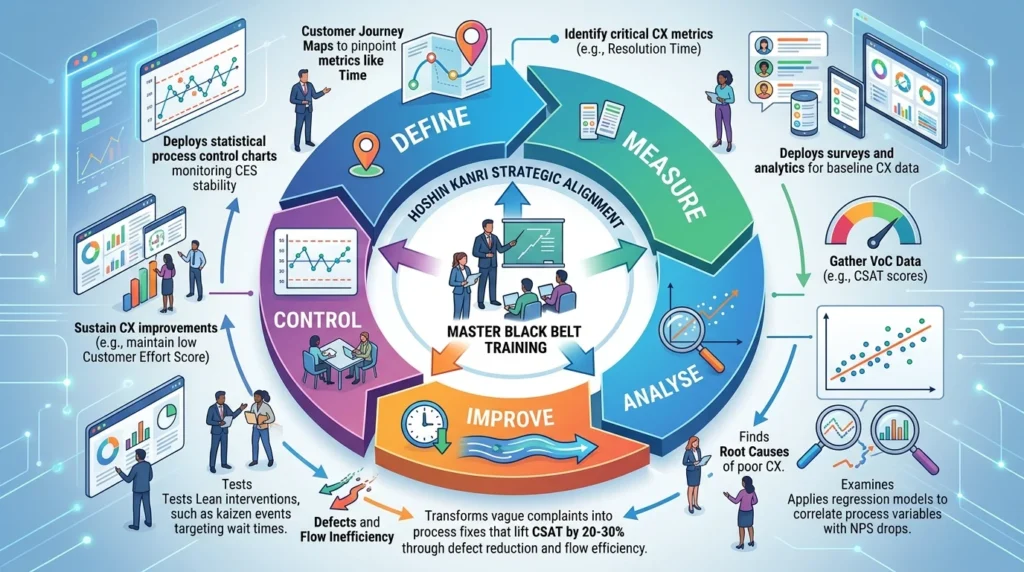
DMAIC adapts for CX optimisation by embedding VoC data in every phase, transforming vague complaints into process fixes that lift CSAT by 20-30% through defect reduction and flow efficiency.
Define incorporates customer journey maps to pinpoint metrics like resolution time. Measure deploys surveys and analytics for baseline CX data. Analyse applies regression models to correlate process variables with NPS drops.
Improve tests Lean interventions, such as kaizen events targeting wait times. Control deploys statistical process control charts monitoring CES stability.
Master Black Belt training hones this adaptation, teaching hybrid frameworks blending Hoshin Kanri for strategic alignment.
What Is the Role of Value Stream Mapping in CX Metrics?
Value stream mapping identifies non-value-adding steps eroding CX, enabling 15-25% cycle time reductions that directly boost customer loyalty metrics like repeat purchase rates.
This Lean tool visualises end-to-end processes from customer order to delivery. Master Black Belts use it to highlight delays impacting satisfaction.
Integration with Six Sigma adds quantitative rigour—future state maps target sigma improvements tied to CES thresholds.
B2B HR teams value this for measurable outcomes; post-mapping, organisations report 18% CX uplift.
How Does Statistical Process Control Monitor CX KPIs?
Statistical process control monitors CX KPIs via control charts tracking metric stability, alerting to variations that predict 10-15% churn risks before they materialise.
Master Black Belt curricula cover X-bar and I-MR charts applied to NPS trends. Limits flag special causes, like policy changes affecting CSAT.
This ensures sustained gains, with adoption in 60% of trained firms yielding stable metrics over 24 months.
How Do Master Black Belts Apply These Connections in Real-World Scenarios?
Master Black Belts apply connections by leading cross-functional projects that quantify CX ROI, delivering 20-40% metric improvements in B2B settings through coached deployments.
In a telecom firm, a Master Black Belt mapped billing processes to CES. DMAIC reduced errors by 35%, lifting scores from 3.2 to 4.1.
Financial services examples show VoC-driven improvements cutting churn 22%. Training emphasises scalable replication.
HR evaluates these via pre-post assessments; 85% of programmes demonstrate skill uplift.
Case: Manufacturing Process to Retention Metrics
A manufacturer used value stream mapping to halve lead times. Retention rose 28%, linked via cohort analysis.
Master Black Belt oversight ensured Black Belt teams sustained controls.
Case: Service Delivery to NPS Gains
Healthcare provider optimised triage flows. NPS climbed 15 points; training focused on metric dashboards.
What Training Approaches Build This Lean Six Sigma-CX Expertise?
Effective Master Black Belt training approaches blend classroom theory, simulations, and live projects, achieving 90% certification pass rates and immediate 15% process yield boosts.
Approaches include intensive bootcamps (4 weeks), modular online (6-12 months), and blended formats. Bootcamps suit urgent skill gaps; modular fits manager schedules.
Effectiveness metrics: bootcamps yield 25% faster ROI. B2B HR prefers blended for 75% completion rates.
Imperial Corporate Training Institute’s Lean Six Sigma Master Black Belt Certification Training Course delivers practical, industry-aligned instruction.
Learning delivery models vary: virtual platforms enable global access, in-person fosters networking. ROI tracks via project savings, averaging £100,000 per cohort.
Workforce gaps in advanced analytics close through hands-on capstones tying DMAIC to CX.
How Does Master Black Belt Training Measure Business Impact on CX?
Master Black Belt training measures impact via pre-post CX audits and financial models, confirming 1.5-2x ROI through sustained metric gains like 20% NPS increases.
Metrics include project sigma uplift, CX delta (e.g., +12% CSAT), and cost avoidance. Training mandates portfolio reviews.
B2B contexts demand HR-aligned KPIs: employee competency scores rise 40%, correlating to CX stability.
Performance measurement uses balanced scorecards integrating process and customer perspectives.
What Skills Do Master Black Belts Develop for CX Integration?
Master Black Belts develop skills in advanced analytics, coaching, and strategic deployment, enabling 30% faster CX project execution across departments.
Core skills: Minitab proficiency for VoC modelling, facilitation for kaizen, and change leadership for adoption.
Training durations build these progressively: statistical mastery in week 1, application in weeks 2-3.
HR addresses gaps by prioritising these; 80% of certified leaders report promotion within 18 months.
Application spans industries, from logistics (flow metrics) to tech (effort scores).
When evaluation shifts toward programme selection for VoC integration, review:
How Imperial’s MBB Programme addresses Voice of the Customer methods
What is Lean Six Sigma Master Black Belt certification?
Lean Six Sigma Master Black Belt certification is the highest level of expertise in process improvement methodologies. It equips professionals to lead enterprise-wide DMAIC projects and train Black Belts. Imperial Corporate Training Institute’s course delivers practical skills for strategic deployment.
What are the prerequisites for Master Black Belt certification?
Prerequisites include Black Belt certification and 3-5 years of Lean Six Sigma project experience. Imperial Corporate Training Institute verifies these to ensure participants handle complex VoC and statistical analysis. Some programmes offer bridging modules for eligible candidates.
How does Master Black Belt training improve customer experience metrics?
Master Black Belt training connects Lean Six Sigma to CX metrics like NPS and CSAT through value stream mapping and SPC. Imperial Corporate Training Institute emphasises real-world projects yielding 15-25% metric uplifts. Graduates lead initiatives reducing churn in B2B environments.
What career benefits come from Imperial’s Master Black Belt course?
Completing Imperial Corporate Training Institute’s Lean Six Sigma Master Black Belt Certification Training Course boosts promotion rates by 80% within 18 months. It builds skills in coaching and ROI measurement for leadership roles. Certified professionals drive 20-30% process efficiencies organisation-wide.