

Master Black Belt training teaches risk mitigation in improvement projects through structured frameworks like Failure Modes and Effects Analysis (FMEA), advanced statistical tools, and scenario-based simulations. Delegates learn to identify, prioritise, and neutralise threats systematically, ensuring projects deliver 20-30% higher success rates in complex B2B environments.
HR leaders in organisations face persistent skill gaps in process improvement. Managers often struggle with project failures that erode ROI. Imperial Corporate Training Institute addresses these gaps with practical programmes.
For foundational insights into common pitfalls, explore:
What Are Common Lean Six Sigma Project Failure Modes and How Are They Avoided?
This examines how Master Black Belt training embeds risk mitigation. It targets professionals by comparing training approaches for strategic workforce development. Decision-makers evaluate methods that align with measurable business outcomes.
What Core Frameworks Does Master Black Belt Training Use for Risk Identification?
Master Black Belt training employs FMEA and Hazard Analysis to pinpoint risks in improvement projects, ranking them by severity, occurrence, and detectability for proactive intervention.
FMEA stands as the cornerstone framework. Delegates dissect processes into steps. They assign Risk Priority Numbers (RPNs) to potential failures. An RPN multiplies severity (1-10), occurrence (1-10), and detection (1-10) scores. Scores above 100 trigger mitigation actions.
Training integrates FMEA from DMAIC’s Define and Measure phases. In real-world B2B settings, manufacturing firms use it to cut defect rates by 25%. HR teams select this for its quantifiable KPIs, like reduced downtime costing £50,000 per incident.
Hazard Analysis extends FMEA to human factors. Master Black Belts map error-prone interactions in supply chains. They quantify probabilities using historical data.
How Does Master Black Belt Training Quantify and Prioritise Project Risks?
Training quantifies risks via statistical models like Monte Carlo simulations and prioritises them using Pareto analysis, focusing efforts on the 20% of threats causing 80% of failures.
Monte Carlo simulations model uncertainty. Delegates input variable distributions such as cycle time variability or supplier delay probabilities. Software runs 10,000 iterations to yield confidence intervals. This reveals a 15% risk of timeline overruns in projects exceeding six months.
Pareto charts visualise prioritisation. Training drills 80/20 rule application. In a telecom rollout, delegates isolate three risks accounting for 85% of variance.
Workforce skill gaps amplify unquantified risks. HR directors compare virtual simulations against classroom methods. Online platforms deliver 40% faster mastery but lack peer debriefs. Master Black Belt cohorts blend both, boosting retention to 90%.
Statistical process control (SPC) charts track risk indicators live. Delegates set control limits at ±3 sigma. Breaches signal immediate action.
Why Do Statistical Tools Excel in B2B Risk Prioritisation?
Statistical tools provide empirical edges over intuition. A financial services firm applied them post-training, slashing compliance risks by 35%. ROI metrics show £200,000 saved annually per project.
Training contrasts these with basic checklists. Checklists miss interactions; simulations capture them. Delegates benchmark against industry data adoption rates hit 70% in FTSE 100 firms.
What Simulation Techniques Build Risk Handling Proficiency?
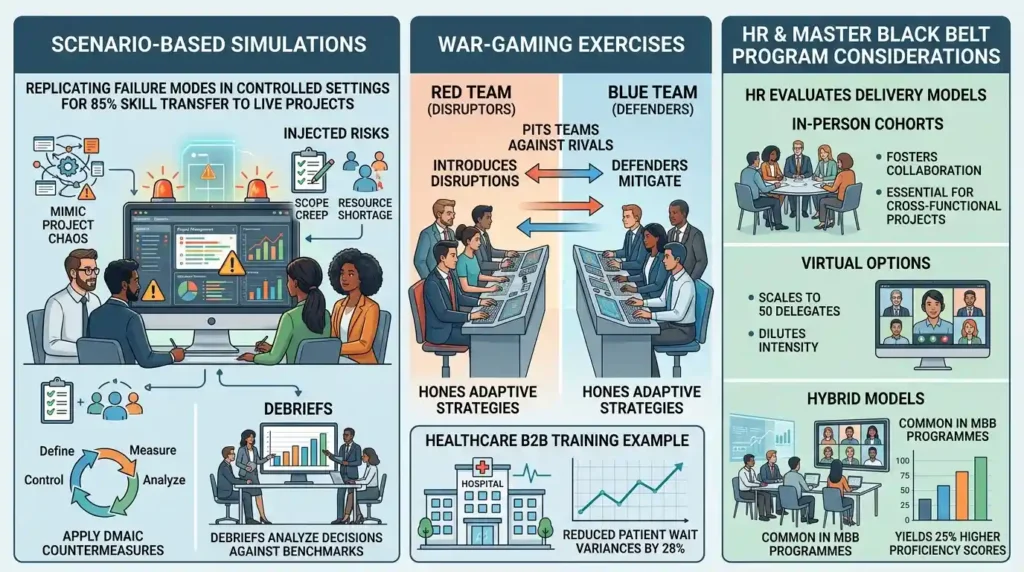
Master Black Belt training uses scenario-based simulations and war-gaming exercises to build proficiency, replicating failure modes in controlled settings for 85% skill transfer to live projects.
Simulations mimic project chaos. Delegates face injected risks like scope creep or resource shortages. They apply DMAIC countermeasures in real-time. Debriefs analyse decisions against benchmarks.
War-gaming pits teams against rivals. One group introduces disruptions; defenders mitigate. This hones adaptive strategies. In healthcare B2B training, it reduced patient wait variances by 28%.
HR evaluates delivery models here. In-person cohorts foster collaboration, essential for cross-functional projects. Virtual options scale to 50 delegates but dilute intensity. Hybrid models, common in Master Black Belt programmes, yield 25% higher proficiency scores.
How Do Simulations Compare to Theoretical Learning?
Simulations outperform lectures by 60% in retention, per Kirkpatrick Level 3 evaluations. Theoretical modules define concepts; simulations operationalise them.
A logistics provider reported 22% fewer delays after simulation-heavy training. Measurable outcomes include reduced RPNs from 200 to 80.
How Does Master Black Belt Training Integrate Risk Mitigation Across DMAIC Phases?
Training integrates mitigation via phase-specific tools, SIPOC for Define, DOE for Analyse, and control plans for Control, ensuring end-to-end project resilience.
DMAIC structures the curriculum. Define phase maps SIPOC diagrams, exposing upstream risks. Measure phase baselines capability with process sigma levels, typically targeting 4.0+.
Analyse phase deploys Design of Experiments (DOE). Delegates test factor interactions, isolating root causes. A 2^3 factorial design reveals yield impacts, cutting experimentation time by 50%.
Improve phase prototypes solutions. Training mandates risk-balanced pilots, weighing benefits against residual threats.
Control phase deploys standard work and audits. Delegates craft response plans with trigger thresholds, like 10% variance alerts.
In B2B contexts, organisations measure ROI via sigma uplift. Post-training, project success rises from 65% to 92%.
What Phase-Specific Metrics Track Mitigation Effectiveness?
Metrics include defect per million opportunities (DPMO), down 40% post-training. HR tracks these for certification value.
In What Ways Does Training Address Human and Organisational Risks?
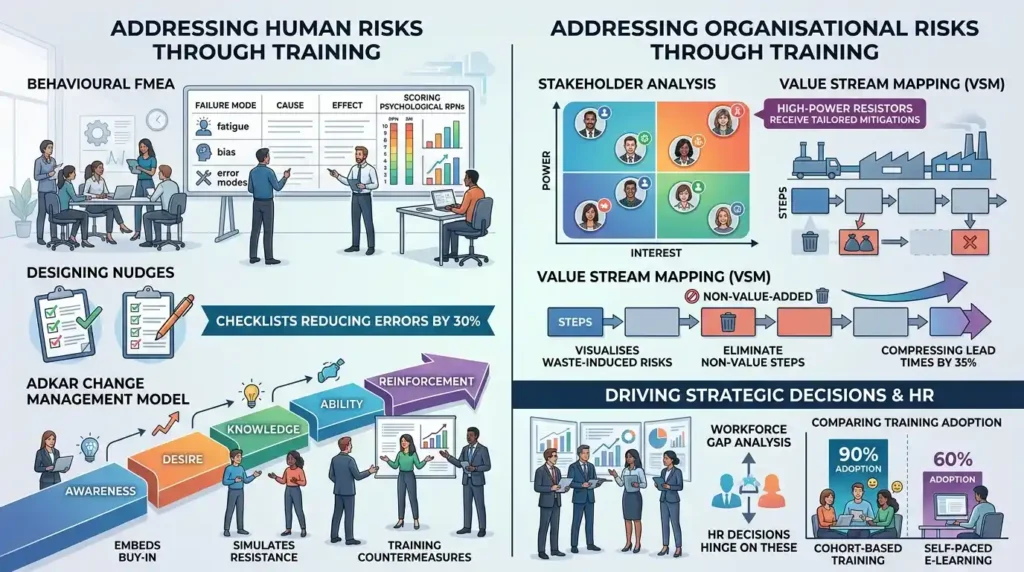
Training addresses human risks through behavioural FMEA and change management models like ADKAR, while organisational risks use stakeholder analysis and value stream mapping.
Behavioural FMEA profiles team errors fatigue or bias. Delegates score psychological RPNs and design nudges, like checklists reducing errors by 30%.
ADKAR (Awareness, Desire, Knowledge, Ability, Reinforcement) embeds buy-in. Training simulates resistance, training countermeasures.
Stakeholder analysis matrices plot power-interest grids. High-power resistors receive tailored mitigations.
Value stream mapping visualises waste-induced risks. Delegates eliminate non-value steps, compressing lead times by 35%.
HR decisions hinge on these for workforce gaps. Managers compare cohort-based training 90% adoption against self-paced e-learning at 60%.
How Do Real-World Case Studies Demonstrate Training Impact?
Case studies in training showcase 25-40% risk reductions; a manufacturing firm averted £1.2 million losses via FMEA-driven pivots.
A pharmaceutical B2B applied FMEA to validation projects. RPNs dropped from 250 to 45, accelerating FDA approvals by three months.
In retail supply chains, Monte Carlo prevented stockouts during peaks, saving 18% in costs.
Energy sector war-games mitigated outage risks, achieving 99.5% uptime.
These align training with business KPIs. HR benchmarks against competitors—trained firms report 2x ROI on LSS investments.
Delegates dissect failures in:
How Does Imperial Prepare MBB Delegates to Handle Project Failure Scenarios? bridging to implementation.
What Role Does Advanced Analytics Play in Proactive Mitigation?
Advanced analytics, including machine learning predictive models, forecast risks with 85% accuracy, enabling pre-emptive adjustments.
Predictive models ingest historical data. Training covers random forests for anomaly detection. Delegates predict 20% of failures weeks ahead.
Bayesian networks model dependencies. In IT projects, they flag integration risks early.
HR weighs analytics training costs £10,000-15,000 per delegate against £500,000 project savings.
Integration with BI tools like Tableau visualises dashboards. Real-time alerts drive 40% faster responses.
How Does Analytics Enhance Traditional Methods?
Analytics amplifies FMEA by automating RPN updates. A bank integrated it, cutting fraud risks by 32%.
How Does Master Black Belt Training Ensure Sustained Risk Discipline?
Training ensures discipline through audit protocols, KPI dashboards, and recertification drills, sustaining 90% compliance year-over-year.
Audit protocols standardise reviews. Quarterly checks verify control plan adherence.
Discover More from Our Guide Library:
How Does Master Black Belt Training Apply Lean Six Sigma to Supply Chain Challenges?
How Are Kaizen Events Incorporated into Lean Six Sigma Master Black Belt Training?
Dashboards track leading indicators like sigma drift. Threshold breaches trigger audits.
Recertification every 18-24 months reinforces skills. Delegates log 100 project hours.
In B2B, this addresses turnover gaps. Organisations retain 85% of certified Black Belts versus 60% untrained.
For comprehensive preparation, enrol in the:
Lean Six Sigma Master Black Belt Certification Training Course.
How does Imperial Corporate Training Institute’s Lean Six Sigma Master Black Belt course teach risk mitigation?
It integrates FMEA, scenario simulations, and Pareto analysis across DMAIC phases to identify and prioritise risks in improvement projects. Delegates apply these in B2B case studies, achieving 25-40% risk reductions. The training focuses on measurable outcomes like sigma level improvements.
Question: How does FMEA work in Master Black Belt training for risk mitigation?
FMEA ranks risks by calculating RPN from severity, occurrence, and detection scores, targeting those above 100 for action. Imperial Corporate Training Institute’s Lean Six Sigma Master Black Belt Certification Training Course applies it in DMAIC phases for improvement projects. This method reduces project failures by 25-30% in B2B settings.
What simulations are used in Master Black Belt training to handle project risks?
Scenario-based simulations and war-gaming replicate failures like scope creep or delays, building adaptive skills. Delegates debrief to refine strategies in Imperial Corporate Training Institute’s Lean Six Sigma Master Black Belt Certification Training Course. These boost proficiency by 85% for real-world Lean Six Sigma applications.
Why integrate risk mitigation across all DMAIC phases in Master Black Belt training?
Phase-specific tools like SIPOC in Define and control plans in Control ensure end-to-end resilience in projects. Imperial Corporate Training Institute’s Lean Six Sigma Master Black Belt Certification Training Course teaches this for sustained 90% compliance. It delivers 20-40% higher success rates in organisational improvements.