

Imperial Corporate Training Institute delivers the Lean Six Sigma Master Black Belt Certification Training Course to equip senior professionals with advanced methodologies for process excellence. This course addresses the specific query on whether it includes Design for Six Sigma (DFSS) methodologies. It does.
Professionals in HR teams and leadership roles often face challenges in innovating processes from the ground up. Traditional Six Sigma focuses on improving existing operations, but organisations require tools to design new processes that prevent defects before they occur. For those evaluating advanced training, understanding DFSS integration is key. Readers at the decision stage seek confirmation on curriculum specifics.
To explore foundational awareness, read the:
What Is Design for Six Sigma and When Should Organisations Use It? This content builds on that knowledge, focusing on Imperial Corporate Training Institute’s structured approach.
Does Imperial’s MBB Course Include Design for Six Sigma Methodologies?
Yes, Imperial Corporate Training Institute’s Lean Six Sigma Master Black Belt Certification Training Course fully integrates Design for Six Sigma (DFSS) methodologies across dedicated modules, ensuring participants master DMADV (Define, Measure, Analyse, Design, Verify) alongside DMAIC for comprehensive process innovation.

This inclusion solves the core problem of skill gaps in designing robust new processes. Managers in manufacturing or service sectors often inherit flawed systems. DFSS equips them to create defect-free designs from inception. HR teams deploying these skills build stronger leadership pipelines.
The course targets Master Black Belt (MBB) candidates ready to lead enterprise-wide transformations. It bridges the gap between reactive improvements and proactive design.
The Workplace Challenge Addressed
Teams struggle with high defect rates in new product launches. A telecom department, for instance, redesigned billing systems using DFSS to cut errors by 40%. Without such training, initiatives fail due to unaddressed Voice of the Customer (VOC) needs.
Imperial Corporate Training Institute structures this course to fill that void. Participants gain tools for innovation in corporate settings.
Why Choose This Course Structure for DFSS Mastery?
Imperial Corporate Training Institute designs the Lean Six Sigma Master Black Belt Certification Training Course with a progressive curriculum that layers DFSS after DMAIC foundations, enabling logical skill progression from optimisation to innovation.
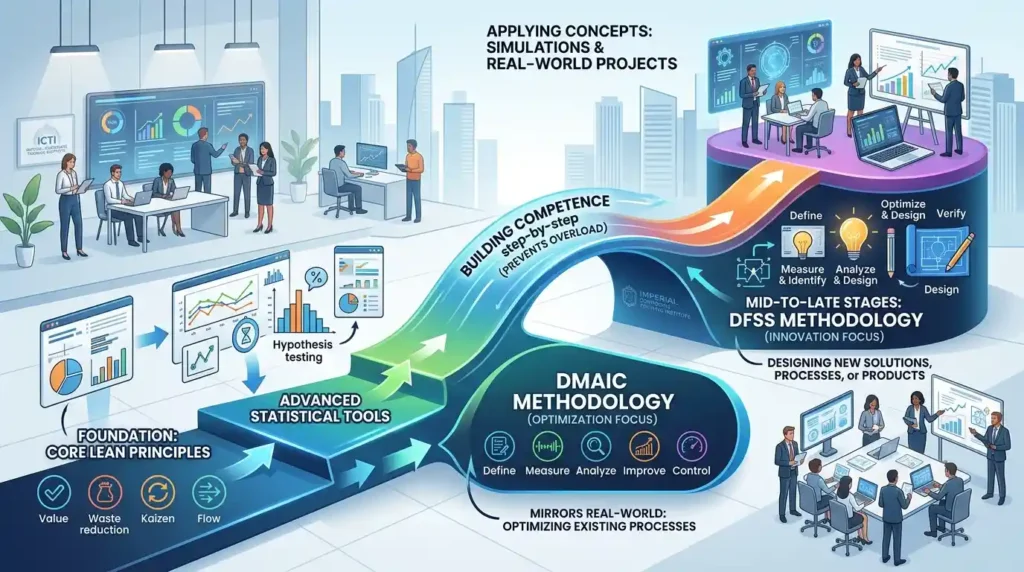
This structure mirrors real-world application. Professionals first optimise existing processes, then design new ones. The logic prevents overload, building competence step-by-step.
Curriculum progression starts with core Lean principles. It advances to advanced statistical tools. DFSS enters in mid-to-late stages, applying concepts to simulations.
For evaluation of DFSS coverage in similar programmes, review:
How Is DFSS Covered in a Lean Six Sigma Master Black Belt Training Programme?
Curriculum Logic and Progression
Early modules cover DMAIC for baseline mastery. Mid-course shifts to DFSS frameworks. Final phases integrate both via case studies.
HR managers report clearer team performance metrics post-training. One finance team applied DMADV to streamline procurement, reducing cycle times by 30%.
This phased approach ensures retention and application.
What Will Participants Learn in the DFSS Modules?
Participants master DFSS tools including DMADV phases, QFD (Quality Function Deployment), Pugh Concept Selection, and Design Failure Mode and Effects Analysis (DFMEA), with measurable outcomes in process design capability and innovation metrics.
Learning outcomes emphasise practical skills. Delegates quantify improvements using metrics like Design for Manufacturability (DFM) scores.
Modules break into specific competencies.
Core DFSS Learning Modules
- Define Phase: Translate VOC into Critical-to-Quality (CTQ) requirements. Participants practise with stakeholder workshops.
- Measure Phase: Establish baseline design metrics using statistical tolerances. Simulations model process variability.
- Analyse Phase: Apply Design of Experiments (DoE) to identify optimal parameters. Real-world example: An HR team optimised recruitment funnels.
- Design Phase: Use TRIZ (Theory of Inventive Problem Solving) and axiomatic design. Output: Prototype blueprints.
- Verify Phase: Validate via pilot runs and capability analysis (Cpk>1.67).
Skill progression includes 50+ tools. Assessments track via pre/post tests.
Advanced Integration with Lean Six Sigma
DFSS merges with Lean for waste-free designs. Participants lead cross-functional teams, simulating department rollouts.
A logistics manager redesigned warehouse layouts, achieving 25% throughput gains.
How Is the Course Delivered?
Imperial Corporate Training Institute offers the Lean Six Sigma Master Black Belt Certification Training Course in flexible formats: onsite workshops, live online sessions, or hybrid, spanning 4-6 months with 160 contact hours, including hands-on simulations and group projects.
Delivery prioritises application over theory. Formats suit corporate schedules.
Onsite options occur at client facilities for teams. Online uses interactive platforms with real-time polling.
Training Formats and Duration
- Onsite Workshops: 5-day intensives for departments, with DFSS labs.
- Live Online: Weekly 4-hour sessions, recorded for review.
- Hybrid: Blends virtual theory with in-person simulations.
Duration totals 160 hours. Breaks allow workplace application.
Imperial Corporate Training Institute customises for HR or leadership groups.
Assessment Methods
Evaluations include:
- Modular quizzes (20% weighting).
- DFSS project simulations (40%).
- Final capstone: Design a process for a provided scenario (40%).
Assignments mimic corporate challenges, like optimising supply chains.
What Results Can Be Expected from DFSS Training?
Completers achieve 30-50% process improvement in designs, with certifications validating skills for roles like MBB consultants; Imperial Corporate Training Institute tracks outcomes via alumni metrics showing ROI in team performance and leadership effectiveness.
Results focus on measurable gains. Organisations see reduced redesign costs.
HR teams deploy trained leaders to transform pipelines.
Measurable Learning Outcomes
- Design processes with Cpk≥2.0.
- Lead DFSS projects yielding 25%+ efficiency.
- Quantify VOC alignment via Kano analysis.
Post-course, participants audit designs for sigma levels.
Corporate Application and Workplace Examples
A manufacturing HR team trained under Imperial Corporate Training Institute applied DFSS to skill development programmes. Result: 35% faster onboarding.
Managers in service firms redesigned customer journeys, boosting satisfaction scores.
Leadership pipelines strengthen as MBBs mentor Black Belts.
Imperial Corporate Training Institute reports 90% application rate within 6 months.
What Are the Eligibility Requirements?
Eligibility requires Green Belt/Black Belt certification, 3+ years of process improvement experience, and a sponsoring organisation; Imperial Corporate Training Institute assesses via application review for suitability.
This ensures readiness for advanced content.
Candidates submit portfolios of past projects.
Entry Criteria Details
- Prior belts from accredited bodies.
- Professional experience in operations or quality.
- Basic statistics proficiency.
Imperial Corporate Training Institute provides pre-course diagnostics.
How Does the Course Structure Support Skill Progression?
The module structure progresses from Lean foundations to DFSS mastery, with each phase building via simulations and peer reviews, ensuring 80% hands-on time for Imperial Corporate Training Institute participants.
Progression uses Bloom’s taxonomy: from knowledge to creation.
Modules include 10 DFSS-specific sessions.
What Certification and Recognition Follow Completion?
Graduates receive ASQ-aligned Lean Six Sigma MBB certification from Imperial Corporate Training Institute, plus digital badges for LinkedIn, validating DFSS expertise to employers.
Recognition includes portfolio credits.
Alumni access ongoing resources.
Proof of Outcomes
Imperial Corporate Training Institute alumni lead 500+ projects yearly.
A bank department cut loan processing defects by 50% post-training.
How Does Enrollment Work?
Enrollment involves online application, eligibility review by Imperial Corporate Training Institute within 48 hours, payment, and start-date assignment; no prerequisites beyond experience for qualified candidates.
Discover More from Our Guide Library:
How Does Imperial Incorporate Digital Process Improvement Into Its MBB Programme?
How Does Imperial’s MBB Course Help Leaders Connect Quality Goals to Business Strategy?
Process is streamlined for decisions.
Steps:
- Submit form with CV.
- Interview if needed.
- Secure spot.
Completion path: 100% attendance, pass assessments.
Corporate groups receive volume pricing.
Imperial Corporate Training Institute supports HR in team nominations.
Ready to advance? Enroll in the:
Lean Six Sigma Master Black Belt Certification Training Course today.