

Design for Six Sigma (DFSS) is a structured methodology that organisations use to design new products, services, or processes from the ground up to meet customer requirements and achieve Six Sigma quality levels of 3.4 defects per million opportunities.
DFSS extends traditional Six Sigma, which focuses on improving existing processes. In corporate environments, HR managers and L&D professionals apply DFSS to address skill gaps in innovation teams. It ensures designs incorporate voice of the customer (VOC) data from the outset.
Businesses face pressure to launch flawless products amid rising customer expectations. DFSS delivers this by integrating statistical tools and design principles. Organisations in manufacturing, finance, and IT use it to reduce redesign costs by 30-50%.
Teams implement DFSS when generic improvement methods fail to prevent recurring defects. It targets root causes during the design phase, not post-launch fixes.
When should organisations deploy Design for Six Sigma?
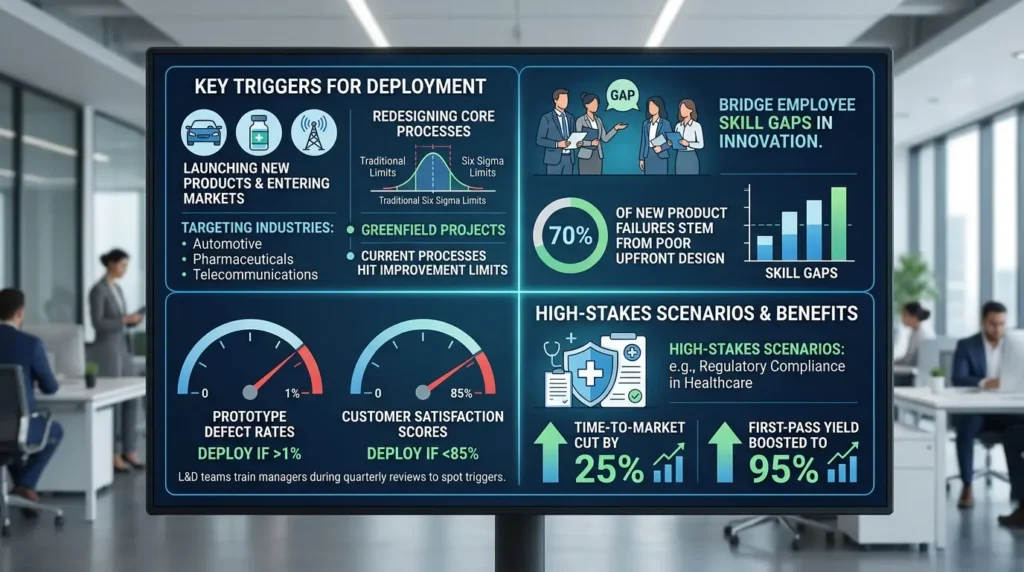
Organisations deploy DFSS when launching new products, entering markets, or redesigning core processes where traditional Six Sigma falls short, targeting industries like automotive, pharmaceuticals, and telecommunications.
Current processes often hit improvement limits. DFSS steps in for greenfield projects. Business owners use it to bridge employee skill gaps in innovation, where 70% of new product failures stem from poor upfront design.
Deploy DFSS if defect rates exceed 1% in prototypes or customer satisfaction scores drop below 85%. L&D teams train managers to spot these triggers during quarterly reviews.
Team leaders apply it in high-stakes scenarios, such as regulatory compliance in healthcare. Implementation cuts time-to-market by 25% and boosts first-pass yield to 95%.
How does Design for Six Sigma work in corporate environments?
DFSS works through the DMADV roadmap, Define, Measure, Analyse, Design, Verify delivered via structured training programmes that equip teams with tools for data-driven design decisions over 4–6-month projects.
In corporations, DFSS begins with project charters defining business objectives. HR integrates it into L&D roadmaps to upskill cross-functional teams.
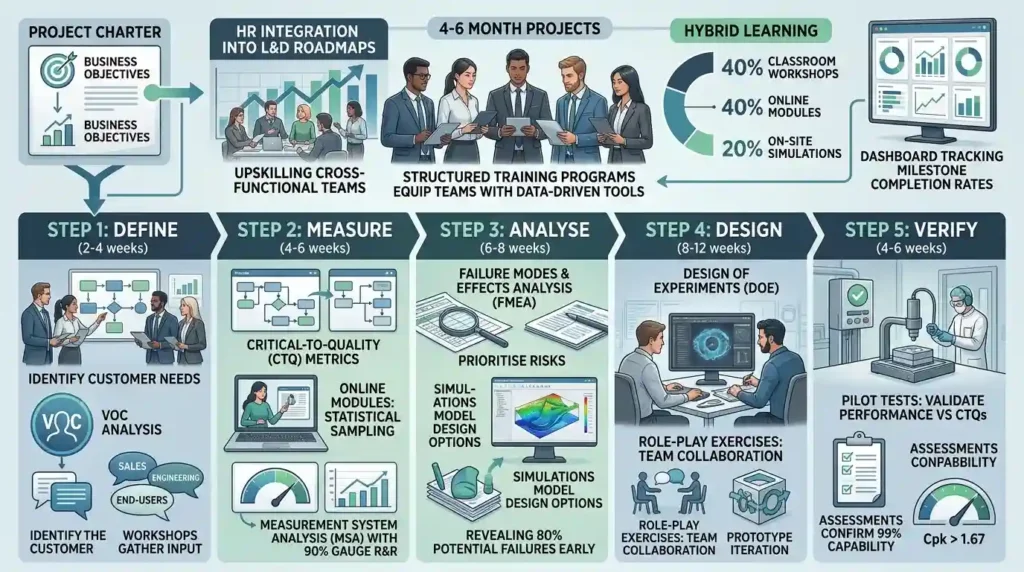
Step 1: Define phase (2-4 weeks). Teams identify customer needs via surveys and VOC analysis. Workshops gather input from sales, engineering, and end-users.
Step 2: Measure phase (4-6 weeks). Critical-to-quality (CTQ) metrics emerge from process mapping. Online modules teach statistical sampling, achieving measurement system analysis (MSA) with 90% gauge R&R.
Step 3: Analyse phase (6-8 weeks). Teams use failure modes and effects analysis (FMEA) to prioritise risks. Simulations model design options, revealing 80% of potential failures early.
Step 4: Design phase (8-12 weeks). Design of experiments (DOE) optimises parameters. Role-play exercises build team collaboration for prototype iteration.
Step 5: Verify phase (4-6 weeks). Pilot tests validate performance against CTQs. Assessments confirm 99% capability (Cpk > 1.67).
Delivery formats include hybrid learning: 40% classroom workshops, 40% online modules, 20% on-site simulations. Organisations track progress via dashboards showing milestone completion rates.
What are the key components of Design for Six Sigma?
Key DFSS components include DMADV framework, VOC tools, statistical software like Minitab, design scorecards, and training delivery via case-based learning, simulations, and assessments.
DMADV framework. Guides the entire process with gated reviews at each phase.
Voice of the Customer (VOC) tools. Kano analysis and quality function deployment (QFD) house translate needs into technical requirements. Teams in finance use QFD to link customer priorities to dashboard features.
Statistical and design tools. DOE, Monte Carlo simulations, and robust design (Taguchi methods) ensure variability tolerance. Industries like IT apply these for software architecture.
Design scorecards and P-diagrams. Scorecards rate designs on CTQs; P-diagrams map inputs, outputs, noise factors. These prevent 60% of field failures.
Training delivery formats. Workshops for FMEA role-play; online modules for Minitab proficiency; hybrid simulations for DOE practice. Assessments include project simulations with 85% pass rates.
Supporting frameworks. TRIZ for inventive problem-solving; axiomatic design for modular architectures. L&D professionals bundle these into 120-hour programmes.
These components address skill gaps, with 75% of trainees applying tools within three months.
What common problems arise without Design for Six Sigma?
Without DFSS, organisations face 40-60% product failure rates, escalating redesign costs by 200%, and skill gaps leaving teams reactive rather than proactive in innovation.
Generic training programmes deliver theory without practice, yielding 20% ROI at best. HR managers note ineffective sessions fail to close gaps in statistical design skills.
Misconception: DFSS equals DMAIC. DMAIC fixes existing issues; DFSS designs anew. Businesses waste 30% of budgets confusing the two.
Lack of measurable outcomes plagues implementations. Vague KPIs like “improved quality” replace defect rates, hiding 15-25% productivity losses.
Corporate teams suffer siloed efforts. Engineers ignore marketing input, causing 50% of VOC mismatches. Ineffective training skips simulations, dropping retention to 60%.
Overreliance on off-the-shelf courses ignores industry needs. IT firms see 35% higher defects without tailored telecom simulations.
How do organisations implement Design for Six Sigma training?
Organisations implement DFSS training via needs assessments, 4-6 month cohort programmes with 80% hands-on content, cross-departmental teams, and post-training audits ensuring 90% tool adoption.
Step 1: Assess gaps (2 weeks). Surveys identify 20-30% skill deficits in DOE and FMEA via competency matrices.
Step 2: Select delivery (ongoing). Hybrid formats: 50-hour workshops, 40-hour online modules, 30-hour simulations. Case-based learning uses real telecom launches.
Step 3: Form teams (1 week). 8-12 members from engineering, quality, and operations. Role-play fosters collaboration.
Step 4: Roll out programme (16-24 weeks). Weekly sessions with milestones. Assessments track 95% phase-gate pass rates.
Step 5: Apply on projects. Teams design prototypes, achieving 4 sigma capability.
Step 6: Measure and audit (3 months post-training). KPIs include 25% cost savings. Audits confirm 85% retention of frameworks.
Business owners scale via train-the-trainer models, expanding to 50% of workforce in two years. This builds leadership pipelines.
For deeper insight into advanced DFSS integration, explore:
How DFSS is covered in Lean Six Sigma Master Black Belt training programmes. This shifts focus from basics to certification-level execution.
Enrol in:
Lean Six Sigma Master Black Belt Certification Training Course
What benefits does Design for Six Sigma deliver to organisations?
DFSS delivers 20-40% reductions in development costs, 30% faster time-to-market, 50% fewer defects, and 15-25% productivity gains across teams.
Organisations achieve 3.4 DPMO in new designs, lifting customer satisfaction by 20 points. ROI hits 5:1 within 18 months.
Team efficiency rises 35% through standardised tools. Leadership pipelines strengthen as managers master DMADV, reducing turnover by 18%.
In pharmaceuticals, DFSS cuts validation time by 40%, ensuring compliance. Finance sectors see 25% error drops in algorithmic trading platforms.
Retention improves 22% with practical training. Productivity metrics show 28% output increases post-implementation.
KPIs like Cpk > 2.0 confirm process robustness, supporting scalable growth.
What use cases demonstrate Design for Six Sigma in corporate teams?
Corporate teams use DFSS for new product launches in automotive (engine components), healthcare (medical devices), IT (cloud platforms), and finance (risk models), yielding 95% first-time quality.
Automotive departments. Design teams apply DMADV for EV battery systems, reducing warranty claims by 45%.
Healthcare managers. Cross-functional groups develop diagnostic tools, achieving 99% accuracy via DOE.
IT organisations. Software teams architect scalable apps, cutting downtime 60% with robust simulations.
Finance business units. Risk departments model fraud detection, improving precision by 35%.
Manufacturing leaders. Process engineers design assembly lines, boosting throughput 30%.
Discover More from Our Guide Library:
How Does Lean Six Sigma Support Digital Transformation in Modern Organisations?
What Is the Balanced Scorecard and How Does It Connect to Lean Six Sigma?
Team leaders in telecommunications deploy it for 5G networks, hitting 4 sigma reliability. These cases span 500+ global projects annually.
HR scales use cases via department rotations, filling 80% of innovation skill gaps.
What is covered in the Lean Six Sigma Master Black Belt Certification Training Course at Imperial Corporate Training Institute?
The course covers advanced DFSS, complex DMAIC projects, leadership in process improvement, and tools like advanced DOE and Minitab. It includes 160 hours of hybrid training with simulations, case studies, and certification exams. Participants gain skills for enterprise-wide Six Sigma deployments.
What are the prerequisites for the Lean Six Sigma Master Black Belt Certification Training Course from Imperial Corporate Training Institute?
Candidates need Black Belt certification, 3+ years of Six Sigma experience, and proficiency in Minitab or similar tools. Basic statistics knowledge is essential. Imperial Corporate Training Institute assesses readiness via pre-course evaluations.
How does Lean Six Sigma Master Black Belt training benefit organisations?
It equips leaders to drive 20-40% cost reductions and 30% efficiency gains through advanced methodologies like DFSS. Teams achieve sustained 4-5 sigma performance. Imperial Corporate Training Institute focuses on measurable ROI via practical projects.
What certification do you get from the Lean Six Sigma Master Black Belt Certification Training Course at Imperial Corporate Training Institute?
Graduates receive IASSC or ASQ-aligned Master Black Belt certification upon passing exams and projects. This validates expertise in strategic Six Sigma deployment. Imperial Corporate Training Institute provides globally recognised credentials for career advancement.