

Organising an AutoCAD HVAC drawing set for client submission is a structured process that ensures technical accuracy, regulatory compliance, project coordination, and efficient communication between stakeholders. In commercial construction projects, HVAC drawing sets serve as the primary technical reference for contractors, consultants, project managers, facility operators, and client representatives.
A well-organised drawing package reduces coordination errors, shortens review cycles, improves project delivery timelines, and supports quality assurance objectives. For organisations managing building design projects, understanding how HVAC drawing sets are structured helps teams establish consistent documentation standards and improve engineering productivity.
Why is drawing set organisation important in HVAC project delivery?
A properly organised HVAC drawing set improves communication, reduces design coordination issues, accelerates client approvals, and creates a reliable record of project decisions. It supports quality control, document management, and efficient collaboration across engineering and construction teams.
In corporate engineering environments, HVAC documentation acts as a controlled information system. Mechanical engineers, BIM coordinators, project managers, architects, electrical designers, and contractors all depend on the same information source throughout the project lifecycle.
When drawing packages follow consistent organisational standards, stakeholders locate information quickly. This reduces review time and eliminates confusion during construction and commissioning stages.
Organisations often measure documentation quality through KPIs such as:
- Drawing revision accuracy
- Number of coordination clashes
- Request for Information (RFI) volumes
- Design review cycle duration
- Client approval turnaround times
- Construction rework percentages
Companies operating in industries like commercial real estate, healthcare, education, manufacturing, and hospitality rely on organised HVAC documentation to maintain project delivery standards.
What is included in an AutoCAD HVAC drawing set?
An AutoCAD HVAC drawing set contains technical documents that define system design, equipment placement, ductwork layouts, airflow requirements, installation details, schedules, and project coordination information required for construction and client review.
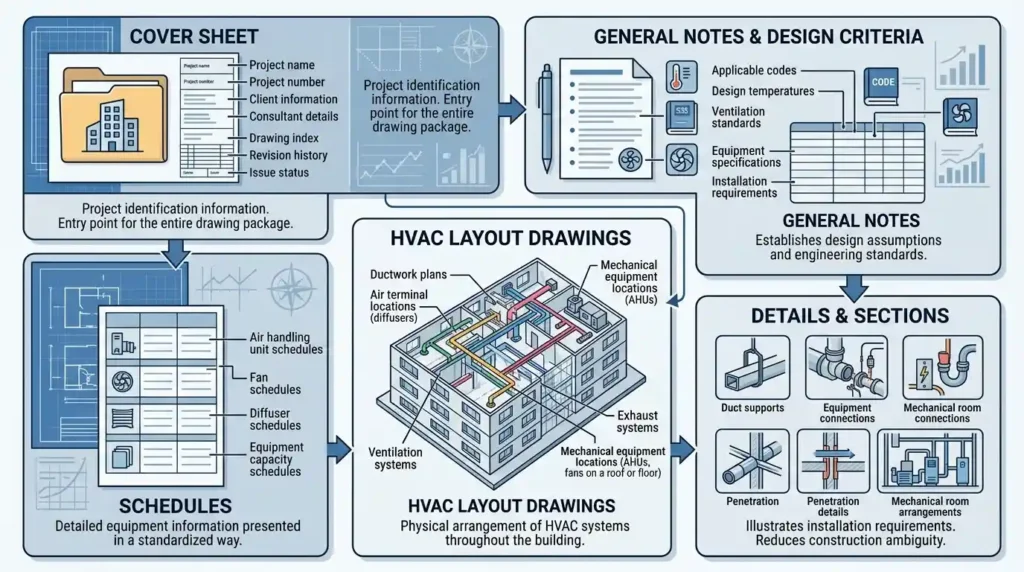
A complete HVAC drawing package typically contains multiple drawing categories arranged in a logical sequence.
Cover Sheet
The cover sheet provides project identification information.
It commonly includes:
- Project name
- Project number
- Client information
- Consultant details
- Drawing index
- Revision history
- Issue status
The cover sheet serves as the entry point for the entire drawing package.
General Notes and Design Criteria
This section establishes design assumptions and engineering standards.
It includes:
- Applicable codes
- Design temperatures
- Ventilation standards
- Equipment specifications
- Installation requirements
These notes provide context for interpreting technical drawings.
HVAC Layout Drawings
Layout drawings show the physical arrangement of HVAC systems.
Typical layouts include:
- Ductwork plans
- Air terminal locations
- Mechanical equipment locations
- Ventilation systems
- Exhaust systems
These drawings communicate system distribution throughout the building.
Schedules
Schedules provide detailed equipment information.
Examples include:
- Air handling unit schedules
- Fan schedules
- Diffuser schedules
- Equipment capacity schedules
Schedules standardise technical data presentation.
Details and Sections
Details illustrate installation requirements.
Examples include:
- Duct supports
- Equipment connections
- Penetration details
- Mechanical room arrangements
These drawings reduce construction ambiguity.
How does the drawing set organisation process work?
HVAC drawing sets follow a structured workflow involving creation, review, coordination, revision control, approval, and issue management before client submission. Each stage ensures documentation accuracy and compliance with project requirements.
Engineering organisations typically follow document control procedures throughout project development.
Initial Design Development
Engineers create conceptual HVAC layouts based on project requirements.
Key activities include:
- Load calculations
- Equipment selection
- System sizing
- Preliminary layouts
The objective is establishing the design foundation.
Internal Technical Review
Senior engineers review technical accuracy.
Review criteria include:
- Code compliance
- System performance
- Equipment capacities
- Design consistency
This stage strengthens quality assurance processes.
Multidisciplinary Coordination
HVAC drawings undergo coordination with other disciplines.
Examples include:
- Architecture
- Electrical engineering
- Plumbing engineering
- Structural engineering
Coordination reduces clashes and construction conflicts.
Revision and Mark-Up Resolution
Review comments are incorporated into updated drawings.
Document controllers track:
- Revision numbers
- Approval status
- Reviewer comments
- Change history
Version control prevents information loss.
Client Submission
Approved drawing packages are compiled according to project requirements.
Submission packages often include:
- PDF drawing sets
- CAD files
- Equipment schedules
- Calculation reports
The final package becomes the official client review document.
What standards govern HVAC drawing set organisation?
HVAC drawing organisation follows established engineering standards, naming conventions, document control procedures, and quality management frameworks that ensure consistency across projects and teams.
Large organisations frequently adopt standardised documentation frameworks to improve operational efficiency.
Drawing Numbering Systems
Drawing numbers create a consistent identification structure.
A typical drawing code contains:
- Discipline identifier
- Project identifier
- Sheet number
- Revision code
This system improves traceability.
Layer Management Standards
Layer standards organise graphical information.
Common HVAC layers include:
- Ductwork
- Equipment
- Diffusers
- Text
- Dimensions
- Annotations
Structured layer usage improves editing efficiency and coordination.
Revision Management
Revision control tracks document changes.
Each revision records:
- Change description
- Revision date
- Approver information
- Issue purpose
Revision management supports auditability and accountability.
Quality Management Frameworks
Many organisations align documentation processes with recognised quality systems.
Examples include:
- ISO 9001 quality management
- Engineering document control procedures
- Project execution plans
- Design review frameworks
These systems create measurable documentation quality standards.
How do organisations train employees to manage HVAC drawing sets?
Organisations develop drawing management capabilities through structured training programmes that combine technical software skills, document control practices, coordination workflows, and project delivery requirements.
Engineering teams often identify skill gaps in drawing production and document management.
Training programmes address these gaps through progressive learning pathways.
To get more information enrol in:
AutoCAD HVAC and Plumbing Design Training Course.
Technical Software Skills
Employees learn how to:
- Create HVAC layouts
- Manage layers
- Configure viewports
- Generate schedules
- Prepare plotting layouts
Technical proficiency supports documentation accuracy.
Drawing Standards Training
Teams learn internal and industry documentation standards.
Topics include:
- Naming conventions
- Revision procedures
- File management
- Quality requirements
Standardisation improves team consistency.
Project Coordination Skills
Engineers participate in coordination exercises.
Activities include:
- Clash detection reviews
- Design coordination meetings
- Mark-up management
- Drawing issue tracking
These skills improve cross-functional collaboration.
Issue Management Processes
Issue management training teaches document lifecycle control.
Professionals learn how to:
- Track revisions
- Record comments
- Manage approvals
- Control document distribution
This knowledge supports project governance.
As organisations evaluate structured approaches for developing these capabilities, readers often move from understanding documentation principles to examining implementation methods.
At this stage, a detailed discussion of:
How training programmes teach drawing organisation and issue management can be explored.
What business benefits result from organised HVAC drawing submissions?
Structured HVAC documentation improves operational efficiency, reduces project risk, enhances quality control, and supports predictable project delivery outcomes across engineering and construction teams.

Poor documentation creates measurable business costs.
Examples include:
- Construction delays
- Design rework
- Coordination conflicts
- Increased RFIs
- Client dissatisfaction
Well-organised drawing packages address these challenges.
Improved Productivity
Engineers spend less time searching for information.
Teams follow consistent workflows.
Documentation becomes easier to review and update.
Productivity gains often appear through reduced drawing preparation time and faster approval cycles.
Reduced Rework
Accurate drawing packages reduce construction errors.
Contractors receive clear installation instructions.
Design intent remains consistent throughout project execution.
Reduced rework directly impacts project profitability.
Better Collaboration
Standardised drawing structures improve communication between departments.
Examples include:
- Engineering teams
- Project management offices
- Procurement teams
- Construction teams
Improved collaboration supports project performance objectives.
Stronger Compliance
Organised documentation supports regulatory and contractual compliance.
Audit trails become easier to maintain.
Revision histories remain accessible throughout the project lifecycle.
What common problems affect HVAC drawing set organisation?
Many organisations experience documentation issues because of inconsistent standards, inadequate training, poor revision control, and fragmented project workflows. These problems reduce efficiency and increase project risk.
Several recurring challenges appear across engineering environments.
Inconsistent Naming Conventions
Different team members apply different file naming methods.
This creates confusion and slows document retrieval.
Standardisation solves this issue.
Poor Layer Management
Unstructured layer usage complicates editing and coordination.
Drawings become difficult to maintain.
Consistent layer standards improve usability.
Weak Revision Control
Uncontrolled revisions create conflicting document versions.
Teams lose confidence in drawing accuracy.
Formal document control procedures address this challenge.
Limited Coordination Processes
Departments sometimes work in isolation.
Design conflicts remain undetected until construction begins.
Structured coordination reviews reduce clashes and delays.
How does organised HVAC documentation support workforce development?
HVAC drawing set organisation develops technical competence, strengthens process discipline, improves collaboration, and supports long-term engineering capability within organisations.
Workforce development extends beyond software proficiency.
Employees require knowledge of:
- Engineering documentation
- Quality management
- Project coordination
- Information governance
- Technical communication
Structured learning programmes integrate these competencies into practical workflows.
Organisations that establish documentation standards create repeatable processes. Repeatable processes improve onboarding efficiency, reduce dependency on individual expertise, and support scalable project delivery.
Discover More from Our Guide Library:
Why Is Proper Layer Management Critical in AutoCAD HVAC Drawings?
How Do AutoCAD HVAC Designers Produce As-Built Drawings After Construction?
For HR managers, L&D professionals, engineering leaders, and business decision-makers, HVAC drawing set organisation represents both a technical capability and an operational performance framework. When documentation standards, training methodologies, quality controls, and issue management practices align, organisations achieve greater consistency, improved project outcomes, and measurable improvements in engineering productivity.
Frequently Asked Questions
Who should attend an AutoCAD HVAC and Plumbing Design Training Course?
This course is suitable for HVAC engineers, mechanical engineers, CAD technicians, MEP designers, project coordinators, and technical professionals involved in building services design. Imperial Corporate Training Institute structures the training to support both new and experienced users of AutoCAD.
How does AutoCAD HVAC and Plumbing training improve workplace performance?
AutoCAD HVAC and Plumbing training helps teams produce accurate technical drawings, follow industry standards, and reduce design errors. At Imperial Corporate Training Institute, the course focuses on practical drafting skills that support project efficiency and documentation quality.
Why is drawing set organisation important in HVAC and plumbing design projects?
Drawing set organisation improves document control, coordination between disciplines, and client review processes. The AutoCAD HVAC and Plumbing Design Training Course teaches structured drawing management methods that support consistent project delivery.
What skills are gained from an AutoCAD HVAC and Plumbing Design Training Course?
Participants develop skills in HVAC drafting, plumbing design documentation, AutoCAD layer management, drawing coordination, revision control, and technical drawing standards. Imperial Corporate Training Institute emphasises real-world design practices used across construction and engineering environments.