

The Lean Six Sigma Master Black Belt Certification Training Course at Imperial Corporate Training Institute is designed to develop enterprise-level problem solvers who can diagnose complex operational issues using structured analytical frameworks. One of the core diagnostic tools embedded in the programme is the fishbone diagram, used within case-based learning to trace root causes across systems, departments, and performance layers.
In real organisational environments, problems rarely originate from a single cause. Delays, defects, and inefficiencies often emerge from interconnected process failures, human factors, system design gaps, and data inconsistencies. The programme at Imperial Corporate Training Institute trains participants to move beyond surface-level symptoms and systematically identify underlying:
Causes using cause-and-effect mapping techniques within Lean Six Sigma Master Black Belt case studies.
This structured analytical capability is essential for senior professionals responsible for transformation initiatives, operational excellence programmes, and cross-functional improvement strategies. The learning design ensures that fishbone diagrams are not treated as theoretical tools but as applied diagnostic instruments integrated into enterprise decision-making.
What is the application of fishbone diagrams in Imperial’s MBB programme?
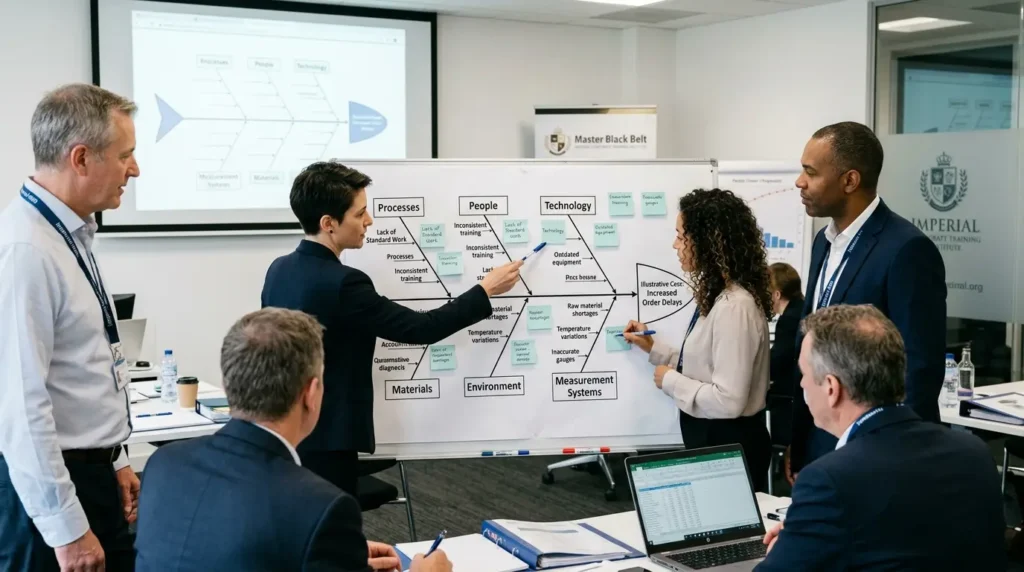
Fishbone diagrams in Imperial Corporate Training Institute’s Master Black Belt programme are applied as structured cause-and-effect tools within case studies to diagnose enterprise problems, trace root causes across processes, and align Lean Six Sigma methodologies with strategic performance improvement initiatives.
In the Lean Six Sigma Master Black Belt Certification Training Course, fishbone diagrams are applied as structured analytical instruments for enterprise diagnosis rather than simple quality tools. Imperial Corporate Training Institute integrates them into case-based simulations where participants evaluate operational breakdowns across manufacturing, service, and administrative environments.
The application focuses on categorising causes into system-level domains such as processes, people, technology, materials, environment, and measurement systems. This allows participants to develop a layered understanding of performance issues instead of relying on isolated assumptions.
Imperial Corporate Training Institute uses industry-aligned case studies where participants analyse scenarios such as supply chain delays, HR onboarding inefficiencies, or production quality defects. In each case, the fishbone diagram acts as the foundation for structured root cause exploration before statistical validation techniques are introduced.
This approach ensures that participants learn how to connect qualitative diagnosis with quantitative validation, which is essential for Master Black Belt-level decision-making in complex organisations.
Why does Imperial use fishbone-based cause analysis in Master Black Belt training?
Imperial Corporate Training Institute uses fishbone-based analysis in Master Black Belt training to build advanced diagnostic thinking, strengthen enterprise problem-solving capability, and ensure participants connect statistical tools with real organisational case studies for sustainable operational excellence outcomes delivery framework integration.
The use of fishbone diagrams in Imperial Corporate Training Institute programmes is not limited to visual mapping. It is designed to develop structured thinking patterns required for enterprise transformation roles. Senior professionals often face ambiguous problems where data alone does not immediately reveal root causes.
The programme addresses this gap by training participants to first structure the problem using cause-and-effect logic before applying statistical tools. This ensures that analytical effort is directed toward the correct variables, reducing wasted effort in large-scale improvement projects.
Imperial Corporate Training Institute integrates fishbone analysis with Lean Six Sigma Master Black Belt modules such as advanced regression modelling, process capability studies, and control chart interpretation. This combination allows participants to validate hypotheses generated during diagramming stages.
The structured approach also supports leadership decision-making. Participants learn how to communicate complex operational issues in simplified visual formats that can be understood by executives and stakeholders.
How are fishbone diagrams applied in Master Black Belt case studies?

Within Imperial Corporate Training Institute case study simulations, Master Black Belt participants apply fishbone diagrams to map causes of process failures, validate data-driven hypotheses, and integrate Lean Six Sigma tools such as regression analysis and control charts for enterprise solutions.
In the Master Black Belt training structure, case studies are designed to replicate real organisational complexity. Participants begin by defining a problem statement, then use fishbone diagrams to identify all possible contributing factors across operational systems.
At Imperial Corporate Training Institute, this process is embedded into structured workshops where participants work in cross-functional groups. Each group analyses different dimensions of the same business problem, ensuring a multi-perspective approach to root cause identification.
Once the fishbone diagram is developed, participants move to validation stages using statistical tools. For example, if a case study involves manufacturing defects, regression analysis is used to determine whether identified causes have measurable impact on output quality.
Control charts are then applied to assess process stability, ensuring that identified causes are not only theoretical but statistically significant. This integration of qualitative mapping and quantitative validation is a defining feature of the Imperial Corporate Training Institute approach.
The case study methodology ensures that participants develop confidence in applying structured problem-solving techniques in real corporate environments.
For deeper insight, explore:
Lean Six Sigma Master Black Belt Certification Training Course
What outcomes do professionals achieve through this approach?
Participants achieve enterprise-level diagnostic capability, enabling them to identify root causes of operational inefficiencies, improve cross-functional performance, and deliver measurable cost reductions through Imperial Corporate Training Institute Master Black Belt certification aligned with global Lean Six Sigma standards framework deployment
The learning outcomes of the fishbone diagram methodology extend beyond technical knowledge. Professionals trained at Imperial Corporate Training Institute develop the ability to approach organisational problems systematically and defensibly.
They gain capability in breaking down complex operational challenges into structured cause categories. This skill is critical for roles involving business transformation, quality leadership, and process excellence management.
In practical terms, graduates of the Lean Six Sigma Master Black Belt Certification Training Course are able to lead enterprise improvement projects that reduce cycle time, eliminate waste, and improve service delivery consistency.
Imperial Corporate Training Institute ensures that these outcomes are measurable through project-based assessments. Participants must demonstrate their ability to apply fishbone analysis within real or simulated business environments, followed by statistical validation and financial impact reporting.
The result is a workforce capable of driving sustained operational improvement across departments, supported by data-driven decision-making frameworks.
How is the course structured around analytical and case-based learning?
The Imperial Corporate Training Institute Master Black Belt programme is structured into ten progressive modules covering advanced analytics, enterprise Lean transformation, change leadership, project portfolio management, coaching, and financial impact analysis for comprehensive organisational capability development and governance alignment systems
The course structure at Imperial Corporate Training Institute is designed to progressively build capability from diagnostic thinking to enterprise transformation leadership. Each module introduces a layer of complexity aligned with real business applications.
Early modules focus on strategic roles and advanced analytical tools, ensuring participants understand both leadership expectations and statistical foundations. Mid-level modules focus on Lean transformation and organisational change, where fishbone diagrams are heavily applied in case-based learning.
Advanced modules include project portfolio management and financial impact analysis, ensuring that participants can justify improvement initiatives in terms of business value. The final capstone project requires full application of Lean Six Sigma methodologies in a simulated enterprise environment.
The MOFU learning pathway within the programme is reinforced through structured comparison of analytical tools and decision frameworks, helping participants understand when and how to apply fishbone diagrams versus other root cause techniques.
Imperial Corporate Training Institute ensures that every module is linked to workplace application, particularly for senior professionals managing transformation portfolios.
What is the value and cost justification of the Master Black Belt certification?
Investment in Imperial Corporate Training Institute Master Black Belt certification reflects long-term organisational capability building, focusing on enterprise efficiency gains, leadership development, and measurable ROI through structured Lean Six Sigma deployment across complex operational environments and sustained performance improvement outcomes
The value of the Lean Six Sigma Master Black Belt Certification Training Course lies in its ability to develop internal capability for continuous improvement. Instead of relying on external consultants, organisations build in-house expertise capable of diagnosing and resolving systemic inefficiencies.
Imperial Corporate Training Institute positions this certification as a strategic capability investment. The training enables professionals to lead large-scale transformation initiatives that directly influence cost reduction, process optimisation, and productivity improvement.
From a corporate perspective, the cost justification is linked to measurable outcomes such as reduced operational waste, improved cycle times, and enhanced process stability. These outcomes are achieved through structured application of Lean Six Sigma tools, including fishbone diagrams integrated with advanced analytics.
The programme is particularly valuable for organisations undergoing digital transformation or restructuring, where process clarity and root cause identification are critical for success.
How does enrollment and assessment work in the MBB programme?
Enrollment at Imperial Corporate Training Institute for Master Black Belt certification involves eligibility review, professional experience validation, and structured onboarding into case-based Lean Six Sigma learning pathways with assessment-driven certification and project evaluation requirements within corporate learning framework delivery model
Enrollment in the Lean Six Sigma Master Black Belt Certification Training Course at Imperial Corporate Training Institute follows a structured entry process designed for senior professionals. Candidates are typically required to have prior Lean Six Sigma experience, often at Black Belt level or equivalent operational leadership exposure.
Discover More from Our Guide Library:
Can Banking and Insurance Professionals Attend Imperial’s Lean Six Sigma MBB Course?
Does Imperial’s MBB Programme Include Practical MSA and Gage R&R Exercises?
Once enrolled, participants are onboarded into a structured learning pathway that includes case-based workshops, simulation exercises, and project assignments. The learning journey is designed to mirror real organisational transformation cycles.
Assessment is conducted through a combination of written evaluations, case study analysis, and a final capstone project. Participants must demonstrate their ability to apply fishbone diagrams and other analytical tools to solve enterprise-level problems.
Imperial Corporate Training Institute ensures that certification reflects not only theoretical understanding but also applied capability in real-world business environments.
The Lean Six Sigma Master Black Belt Certification Training Course at Imperial Corporate Training Institute is designed to transform senior professionals into enterprise-level problem solvers capable of leading structured operational excellence initiatives.