

Engineering organisations in oil and gas, power generation, manufacturing, and infrastructure projects depend on accurate technical drawings to design, install, and maintain mechanical systems. HVAC systems regulate temperature, air quality, ventilation, and environmental control across industrial facilities. AutoCAD HVAC training develops the technical drafting and design skills required to create these systems according to engineering specifications and operational requirements.
As industrial projects become more complex, organisations require technicians, designers, and engineers who can interpret technical requirements and convert them into accurate digital designs. AutoCAD HVAC training supports workforce readiness by providing practical design knowledge, software proficiency, and industry-standard documentation skills that align with engineering project requirements.
What Is AutoCAD HVAC Training and Why Is It Important for Industrial Sectors?
AutoCAD HVAC training develops the skills required to create, modify, and manage heating, ventilation, air conditioning, and plumbing system drawings. Organisations use these competencies to improve engineering accuracy, project coordination, regulatory compliance, and operational efficiency across industrial environments.
AutoCAD is a computer-aided design (CAD) platform used to create technical drawings and engineering documentation. HVAC refers to Heating, Ventilation, and Air Conditioning systems that control indoor environmental conditions.
In industrial sectors such as oil and gas, power generation, petrochemicals, manufacturing, and utilities, HVAC systems perform critical operational functions. These systems maintain equipment temperatures, protect sensitive assets, support worker safety, and ensure regulatory compliance.
AutoCAD HVAC training focuses on technical drafting standards, mechanical system layouts, duct routing, piping design, equipment placement, airflow calculations, and engineering documentation.
From a workforce development perspective, the training addresses skill gaps in technical design capabilities. Organisations often require personnel who understand both engineering principles and digital design tools. Training bridges this gap by combining theoretical knowledge with practical application.
How Industrial Facilities Use HVAC Systems
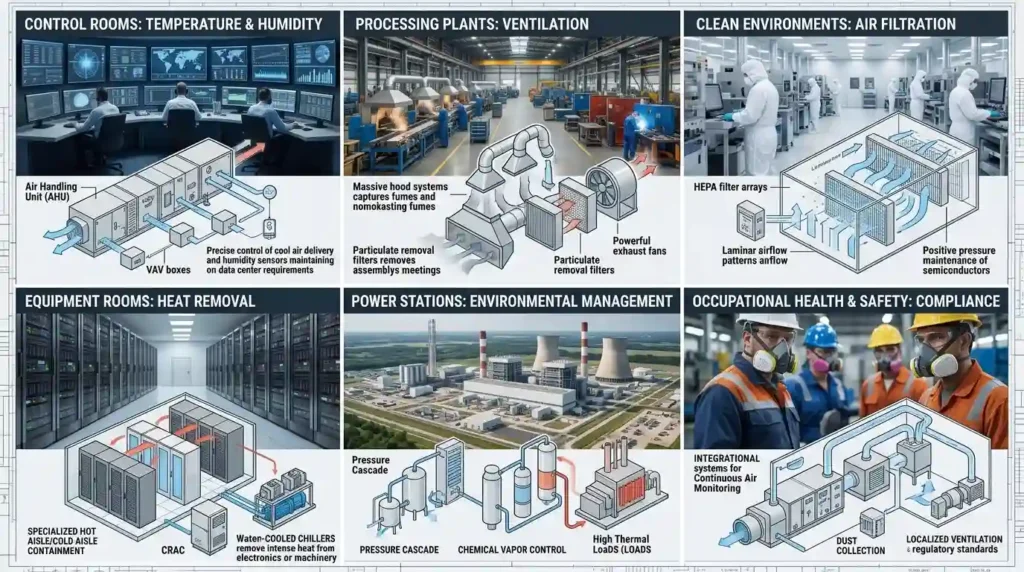
Industrial facilities rely on HVAC systems for several operational requirements:
- Temperature control in control rooms
- Ventilation in processing plants
- Air filtration in clean environments
- Heat removal from equipment rooms
- Environmental management in power stations
- Occupational health and safety compliance
Each application requires detailed engineering drawings that support installation, maintenance, and future modifications.
How Does AutoCAD HVAC Training Work in Professional Learning Environments?
AutoCAD HVAC training follows a structured learning process that combines technical theory, software instruction, practical exercises, simulations, assessments, and project-based learning to develop workplace-ready design competencies applicable across engineering-driven industries.
Organisations typically implement technical training through structured learning pathways. These pathways include knowledge acquisition, skills practice, performance assessment, and workplace application.
The training process generally begins with engineering drawing fundamentals. Participants learn technical symbols, drafting standards, dimensioning methods, and drawing conventions.
The next phase focuses on AutoCAD software functionality. Learners develop proficiency in commands, drawing tools, layer management, annotation techniques, and documentation standards.
Stage 1: Foundation Knowledge
Learners study:
- Mechanical engineering drawing principles
- HVAC system components
- Industrial ventilation concepts
- Ductwork fundamentals
- Plumbing system basics
- Technical documentation requirements
This foundation ensures consistency before advanced design activities begin.
Stage 2: Software Skills Development
Participants practise:
- Creating engineering drawings
- Managing layers and templates
- Producing technical layouts
- Applying engineering standards
- Generating design documentation
- Creating construction-ready drawings
Practical exercises reinforce software proficiency through repeated application.
Stage 3: Project-Based Application
Training programmes often include realistic project scenarios.
Learners create:
- HVAC floor plans
- Equipment layouts
- Duct routing designs
- Plumbing schematics
- Mechanical room configurations
- Coordination drawings
These activities replicate workplace tasks found within engineering departments.
Stage 4: Assessment and Validation
Performance assessments measure competency through:
- Drawing accuracy
- Standards compliance
- Design quality
- Documentation completeness
- Software efficiency
- Problem-solving capability
Assessment results provide measurable evidence of skill development.
What Skills and Technical Components Are Included in AutoCAD HVAC Training?
AutoCAD HVAC training combines software expertise, engineering knowledge, technical documentation skills, design methodologies, system coordination techniques, and industry-standard drafting practices required for engineering projects within industrial sectors.
Successful HVAC design requires multiple competencies working together.
Training programmes typically integrate technical, operational, and documentation skills.
AutoCAD Drafting Skills
Learners develop proficiency in:
- 2D drafting
- Layer management
- Block creation
- Annotation systems
- Dimensioning standards
- Plotting procedures
These capabilities support efficient design production.
HVAC Design Knowledge
Training covers:
- Air distribution systems
- Ventilation principles
- Equipment selection criteria
- Duct sizing concepts
- Airflow management
- Mechanical coordination
These concepts help designers understand system functionality.
Plumbing Design Components
Plumbing design modules often include:
- Water supply systems
- Drainage networks
- Pipe routing techniques
- Fixture coordination
- Technical schematics
- Construction documentation
Integrated HVAC and plumbing knowledge improves multidisciplinary collaboration.
Engineering Documentation Standards
Industrial projects require extensive documentation.
Training develops competencies in:
- Design specifications
- Technical schedules
- Drawing revisions
- Engineering records
- Compliance documentation
- Quality assurance processes
These outputs support project governance and operational continuity.
Why Do Oil Gas and Power Companies Value AutoCAD HVAC Skills?

Oil gas and power organisations require accurate HVAC design documentation to support safety, operational reliability, environmental control, equipment protection, and regulatory compliance throughout facility lifecycles.
Industrial facilities operate within highly regulated environments.
Engineering drawings serve as critical references throughout design, construction, operation, maintenance, and expansion phases.
HVAC systems influence operational continuity. Equipment overheating, poor ventilation, and environmental control failures can affect productivity and safety performance.
AutoCAD HVAC professionals contribute to project teams by creating documentation that supports engineering decision-making.
Oil and Gas Applications
Oil and gas facilities use HVAC systems in:
- Control rooms
- Compressor stations
- Offshore platforms
- Refining facilities
- Processing plants
- Storage terminals
Each environment requires specialised engineering design documentation.
Power Sector Applications
Power generation facilities require HVAC systems for:
- Turbine halls
- Electrical rooms
- Control centres
- Battery storage areas
- Data centres
- Administrative facilities
Design accuracy directly supports operational performance.
How Do Organisations Implement AutoCAD HVAC Training Programmes?
Organisations implement AutoCAD HVAC training through competency frameworks, blended learning delivery, performance assessments, workplace projects, and continuous skills evaluation aligned with operational objectives and workforce development strategies.
Training implementation begins with workforce capability analysis.
Learning and Development teams identify technical skill gaps through performance reviews, engineering audits, and project requirements.
Training objectives are then aligned with organisational goals.
Common Training Delivery Formats
Many organisations use multiple delivery methods.
These include:
- Instructor-led workshops
- Virtual classrooms
- Online learning modules
- Technical simulations
- Practical laboratories
- Hybrid learning programmes
Blended learning often improves knowledge retention because participants combine theory with practical application.
Learning Methodologies
Technical training commonly incorporates:
- Case-based learning
- Engineering simulations
- Guided projects
- Peer collaboration
- Practical assessments
- Skills demonstrations
These methodologies support real-world knowledge transfer.
At the point where organisations begin evaluating specialised engineering pathways and sector-specific opportunities, readers often seek deeper insight into how HVAC design skills connect with industrial careers.
This is an appropriate stage to reference such as exploring
How Does AutoCAD HVAC Design Training Open Doors into Industrial Engineering Sectors?
What Measurable Outcomes Does AutoCAD HVAC Training Produce?
AutoCAD HVAC training improves design accuracy, project efficiency, technical competency, documentation quality, cross-functional collaboration, and engineering productivity through structured learning and measurable performance indicators.
Organisations increasingly evaluate training effectiveness using objective metrics.
Key Performance Indicators (KPIs) measure learning impact and operational value.
Common Training KPIs
Examples include:
- Design error reduction rates
- Drawing completion times
- Project delivery efficiency
- Rework reduction percentages
- Compliance audit scores
- Employee competency assessments
Engineering departments frequently track drawing revision rates before and after training implementation.
Lower revision volumes indicate improved design quality.
Operational Benefits
Improved technical competency contributes to:
- Faster project execution
- Reduced engineering bottlenecks
- Improved documentation consistency
- Better interdisciplinary coordination
- Enhanced quality assurance processes
These outcomes support organisational performance objectives.
Which Industries and Departments Benefit Most from AutoCAD HVAC Training?
AutoCAD HVAC training supports departments responsible for engineering design, facilities management, project execution, infrastructure development, maintenance planning, and technical operations across multiple industrial sectors.
The applicability of HVAC design skills extends beyond traditional construction projects.
Several industries rely on technical design capabilities.
Industries Using HVAC Design Skills
Examples include:
- Oil and gas
- Power generation
- Manufacturing
- Pharmaceuticals
- Healthcare
- Infrastructure development
- Data centres
- Commercial real estate
Each sector requires detailed engineering documentation.
Departments That Use These Competencies
Internal teams include:
- Mechanical engineering
- Facilities management
- Project management
- Maintenance engineering
- Asset management
- Technical services
Cross-functional collaboration improves when design standards remain consistent across departments.
What Common Misconceptions Limit the Effectiveness of AutoCAD HVAC Training?
Many organisations focus solely on software operation while overlooking engineering principles, practical application, competency assessment, and workplace integration, reducing overall training effectiveness and business impact.
Training programmes often fail when software instruction becomes the only objective.
Technical competency requires a broader framework.
Misconception 1: AutoCAD Skills Alone Create Competent Designers
Software knowledge represents only one component.
Effective HVAC design also requires:
- Engineering understanding
- System knowledge
- Industry standards awareness
- Documentation discipline
- Problem-solving capability
Technical judgement remains essential.
Misconception 2: Generic Technical Training Produces Industry Readiness
Industrial sectors operate under specific requirements.
Oil and gas facilities differ from hospitals, manufacturing plants, and power stations.
Training should reflect workplace realities and sector-specific applications.
Misconception 3: Training Success Equals Course Completion
Completion rates measure participation.
Competency measures performance.
Organisations achieve better results when assessments evaluate practical application rather than attendance alone.
How Does AutoCAD HVAC Training Contribute to Long-Term Workforce Development?
AutoCAD HVAC training strengthens technical capability pipelines, supports engineering succession planning, standardises design practices, and improves organisational readiness for future infrastructure and industrial development projects.
Workforce development requires sustainable skill-building systems.
Technical design competencies support long-term organisational objectives.
Engineering organisations frequently face challenges related to workforce shortages, evolving technology, and increasing project complexity.
Discover More from Our Guide Library:
How Does AutoCAD HVAC Training Cover Plotting Layout and Drawing Output Setup?
How Does AutoCAD HVAC Training Distinguish Between Schematic and Working Drawings?
Structured HVAC training helps address these challenges through practical knowledge development and measurable competency growth.
When integrated into broader learning strategies, AutoCAD HVAC training contributes to improved workforce capability, stronger engineering standards, and greater operational consistency across industrial environments such as oil and gas facilities, power generation plants, manufacturing operations, and large-scale infrastructure projects.
Frequently Asked Questions
How does AutoCAD HVAC training help in engineering careers?
AutoCAD HVAC training develops technical drafting and system design skills required in mechanical engineering, oil and gas, and power sector projects. It improves the ability to create accurate HVAC and plumbing drawings, which are essential for industrial design and infrastructure development roles.
Who should enrol in AutoCAD HVAC and Plumbing Design training?
This training is suitable for mechanical engineers, diploma holders, draftsmen, and technicians aiming to enter HVAC design and industrial engineering fields. It is also relevant for professionals working in construction, facilities management, and energy sector projects.
What skills are gained from AutoCAD HVAC design training?
Learners gain skills in HVAC system layout design, plumbing network drafting, and AutoCAD 2D drawing techniques used in engineering documentation. The course also builds competency in technical standards, project drawings, and mechanical coordination in industrial environments.
How is AutoCAD HVAC training used in industrial projects?
AutoCAD HVAC training is used to create precise engineering drawings for ventilation, heating, cooling, and plumbing systems in industrial facilities. These drawings support oil and gas plants, power stations, and manufacturing units by improving design accuracy and project execution efficiency.