

The AutoCAD HVAC and Plumbing Design Training Course at Imperial Corporate Training Institute is a structured corporate training programme designed to solve coordination breakdowns between HVAC, plumbing, electrical, and architectural design teams. It focuses on building technical drafting accuracy, multi-discipline communication capability, and integrated engineering documentation workflows for real construction projects.
In many engineering organisations, HVAC designers operate in isolation from other disciplines. This creates clashes, rework cycles, and delayed approvals. The skill gap is not only software-related. It is coordination related. Engineers often lack structured exposure to multi-discipline workflows using AutoCAD in real project environments.
This is where structured training becomes essential. The programme by Imperial Corporate Training Institute builds systematic understanding of how HVAC and plumbing systems interact with structural grids, architectural layouts, and electrical routing.
Early-stage learners often explore foundational roles of HVAC designers in team environments. A related conceptual breakdown is available in this resource on:
What is the role of the HVAC designer in a multi-discipline design team, which establishes how coordination responsibilities evolve in real projects?
The course is not designed as isolated software training. It is structured around engineering collaboration logic. Imperial Corporate Training Institute integrates drafting, system design, and documentation into one workflow model that reflects real construction project environments.
Participants learn how HVAC drawings influence plumbing risers, how duct routing interacts with ceiling constraints, and how spatial coordination is validated through CAD systems. This reduces design conflicts during execution phases.
Imperial Corporate Training Institute positions this course as a transition point between technical drafting ability and coordinated engineering delivery across multiple disciplines.
Why is this course structured around multi-discipline coordination rather than standalone AutoCAD training?
The course is structured around multi-discipline coordination because modern HVAC and plumbing design cannot function in isolation, and Imperial Corporate Training Institute has designed the curriculum to reflect real construction environments where architectural, structural, and MEP systems must be aligned through shared CAD workflows and coordination protocols.
Traditional AutoCAD training focuses on commands and drawing tools. This programme focuses on workflow logic. The structure reflects how engineering teams operate in corporate environments where multiple consultants contribute to a single model.
Imperial Corporate Training Institute has designed the learning progression to move from basic drafting control to advanced coordination scenarios. This includes external references (Xrefs), layered system management, and revision-based collaboration models.
The reasoning behind this structure is practical. HVAC engineers frequently face issues such as duct clashes with beams, plumbing conflicts with electrical trays, and incorrect spatial assumptions during design handover. These issues occur due to lack of structured coordination training.
The course logic is built to eliminate these gaps through progressive modules. Each module introduces increasing complexity, starting with drafting standards and advancing into integrated BIM coordination workflows.
Learners also compare AutoCAD-based workflows with modern BIM practices. This comparison becomes critical during evaluation-stage understanding, especially when deciding how CAD-based design integrates into broader digital construction systems.
A structured comparison is discussed in:
How AutoCAD HVAC training prepares engineers for multi-discipline collaboration, which explains workflow alignment between disciplines.
Imperial Corporate Training Institute ensures that each module is aligned with workplace deliverables rather than theoretical instruction. The structure reflects how engineering drawings move from concept to approval to construction execution.
This design logic prepares participants to function within coordinated teams rather than isolated drafting roles.
What technical and coordination skills will participants develop through this course?
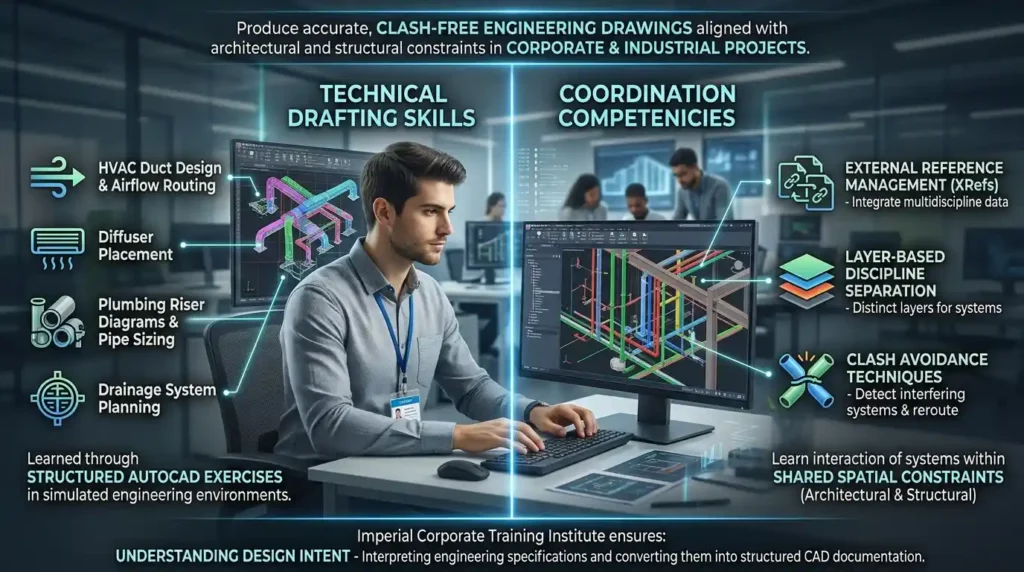
Participants at Imperial Corporate Training Institute develop advanced HVAC drafting capability, plumbing system design proficiency, and structured multi-discipline coordination skills that enable them to produce accurate, clash-free engineering drawings aligned with architectural and structural constraints in corporate and industrial projects.
The learning outcomes are divided into technical drafting skills and coordination competencies.
Technical skills include HVAC duct design, airflow routing, diffuser placement, plumbing riser diagram creation, pipe sizing, and drainage system planning. These are developed through structured AutoCAD exercises that simulate real engineering environments.
Coordination skills include external reference management, layer-based discipline separation, and clash avoidance techniques. Learners understand how different engineering systems interact within shared spatial constraints.
Imperial Corporate Training Institute ensures that learners do not only create drawings but also understand design intent. This includes interpreting engineering specifications and converting them into structured CAD documentation.
HVAC Design and Drafting Skills
Participants learn how to design duct layouts for commercial buildings. They work with airflow distribution planning, equipment placement, and ventilation system routing.
They also learn how to manage HVAC layers in AutoCAD. This ensures clarity in multi-discipline drawings where multiple systems overlap.
Plumbing System Design Skills
Participants develop the ability to design cold water, hot water, and drainage systems. They create riser diagrams and coordinate pipe routing with HVAC and electrical systems.
Imperial Corporate Training Institute emphasises pressure drop analysis and fixture unit calculations to ensure functional system design.
Multi-Discipline Coordination Skills
The course introduces Xref-based collaboration workflows. This allows learners to work on shared architectural and structural backgrounds while maintaining discipline-specific drawings.
Learners also understand how to identify clashes and resolve spatial conflicts before construction.
Documentation and Standards Skills
Participants develop structured documentation capability, including drawing sheets, legends, schedules, and revision control systems.
These outputs reflect corporate-level engineering documentation standards used in real projects.
How does Imperial Corporate Training Institute deliver HVAC and plumbing coordination training?
Imperial Corporate Training Institute delivers the HVAC and plumbing coordination training through structured instructor-led workshops, hands-on AutoCAD simulations, project-based exercises, and scenario-driven assessments that replicate real corporate engineering environments and multi-discipline coordination workflows.
The delivery model is designed for applied learning. It is not lecture-heavy. Each session focuses on building operational capability through real drawing tasks.
Training is typically delivered in a hybrid format. This includes classroom instruction, guided software practice, and project-based assignments that simulate real construction documentation.
Imperial Corporate Training Institute uses layered learning progression. Early sessions focus on interface control and drafting precision. Later sessions focus on coordination and integration across disciplines.
Participants work on simulated building projects where HVAC and plumbing systems must align with architectural layouts. This includes ceiling coordination, vertical riser planning, and equipment room design.
Assessment is continuous. Learners are evaluated through drawing accuracy, coordination logic, and documentation completeness. This ensures measurable skill development rather than theoretical understanding.
Assignments include HVAC duct layout creation, plumbing system design, and integrated MEP coordination drawings.
Imperial Corporate Training Institute also includes revision-based training. Learners submit drawings, receive structured feedback, and revise outputs based on engineering standards.
This process reflects real project workflows where design revisions are part of client and consultant coordination cycles.
The final stage includes a complete project simulation. Learners produce a full HVAC and plumbing design package with documentation suitable for corporate review.
What outcomes can organisations and professionals expect after completing this course?
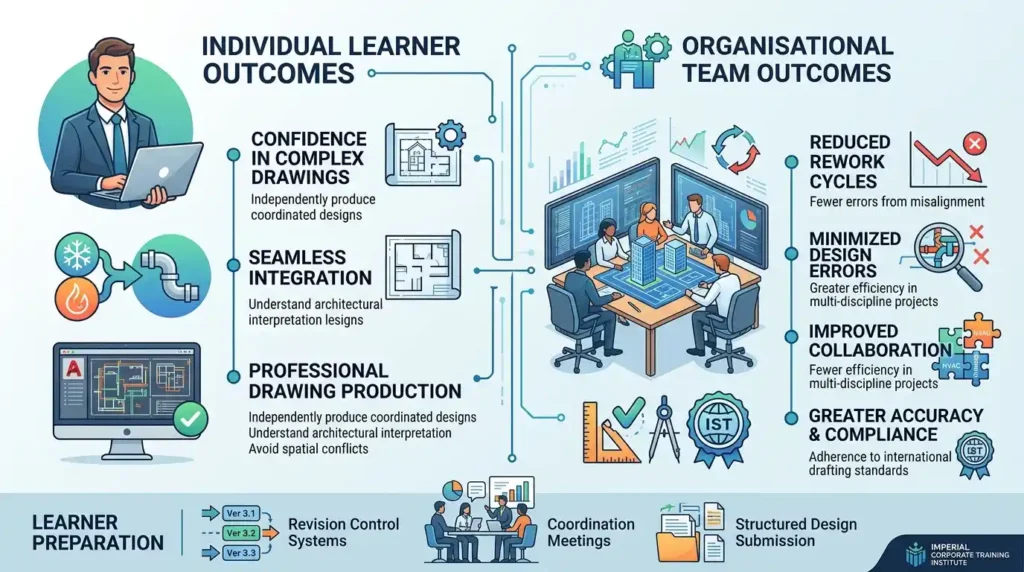
After completing this programme at Imperial Corporate Training Institute, professionals can independently produce coordinated HVAC and plumbing AutoCAD drawings, reduce design conflicts, improve multi-discipline collaboration efficiency, and contribute to engineering project delivery with greater accuracy and compliance with international drafting standards.
The outcomes are measurable at both individual and organisational levels.
At an individual level, learners develop confidence in handling complex CAD drawings involving multiple systems. They understand how to interpret architectural layouts and integrate HVAC and plumbing systems without spatial conflicts.
At an organisational level, teams experience reduced rework cycles. Design errors caused by misalignment between disciplines are significantly reduced.
Imperial Corporate Training Institute ensures that learners are prepared for real engineering environments. This includes exposure to revision control systems, coordination meetings, and structured design submission processes.
Workplace Application Scenarios
In construction firms, trained engineers can coordinate HVAC duct routing with ceiling designs without clashes.
In facility management teams, professionals can interpret system layouts for maintenance planning and operational upgrades.
In design consultancies, engineers can prepare coordinated drawings for client approval and tender submissions.
Imperial Corporate Training Institute also prepares learners for BIM transition environments. This allows them to collaborate effectively in hybrid CAD-BIM workflows.
The course improves communication efficiency between departments. Engineers become capable of explaining design intent clearly during coordination meetings.
Documentation quality also improves. Drawings become structured, readable, and aligned with corporate engineering standards.
How does this training align with modern CAD, BIM, and multi-discipline engineering workflows?
Imperial Corporate Training Institute aligns this training with modern CAD and BIM workflows by integrating AutoCAD-based design practices with multi-discipline coordination techniques, external referencing systems, and data-ready documentation methods that prepare engineers for transition into BIM-based collaborative environments.
Modern engineering workflows are no longer isolated to 2D drafting. Projects now require integration between AutoCAD, Revit, and BIM coordination platforms.
This course introduces learners to these transitions without removing AutoCAD from its core role. Instead, it builds compatibility understanding.
Imperial Corporate Training Institute includes modules that explain how AutoCAD drawings are referenced into BIM systems. Learners understand how data flows between design platforms.
External reference workflows are central to this alignment. Engineers learn how Xrefs function as coordination tools between disciplines.
The training also includes understanding of 3D spatial planning. This supports transition toward BIM environments without losing foundational CAD control.
Imperial Corporate Training Institute ensures that learners can operate in hybrid environments where AutoCAD remains a core documentation tool while BIM handles integrated modelling.
This alignment is critical for modern construction projects where multiple consultants use different software ecosystems.
How does enrollment work and what is required to join this programme?
Enrollment at Imperial Corporate Training Institute is structured for engineering professionals with basic AutoCAD familiarity or mechanical design exposure, and the process involves application submission, eligibility review, course confirmation, and scheduled participation in structured training batches aligned with corporate learning requirements.
The course is open to mechanical engineers, HVAC designers, MEP coordinators, draftsmen, and professionals working in construction or facility management environments.
Basic understanding of engineering drawing concepts is recommended. Prior AutoCAD experience is helpful but not mandatory for entry-level participants.
Discover More from Our Guide Library:
Does Imperial’s HVAC Course Cover Drawing Issue Management Procedures?
Does Imperial’s HVAC Programme Teach International Drawing Standards?
Imperial Corporate Training Institute evaluates participants based on professional background relevance rather than academic restrictions. This ensures accessibility for working professionals.
The enrollment process includes registration through the official training platform, confirmation of batch scheduling, and allocation into structured learning groups.
Training batches are organised to reflect corporate learning cycles. This allows organisations to train teams together for improved coordination outcomes.
Completion is based on assignment submission, project evaluation, and final coordination simulation performance.
Upon completion, participants gain structured capability in HVAC and plumbing design coordination using AutoCAD, aligned with real corporate engineering workflows delivered through Imperial Corporate Training Institute.