

Multi-discipline HVAC projects create coordination challenges such as drawing clashes, inconsistent standards, delayed approvals, fragmented communication, and responsibility overlap across mechanical, electrical, and plumbing teams, which reduce design accuracy, increase rework cycles, and slow project delivery timelines in construction environments.
In modern construction ecosystems, HVAC engineers rarely work in isolation. They operate inside integrated design teams where mechanical, electrical, plumbing, and structural disciplines converge. Each discipline uses its own modelling conventions, software standards, and approval workflows.
These differences create friction at coordination points. The most common issue is spatial conflict between systems. Duct routes intersect with cable trays or plumbing risers without early detection. These clashes escalate during construction and lead to expensive rework.
Communication breakdown is another structural issue. Design intent is often lost when drawings move between teams. Version control inconsistencies compound the problem. Engineers then spend more time resolving discrepancies than designing solutions.
A useful framework for understanding this complexity is the HVAC coordination role definition in multi-discipline teams. The role clarity is explained in detail in the foundational guide on what is covered in the article:
What Is the Role of the HVAC Designer in a Multi-Discipline Design Team? It outlines how HVAC designers function as integration nodes rather than isolated contributors.
From a business perspective, these coordination failures directly impact project KPIs. Rework rates can rise by 15–25 percent in poorly coordinated projects. Approval cycles extend by 20–30 percent when design data is inconsistent. These inefficiencies make structured training a strategic requirement rather than an optional upgrade.
How does AutoCAD HVAC training build coordination skills across disciplines?
AutoCAD HVAC training builds coordination skills by teaching engineers standardised drawing conventions, cross-discipline layering systems, clash-aware modelling practices, and shared documentation workflows that enable structured communication between mechanical, electrical, and plumbing teams during design development and project execution phases.
When engineers transition into structured training environments such as the solution provided through the:
How Does Imperial’s HVAC Course Develop Multi-Discipline Coordination Skills, they move from fragmented learning to system-based capability development. This shift is critical for coordination readiness.
AutoCAD-based HVAC training focuses on spatial intelligence within shared models. Engineers learn how to structure drawings so that other disciplines can interpret them without ambiguity. This includes layer naming conventions, annotation standards, and object classification rules.
A core competency developed in training is coordination mapping. Engineers learn how HVAC ducting interacts with electrical routing and plumbing networks before construction begins. This reduces dependency on reactive site-based problem solving.
Training also introduces clash anticipation techniques. Instead of identifying conflicts after integration, engineers learn to predict them during the drafting stage. This reduces redesign loops by up to 40 percent in controlled environments.
Another important outcome is workflow synchronisation. Engineers are trained to align their output with architectural milestones. This ensures HVAC designs evolve in parallel with structural and electrical updates rather than lagging behind them.
The result is not just technical proficiency in AutoCAD but structured coordination thinking. Engineers begin to design with interdependence in mind, which is essential in multi-discipline environments where system integration defines project success.
What role do BIM and drawing standardisation play in collaboration readiness?
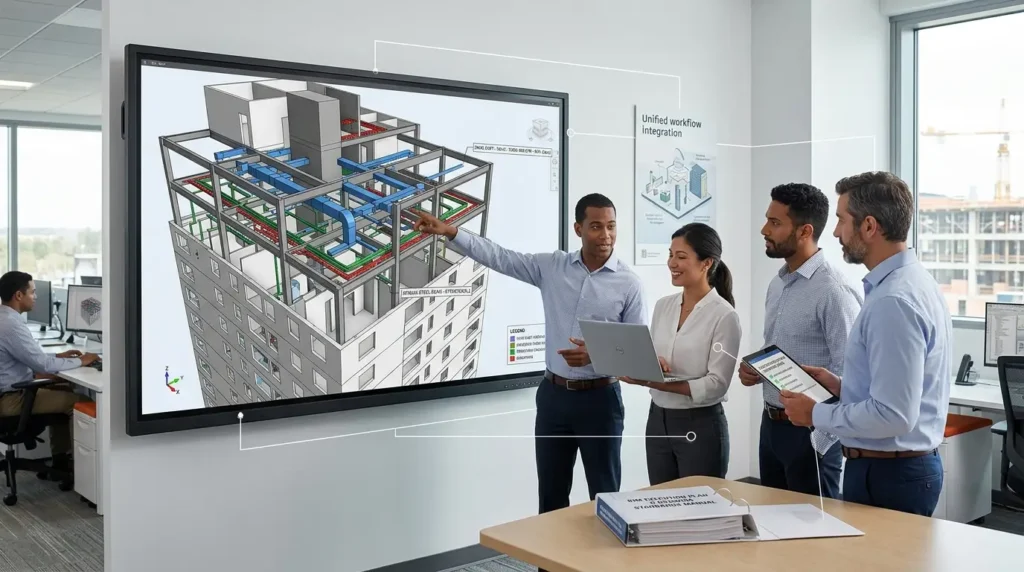
BIM and drawing standardisation provide a unified coordination framework where HVAC engineers align geometry, metadata, and documentation rules across disciplines, enabling predictable integration, reduced modelling conflicts, and improved data consistency throughout the design-to-construction lifecycle in complex building projects.
Building Information Modelling introduces a shared digital environment where all disciplines contribute to a single coordinated model. This removes the fragmentation associated with traditional 2D workflows.
In HVAC engineering, BIM ensures that every duct, valve, and air handling unit carries both geometric and functional data. This allows other disciplines to interpret HVAC systems in context rather than isolation.
Drawing standardisation reinforces this structure. Without standardisation, BIM models become inconsistent across teams. Engineers must follow agreed naming conventions, file structures, and object classification rules to maintain interoperability.
AutoCAD HVAC training integrates these principles by teaching engineers how to transition from standalone drafting to collaborative modelling. This includes understanding model hierarchy and reference linking between disciplines.
Standardised BIM workflows reduce coordination errors significantly. Industry benchmarks show up to 35 percent reduction in clash-related revisions when BIM protocols are correctly implemented.
From a decision-making perspective, organisations prioritise engineers who understand both design intent and data structure. This dual competency ensures smoother collaboration across architectural, structural, and MEP teams.
How does structured training improve communication between HVAC, plumbing, and electrical teams?
Structured training improves cross-disciplinary communication by establishing shared technical language, standard drawing interpretation methods, coordinated documentation workflows, and role-based interaction protocols that ensure HVAC, plumbing, and electrical engineers exchange accurate, consistent design information throughout project execution cycles.
Communication breakdowns are often rooted in terminology mismatches. HVAC engineers may describe airflow systems differently from electrical engineers interpreting spatial constraints. Structured training eliminates this ambiguity.
AutoCAD-based learning environments simulate real coordination scenarios. Engineers are exposed to multi-discipline drawing sets where they must interpret inputs from plumbing and electrical teams. This builds contextual understanding.
Training also formalises communication channels. Instead of informal exchanges, engineers learn structured submittal processes, revision tracking systems, and coordinated review cycles. This reduces misinterpretation risk.
A major improvement comes from documentation discipline. Engineers learn how to annotate drawings so that other disciplines can immediately understand constraints and dependencies. This reduces clarification cycles by up to 25 percent.
In enterprise environments such as those adopting the AutoCAD HVAC and Plumbing Design Training Course, communication is treated as a system output rather than a soft skill. This shifts performance measurement from individual clarity to team-wide coordination efficiency.
The result is a more predictable engineering workflow where HVAC, plumbing, and electrical outputs align without constant rework loops or clarification delays.
How do companies measure ROI of multi-discipline HVAC training?
Companies measure ROI of multi-discipline HVAC training through reduced design rework rates, faster coordination cycles, improved project delivery timelines, lower RFIs during construction, and increased alignment between engineering outputs and architectural execution requirements across complex building projects.
ROI measurement in engineering training is directly tied to operational efficiency. Unlike theoretical training outcomes, HVAC coordination skills produce measurable project-level improvements.
One of the most common KPIs is reduction in rework. Organisations track how many design revisions are triggered by coordination failures. Structured training typically reduces these incidents by 20–40 percent.
Another metric is RFI (Request for Information) frequency during construction. When drawings are unclear or inconsistent, contractors submit RFIs. Training reduces this dependency by improving design clarity at the source.
Project delivery speed is also a key indicator. When HVAC, electrical, and plumbing teams coordinate effectively, approval cycles compress significantly. This leads to earlier procurement and construction phases.
Cost efficiency is measured through reduced waste in materials and labour caused by design conflicts. Even a 5–10 percent improvement in coordination efficiency can translate into significant savings on large-scale projects.
From an HR perspective, training ROI is also reflected in reduced onboarding time for engineers joining multi-discipline projects. Structured AutoCAD HVAC training shortens adaptation periods by several weeks.
What makes AutoCAD-based HVAC training more effective than on-the-job learning alone?
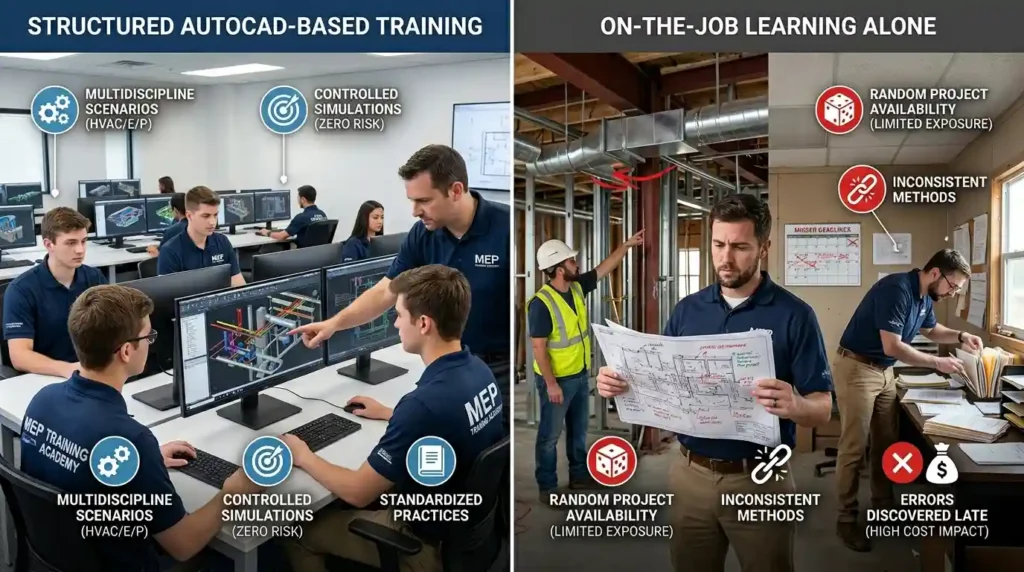
AutoCAD-based HVAC training is more effective than on-the-job learning because it provides structured exposure to multidisciplinary scenarios, standardised coordination frameworks, guided clash-resolution methods, and controlled project simulations that accelerate competency development in engineering environments.
On-the-job learning depends heavily on project availability and team exposure. Engineers may only encounter specific coordination problems occasionally, limiting skill breadth.
Structured training removes this randomness. Engineers are exposed to curated scenarios covering HVAC integration with electrical and plumbing systems. This ensures comprehensive skill coverage.
AutoCAD-based environments also allow repetition. Engineers can repeatedly practice coordination workflows without project risk. This accelerates learning curves compared to live project dependency.
Discover More from Our Guide Library:
How Does AutoCAD HVAC Training Teach Drawing Issue Revision and Transmittal?
How Does AutoCAD HVAC Training Cover International Standards Like ASHRAE and BS EN?
Another advantage is feedback structure. In training, errors are identified and corrected immediately. In workplace environments, mistakes often surface late during construction, increasing cost impact.
Training also standardises best practices. On-site learning often leads to inconsistent methods across teams. Structured programs ensure all engineers follow the same coordination logic.
Over time, this creates organisational alignment. Teams trained under a unified framework collaborate more efficiently because they share identical modelling, documentation, and communication standards.
Frequently Asked Questions
How does AutoCAD HVAC training improve multi-discipline coordination skills?
AutoCAD HVAC training improves coordination by teaching engineers how to align HVAC drawings with electrical and plumbing systems using standardised layers and BIM-ready workflows. At Imperial Corporate Training Institute, learners also practise clash-aware drafting and documentation control for better collaboration.
Who should enrol in an AutoCAD HVAC and Plumbing Design Training Course?
This course is suitable for mechanical engineers, HVAC designers, MEP drafters, and site engineers involved in building services design. Imperial Corporate Training Institute structures the training for professionals who want to improve drafting accuracy and coordination in multi-discipline projects.
What software skills are developed in AutoCAD HVAC training?
The training develops AutoCAD drafting skills for HVAC systems, including duct sizing layouts, pipe routing, and technical drawing annotation. Learners at Imperial Corporate Training Institute also gain skills in drawing management and coordination with other engineering disciplines.
Why is AutoCAD important for HVAC and plumbing design in construction projects?
AutoCAD is essential because it allows precise creation of HVAC and plumbing layouts that integrate with architectural and structural drawings. In the Imperial Corporate Training Institute AutoCAD HVAC and Plumbing Design Training Course, it is used to ensure accuracy and reduce design conflicts across project teams.