

AutoCAD HVAC drawings are issued and revised to maintain design accuracy, communicate approved changes, ensure installation compliance, and provide a controlled record of engineering decisions throughout the construction lifecycle. Revision management reduces errors, prevents rework, and supports project coordination.
HVAC drawings are technical documents used to communicate heating, ventilation, and air conditioning system designs to contractors, engineers, project managers, and facility owners. During construction projects, these drawings change as new information emerges, site conditions differ from initial assumptions, and coordination requirements evolve.
Drawing issuance refers to the formal distribution of approved drawings for a specific project stage. Revision refers to controlled modifications made after the original issue. Both activities form part of document control processes used across industries such as construction, manufacturing, healthcare, energy, and commercial real estate.
In large projects, a single HVAC package can contain more than 200 drawings. Without structured issue and revision procedures, teams work from outdated information, causing installation conflicts, procurement errors, and project delays.
Organisations measure drawing control effectiveness using key performance indicators (KPIs) such as revision turnaround time, number of drawing-related site errors, rework costs, and document approval cycle duration.
How Does the Drawing Issue Process Work in Construction Projects?
The drawing issue process follows a structured workflow that includes design preparation, quality review, approval, document coding, transmittal creation, distribution, and version tracking to ensure stakeholders receive accurate project information.
Construction projects use document management systems to control engineering information. Every drawing follows a predefined approval process before release.
What Happens Before a Drawing Is Issued?
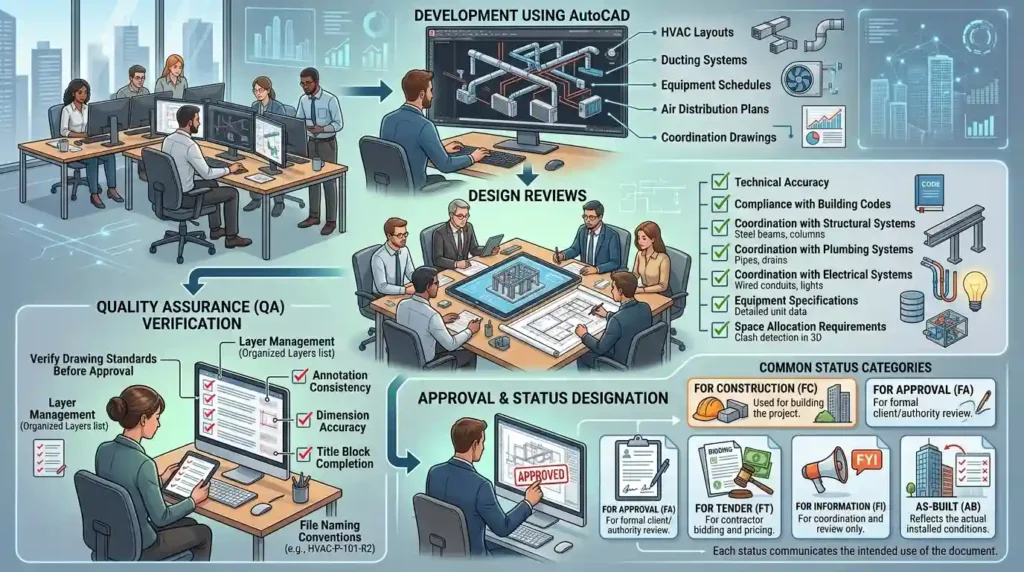
Engineering teams first develop HVAC layouts, ducting systems, equipment schedules, air distribution plans, and coordination drawings using AutoCAD.
Design reviews assess:
- Technical accuracy
- Compliance with building codes
- Coordination with structural systems
- Coordination with plumbing systems
- Coordination with electrical systems
- Equipment specifications
- Space allocation requirements
Quality assurance teams verify drawing standards before approval. These standards include layer management, annotation consistency, dimension accuracy, title block completion, and file naming conventions.
Once approved, the drawing receives a status designation.
Common status categories include:
- For Construction (FC)
- For Approval (FA)
- For Tender (FT)
- For Information (FI)
- As-Built (AB)
Each status communicates the intended use of the document.
How Are Drawings Distributed?
Document controllers create transmittals that record:
- Drawing numbers
- Revision numbers
- Issue dates
- Recipients
- Purpose of issue
- Approval status
The transmittal acts as an auditable record. Every recipient receives confirmation regarding which drawing version should be used.
Modern organisations use cloud-based document management systems that provide real-time access to controlled documents and reduce manual distribution errors.
What Triggers HVAC Drawing Revisions During Construction?
HVAC drawing revisions occur when design changes, site conditions, coordination conflicts, client requirements, regulatory updates, or installation challenges require modifications to approved project documentation.
Construction projects rarely proceed exactly as planned. New information continually affects engineering decisions.
Design Coordination Changes
Mechanical systems interact with multiple disciplines.
Examples include:
- Structural beams conflicting with duct routes
- Electrical cable trays occupying HVAC pathways
- Plumbing systems requiring shared ceiling space
When clashes occur, engineering teams revise HVAC drawings to maintain constructability.
Site Condition Changes
Actual site conditions often differ from design assumptions.
Examples include:
- Reduced ceiling heights
- Unexpected structural elements
- Existing building constraints
- Equipment access limitations
Site surveys identify these issues, prompting design revisions.
Client Change Requests
Building owners frequently request modifications during construction.
Examples include:
- Additional air conditioning zones
- Equipment upgrades
- Layout alterations
- Occupancy changes
Each modification requires documented revisions to maintain project control.
Regulatory Requirements
Building regulations and safety standards influence HVAC designs.
Changes affecting:
- Ventilation rates
- Fire protection requirements
- Energy efficiency standards
- Indoor air quality criteria
can necessitate drawing updates during project execution.
What Information Is Included in HVAC Drawing Revision Control?
HVAC drawing revision control includes revision identifiers, change descriptions, approval records, issue dates, affected areas, document history, and stakeholder distribution records to ensure complete traceability.
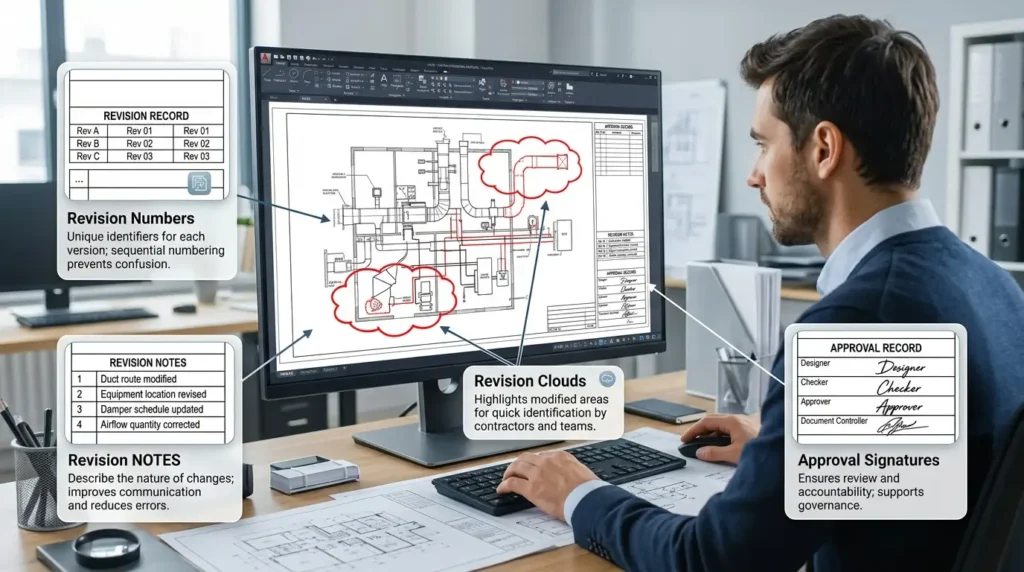
Revision control provides a documented history of engineering decisions.
Revision Numbers
Each drawing revision receives a unique identifier.
Examples include:
- Revision A
- Revision B
- Revision C
or
- Revision 01
- Revision 02
- Revision 03
Sequential numbering prevents confusion regarding document versions.
Revision Clouds
AutoCAD users apply revision clouds to highlight modified areas.
These visual markers allow contractors and site teams to quickly identify changes without reviewing the entire drawing.
Revision Notes
Revision notes describe the nature of changes.
Examples include:
- Duct route modified
- Equipment location revised
- Damper schedule updated
- Airflow quantity corrected
Clear documentation improves communication and reduces interpretation errors.
Approval Signatures
Every revision undergoes review and approval.
Approval records typically include:
- Designer
- Checker
- Approver
- Document controller
This process supports accountability and governance.
How Do Organisations Implement Effective Drawing Revision Management?
Organisations implement drawing revision management through document control procedures, standardised workflows, training programmes, software platforms, and performance monitoring systems that support consistency and compliance.
Successful implementation requires both technology and workforce capability.
Standard Operating Procedures
Document control procedures define:
- Revision approval workflows
- Drawing naming conventions
- Distribution requirements
- Record retention policies
- Change management responsibilities
Standardisation improves consistency across departments.
Digital Document Management Systems
Modern organisations use platforms that provide:
- Version control
- Audit trails
- User permissions
- Automated notifications
- Approval workflows
These capabilities reduce administrative effort and improve information accuracy.
Workforce Development
Employee skill gaps frequently affect document control quality.
Training programmes teach employees:
- AutoCAD standards
- Revision workflows
- Document management principles
- Construction coordination processes
- Engineering communication practices
Learning interventions often combine workshops, online learning modules, practical exercises, assessments, and project-based simulations.
When organisations begin evaluating workforce capability development for document control and engineering communication, understanding how training addresses revision workflows becomes relevant.
Readers seeking implementation-focused learning pathways can explore:
How Does AutoCAD HVAC Training Teach Drawing Issue Revision and Transmittal?
To get more information, enrol in:
AutoCAD HVAC and Plumbing Design Training Course.
What Skills Are Required to Manage HVAC Drawing Revisions Effectively?
Effective HVAC drawing revision management requires technical drafting skills, document control knowledge, communication capability, coordination expertise, quality assurance practices, and understanding of construction project workflows.
Drawing revision management combines technical and administrative competencies.
Technical Skills
Professionals require proficiency in:
- AutoCAD drafting
- HVAC system design
- Layer management
- Annotation standards
- Drawing production
These skills ensure modifications remain technically accurate.
Coordination Skills
Construction environments involve multiple stakeholders.
Teams regularly communicate with:
- Mechanical engineers
- Site supervisors
- Architects
- Electrical engineers
- Procurement teams
Effective coordination reduces delays and misunderstandings.
Quality Control Skills
Quality control ensures revisions meet organisational standards.
Key activities include:
- Checking dimensions
- Verifying equipment schedules
- Reviewing calculations
- Confirming coordination requirements
- Validating design intent
These activities improve project reliability.
What Training Methods Help Employees Learn Drawing Issue Revision Processes?
Training programmes teach drawing issue revision processes through case studies, software demonstrations, project simulations, workflow exercises, assessments, and practical drafting activities that replicate real construction environments.
Corporate learning programmes focus on application rather than theory alone.
Instructor-Led Workshops
Workshops provide structured instruction on:
- Drawing standards
- Revision procedures
- Documentation requirements
- Quality assurance frameworks
Participants engage in guided exercises and group discussions.
Simulation-Based Learning
Simulations recreate project environments.
Learners practise:
- Issuing drawings
- Managing revisions
- Resolving coordination conflicts
- Preparing transmittals
Simulation activities strengthen decision-making capabilities.
Assessment and Performance Measurement
Training effectiveness is evaluated using measurable outcomes.
Common metrics include:
- Assessment scores
- Drawing accuracy rates
- Revision processing speed
- Error reduction percentages
- Compliance rates
Organisations use these metrics to evaluate return on training investment.
What Benefits Does Effective Drawing Revision Management Deliver?
Effective drawing revision management improves project coordination, reduces construction errors, lowers rework costs, increases compliance, enhances stakeholder communication, and strengthens operational efficiency across engineering and construction teams.
Construction projects operate within strict cost and schedule constraints.
Poor document control creates significant operational risks.
Reduced Rework
Industry studies consistently identify rework as a major source of project cost escalation.
Accurate revision management ensures teams install systems using approved information.
This reduces:
- Material waste
- Labour inefficiencies
- Project delays
- Change order costs
Improved Productivity
Teams spend less time searching for current documents when revision controls are properly implemented.
Productivity improvements often result from:
- Faster information retrieval
- Reduced approval delays
- Clear communication channels
- Better coordination processes
Enhanced Compliance
Documented revision histories support regulatory compliance and contractual obligations.
Organisations maintain complete records of engineering decisions throughout the project lifecycle.
This documentation becomes valuable during audits, inspections, and facility handovers.
What Common Problems Affect HVAC Drawing Issue and Revision Processes?
Common problems include uncontrolled document distribution, inconsistent revision practices, inadequate employee training, poor communication, missing approvals, and ineffective document management systems that reduce project efficiency.
Many organisations struggle with process discipline rather than technical capability.
Version Confusion
Teams sometimes work from outdated drawings.
This issue occurs when:
- Distribution records are incomplete
- Revision notifications are missed
- Manual filing systems are used
Version confusion frequently results in site rework.
Lack of Standardisation
Different departments often apply different document control practices.
Inconsistent procedures create confusion regarding:
- Revision numbering
- Approval workflows
- Distribution requirements
- Record management
Standardised frameworks improve organisational alignment.
Insufficient Training
Employees without formal training often misunderstand revision responsibilities.
Common errors include:
- Incorrect transmittal preparation
- Missing revision notes
- Unauthorised changes
- Incomplete approval records
Structured learning programmes address these capability gaps and improve operational performance.
How Do AutoCAD HVAC Drawing Revisions Support Long-Term Project Success?
AutoCAD HVAC drawing revisions support long-term project success by preserving design integrity, maintaining accurate records, improving collaboration, enabling compliance, and ensuring construction teams work from approved information throughout the project lifecycle.
Drawing issue and revision management forms a critical component of engineering governance. It connects design teams, construction personnel, project managers, and building owners through controlled information flow.
Discover More from Our Guide Library:
What International Drawing Standards Apply to AutoCAD HVAC Design Work?
How Does AutoCAD HVAC Training Cover Refrigerant Pipe Design for VRF Systems?
Organisations that establish clear revision procedures, invest in workforce development, and implement structured document control systems achieve stronger project outcomes. These outcomes include reduced rework, improved productivity, faster approvals, enhanced compliance, and better coordination across multidisciplinary teams. Effective revision management transforms technical documentation from a static record into a controlled business process that supports quality, efficiency, and measurable project performance.
Frequently Asked Questions
Who should attend an AutoCAD HVAC and Plumbing Design Training Course?
This course is suitable for HVAC engineers, mechanical designers, CAD technicians, project engineers, and construction professionals. Imperial Corporate Training Institute provides training that helps learners understand industry-standard HVAC and plumbing design practices.
Why is AutoCAD important for HVAC and plumbing design projects?
AutoCAD enables accurate creation, modification, and management of HVAC and plumbing drawings used throughout the project lifecycle. The AutoCAD HVAC and Plumbing Design Training Course teaches drafting standards, design coordination, and technical documentation skills required in construction environments.
What skills are gained from an AutoCAD HVAC and Plumbing Design Training Course?
Participants learn HVAC system drafting, plumbing layout development, drawing revision control, equipment placement, duct routing, and construction documentation. Imperial Corporate Training Institute includes practical exercises that reflect real-world engineering and design requirements.
How does AutoCAD HVAC and plumbing design support construction projects?
AutoCAD HVAC and plumbing drawings provide detailed information for installation, coordination, and project execution. The AutoCAD HVAC and Plumbing Design Training Course explains how technical drawings improve accuracy, reduce design conflicts, and support efficient project delivery.