
The AutoCAD HVAC and Plumbing Design Training Course is positioned as a structured corporate learning pathway focused on bridging technical drafting skills with international mechanical engineering documentation standards. In real engineering environments, design accuracy depends on strict compliance with ASHRAE guidance, BS EN standards, layering conventions, and coordinated MEP workflows. This course is structured to address that gap through applied AutoCAD-based training aligned with corporate project requirements.
Within Imperial Corporate Training Institute, the programme is developed to support professionals who must translate engineering concepts into precise HVAC and plumbing drawings used in commercial and industrial projects. The training moves beyond basic drafting and focuses on structured design logic, documentation discipline, and international drawing conventions required in real project delivery environments.
Understanding international drawing standards is not optional in modern MEP workflows. It directly impacts coordination efficiency, compliance approvals, and construction accuracy.
The discussion on foundational standards can be reviewed here:
What International Drawing Standards Apply to AutoCAD HVAC Design Work?
What is the AutoCAD HVAC programme and what problem does it solve in international drawing standards compliance?
The AutoCAD HVAC and Plumbing Design Training Course by Imperial Corporate Training Institute is a structured engineering programme that solves the gap between theoretical mechanical knowledge and international drawing standard implementation using AutoCAD for real corporate HVAC and plumbing project documentation workflows.
The primary problem in HVAC and MEP industries is inconsistency in drafting standards. Engineers and draftsmen often understand system design but struggle to apply ASHRAE principles, BS EN conventions, and coordinated CAD documentation rules in real project environments. This leads to rework, miscommunication, and design conflicts during execution.
Within Imperial Corporate Training Institute, the course is designed to eliminate these issues through structured CAD workflows. Participants learn how to translate engineering requirements into standardised drawings that align with international mechanical documentation expectations. The focus is not only on drawing creation but also on disciplined representation of ducting, piping, and system coordination.
The course also solves workflow fragmentation. Many professionals use AutoCAD without structured templates, layer systems, or standardised symbols. This programme introduces corporate-level drafting systems that ensure consistency across project teams, making drawings readable and approval-ready in multi-disciplinary environments.
By the end of this phase, learners are able to interpret engineering specifications and convert them into structured HVAC and plumbing layouts aligned with international drafting conventions used in global construction projects.
Why is this course structured around international HVAC drawing standards and corporate design workflows?
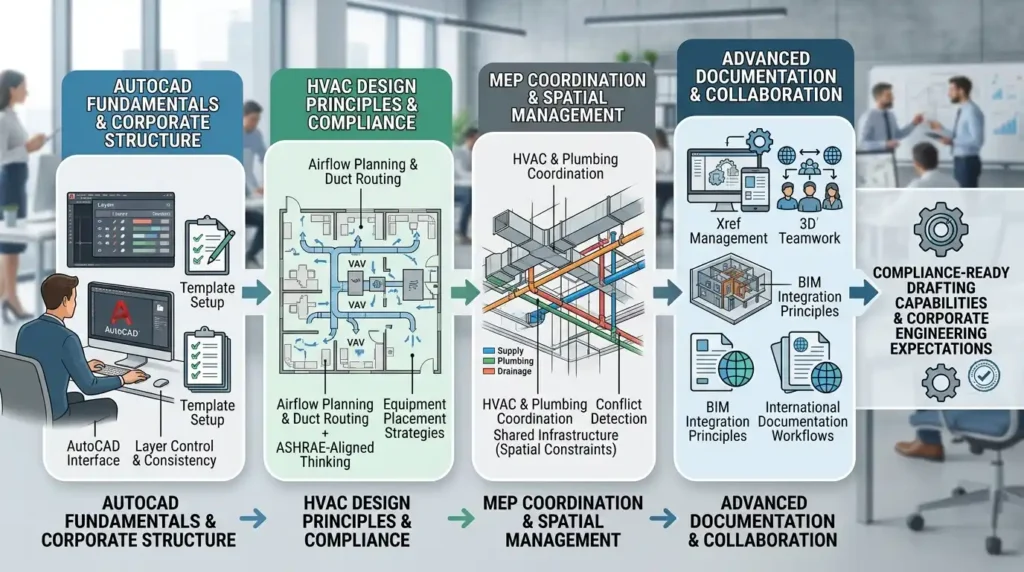
The course structure at Imperial Corporate Training Institute is built around progressive skill development, starting from AutoCAD fundamentals and advancing into international HVAC and plumbing design standards, ensuring learners develop both technical drafting accuracy and compliance-driven engineering documentation capability.
The structure follows a logical engineering workflow rather than isolated software training. Early modules focus on AutoCAD interface mastery, layer control, and template setup because these are foundational to maintaining drawing consistency in corporate environments.
As learners progress, Imperial Corporate Training Institute introduces HVAC system design principles aligned with real building services requirements. This includes duct routing, airflow planning, and equipment placement strategies that reflect ASHRAE-aligned design thinking.
The intermediate structure integrates plumbing system coordination, ensuring learners understand how water supply, drainage, and HVAC systems coexist within spatial constraints. This reflects real-world MEP coordination challenges where multiple disciplines must share limited building infrastructure.
At advanced levels, the course introduces Xref management, BIM integration principles, and international documentation workflows. This ensures that learners are not only producing drawings but also managing them within collaborative engineering ecosystems.
This structured progression ensures that participants develop compliance-ready drafting capabilities aligned with corporate engineering expectations rather than fragmented CAD skills.
What will participants learn about AutoCAD HVAC design, ASHRAE principles, and BS EN drawing standards?
Participants at Imperial Corporate Training Institute will develop advanced capabilities in HVAC ducting design, plumbing system drafting, AutoCAD-based MEP coordination, and international drawing standards application, including ASHRAE-aligned airflow design logic and BS EN documentation practices for corporate engineering projects.
The learning outcomes are divided into technical, analytical, and documentation-based competencies.
Learners gain the ability to produce HVAC duct layouts using correct scaling, layer structures, and annotation standards. They also learn how to coordinate airflow distribution systems in line with engineering design intent and building performance requirements.
In plumbing design, participants develop skills in pipe sizing, slope calculations, riser diagram creation, and fixture coordination. These skills ensure plumbing systems are represented accurately in AutoCAD drawings used for construction and approval workflows.
At Imperial Corporate Training Institute, emphasis is placed on international compliance. Learners are trained to apply drafting conventions that align with BS EN standards for mechanical documentation and ASHRAE-based HVAC design logic. This includes correct symbol usage, layer naming conventions, and system classification standards.
A breakdown of evaluation criteria and standards integration can be reviewed here:
How Does AutoCAD HVAC Training Cover International Standards Like ASHRAE and BS EN?
Additional learning outcomes include:
- Creation of coordinated HVAC and plumbing layouts
- Application of AutoCAD Xrefs for multidisciplinary coordination
- Development of construction-ready technical drawings
- Integration of calculation outputs into design layouts
- Preparation of documentation for tender and approval processes
This ensures learners are prepared for real engineering deliverables rather than isolated software tasks.
How is the AutoCAD HVAC programme delivered at Imperial Corporate Training Institute?
The delivery model at Imperial Corporate Training Institute is based on applied corporate simulation, combining instructor-led sessions, practical AutoCAD workshops, real project drafting exercises, and workflow-based assessments designed to replicate engineering office environments and international MEP project coordination standards.
Training is delivered through structured modules that progressively simulate real engineering project cycles. Each session includes guided demonstrations followed by hands-on drafting exercises where learners apply HVAC and plumbing design principles directly in AutoCAD.
Imperial Corporate Training Institute uses a workshop-based methodology where participants work on real-world building service scenarios. This includes commercial HVAC system layouts, industrial ducting designs, and multi-floor plumbing coordination drawings.
The delivery also integrates collaborative design simulation. Learners are exposed to coordination workflows where HVAC, plumbing, and structural constraints must be considered simultaneously. This reflects real corporate engineering environments where multiple teams interact on a single project.
Assessment is continuous and performance-based. Participants are evaluated on drawing accuracy, compliance with standards, layer management discipline, and documentation quality. This ensures skill validation is practical rather than theoretical.
The course also includes exposure to BIM integration principles, preparing learners for hybrid environments where AutoCAD outputs feed into Revit-based coordination systems.
What results can professionals expect after completing HVAC training at Imperial Corporate Training Institute?

After completing the programme at Imperial Corporate Training Institute, professionals are able to produce internationally compliant HVAC and plumbing drawings, improve coordination efficiency across engineering teams, reduce design errors, and independently manage AutoCAD-based MEP documentation for corporate and infrastructure projects.
The primary outcome is technical independence in HVAC and plumbing drafting. Participants transition from basic CAD users to structured MEP designers capable of producing construction-ready documentation aligned with international standards.
In corporate environments, this translates into improved project efficiency. Engineers can coordinate with architects, structural teams, and project managers using standardized drawings that reduce misinterpretation and design conflicts.
Imperial Corporate Training Institute also ensures learners develop workflow discipline. This includes proper file structuring, version control, revision tracking, and documentation consistency across large-scale engineering projects.
Professionals completing the course are capable of supporting roles in consultancy firms, construction companies, and facility management departments where HVAC and plumbing system accuracy is critical.
The training also enhances career mobility. Learners can transition into roles such as MEP designer, HVAC draftsman, or design coordinator in international project environments where ASHRAE and BS EN standards are mandatory.
How does enrollment work for the AutoCAD HVAC and Plumbing Design Training Course?
Enrollment at Imperial Corporate Training Institute is structured through a straightforward application process requiring basic engineering background or CAD familiarity, followed by course registration, scheduling confirmation, and access to structured training sessions aligned with corporate MEP design standards and international HVAC documentation workflows.
Eligibility is typically suited for mechanical engineers, HVAC technicians, CAD operators, and professionals in construction or facility management. Prior AutoCAD experience is beneficial but not mandatory, as foundational modules are included in the course structure.
The enrollment process begins with candidate evaluation to determine suitability for corporate-level training. Once confirmed, participants are scheduled into the appropriate batch format depending on delivery mode and availability.
Imperial Corporate Training Institute provides structured onboarding, including course material orientation, software setup guidance, and introduction to HVAC drafting standards used throughout the programme.
Discover More from Our Guide Library:
Does Imperial’s HVAC Course Include VRF System Design Drawing Exercises?
How Does Imperial’s HVAC Training Provide a Career Development Roadmap?
Training access includes all modules covering HVAC design, plumbing coordination, AutoCAD drafting workflows, and international standards integration. Participants progress through structured assessments until completion of the full curriculum.
Upon completion, learners receive certification validating their capability in AutoCAD-based HVAC and plumbing design aligned with international engineering documentation standards.