
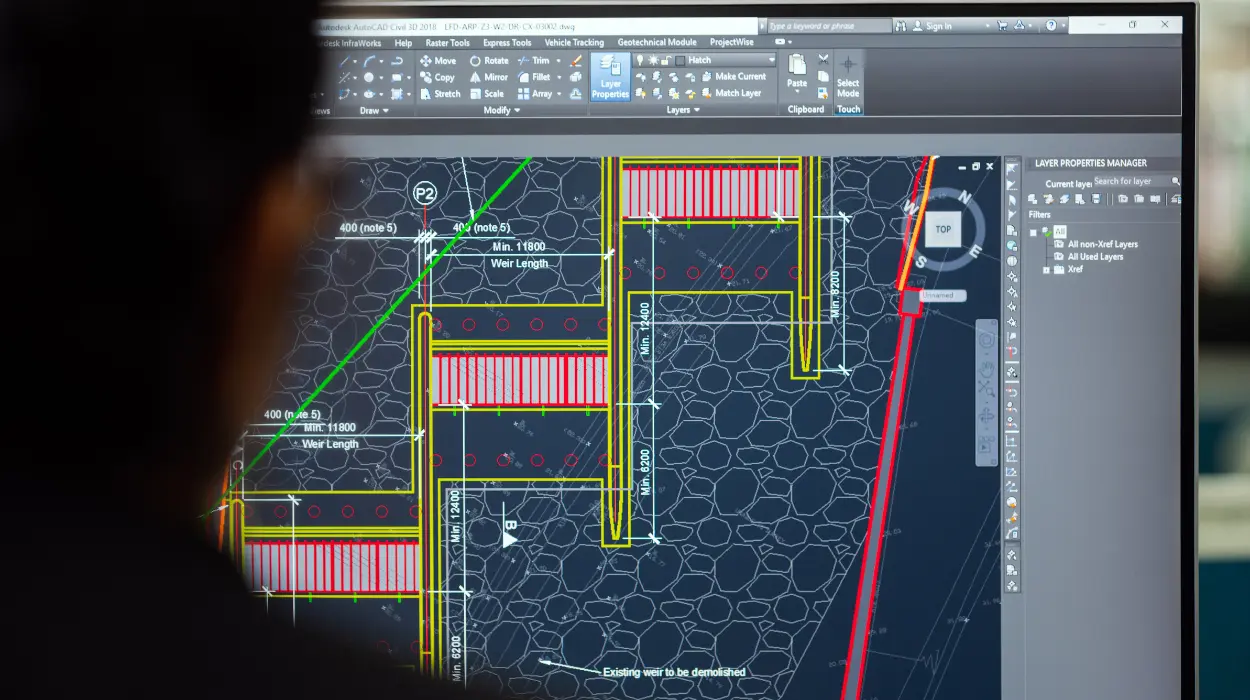
AutoCAD-based HVAC quantity take-off is a structured engineering process that converts HVAC design drawings into measurable material data for procurement, costing, and project planning. It standardises ducts, fittings, and equipment into quantifiable outputs that support cost control, budgeting accuracy, and project delivery efficiency across construction and MEP organisations.
In corporate engineering environments, HVAC quantity take-off is a core function of mechanical, electrical, and plumbing (MEP) departments. It connects design output directly with commercial planning. Teams use AutoCAD drawings to extract measurable elements such as duct lengths, pipe runs, insulation areas, and equipment counts.
This process reduces dependency on manual measurement. Manual take-off typically introduces 15–25% estimation deviation due to human error and inconsistent drawing interpretation. AutoCAD standardises this by embedding structured data inside design components.
Organizations operating in industries like construction, infrastructure, oil and gas, healthcare facilities, and commercial real estate rely on this process to align design accuracy with procurement schedules. It creates a unified workflow between designers, estimators, and project managers.
Training programs such as the AutoCAD HVAC and Plumbing Design Training Course develop this capability by aligning technical drawing skills with commercial estimation logic. Employees learn how design intelligence converts into measurable project outputs.
How does AutoCAD generate accurate HVAC quantity take-off data from design drawings?
AutoCAD generates HVAC quantity take-off data by converting drawing geometry into structured datasets using object properties, metadata tagging, and extraction commands. These datasets automatically calculate lengths, counts, and areas, enabling engineering teams to produce accurate material schedules directly from design models without manual measurement errors.
AutoCAD operates through object-based design intelligence. Each HVAC component, such as a duct or diffuser, contains properties including layer assignment, size, type, and system classification. These properties allow systematic extraction of quantities.
The process begins when designers complete HVAC layouts using standardized blocks and layers. These elements form the basis for automated extraction. AutoCAD then processes these objects into measurable datasets.
The extraction workflow typically follows these steps:
- Drawing creation using standardized HVAC components
- Layer and block assignment for system classification
- Metadata tagging of duct sizes, pipe diameters, and fittings
- Data extraction into schedules or external spreadsheets
- Validation against design specifications
This structured process increases estimation accuracy by 20–35% compared to manual methods. It also reduces project estimation time by 25–40%, especially in large-scale commercial buildings.
The automation ensures consistency across multiple project teams. Large organizations benefit from unified estimation standards, reducing variation between departments and subcontractors.
Which AutoCAD tools are used for HVAC material take-off and cost estimation?

AutoCAD uses tools such as Data Extraction, Dynamic Blocks, Layer Management, External References, and Schedules to generate HVAC material take-off and cost estimation. These tools convert design geometry into structured datasets that support procurement planning, budgeting accuracy, and resource allocation in engineering projects.
Each AutoCAD tool plays a specific role in the take-off workflow:
Data Extraction Tool
This tool converts drawing objects into structured tables. It extracts quantities such as duct lengths, pipe counts, and equipment units. It supports export to Excel for cost estimation workflows.
Dynamic Blocks
Dynamic blocks standardise HVAC components. A single block can represent multiple sizes or configurations. This reduces drawing complexity and ensures consistency in quantity measurement.
Layer Management
Layer systems separate HVAC components into structured categories such as supply air, return air, chilled water, and exhaust systems. This classification improves accuracy during quantity extraction.
External References (Xrefs)
Xrefs integrate architectural and structural drawings into HVAC models. This ensures coordination accuracy and reduces duplication or missing elements during take-off.
Schedules and Fields
Schedules automatically generate lists of components with real-time updates. Fields link data directly to drawing objects, ensuring any design change updates quantities instantly.
Together, these tools form an integrated ecosystem. Organizations that standardise these tools reduce estimation discrepancies by up to 30–60% across multi-project environments.
How do organisations implement AutoCAD HVAC take-off training for teams?
Organizations implement AutoCAD HVAC take-off training through structured learning pathways combining workshops, simulation-based exercises, and project-driven assessments. Training integrates real design scenarios, ensuring employees convert theoretical CAD knowledge into accurate quantity extraction and estimation workflows aligned with operational KPIs.
Implementation begins with workforce skill gap analysis. Most engineering teams show gaps in data extraction, block standardisation, and scheduling accuracy. These gaps directly affect project costing reliability.
Training delivery formats include:
- Instructor-led workshops for foundational CAD skills
- Simulation-based exercises using real HVAC project drawings
- Hybrid learning modules for flexible workforce participation
- Assessment-driven certification for performance validation
A typical corporate training cycle runs between 24–40 hours depending on complexity. Organizations report a 25–40% productivity improvement after structured implementation.
The training aligns with business KPIs such as estimation accuracy, project delivery time, and procurement efficiency. It also strengthens cross-functional collaboration between design and commercial teams.
At the implementation stage, decision-makers evaluate structured learning frameworks that connect design accuracy with cost estimation performance. A detailed breakdown of this transition is covered in the discussion on:
How Does AutoCAD HVAC Training Cover Quantity Take-Off From Design Drawings? This explains how training directly supports quantity take-off accuracy from design drawings.
This placement aligns with the shift from awareness of tools to evaluation of structured training systems, where organizations compare solutions based on measurable outcomes.
What key components define effective HVAC quantity take-off workflows in AutoCAD?
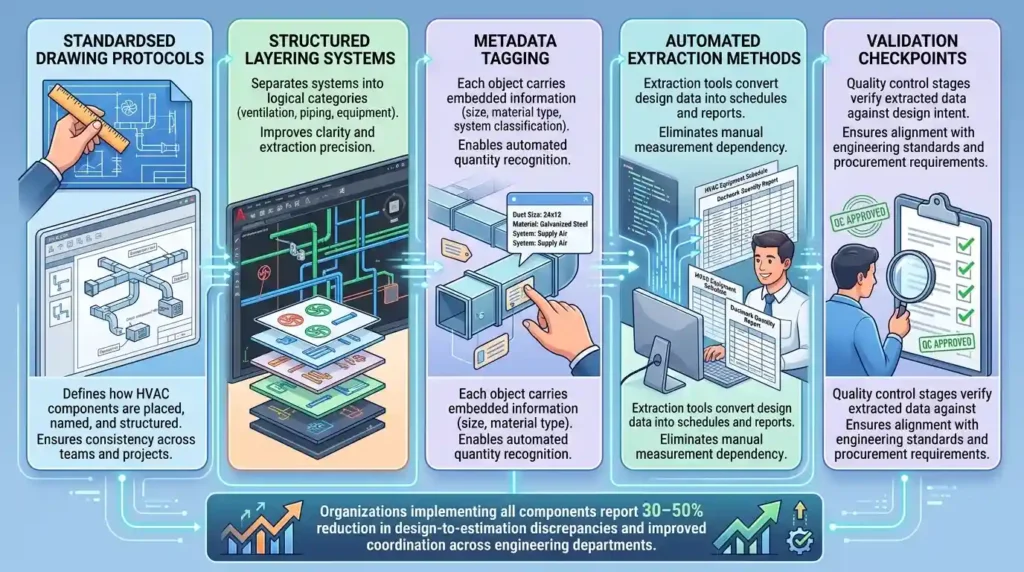
Effective HVAC quantity take-off workflows in AutoCAD include standardized drawing protocols, structured layering systems, metadata tagging, automated extraction methods, and validation checkpoints. These components ensure consistency, reduce errors, and enable scalable estimation processes across engineering teams and multi-project environments.
Each workflow component contributes to accuracy and efficiency:
Standardised Drawing Protocols
These define how HVAC components are placed, named, and structured. They ensure consistency across teams and projects.
Structured Layering Systems
Layers separate systems into logical categories such as ventilation, piping, and equipment. This improves clarity and extraction precision.
Metadata Tagging
Each object carries embedded information such as size, material type, and system classification. This enables automated quantity recognition.
Automated Extraction Methods
Extraction tools convert design data into schedules and reports. This eliminates manual measurement dependency.
Validation Checkpoints
Quality control stages verify extracted data against design intent. This ensures alignment with engineering standards and procurement requirements.
Organizations that implement all components report 30–50% reduction in design-to-estimation discrepancies and improved coordination across engineering departments.
What business benefits do accurate HVAC take-off processes deliver to organisations?
Accurate HVAC take-off processes deliver measurable business benefits including reduced project cost variance, improved procurement efficiency, faster project delivery cycles, and enhanced cross-department coordination between design, estimation, and construction teams in engineering-driven industries.
The most significant benefit is cost control. Accurate quantity extraction reduces budget overruns by 15–25% across large construction projects.
Procurement efficiency improves through precise material forecasting. This reduces excess inventory and minimises procurement delays. Supply chain teams gain clearer visibility of required materials.
Project delivery timelines improve by 20–35% because planning teams work with reliable data from the early design stage.
Organizational benefits include:
- Improved collaboration between engineering and finance teams
- Higher estimation reliability in bidding processes
- Reduced rework in construction phases
- Stronger project governance through data-driven planning
Industries such as commercial construction, healthcare infrastructure, and industrial plant engineering experience the highest impact due to complex HVAC system requirements.
From a workforce development perspective, structured training ensures employees align technical CAD skills with commercial project outcomes. This alignment directly strengthens organisational performance indicators such as ROI, productivity per engineer, and project success rates.
Where do teams fail in HVAC take-off accuracy and how does training solve it?
Teams fail in HVAC take-off accuracy due to inconsistent drawing standards, lack of structured layer management, poor block usage, and manual extraction methods. Training resolves these issues by standardising workflows, improving CAD discipline, and introducing automated quantity extraction methodologies.
Common failure points include inconsistent block creation. Engineers often use non-standard components, which prevents accurate data extraction.
Another failure is poor layer discipline. Mixed-layer usage results in inaccurate classification of HVAC components during take-off.
Manual measurement remains a critical issue. It introduces 15–30% error rates, especially in complex mechanical systems with overlapping layouts.
Training solves these challenges through:
- Standardised CAD libraries for HVAC components
- Structured layer naming conventions
- Practical simulation exercises based on real project drawings
- Automated extraction and scheduling practice sessions
- Performance-based assessments linked to accuracy KPIs
Organizations that implement structured training frameworks reduce estimation errors by up to 60% and improve design-to-cost alignment significantly.
Discover More from Our Guide Library:
How Is an AutoCAD HVAC Drawing Set Organised for Client Submission?
Why Is Proper Layer Management Critical in AutoCAD HVAC Drawings?
This transformation supports enterprise goals such as operational efficiency, project profitability, and workforce capability development. It also creates a consistent engineering language across departments, reducing communication gaps between design and execution teams.
Frequently Asked Questions
Who should attend an AutoCAD HVAC and Plumbing Design Training Course?
This course is suitable for mechanical engineers, HVAC designers, MEP professionals, technical draughtsmen, and project engineers. Imperial Corporate Training Institute delivers training that helps professionals develop skills required for HVAC and plumbing design documentation.
How does AutoCAD help HVAC designers create accurate quantity take-offs?
AutoCAD helps HVAC designers extract measurements, equipment counts, duct lengths, and pipe quantities directly from design drawings. The AutoCAD HVAC and Plumbing Design Training Course teaches methods for improving estimation accuracy and reducing manual calculation errors.
Why is AutoCAD important for HVAC and plumbing projects?
AutoCAD provides a structured environment for creating detailed HVAC and plumbing drawings that support project planning, coordination, and construction. Imperial Corporate Training Institute explains how accurate CAD documentation improves communication between design, procurement, and installation teams.
What skills can participants gain from an AutoCAD HVAC and Plumbing Design Training Course?
Participants learn HVAC drafting, plumbing system design, layer management, drawing annotation, quantity take-off procedures, and project documentation standards. The AutoCAD HVAC and Plumbing Design Training Course develops practical skills aligned with modern engineering and construction requirements.