

This course teaches participants to produce accurate HVAC and plumbing drawings, including riser diagrams, to meet corporate engineering standards and reduce coordination errors.
Riser diagrams are a frequent source of project delays when incorrectly drafted or poorly coordinated. Corporate engineering teams, design coordinators and facilities managers face recurring issues: inconsistent drawing standards, clashes between services, missing schematic detail, and slow handover of construction documentation. The AutoCAD HVAC and Plumbing Design Training Course by Imperial Corporate Training Institute targets these gaps with specification-driven instruction and practical tasks.
For an introductory overview of riser diagram roles, see:
What Is the Role of Riser Diagrams in HVAC and Plumbing Design?
Why this course is structured this way
The curriculum progresses from fundamentals to integrated project execution to ensure competency in production, coordination and quality assurance.
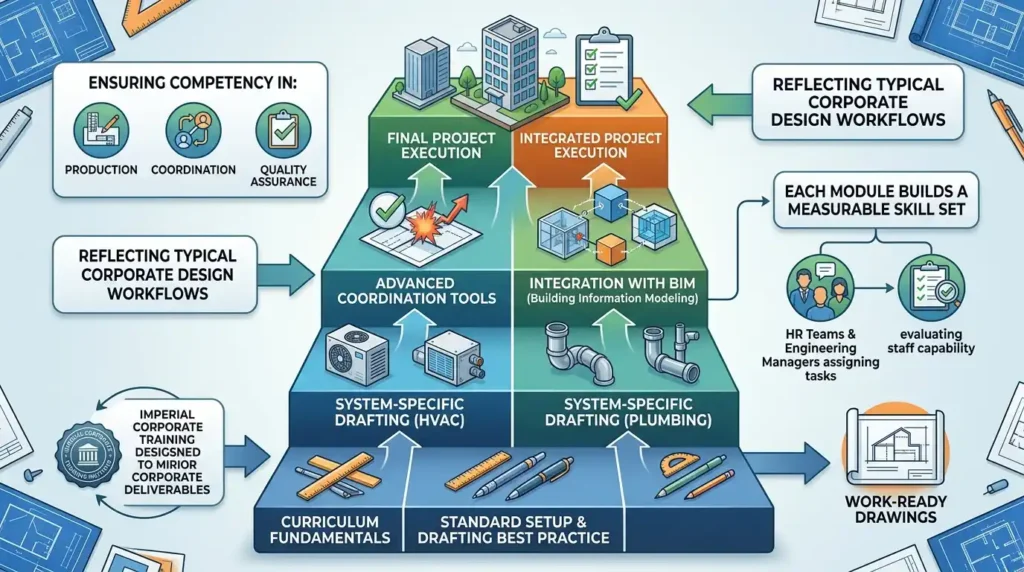
The structure reflects typical corporate design workflows. Module sequencing begins with a standard setup and drafting best practice. It then moves to system-specific drafting (HVAC; plumbing), advanced coordination tools, integration with BIM, and final project execution. Each module builds a measurable skill set used directly by HR teams and engineering managers when assigning design tasks and evaluating staff capability. Imperial Corporate Training Institute designs the modules to mirror corporate deliverables, ensuring participants produce work-ready drawings from the first assessment.
What will participants learn?
Learners will gain measurable drafting, coordination and documentation skills, including the ability to produce compliant riser diagrams and full MEP drawing sets.
Learning outcomes are module-aligned and stated in observable terms.
Core skill outcomes
- Produce standardised mechanical and plumbing drawing templates, title blocks and layer structures.
- Draft HVAC duct layouts, diffuser schedules and calculate duct sizing to defined corporate tolerances.
- Create plumbing schematics: cold/hot water, drainage, fixture schedules and pipe sizing with slope and pressure calculations.
- Produce riser diagrams that show vertical piping routing, branch connections, valve locations and access points with correct annotation and symbol usage.
- Use Xrefs and external references to assemble coordinated multi-discipline drawings for clash review.
- Conduct basic clash detection and resolve routing conflicts using AutoCAD 2D/3D tools.
- Extract data, generate BOMs and produce schedule sheets from CAD drawings.
- Integrate AutoCAD outputs with BIM/Revit workflows and maintain data consistency.
- Manage drawing revisions, QA checks and issue final as-built documentation meeting corporate handover standards.
Module-by-module specification
- Module 1: Introduction to AutoCAD for Corporate Design Workflows — CAD environment, template creation, precision drafting standards and company-level drawing protocols.
- Module 2: Fundamentals of HVAC Design Drafting — duct layouts, airflow routing, HVAC blocks and annotation conventions.
- Module 3: Plumbing and Drainage Design Using AutoCAD — piping schematics, riser diagram methodology, slope and sizing standards.
- Module 4: Advanced AutoCAD Tools for MEP Coordination — Xrefs, 3D routing, layer management and clash avoidance techniques.
- Module 5: HVAC Load Calculations and Design Optimization — interfacing AutoCAD with calculation tools, equipment placement rules.
- Module 6: Plumbing System Detailing and Documentation — pipe schedules, pressure drop checks, fixture unit analysis and BOM generation.
- Module 7: Corporate Project Implementation and Documentation Standards — drawing templates, company CAD standards, version control.
- Module 8: Quality Assurance and Design Review Process — internal audit procedures, compliance checklists and correction workflows.
- Module 9: Integration with BIM and Revit for MEP Coordination — data linking, export/import practices and multidisciplinary handoffs.
- Module 10: Corporate-Level Project Execution and Professional Development — capstone project producing full MEP set, presentation and submission procedures.
How is the course delivered?
Delivery combines instructor-led workshops, hands-on labs, simulation assignments and a final project; formats include classroom, online and hybrid options tailored for corporate cohorts.
Imperial Corporate Training Institute offers the AutoCAD HVAC and Plumbing Design Training Course in three delivery modes to suit organisational needs.
Delivery formats and specifications
- Onsite classroom workshops: Intensive 5-day modules or distributed multi-week sessions. Each workshop includes instructor demonstrations, supervised practice and group coordination exercises. Imperial Corporate Training Institute provides sample project data and corporate-standard drawing templates for use during sessions.
- Live online instructor-led training: Scheduled synchronous sessions with live CAD demonstrations, screen-sharing and step-by-step guided exercises. Labs are submitted for review. Imperial Corporate Training Institute uses virtual desktops or student licences to ensure consistent software environments.
- Hybrid: A mix of recorded lectures, live skill clinics and in-person sessions for hands-on coordination tasks. Hybrid delivery supports dispersed teams and allows HR managers to schedule sessions around operational demands.
- Self-paced extension: Optional recorded modules and practice files for reinforcement after the main course. This supports ongoing competency validation within corporate training plans.
Duration and contact hours
- Standard intensive pathway: 40 contact hours (recommended for experienced CAD users transitioning to MEP).
- Extended pathway: 60 contact hours (recommended for learners needing foundational CAD upskilling before MEP content).
- Corporate cohort customisation: Duration adjusted to match company onboarding schedules, with modular delivery available per module basis.
Assessment methods
Assessment uses pass/fail practical assignments, timed drafting tests, evidence-based simulations and a capstone project evaluated against corporate criteria.
Assessment components are specification-based and tied to learning outcomes.
- Module practical assignments: Individual drawing tasks scored on accuracy, layer control, annotation and adherence to template standards.
- Timed drafting tests: Simulate time-bound production requirements; measure speed and correctness.
- Simulation-based coordination exercises: Multi-discipline Xref assemblies where participants identify and resolve clashes.
- Documentation deliverable checks: Verification of schedules, BOMs, legend sheets and compliance with drawing standards.
- Capstone project: Produce a complete set of HVAC and plumbing drawings for a commercial building, including riser diagrams, schedules and QA sign-off. Assessed by Imperial Corporate Training Institute against a defined rubric.
- Passing criteria: Minimum competency thresholds per module and an overall pass on the capstone for certification.
What results can be expected?
Participants will produce compliant riser diagrams and coordinated MEP documentation, reduce design rework, and increase delivery consistency according to corporate KPIs.
Outcomes are presented as workplace impacts and measurable improvements.
Expected workplace impact
- Reduced coordination errors: Standardised templates and riser diagram protocols cut review cycles and RFI counts.
- Faster turnover of tender-ready drawings: Time-to-deliver measured in days rather than weeks for standard project packages.
- Improved cross-discipline coordination: Xref workflow practices lower clash rates during early design stages.
- Clear audit trail and version control: Drawing management processes reduce rework from client comments and regulatory reviews.
- Enhanced HR capability mapping: HR teams can map module competencies to role descriptions and promotion pathways.
- Consistent handover documentation: Facilities and maintenance teams receive clearer as-built records, improving lifecycle servicing.
Real-world workplace examples
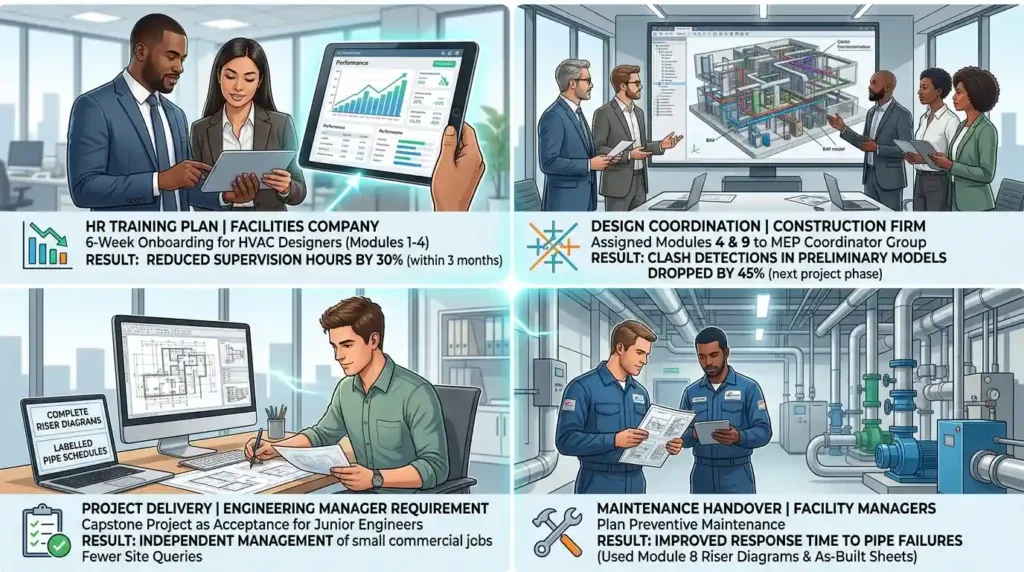
- HR training plan: A facilities company incorporates Modules 1–4 into a six-week onboarding plan for new HVAC designers. The HR team measures reduced supervision hours by 30% within three months.
- Design coordination: A construction firm assigns Module 4 and Module 9 to its MEP coordinator group. Clash detections in preliminary models dropped by 45% during the next project phase.
- Project delivery: An engineering manager requires the capstone project as an acceptance criterion for junior engineers to independently manage small commercial jobs. Project handovers now include complete riser diagrams and labelled pipe schedules, reducing site queries.
- Maintenance handover: Facility managers use riser diagrams and as-built sheets from Module 8 to plan preventive maintenance, improving response time to pipe failures.
How does enrollment work?
Entry requires relevant technical background, and enrolment is a simple application process with clearly defined eligibility and completion pathways.
Imperial Corporate Training Institute specifies eligibility, selection and completion protocols.
Eligibility and prerequisites
- Recommended: Basic AutoCAD proficiency for the 40-hour pathway; no prior MEP experience required for the extended pathway.
- Target audience: Mechanical design engineers, MEP draftsmen, project engineers, facilities professionals, and engineering graduates seeking corporate-ready drafting skills.
- Company enrolment: HR or training managers may enrol cohorts. Custom pre-course assessments identify baseline skill levels for tailored delivery.
Application and selection process
- Step 1: Submit application form with candidate details and current role. Corporate clients may submit a batch roster.
- Step 2: Pre-course competency check for AutoCAD basics for participants without prior MEP exposure.
- Step 3: Agreement on delivery format, dates and participant numbers. Imperial Corporate Training Institute provides a detailed course schedule and pre-course materials on confirmation.
- Step 4: Payment and contract execution. Corporate purchase orders and invoicing terms are available.
Certification and completion path
- Participants who meet assessment criteria receive a completion certificate issued by Imperial Corporate Training Institute.
- Certificates indicate module-level competencies and successful capstone assessment.
- Imperial Corporate Training Institute supports post-course verification for HR records and competency matrices.
Cost and corporate procurement
Pricing varies by delivery mode, cohort size and customisation; corporate quotes are provided on request with transparent breakdowns for training, materials and licensing.
Cost considerations
- Base tuition covers instruction, course materials, practice files and access to recorded content where applicable.
- Onsite delivery includes logistics and trainer travel where required.
- Corporate add-ons: custom template setup, tailored project data, extended post-course support and LMS integration.
- Imperial Corporate Training Institute provides a detailed cost proposal after an initial scoping call or written brief.
Decision criteria for selecting this course
Choose this course when the objective is to embed standardised drawing production, riser diagram competency and coordinated MEP workflows within corporate teams.
Use these criteria when comparing courses:
- Outcome alignment: The course focuses on producing compliant riser diagrams and coordinated documentation. Compare this emphasis with other programmes that focus on theoretical topics rather than production-ready outputs. See How Are Riser Diagrams Created and Used in AutoCAD HVAC and Plumbing Training? When evaluating instructional depth on riser creation techniques.
- Assessment rigour: The course uses timed drafting tests and a capstone project. Ensure other providers include measurable, performance-based assessments.
- Integration capability: The course includes module-level workflows for linking AutoCAD with BIM/Revit. Confirm that chosen training supports your integration needs.
- Corporate applicability: Imperial Corporate Training Institute frames modules to match HR competency tracking and project delivery expectations.
- Delivery flexibility: Evaluate whether the provider offers on-site, live online, hybrid and self-paced reinforcement; this course does.
Credibility and institutional context
Imperial Corporate Training Institute embeds corporate-standard drafting protocols, role-based assessments and post-course verification into the programme.
Discover More from Our Guide Library:
Does Imperial’s HVAC Course Include Mechanical Room Layout Design Exercises?
How Does Imperial’s Programme Prepare Engineers to Coordinate HVAC With Architects?
Institutional benefits
- Program design aligns with corporate engineering deliverables and QA expectations.
- Trainers possess industry experience and a focus on workplace applicability.
- Course materials include company-template examples and sample project datasets that replicate real corporate briefs.
- HR teams can use module results as part of competency matrices and promotion criteria.
Final administrative details
Completion requires passing the capstone project; certificates list demonstrated module competencies and are suitable for HR records and internal qualification frameworks.
Record-keeping and follow-up
- Participant performance reports supplied to HR on request.
- Optional post-course skills verification sessions available to validate on-the-job application.
- Imperial Corporate Training Institute supports clients with follow-up clinics and refresher modules to sustain competency.