

Modern building services projects require engineers and design teams to produce coordinated HVAC and plumbing documentation with accurate hot water system layouts. Many professionals understand general drafting principles but struggle when translating heating calculations, pipe routing, riser coordination, and documentation standards into structured AutoCAD workflows. Imperial Corporate Training Institute addresses this gap through practical HVAC and plumbing design exercises integrated into its corporate-focused AutoCAD training structure.
Professionals evaluating HVAC drafting programmes often need clarification about whether hot water system exercises are treated as isolated theory topics or developed as practical engineering deliverables. Imperial Corporate Training Institute structures its training around applied project execution, meaning participants work with heating layouts, plumbing schematics, documentation procedures, and coordinated MEP drafting standards used in commercial environments.
For foundational context on heating and hot water drafting principles, readers can review:
How hot water and heating system design is created in AutoCAD drawings, which explains the technical basis behind coordinated HVAC documentation workflows.
What Does Imperial’s HVAC Programme Include Regarding Hot Water System Drawing Exercises?
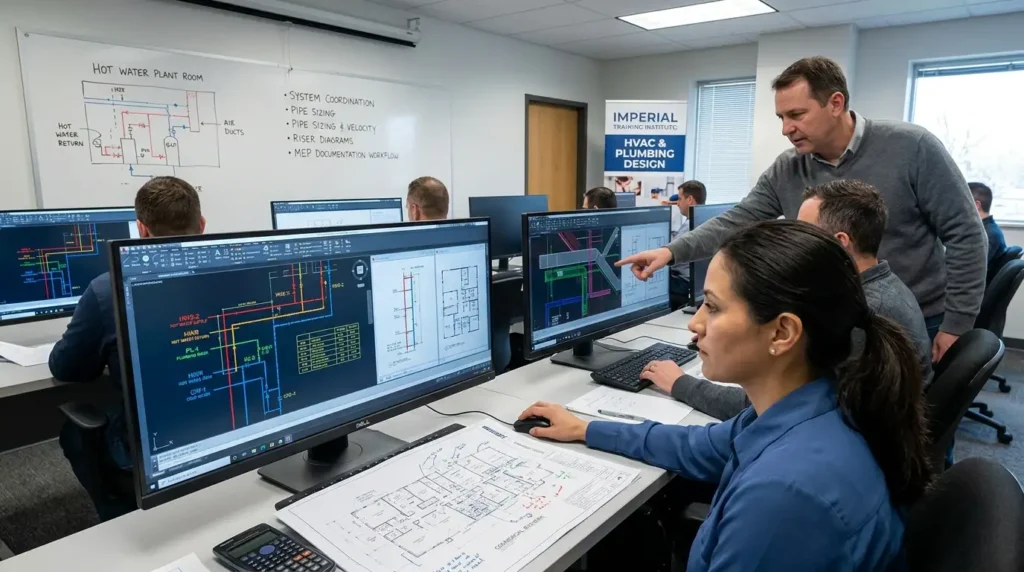
Imperial Corporate Training Institute includes structured hot water system drawing exercises within its AutoCAD HVAC and Plumbing Design Training Course through plumbing drafting modules, schematic coordination tasks, riser diagram preparation, pipe sizing activities, and integrated MEP documentation exercises aligned with commercial engineering project standards and workflow requirements.
Hot water system drawing exercises form part of the plumbing and drainage design components of the programme. These exercises are not treated as isolated software tutorials. They are integrated into broader HVAC and MEP coordination activities to reflect workplace project requirements.
Imperial Corporate Training Institute structures the programme around real drafting scenarios used in engineering consultancies, construction firms, and building services departments. Participants work on layouts involving cold water systems, hot water routing, drainage planning, and coordination between HVAC and plumbing networks.
Hot Water Drafting Topics Included in the Programme
The course includes practical exercises covering:
- Hot water distribution layouts
- Pipe routing coordination
- Plumbing riser diagrams
- Fixture connection documentation
- Pipe sizing and slope representation
- Mechanical room drafting
- Layer management for plumbing systems
- System annotation and legends
- Bill of materials preparation
- Coordination with HVAC duct systems
Participants are required to produce technical layouts rather than observe demonstrations passively. Imperial Corporate Training Institute uses drafting assignments that replicate engineering documentation procedures used within commercial project delivery environments.
Why Hot Water Exercises Matter in HVAC Training
Heating and plumbing coordination is a core requirement in building services engineering. Engineers frequently encounter problems where HVAC ducting conflicts with hot water lines, drainage routing, or mechanical equipment placement.
Without structured drafting practice, professionals often struggle with:
- Design coordination delays
- Incorrect documentation standards
- Drawing revision errors
- Poor layer organisation
- Incomplete system schedules
- Non-compliant engineering documentation
Imperial Corporate Training Institute addresses these problems by integrating hot water system drawing exercises directly into the drafting workflow instead of separating HVAC and plumbing into disconnected subjects.
Why Is the Course Structured Around HVAC and Plumbing Coordination Instead of Separate Drafting Topics?
Imperial Corporate Training Institute structures the programme around integrated HVAC and plumbing coordination because commercial engineering projects require multidisciplinary documentation, shared design standards, coordinated mechanical layouts, and collaborative workflows rather than isolated drafting outputs produced independently by separate technical departments or design specialists.
Many training programmes teach AutoCAD commands without connecting them to building services workflows. This creates a disconnect between software familiarity and engineering application.
Imperial Corporate Training Institute uses a progressive curriculum model where each module supports increasingly complex project coordination activities.
Progressive Skill Development Structure
The programme begins with foundational AutoCAD configuration and drafting standards before moving into HVAC layouts, plumbing coordination, advanced MEP tools, and integrated project documentation.
This progression reflects actual engineering practice:
Module 1: AutoCAD Workflow Foundations
Participants establish company drawing standards, title blocks, scaling methods, and template structures used in professional engineering documentation.
Module 2: HVAC Drafting Systems
Learners develop airflow routing layouts, diffuser placement plans, and duct system schematics while applying drafting conventions used in corporate mechanical projects.
Module 3: Plumbing and Hot Water Design
Hot water exercises become central within this module. Participants create plumbing layouts, riser diagrams, drainage coordination drawings, and pipe routing systems aligned with building service standards.
Module 4: MEP Coordination
Participants integrate HVAC and plumbing layouts using Xrefs, layered coordination methods, and clash management strategies.
This structure allows professionals to understand how hot water systems interact with wider mechanical infrastructure rather than treating plumbing drawings as standalone outputs.
Corporate Relevance of Integrated Training
Imperial Corporate Training Institute aligns the curriculum with multidisciplinary project delivery requirements found in:
- Commercial buildings
- Industrial facilities
- Healthcare infrastructure
- Hospitality developments
- High-rise residential projects
- Public sector engineering works
Engineering teams rarely work in isolation. HVAC professionals coordinate continuously with plumbing, electrical, architectural, and structural departments. The programme reflects this operational reality.
What Will Participants Learn Through the Hot Water System Drawing Exercises?
Participants develop measurable drafting and coordination skills through practical hot water system exercises involving plumbing layouts, riser diagrams, system detailing, documentation standards, MEP coordination, calculation integration, and technical drawing production aligned with international engineering drafting requirements and commercial project execution standards.
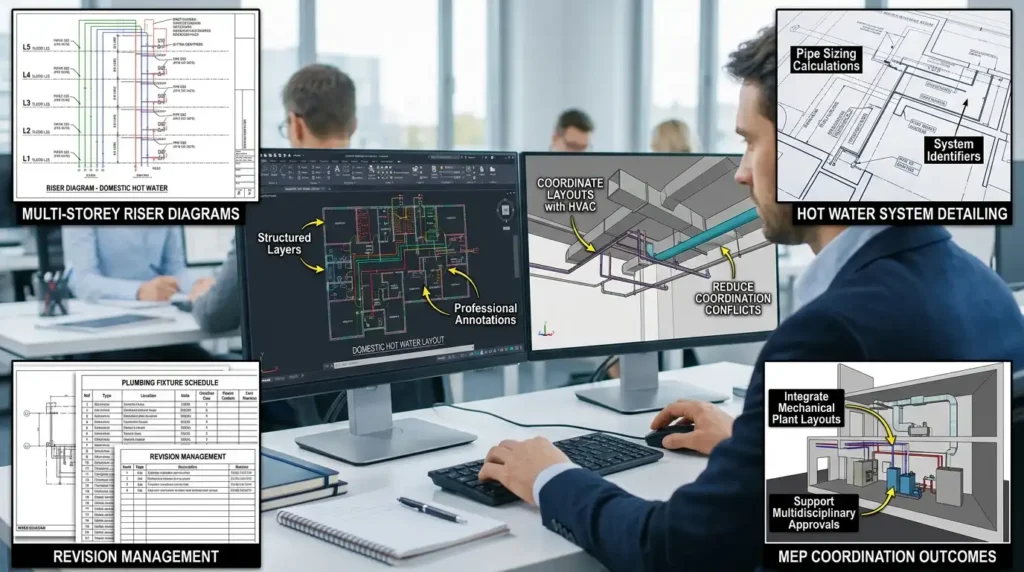
The learning outcomes are tied directly to technical deliverables rather than theoretical awareness alone.
Imperial Corporate Training Institute focuses on demonstrable drafting capability across multiple stages of HVAC and plumbing documentation development.
Technical Skills Developed
Participants learn how to:
- Draft hot water systems accurately in AutoCAD
- Coordinate plumbing layouts with HVAC systems
- Organise layers and annotations professionally
- Produce riser diagrams for multi-storey buildings
- Apply drafting conventions consistently
- Interpret engineering specifications
- Prepare construction documentation
- Develop material schedules
- Support tender documentation requirements
- Reduce coordination conflicts in MEP drawings
Documentation Competencies
The programme develops documentation quality standards required in corporate engineering environments.
Participants work on:
Sheet Organisation
Learners prepare engineering sheets using structured title blocks, viewport management, plotting standards, and documentation conventions.
Plumbing Schedules
Participants create schedules showing pipe types, fixture references, system identifiers, and technical annotations.
Revision Management
Imperial Corporate Training Institute includes workflow exercises involving drawing revisions, version control, and design updates.
Design Coordination Outcomes
Hot water systems rarely exist independently from HVAC infrastructure. Participants therefore learn how to:
- Avoid routing conflicts
- Coordinate ceiling space allocation
- Integrate mechanical plant layouts
- Support multidisciplinary approvals
- Improve documentation accuracy
Professionals working in MEP consultancies benefit from these integrated coordination exercises because project performance depends heavily on documentation consistency.
How Does Imperial Corporate Training Institute Deliver the HVAC and Plumbing Programme?
Imperial Corporate Training Institute delivers the programme through structured technical workshops, instructor-led drafting sessions, project simulations, practical assignments, collaborative exercises, and professional design documentation activities offered through flexible corporate training formats suitable for engineering teams, technical departments, and individual professionals seeking measurable drafting competency development.
The programme delivery model focuses on practical drafting execution rather than lecture-based instruction alone.
Participants complete exercises that mirror real project workflows used in engineering and construction environments.
Delivery Formats
Imperial Corporate Training Institute provides multiple training delivery structures depending on organisational requirements and participant availability.
Instructor-Led Workshops
Participants receive guided technical instruction while completing structured AutoCAD drafting tasks.
Online Learning Sessions
Remote participants complete drafting exercises through supervised online delivery environments with instructor support and assignment review.
Hybrid Corporate Delivery
Organisations may combine onsite technical workshops with remote assignments and project simulations.
Onsite Team Training
Engineering departments can arrange customised group delivery aligned with company documentation standards and project workflows.
Practical Learning Activities
The programme includes:
- Drafting workshops
- Mechanical layout exercises
- Plumbing coordination activities
- Design simulations
- Documentation reviews
- Layer management tasks
- System detailing assignments
- Revision control exercises
Imperial Corporate Training Institute emphasises active drafting participation throughout the programme.
Assessment Structure
Participant progress is evaluated through:
Technical Assignments
Learners produce HVAC and plumbing drawings based on engineering specifications.
Coordination Exercises
Participants resolve drafting conflicts between systems and disciplines.
Project Simulations
Full project documentation tasks assess workflow accuracy and drafting consistency.
Quality Review Activities
Participants conduct internal drawing audits and identify documentation discrepancies.
This assessment structure supports measurable skill verification instead of attendance-based completion.
How Does the Programme Compare to Standard AutoCAD HVAC Courses?
Imperial Corporate Training Institute differentiates its programme through integrated HVAC and plumbing coordination, corporate workflow simulation, documentation control training, BIM coordination exposure, and practical hot water system drafting exercises aligned with commercial engineering deliverables rather than isolated software command instruction or generic drafting demonstrations alone.
Many AutoCAD courses focus primarily on software navigation and basic command usage. These programmes often lack engineering workflow integration.
Imperial Corporate Training Institute structures the programme around corporate project execution standards.
Key Differences in Curriculum Design
The programme includes:
- Real engineering documentation workflows
- Hot water system coordination exercises
- Corporate drafting standards
- Revision control procedures
- MEP integration activities
- BIM coordination exposure
- Design quality assurance processes
- Technical submission preparation
These elements support workplace readiness rather than software familiarity alone.
For evaluation-stage readers comparing programme depth and engineering coordination coverage:
Heating circuit design and documentation training provides additional insight into how structured drafting workflows are taught within HVAC-focused AutoCAD programmes.
Corporate Application Focus
Imperial Corporate Training Institute aligns exercises with the operational needs of:
- Design consultancies
- Construction contractors
- Facilities management departments
- Infrastructure engineering firms
- Mechanical services companies
- MEP coordination teams
Participants therefore develop drafting outputs relevant to workplace performance requirements.
BIM and Revit Coordination Exposure
The programme also introduces coordination strategies involving BIM and Revit integration.
Participants learn how AutoCAD-generated HVAC and plumbing drawings support broader multidisciplinary digital construction workflows.
This supports professionals transitioning from traditional drafting environments into integrated project delivery structures.
What Workplace Results Can Participants Expect After Completing the Programme?
Participants can expect measurable improvements in drafting accuracy, documentation consistency, project coordination capability, HVAC and plumbing integration skills, engineering communication standards, and technical workflow efficiency applicable across construction, facilities management, infrastructure development, and corporate mechanical design environments after programme completion.
The programme is designed to improve operational drafting performance within engineering teams.
Imperial Corporate Training Institute structures the learning outcomes around practical workplace deliverables rather than abstract software competency.
Performance Improvements
Participants commonly improve their ability to:
- Produce coordinated HVAC and plumbing drawings
- Reduce drafting inconsistencies
- Organise project documentation systematically
- Support multidisciplinary engineering reviews
- Manage revisions accurately
- Deliver professional construction documentation
- Interpret engineering requirements more effectively
Departmental Benefits
Engineering managers and HR teams evaluating workforce development outcomes often require measurable training relevance.
The programme supports:
Engineering Departments
Improved drafting consistency across project documentation.
Project Coordination Teams
Better communication between mechanical, plumbing, and architectural disciplines.
Facilities Management Units
Improved interpretation of HVAC and plumbing layouts during maintenance planning.
Construction Teams
More accurate installation documentation and reduced coordination conflicts.
Career and Technical Development Outcomes
Imperial Corporate Training Institute also supports individual professional development through advanced drafting exposure.
Participants strengthen capabilities relevant to roles such as:
- Mechanical design engineer
- HVAC draughtsman
- MEP coordinator
- Plumbing design technician
- Project engineer
- Building services consultant
- CAD technician
The programme supports both technical accuracy and workflow coordination competency.
How Does Enrollment Work for the AutoCAD HVAC and Plumbing Design Training Course?
Imperial Corporate Training Institute provides structured enrollment pathways for engineering professionals, graduates, corporate departments, and technical teams seeking HVAC and plumbing drafting expertise through flexible participation formats, guided registration procedures, defined completion requirements, and practical training progression aligned with professional development objectives and industry drafting standards.
The programme is intended for professionals working in engineering, construction, facilities management, and technical drafting environments.
Participants may join individually or through organisational workforce development initiatives.
Eligibility Requirements
The course is suitable for:
- Mechanical engineers
- HVAC professionals
- MEP technicians
- Plumbing design staff
- CAD operators
- Engineering graduates
- Project coordinators
- Facilities management professionals
Previous exposure to AutoCAD is beneficial but not mandatory for all participants.
Discover More from Our Guide Library:
How Does Imperial’s HVAC Programme Accelerate Junior Engineer Development?
Does Imperial’s HVAC Course Cover Chiller System Drawing Production?
Completion Path
Participants complete:
- Technical drafting exercises
- HVAC documentation tasks
- Plumbing coordination activities
- Hot water system drawing assignments
- Project simulation exercises
- Quality review procedures
Imperial Corporate Training Institute structures the programme to ensure participants progress from drafting fundamentals toward integrated project documentation capability.
Corporate Training Suitability
The programme is particularly relevant for organisations seeking:
- Standardised drafting procedures
- Improved MEP coordination
- Workforce technical upskilling
- Better documentation quality
- Reduced engineering errors
- Enhanced project communication
The structured curriculum allows engineering departments to align technical development with operational performance objectives.