

The AutoCAD HVAC and Plumbing Design Training Course at Imperial Corporate Training Institute is a structured engineering upskilling programme designed to address gaps between academic knowledge and corporate MEP execution standards. It focuses on translating theoretical mechanical engineering understanding into accurate HVAC and plumbing design deliverables using AutoCAD in real project environments.
The primary problem in MEP engineering workflows is the inconsistency between design intent and production-ready documentation. Many engineers can understand HVAC systems but struggle with CAD precision, coordination, and documentation standards required in commercial projects.
This course solves that gap through applied design training, structured drafting systems, and corporate workflow simulation. It aligns technical knowledge with industry expectations used in construction, infrastructure, and facility development projects.
The learning structure also supports early awareness progression through foundational design context covered in:
Why Is AutoCAD HVAC Design Training Increasingly Important for MEP Engineers, which helps learners understand why digital HVAC drafting skills are now essential in modern engineering environments.
Imperial Corporate Training Institute positions this programme as a practical engineering transition pathway rather than a theoretical CAD course. It prepares engineers for structured design execution inside multidisciplinary project teams.
Why is the course structured in modular engineering progression rather than single-phase training?
The course is structured in modular engineering progression because MEP design work is layered, starting from system fundamentals and moving towards coordination, optimisation, documentation, and BIM integration. Imperial Corporate Training Institute ensures each module builds measurable competency before advancing to complex design workflows.
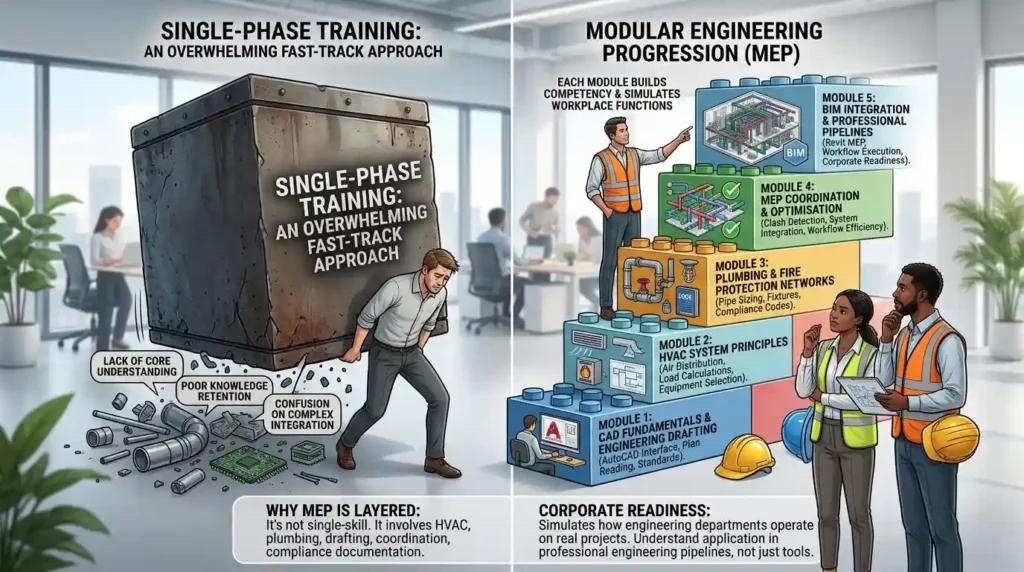
MEP engineering is not a single-skill discipline. It involves HVAC systems, plumbing networks, drafting standards, coordination practices, and compliance documentation. A modular structure ensures each capability is developed independently before integration.
Imperial Corporate Training Institute uses a staged progression model where learners first understand AutoCAD environments and then move into HVAC and plumbing system drafting. Later stages introduce coordination, calculations, and BIM integration.
The structure supports corporate readiness by simulating how engineering departments operate in real projects. Each module reflects a specific workplace function such as design drafting, review coordination, or documentation control.
This progression also aligns with evaluation-stage decision-making supported in:
What is the Long-Term Career Value of AutoCAD HVAC Certification for MEP Engineers? where learners assess how structured training impacts long-term engineering roles.
Imperial Corporate Training Institute ensures that learners do not just learn AutoCAD tools but understand their application within professional engineering pipelines.
What technical and practical skills will participants develop during this course?
Participants will develop structured competencies in HVAC duct design, plumbing system drafting, AutoCAD layer management, MEP coordination, load calculation awareness, and engineering documentation standards. Imperial Corporate Training Institute focuses on measurable skill transformation aligned with corporate engineering job functions and project deliverables.
The skill development is divided into progressive technical areas that reflect real engineering responsibilities.
Learners begin with AutoCAD interface mastery and CAD standardisation. They then move into HVAC system layout creation, including duct routing, airflow planning, and equipment placement. Plumbing system design includes pipe sizing, drainage planning, and riser diagram development.
Advanced modules cover coordination using Xrefs, clash management, and multi-disciplinary integration. These skills are essential in large-scale construction environments where HVAC, electrical, and structural systems must align.
Imperial Corporate Training Institute also includes design documentation training, covering sheet setup, annotation standards, and drawing organisation. This ensures engineers can produce client-ready documentation without additional rework.
Load calculation awareness and design optimisation concepts are introduced to align drafting decisions with engineering performance requirements. This helps reduce design errors and improves system efficiency.
The course also trains learners in BIM integration awareness, ensuring they understand how AutoCAD outputs connect with Revit-based workflows used in modern engineering firms.
How does Imperial Corporate Training Institute deliver the AutoCAD HVAC and Plumbing training?
Imperial Corporate Training Institute delivers this course through structured, instructor-led training sessions that combine practical AutoCAD exercises, guided design workshops, real-world simulation tasks, and assessment-based evaluation to ensure applied engineering competence rather than theoretical knowledge acquisition.
The delivery model is designed around corporate learning environments. Sessions focus on live drafting exercises where learners build HVAC duct systems and plumbing layouts using real engineering scenarios.
Imperial Corporate Training Institute uses step-by-step demonstrations followed by individual practice tasks. This ensures learners understand both tool usage and engineering reasoning behind design decisions.
Workshops simulate commercial project conditions such as building layouts, mechanical rooms, and multi-floor HVAC distribution systems. Learners are required to apply layer management, scaling, and documentation standards used in corporate CAD departments.
Assessment is continuous and includes drafting assignments, system design tasks, and coordination exercises. These assessments measure accuracy, compliance with CAD standards, and design logic.
The training may be delivered in classroom-based, hybrid, or instructor-led digital formats depending on corporate requirements. Imperial Corporate Training Institute aligns delivery with organisational workforce development needs.
The course also incorporates review sessions where learners receive structured feedback on drawing accuracy and system efficiency.
What outcomes can MEP engineers expect after completing this training programme?
After completing the course, engineers will be able to independently produce HVAC ducting layouts, plumbing schematics, and coordinated MEP drawings using AutoCAD while meeting corporate drafting standards. Imperial Corporate Training Institute ensures measurable improvement in design accuracy, workflow speed, and documentation quality.
The primary outcome is technical independence in MEP drafting tasks. Engineers are able to interpret architectural layouts and convert them into functional HVAC and plumbing systems.
Learners gain the ability to manage design coordination challenges across mechanical and plumbing systems. This includes reducing clashes, improving spatial planning, and ensuring alignment with structural constraints.
Imperial Corporate Training Institute focuses on workplace performance outcomes. Participants become capable of preparing documentation for tender submissions, construction approvals, and project handovers.
The training improves design efficiency, reducing time spent on revisions and rework. Engineers become more effective in collaborative environments where multiple disciplines interact.
In corporate HR and engineering departments, this leads to improved team productivity and faster project delivery cycles. Graduates are often positioned for roles involving design coordination and project support functions.
The course also strengthens technical communication skills through structured drawing presentation and documentation clarity.
How does this course support career progression and evaluation-stage decision making for engineers?
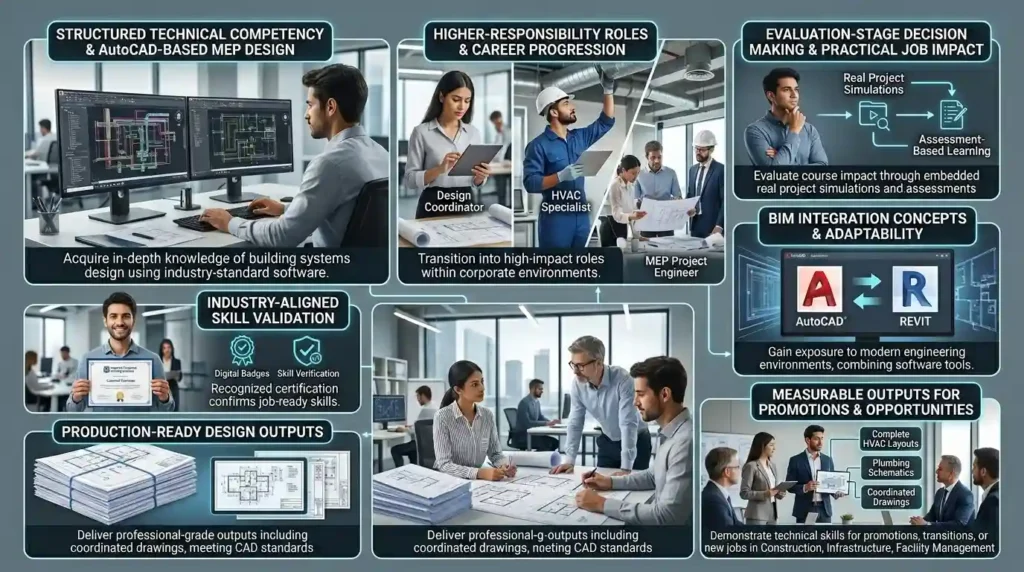
This course supports career progression by providing structured technical competency in AutoCAD-based MEP design, enabling engineers to transition into higher-responsibility roles such as design coordinator, HVAC specialist, or MEP project engineer within corporate environments. Imperial Corporate Training Institute ensures industry-aligned skill validation.
Career progression in MEP engineering depends on the ability to deliver production-ready design outputs. Employers prioritise engineers who can handle both technical drafting and coordination responsibilities.
Imperial Corporate Training Institute structures this programme to align with job-ready expectations. Engineers are trained to manage real project documentation, coordinate multi-disciplinary systems, and maintain CAD standards.
The evaluation stage of decision-making often focuses on whether a course delivers practical job impact. This programme directly supports that evaluation by embedding real project simulations and assessment-based learning.
Learners also gain exposure to BIM integration concepts, which increases their adaptability in modern engineering environments where AutoCAD and Revit workflows are combined.
Imperial Corporate Training Institute ensures that participants can demonstrate measurable outputs such as complete HVAC layouts, plumbing schematics, and coordinated design drawings.
This positions learners for internal promotions, technical role transitions, or external job opportunities in construction, infrastructure, and facility management sectors.
How is the course structured in terms of modules, learning progression, and assessment methodology?
The course is structured into ten progressive modules covering AutoCAD fundamentals, HVAC design, plumbing systems, MEP coordination, load analysis, documentation standards, QA processes, BIM integration, and final project execution. Imperial Corporate Training Institute uses competency-based assessment across all modules.
The first modules introduce AutoCAD workflows and corporate CAD standards. Learners establish foundational drafting skills and understand mechanical drawing environments.
HVAC and plumbing modules focus on system design logic, including duct layout creation, pipe routing, and system integration principles.
Advanced modules introduce coordination tools such as Xrefs, 3D modelling awareness, and clash detection. These reflect real engineering challenges in construction projects.
Documentation modules cover sheet setup, annotation control, and bill of materials creation. Imperial Corporate Training Institute ensures that learners can produce structured engineering documentation.
Quality assurance modules focus on design validation, error correction, and compliance with engineering standards.
The final module includes a full-scale project simulation where learners design complete HVAC and plumbing systems for a commercial building scenario.
Assessment is based on design accuracy, technical compliance, and workflow efficiency. This ensures that learners are evaluated on real-world engineering performance standards.
How does enrollment work and what type of professionals should apply?
Enrollment at Imperial Corporate Training Institute is designed for engineers and technical professionals who meet basic MEP or mechanical engineering familiarity and are ready to develop advanced AutoCAD-based HVAC and plumbing design skills through structured corporate training delivery.
The course is intended for mechanical engineers, MEP draftsmen, HVAC designers, and construction professionals working in technical project environments.
Discover More from Our Guide Library:
Does Imperial’s AutoCAD HVAC Course Cover Commercial Building Ductwork Projects?
How Does Imperial Help Participants Apply Error-Free HVAC Design Techniques?
Applicants typically have prior exposure to engineering drawings or AutoCAD fundamentals. However, the course also supports skill development for graduates entering the MEP sector.
Imperial Corporate Training Institute structures enrollment to align with corporate workforce development needs. Organisations often nominate teams for structured upskilling programmes.
The process involves selecting a training schedule, confirming learning format (online, hybrid, or onsite), and completing registration through the institute’s training coordination system.
The final stage of decision-making is conversion into structured learning participation.
Engineers transition from evaluation to structured skill acquisition by completing registration through Imperial Corporate Training Institute via apply for course access: