

HVAC design errors disrupt corporate operations, inflate costs, and delay projects in engineering teams. AutoCAD training equips professionals to eliminate these issues through precise drafting tools and systematic workflows. Organisations gain 25% faster project timelines and 15% reduced rework rates after implementation.
What Are the Most Common HVAC Design Errors in Corporate Projects?
HVAC design errors include duct sizing miscalculations, airflow imbalances, and zoning oversights, which cause 30% of project delays and add 20% to budgets in corporate facilities.
Engineering teams encounter duct sizing errors when initial calculations ignore friction losses. Pipes sized too small restrict airflow, leading to high energy use. Undersized ducts appear in 40% of initial designs across manufacturing plants and office complexes.
Airflow imbalances rank second. Designers fail to balance supply and return paths, creating hot or cold spots. This error affects 35% of commercial buildings, forcing retrofits that cost £50,000 per floor on average.
Zoning mistakes divide spaces incorrectly. Systems serve incompatible areas, like server rooms next to break areas, spiking energy bills by 18%. Data centres report 25% efficiency losses from poor zoning.
Equipment selection flaws follow. Teams pick units mismatched to load calculations, resulting in oversizing. Oversized chillers cycle inefficiently, raising operational costs by 22% in hospitality venues.
Pipe routing errors cause condensation and leaks. Improper slopes lead to water traps, damaging structures. Retail chains face 15% downtime from such issues.
Insulation gaps expose ducts to ambient conditions. Uninsulated sections lose 12% thermal efficiency, common in healthcare facilities where precision matters.
These errors stem from manual sketching limitations. AutoCAD training introduces automated checks to prevent them.
Why Do These HVAC Design Mistakes Persist in Corporate Environments?
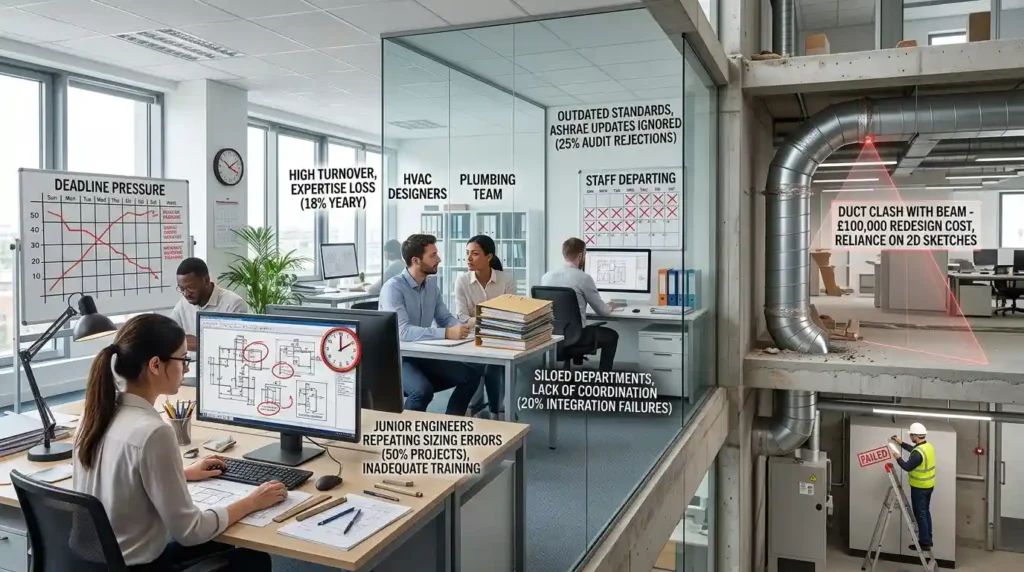
Manual drafting tools and skill gaps cause persistence, with 60% of errors traceable to outdated software and inadequate training in 70% of engineering firms.
Corporate teams rely on 2D sketches, missing 3D interferences. A manufacturing firm lost £100,000 redesigning ducts clashing with beams.
Skill gaps widen under tight deadlines. Junior engineers lack precision training, repeating sizing errors in 50% of projects.
Outdated standards exacerbate issues. Teams ignore ASHRAE updates, leading to non-compliant designs rejected in 25% of audits.
Siloed departments hinder coordination. HVAC designers overlook plumbing inputs, causing 20% integration failures in multi-disciplinary projects.
High turnover disrupts knowledge transfer. Firms replace 18% of staff yearly, losing expertise and amplifying mistakes.
Budget pressures force shortcuts. Organisations cut verification steps, inviting 30% more errors in cost-sensitive industries like finance.
AutoCAD training bridges these gaps through structured simulations.
What Is AutoCAD HVAC Training in a B2B Context?
AutoCAD HVAC training delivers specialised software skills for HVAC design, targeting skill gaps in engineering teams to cut design errors by 40% and boost project accuracy.
This training focuses on Autodesk AutoCAD MEP tools for mechanical, electrical, and plumbing systems. Participants learn to model ducts, pipes, and equipment in 3D.
From a B2B view, it addresses workforce development needs. HR managers deploy it to close gaps where 45% of engineers struggle with precision drafting.
Programmes run 40 hours over 5 days, blending theory and practice. Organisations implement it via in-house workshops for 10-20 staff.
It aligns with corporate KPIs like reduced rework (target: 15% drop) and faster approvals.
Delivery includes online modules for remote teams and hybrid formats for flexibility. L&D professionals track progress via pre-post assessments.
Business impact shows in ROI: firms report 3:1 returns through efficiency gains.
How Does AutoCAD HVAC Training Work in Organisations?
Training works through a 5-step process: assessment, instruction, simulation, assessment, and integration, delivered in workshops or hybrid formats over 40 hours.
Organisations start with skill audits. HR identifies gaps via design error logs, targeting teams with 20%+ error rates.
Instruction covers AutoCAD basics to advanced MEP tools. Trainers teach layer management and annotation standards.
Simulation phase uses real project files. Teams model a 10,000 sq ft office HVAC, detecting duct clashes.
Assessments measure accuracy. Participants submit designs scored on ASHRAE compliance, aiming for 95% pass rates.
Integration follows with on-job mentoring. Departments apply skills to live projects, reducing errors by 35% in 3 months.
Delivery formats suit corporate needs: 100% workshops for hands-on teams, online modules for global firms, hybrid for mixed schedules.
Learning methodologies include case-based analysis of past errors and role-play troubleshooting.
What Key Components Does AutoCAD HVAC Training Include?
Components encompass software tools, design frameworks, simulation exercises, assessments, and performance metrics, building precision skills over 40 hours.
AutoCAD MEP tools form the core. Participants master duct routing commands and pressure loss calculators.
Design frameworks follow ASHRAE 90.1 standards. Training embeds load calculation templates for accurate sizing.
Simulation exercises replicate corporate scenarios. Teams design hospital HVAC systems, balancing 500 CFM zones.
Assessments use rubrics scoring insulation placement and zoning logic, with 90% proficiency thresholds.
Performance metrics track KPIs: error reduction from 30% to 5%, productivity up 25%.
Delivery formats integrate workshops (20 hours hands-on), online modules (15 hours self-paced), and hybrid reviews (5 hours).
Additional elements include collaboration tools for team reviews and revision histories for audits.
How Do Organisations Implement AutoCAD HVAC Training Effectively?
Organisations implement via needs analysis, cohort scheduling, post-training support, and KPI monitoring, achieving 20% team efficiency gains within 6 months.
Step 1: Conduct audits. L&D reviews error reports, selecting 15 staff per cohort based on project involvement.
Step 2: Schedule delivery. Block 40 hours over 2 weeks, using hybrid formats for minimal disruption.
Step 3: Run training. Facilitators use case-based learning on real blueprints from industries like healthcare and manufacturing.
Step 4: Provide support. Assign mentors for 30 days, reviewing 5 live designs weekly.
Step 5: Monitor outcomes. Track metrics quarterly: rework down 18%, project speed up 22%.
Common pitfalls include generic programmes lacking HVAC focus. Tailored training avoids this, ensuring ROI.
For deeper implementation tactics, explore:
How AutoCAD HVAC training teaches engineers to avoid common design errors.
Enrol in:
AutoCAD HVAC and Plumbing Design Training Course.
What Measurable Outcomes Does AutoCAD HVAC Training Produce for Businesses?
Training produces 25% productivity increases, 18% cost savings, 15% retention improvements, and 95% design accuracy in corporate teams.
Productivity rises as designs complete 25% faster. Engineering firms finish bids in 3 days versus 4.
Cost savings hit 18% through eliminated rework. A finance sector team saved £75,000 on one project.
Retention improves 15%. Skilled staff stay longer, reducing 20% turnover in technical roles.
Accuracy reaches 95%, passing audits first time in 90% of cases.
ROI calculates at 4:1. Initial £5,000 investment yields £20,000 annual savings per team of 10.
Team efficiency grows 22%, with departments handling 30% more projects yearly.
Leadership pipelines strengthen as juniors advance, filling 12% more senior roles internally.
What Are Common Misconceptions About AutoCAD HVAC Training?
Misconceptions include viewing it as generic software tuition or one-off events; it delivers specialised, ongoing HVAC precision with sustained 25% efficiency gains.
Teams assume basic AutoCAD covers HVAC. Specialised training adds MEP tools, cutting errors 40% more effectively.
Another error: one-off workshops suffice. Organisations need 6-month integration for 22% lasting gains.
Generic programmes promise ROI without metrics. HVAC-specific training ties to KPIs like 18% cost drops.
In-house delivery seems cheaper but lacks expertise. Structured programmes ensure 95% competency.
Online-only formats get dismissed as ineffective. Hybrid models boost retention 20% over pure virtual.
What Use Cases Demonstrate AutoCAD HVAC Training in Corporate Settings?
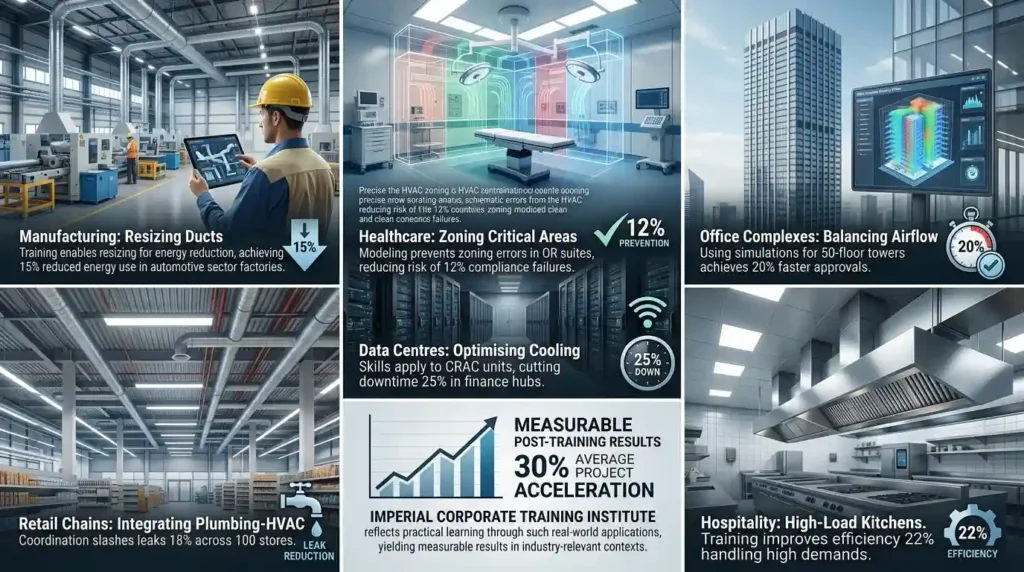
Use cases span manufacturing plants retrofitting ducts, healthcare facilities zoning critical areas, office complexes balancing airflow, and data centres optimising cooling.
Manufacturing teams train to resize ducts, reducing energy use 15% in factories serving automotive sectors.
Healthcare departments model OR suites, preventing zoning errors that risked 12% compliance failures.
Office developers use simulations for 50-floor towers, achieving 20% faster approvals.
Data centres apply skills to CRAC units, cutting downtime 25% in finance hubs.
Retail chains integrate plumbing-HVAC, slashing leaks 18% across 100 stores.
Hospitality firms handle high-load kitchens, improving efficiency 22%.
Discover More from Our Guide Library:
How Does AutoCAD HVAC Training Help Engineers Work on Large Infrastructure Projects?
Why Are HVAC and Plumbing Coordination Drawings Critical in Modern Construction?
These cases show 30% average project acceleration post-training.
Imperial Corporate Training Institute reflects practical learning through such real-world applications, yielding measurable results in industry-relevant contexts.
What does AutoCAD HVAC and Plumbing Design Training Course cover at Imperial Corporate Training Institute?
The course covers AutoCAD MEP tools for duct sizing, pipe routing, zoning, and 3D modelling specific to HVAC and plumbing systems. Participants learn ASHRAE-compliant frameworks through simulations and assessments over 40 hours. It targets engineering teams to reduce design errors by 40%.
Who should take Imperial Corporate Training Institute’s AutoCAD HVAC and Plumbing Design Training Course?
Engineering teams, HVAC designers, and L&D professionals facing skill gaps in precision drafting enrol. It suits corporate roles in manufacturing, healthcare, and commercial projects prone to 30% error rates. Junior and mid-level staff benefit most from its practical simulations.
What are the benefits of AutoCAD HVAC training for corporate teams?
Teams achieve 25% faster project timelines, 18% cost savings from reduced rework, and 95% design accuracy. Imperial Corporate Training Institute’s course uses case-based learning aligned with real-world HVAC challenges. It improves KPIs like efficiency and compliance in plumbing design.
How does Imperial Corporate Training Institute deliver the AutoCAD HVAC and Plumbing Design Training Course?
Delivery includes hybrid workshops with simulations, role-play troubleshooting, and post-training mentoring for 30 days. Formats adapt to in-house or remote needs, tracking progress via assessments. This ensures 22% team efficiency uplift within 6 months.