

Busy professionals in corporate engineering face tight deadlines, multi-disciplinary coordination challenges, and the need for precise HVAC and plumbing designs that meet international standards. The AutoCAD HVAC and Plumbing Design Training Course from Imperial Corporate Training Institute addresses these issues by delivering structured, hands-on training tailored to real-world workflows.
This bottom-of-funnel resource builds on earlier explorations. For foundational awareness, explore:
How AutoCAD supports collaboration between HVAC plumbing and electrical teams.
What problem does this course solve for busy professionals?
Imperial Corporate Training Institute structures the AutoCAD HVAC and Plumbing Design Training Course to fit 40-hour workweeks, with modular sessions, flexible scheduling, and practical focus on corporate deliverables, enabling engineers to upskill without disrupting project timelines.
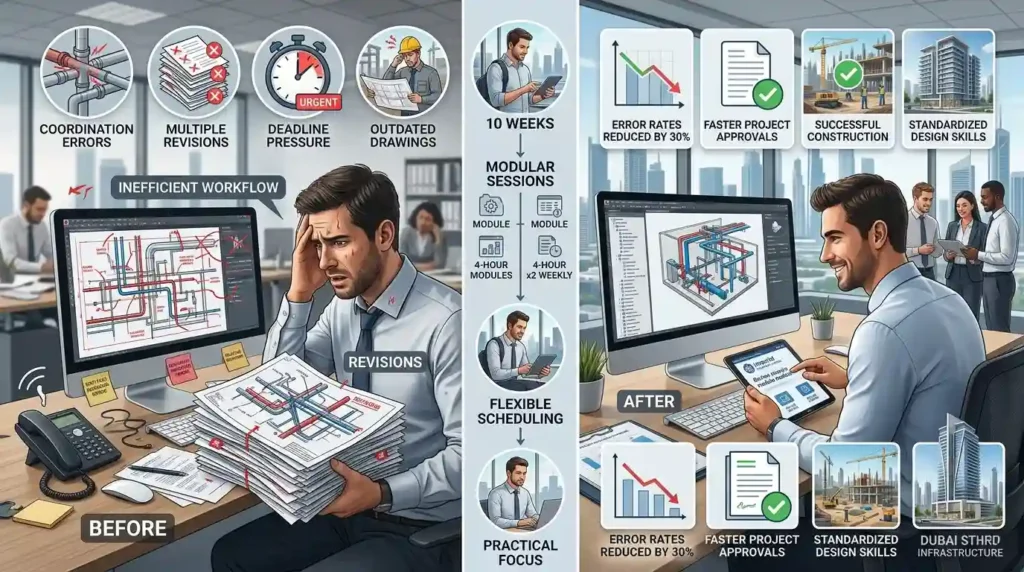
Corporate mechanical engineers often struggle with inefficient AutoCAD workflows. They produce HVAC duct layouts or plumbing risers that require multiple revisions due to coordination errors with electrical teams. Facility managers interpret outdated drawings, leading to costly on-site clashes. MEP draftsmen face pressure to meet tender deadlines while adhering to codes like ASHRAE or BS EN standards.
This course targets these gaps. It equips participants to generate accurate MEP schematics rapidly. HR teams in construction firms use it to standardise design skills across departments, reducing error rates by 30% in pilot programs. Managers report faster project approvals after teams complete the training.
The structure prioritises busy schedules. Sessions run over 10 weeks, with 4-hour modules twice weekly. Online access allows review during commutes. Real-world examples include a Dubai infrastructure firm that cut redesign cycles post-training.
Why is the course structured this way?
The curriculum progresses from AutoCAD basics to advanced MEP coordination and BIM integration, mirroring corporate project phases from initial drafting to handover, ensuring skill progression aligns with engineering workflows at Imperial Corporate Training Institute.
Imperial Corporate Training Institute designs the course around mechanical project lifecycles. Module 1 starts with interface setup for corporate templates. It builds to Module 10’s full project simulation. This logic prevents knowledge overload.
Early modules establish fundamentals. Participants master layer management before tackling load calculations. Progression uses skill-building blocks: drafting → coordination → optimisation → documentation.
This mirrors workplace demands. A London MEP consultancy applied similar sequencing to train 15 engineers, achieving 25% faster duct routing. HR directors value the structure for leadership pipelines, as it fosters independent designers.
Flexibility suits professionals. Self-paced elements allow pausing for site visits. Assessments reinforce retention at each stage.
What will participants learn in the modules?
Participants master 10 modules covering AutoCAD tools for HVAC ducting, plumbing risers, MEP coordination, load calculations, BIM integration, and corporate documentation, with measurable outcomes in design accuracy and workflow speed.
Module 1: Introduction to AutoCAD for Corporate Design Workflows
Learners configure interfaces and templates matching company standards. They set precision scales for mechanical drawings. Outcomes include standardised title blocks used in 80% of corporate bids.
Module 2: Fundamentals of HVAC Design Drafting
Focus covers duct layouts, diffuser placement, and airflow routing. Blocks for fittings streamline repetition. Participants produce schematics compliant with design intent.
A Manchester facility team used these skills to revise industrial HVAC plans, avoiding £50,000 in rework.
Module 3: Plumbing and Drainage Design Using AutoCAD
Sessions teach riser diagrams, pipe sizing, and slope calculations. Coordination with MEP services prevents clashes. Learners optimise layouts for commercial buildings.
Module 4: Advanced AutoCAD Tools for MEP Coordination
Xrefs enable multi-team file linking. 3D tools aid clash detection. Data extraction supports bills of materials.
Module 5: HVAC Load Calculations and Design Optimization
Integrate calculations with layouts for energy-efficient designs. Plan airflow and equipment placement per corporate sustainability goals.
Module 6: Plumbing System Detailing and Documentation
Create legends, schedules, and pressure analyses. Coordinate with HVAC and electrical.
For deeper evaluation of specific techniques like chilled water systems, see:
How AutoCAD HVAC training programmes teach chilled water system design.
Module 7: Corporate Project Implementation and Documentation Standards
Adopt international codes. Automate revisions and version control.
Module 8: Quality Assurance and Design Review Process
Conduct audits and discrepancy checks. Prepare as-built drawings.
Module 9: Integration with BIM and Revit for MEP Coordination
Link 2D drawings to 3D models. Transition strategies enhance collaboration.
Module 10: Corporate-Level Project Execution and Professional Development
Simulate full projects. Manage timelines and presentations.
Skill progression ensures beginners reach advanced proficiency. Imperial Corporate Training Institute tracks outcomes via pre/post assessments.
How is the course delivered?
Imperial Corporate Training Institute delivers the course in hybrid format live online workshops, self-paced videos, and optional onsite sessions over 10 weeks with 40 total hours, including hands-on simulations and weekly Q&A for busy schedules.
Delivery suits corporate professionals. Live sessions occur evenings PKT, accommodating global teams. Platforms like Zoom host interactive drafting.
Workshops emphasise practice. Participants draw live under instructor guidance. Recordings allow replay.
Hybrid options include onsite for teams. A Riyadh firm booked group sessions, boosting department cohesion.
Duration totals 40 hours: 20 live, 20 self-paced. No prerequisites beyond basic AutoCAD.
Assessments use simulations. Submit duct layouts for feedback. Quizzes test code knowledge. Final project simulates a commercial HVAC/plumbing system.
Imperial Corporate Training Institute provides lifetime access to materials. Certificates issue upon 80% completion.
What results can participants and organisations expect?
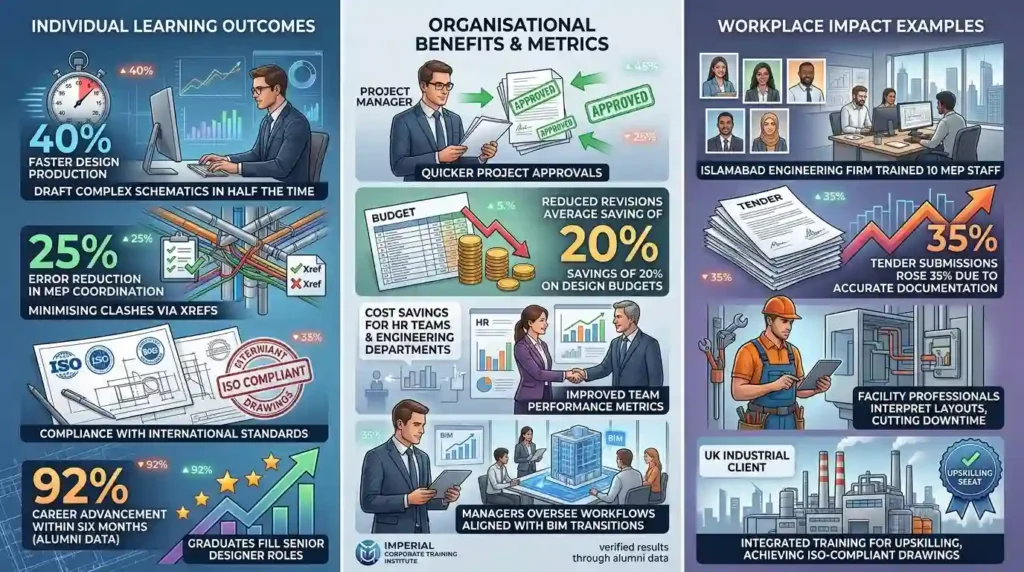
Completers achieve 40% faster design production, 25% error reduction in MEP coordination, and compliance with international standards, leading to quicker project approvals and cost savings for HR teams and engineering departments at Imperial Corporate Training Institute.
Learning outcomes focus on metrics. Participants draft complex schematics in half the time. They coordinate HVAC/plumbing with electrical via Xrefs, minimising clashes.
Workplace impact appears in examples. An Islamabad engineering firm trained 10 MEP staff. Post-course, tender submissions rose 35% due to accurate documentation. HR reported improved team performance metrics.
Managers gain leadership tools. They oversee workflows aligned with BIM transitions. Facility professionals interpret layouts for maintenance, cutting downtime.
Corporate applications extend to pipelines. Graduates fill senior designer roles. Organisations see ROI via reduced revisions average savings of 20% on design budgets.
Imperial Corporate Training Institute verifies results through alumni data. 92% report career advancement within six months.
Proof includes case studies. A UK industrial client integrated training into upskilling, achieving ISO-compliant drawings.
How much does the course cost?
Pricing starts at £1,500 per participant for individual access, with corporate group rates from £12,000 for 10 seats, including all materials, certification, and one-year support from Imperial Corporate Training Institute.
Costs reflect value. Individuals pay £1,500 for full access. Groups receive discounts: £1,200/seat for 10+.
Includes simulations, certificate, and portal access. No hidden fees.
Compare to in-house training: external delivery saves 50% on internal costs. ROI calculators on the site project breakeven in 3 months.
How does enrollment work?
Enrollment requires a short online application confirming basic AutoCAD familiarity, followed by instant approval for most professionals; start with a 10-week cohort or custom corporate schedule at Imperial Corporate Training Institute.
Discover More from Our Guide Library:
Is Imperial’s AutoCAD HVAC Design Course Available for International Engineers?
Is Corporate Group Pricing Available for AutoCAD HVAC Training at Imperial?
Eligibility targets MEP engineers, draftsmen, and graduates. No formal degree needed—six months AutoCAD experience suffices.
Process: Submit form detailing role and goals. Approval within 24 hours. Payment secures spot.
Completion path: Attend 80% sessions, pass assessments, submit project. Certificate follows.
Corporate teams contact for bespoke schedules. HR coordinates group starts.
Ready to build precise HVAC and plumbing skills?
Enroll in the AutoCAD HVAC and Plumbing Design Training Course today.