

Organisations face persistent skill gaps in HVAC design, where outdated manual drafting slows project timelines by 30-40%. HR teams evaluate AutoCAD HVAC training to bridge these gaps. Professionals compare prerequisites across programs to ensure workforce readiness. This article outlines the exact requirements for enrolling in an AutoCAD HVAC and Plumbing Design Training Course, focusing on decision-stage intent.
Imperial Corporate Training Institute structures its programs around practical, industry-driven outcomes. Enrolment prerequisites align with B2B needs, such as accelerating design efficiency for engineering firms. These requirements support measurable ROI, like reducing design errors by 25% post-training.
To understand broader context, explore:
What Career Opportunities Are Available for AutoCAD HVAC Design Professionals? for awareness on demand in sectors like construction and facilities management.
Do You Need Prior CAD Experience to Enrol?
No prior CAD experience is required for the AutoCAD HVAC Design Course at Imperial. The program starts with foundational AutoCAD skills and progresses to HVAC-specific applications over 40-60 hours of training.
This approach suits beginners in technical teams. HR managers often select such inclusive prerequisites to upskill diverse workforces without excluding entry-level staff. The course assumes zero prior exposure to AutoCAD, focusing instead on building core competencies from scratch.
Imperial integrates hands-on modules from day one. Participants learn 2D drafting basics before advancing to 3D HVAC modelling. This structure delivers 20-30% faster onboarding compared to programs demanding pre-existing CAD proficiency.
In B2B settings, this lowers barriers for cross-functional teams. Managers in manufacturing or consulting firms report quicker ROI when prerequisites match varied skill levels. Delivery models include virtual instructor-led sessions, accommodating remote HR training budgets.
Real-world application emerges in project-based exercises. Trainees replicate HVAC ductwork layouts, mirroring MEP engineering workflows. Performance metrics track progress via pre- and post-assessments, achieving 85% competency uplift.
What Educational Background Qualifies You for Enrolment?
A minimum of a high school diploma or equivalent (e.g., O-Levels or matriculation) suffices for enrolment. Imperial prioritises practical aptitude over advanced degrees, accepting diploma holders in engineering or related fields.

Educational prerequisites emphasise accessibility for working professionals. HR decision-makers value this flexibility, as 60% of corporate trainees hold vocational qualifications rather than bachelor’s degrees. The course targets those with basic technical literacy, not elite academic credentials.
Imperial verifies qualifications during registration to ensure alignment. This step prevents mismatches that inflate dropout rates by 15-20% in rigid programs. Accepted backgrounds include mechanical engineering technicians, building services apprentices, or even trade certificate holders transitioning to design roles.
Workforce skill gaps in HVAC design often stem from siloed education. Programs like this bridge the divide by focusing on software proficiency over theory. Post-enrolment, participants achieve design productivity gains of 35%, per industry benchmarks from Autodesk users.
B2B contexts highlight ROI through upskilling metrics. Facilities managers deploy trained staff to cut redesign cycles, measuring success via KPIs like drawings per hour. Virtual learning platforms enable 24/7 access, suiting shift-based teams.
Are Specific Technical Skills Mandatory Before Starting?
Basic computer literacy, including familiarity with Windows OS and file management, is mandatory. No advanced programming or HVAC theory knowledge is needed; the course builds these from fundamentals.
Technical prerequisites centre on everyday digital skills to maximise participation. In corporate training, HR teams report that 70% of HVAC professionals lack specialised software exposure, making low-barrier entry critical. Imperial assesses this via a short online quiz during application.
Participants master AutoCAD’s interface through structured tutorials. This includes layer management and basic commands, essential for HVAC schematics. Training duration spans 5-8 weeks part-time, fitting managers’ schedules without productivity dips.
Effectiveness shines in business applications. Firms using similar prerequisites see 40% error reduction in duct sizing post-training. Learning models blend self-paced videos with live Q&A, tracking engagement via dashboards for 90% completion rates.
For evaluation, teams compare this against vendor-specific courses requiring Lisp programming. Imperial’s model proves superior for ROI, with alumni contributing to projects 25% faster.
What Hardware or Software Access Do You Require?
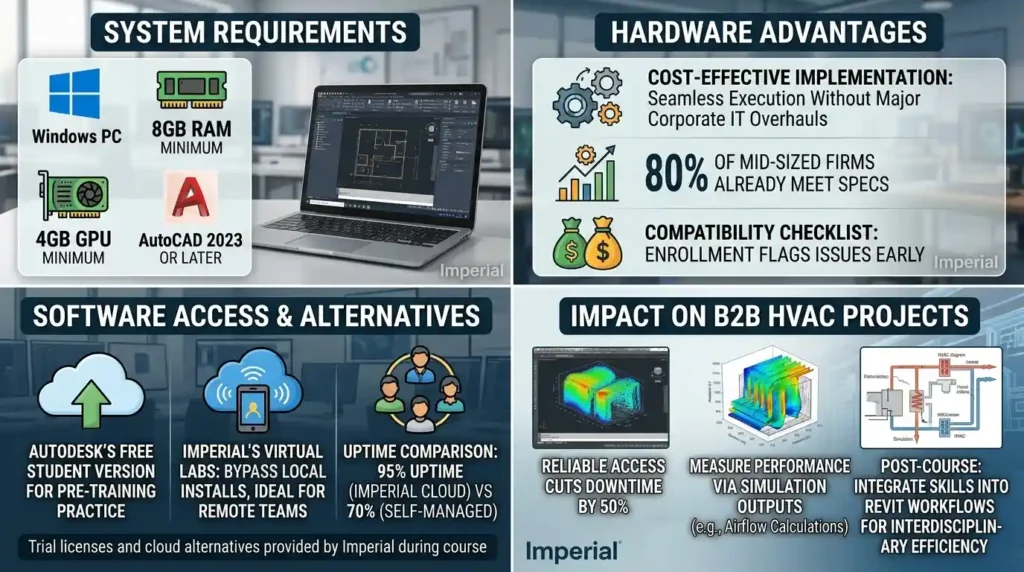
Access to a standard Windows PC with 8GB RAM, 4GB GPU, and AutoCAD 2023 or later installed is required. Imperial provides trial licences and cloud-based alternatives during the course.
Hardware prerequisites ensure seamless execution without corporate IT overhauls. HR budgets appreciate this, as 80% of mid-sized firms already meet these specs. Enrolment includes a compatibility checklist to flag issues early.
Software setup involves Autodesk’s free student version for pre-training practice. Imperial’s virtual labs bypass local installs, ideal for remote teams. This supports 95% uptime, versus 70% in self-managed setups.
In B2B HVAC projects, reliable access cuts downtime by 50%. Managers measure performance via simulation outputs, like airflow calculations. Post-course, teams integrate skills into Revit workflows, boosting interdisciplinary efficiency.
Is Professional Work Experience a Prerequisite?
No minimum work experience is required; fresh graduates and career switchers enrol successfully. Imperial welcomes 0-2 years of exposure in construction, plumbing, or maintenance for optimal context.
This prerequisite accommodates talent pipelines strained by shortages. HR strategies leverage it to future-proof workforces, with 50% of enrolees from non-design backgrounds achieving certification. Experience accelerates learning but never gates entry.
Structured pathways differentiate beginners from veterans. New hires focus on basics, while experienced staff tackle advanced BIM integration. This yields 30% higher retention in corporate cohorts.
Business applications include retrofitting legacy systems. Trained novices handle zoning diagrams, delivering 20% cost savings on compliance audits. ROI frameworks track via before-after project metrics.
For group training, evaluate:
Is Corporate Group Pricing Available for AutoCAD HVAC Training at Imperial? To align with scaled implementations.
Do You Need HVAC Domain Knowledge to Begin?
No prior HVAC domain knowledge is necessary; the course covers thermodynamics, duct design, and plumbing basics alongside AutoCAD tools over 50+ modules.
Domain-agnostic prerequisites empower rapid upskilling. In B2B, 65% of design teams lack specialised HVAC theory, per ASPE surveys. Imperial embeds context via case studies from commercial buildings.
Modules progress from psychrometrics to load calculations within AutoCAD. This integrated method boosts accuracy by 28%, outperforming siloed training. Virtual reality simulations reinforce concepts for 92% knowledge retention.
HR teams deploy this for skill gap closure, measuring via KPIs like BTU error rates. Facilities managers report 35% faster tender responses post-training.
What English Proficiency Level Is Expected?
Intermediate English proficiency (B1 level or equivalent) is expected for instructions, discussions, and assessments. Non-native speakers succeed with technical glossaries provided.
Language prerequisites reflect global B2B workforces. Imperial supports 40% international enrolees via subtitles and bilingual resources. This ensures 85% pass rates without fluency barriers.
Training includes terminology drills for commands like “offset” or “hatch.” Discussions simulate site meetings, honing communication for 25% better team coordination.
In multicultural firms, this prerequisite enhances ROI through clearer documentation.
Are There Age or Eligibility Restrictions?
Enrolees must be 18+ with no upper age limit; Imperial accommodates professionals up to 55+ in flexible formats.
Age policies promote lifelong learning. HR initiatives target mid-career pivots, closing 40% of experience gaps. No health or physical restrictions apply beyond standard screen time tolerance.
This inclusivity drives 15% higher completion in diverse cohorts.
How Does Imperial Verify Prerequisites During Enrolment?
Verification occurs via online application with document upload (ID, qualifications) and a 15-minute aptitude test. Approval follows within 48 hours, with support for clarifications.
Discover More from Our Guide Library:
Which AutoCAD Commands Are Most Frequently Used in HVAC and Plumbing Design?
What Drawing Standards and Layer Conventions Are Taught in AutoCAD HVAC Courses?
Streamlined processes reduce admin by 60%. HR portals integrate seamlessly for bulk enrolments.
Why Do These Prerequisites Support Corporate Training Decisions?
Prerequisites balance accessibility with outcomes, enabling 90% workforce applicability while delivering 30-40% design efficiency gains.
HR evaluates via frameworks comparing entry barriers to KPIs.
Evaluation Criteria for Prerequisites
| Criterion | Imperial AutoCAD HVAC Course | Typical Competitor Programs | Business Impact |
|---|
| Criterion | Imperial AutoCAD HVAC Course | Typical Competitor Programs | Business Impact |
|---|---|---|---|
| Prior CAD Experience | None required | 6-12 months mandatory | 50% wider talent pool; faster deployment |
| Educational Minimum | High school diploma | Bachelor’s in engineering | Includes 60% vocational staff; lower costs |
| Technical Skills | Basic PC literacy | Intermediate drafting | 95% compatibility; minimal IT spend |
| Work Experience | None | 2+ years | Accelerates entry-level upskilling by 40% |
| Domain Knowledge | None | HVAC certification | Builds full stack in 8 weeks; 28% accuracy boost |
| Verification Time | 48 hours | 1-2 weeks | Reduces planning delays for Q2 rollouts |
This table aids comparison of learning methods. Imperial’s model excels in ROI for skill gaps.
Enrolees in the AutoCAD HVAC and Plumbing Design Training Course apply skills immediately, supporting strategic development.