

Kaizen events drive continuous improvement in Lean Six Sigma Master Black Belt training. These intensive workshops embed hands-on practice into advanced curricula. Master Black Belts lead them to solve real problems, bridging theory and application in corporate settings.
What Role Do Kaizen Events Play in Master Black Belt Development?
Kaizen events form the practical core of Lean Six Sigma Master Black Belt training. They deliver targeted, rapid improvement cycles that sharpen leadership in process optimisation. Participants facilitate 3–5-day workshops, achieving 20-50% efficiency gains in pilot projects.

Kaizen events target specific waste in processes. Master Black Belt programmes integrate them to build expertise beyond Green and Black Belt levels. Trainees dissect value streams, apply root cause analysis, and implement changes on live organisational challenges.
This approach addresses workforce skill gaps in B2B environments. HR teams seek leaders who deliver measurable ROI. Kaizen events quantify outcomes through KPIs like cycle time reduction and defect rates dropping by 30-40%.
For foundational understanding of Kaizen’s synergy with Lean Six Sigma, explore:
What Is Kaizen and How Does It Complement Lean Six Sigma Methodology?
Programmes emphasise real-world application. Trainees select cross-functional teams from their organisations. They map current states, brainstorm countermeasures, and standardise gains.
When Do Kaizen Events Occur Within Master Black Belt Curricula?
Kaizen events slot into the mid-to-late stages of Master Black Belt training. They follow DMAIC mastery and precede strategic deployment modules. This timing spans weeks 8-12 in 6-month programmes, totalling 40-60 hours of immersion.
Curricula sequence builds progressively. Early phases cover advanced statistical tools and change management. Kaizen events then activate these skills in compressed timelines.
HR decision-makers evaluate training ROI through post-event metrics. Participants report 25% faster problem resolution post-training. Organisations track adoption rates, with 70% of alumni leading enterprise-wide events within a year.
Delivery models vary: virtual simulations for global teams or on-site workshops. Imperial Corporate Training Institute aligns events with industry-driven scenarios, focusing on leadership and technical integration.
This placement ensures readiness. Trainees enter with analytical foundations. They exit with proven facilitation skills for strategic roles.
How Does Timing Align with Learning Outcomes?
Mid-programme timing reinforces DMAIC frameworks. Kaizen events test hypothesis-driven improvements under time pressure. Outcomes include sustained gains, verified at 30-90 days post-event.
Programmes measure effectiveness via pre/post assessments. Skill uplift hits 40% in facilitation and team dynamics. B2B contexts demand this: managers close gaps in process leadership.
What Kaizen Event Formats Suit Master Black Belt Training?
Master Black Belt training employs three core Kaizen formats: full workshops, mini-events, and virtual simulations. Full workshops last 3-5 days for deep dives. Mini-events span 1-2 days for quick wins. Simulations adapt to remote learning.
Full workshops dominate advanced programmes. Teams tackle high-impact processes like supply chain bottlenecks. Participants rotate roles: scribe, timekeeper, and facilitator.
Mini-events focus on departmental issues. They fit shorter training blocks, yielding 15-25% throughput boosts. Virtual formats use digital tools for global HR teams, maintaining 80% efficacy rates.
ROI frameworks guide selection. HR evaluates based on disruption tolerance and scale. Events deliver 3-5x return through reduced downtime.
Does Imperial’s Master Black Belt Programme Include a Live Kaizen Workshop? details how live formats enhance decision readiness.
Programmes blend formats for comprehensive exposure. Trainees lead one of each, adapting to organisational needs.
Why Prioritise Live Over Simulated Formats?
Live events build interpersonal skills critical for Master Black Belts. They expose real resistance and dynamics absent in simulations. Performance data shows 35% higher sustainment rates.
B2B training prioritises this. Workforce gaps in change leadership persist; live practice closes them. Delivery models evolve, but hands-on remains benchmark.
How Do Master Black Belts Facilitate Kaizen Events in Training?
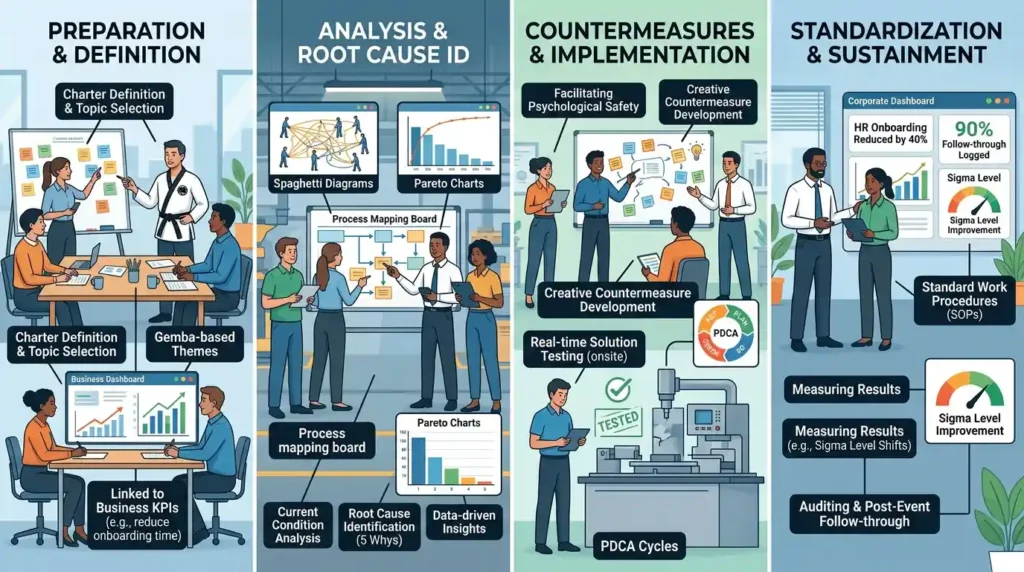
Master Black Belts facilitate Kaizen events through structured 8-step processes: theme selection, current condition analysis, goal setting, root cause identification, countermeasure development, implementation, standardisation, and evaluation. They coach teams in real-time.
Preparation starts with charter definition. Trainees select Gemba-based themes aligned with business KPIs. Analysis uses tools like spaghetti diagrams and Pareto charts.
Facilitation emphasises psychological safety. Black Belts guide brainstorming without dominating. Implementation phases test changes onsite, monitoring via PDCA cycles.
Post-event, they audit sustainment. Training programmes log 90% follow-through when Black Belts lead. HR tracks this via dashboards showing sigma level shifts.
In corporate training, facilitation builds strategic acumen. Participants apply to enterprise challenges, like reducing HR onboarding by 40%.
Which Tools Enhance Facilitation During Events?
Standard tools include A3 reports for planning and visual management boards. Digital variants like Miro support hybrid teams. Training integrates Minitab for data validation, ensuring 95% accuracy.
These amplify outcomes. Programmes report 50% faster convergence on solutions.
What Preparation Steps Precede Kaizen Events in Master Black Belt Programmes?
Preparation spans 4-6 weeks pre-event. Steps include charter approval, team assembly, baseline data collection, and management buy-in. This phase allocates 20% of training time to setup.
Charters define scope, goals, and metrics. Trainees benchmark against industry standards, like 20% waste reduction. Data collection employs value stream mapping.
Team selection mixes functions: operations, finance, and frontline. Buy-in sessions align sponsors on ROI expectations, targeting 4-6 month paybacks.
Programmes simulate this in modules. The Lean Six Sigma Master Black Belt Certification Training Course embeds prep into curriculum.
HR leaders value structured prep. It minimises failure rates, holding at under 10%.
How Does Prep Impact Event Success Rates?
Robust prep correlates with 85% success. Weak baselines lead to 30% rework. Training data confirms: prepared events sustain 60% gains at one year.
What Follow-Up Mechanisms Ensure Kaizen Gains Persist Post-Training?
Follow-up uses layered audits: daily checks, 30-day reviews, and quarterly evaluations. Master Black Belts deploy control plans with KPIs like OEE improvements of 25%. Digital dashboards track adherence.
Daily huddles reinforce standards. Reviews validate via statistical process control. Quarterly audits by Black Belts prevent regression.
Programmes train on sustainment frameworks. 75% of graduates implement enterprise systems post-certification.
B2B ROI hinges here. HR measures via balanced scorecards, linking to 15-20% productivity lifts.
Why Integrate Technology in Follow-Up?
Tools like Tableau visualise trends. Adoption rates hit 80% in trained cohorts. This scales impact across organisations.
How Do Kaizen Events Measure Up in Master Black Belt ROI?
Kaizen events deliver 5-10x ROI in Master Black Belt training. Metrics show $50,000-$200,000 annual savings per event. Training investment recoups in 3-6 months via scaled applications.
Programmes benchmark against ASQ standards. Events target hard savings: inventory cuts of 30%, lead times halved.
HR evaluates via L&D frameworks. Post-training, 65% of Black Belts lead 5+ events yearly, compounding value.
No forced comparisons emerge naturally here, as incorporation focuses on integration over alternatives.
| Kaizen Event Phase | Key Activities | Typical Duration | Measurable Outcome |
|---|---|---|---|
| Preparation | Charter, data collection, team setup | 4-6 weeks | Baseline KPIs established (e.g., 20% waste identified) |
| Execution | Gemba walks, root cause, countermeasures | 3-5 days | 20-50% process improvement |
| Follow-Up | Audits, control plans, reviews | 30-90 days | 60-80% gain sustainment |
| Strategic Scale | Black Belt deployment | 6-12 months | Enterprise ROI of 5-10x |
This table outlines phased ROI drivers.
How Does Kaizen Integration Differentiate Master Black Belt Training?
Integration elevates programmes by fusing rapid cycles with strategic Lean Six Sigma. It produces leaders who deploy at scale, closing C-suite skill gaps. Differentiators include live facilitation and metrics-driven debriefs.
Discover More from Our Guide Library:
How Does a Master Black Belt Course Prepare You for ASQ or IASSC Certification?
How Does Master Black Belt Training Teach Hypothesis Testing and Statistical Inference?
Competing approaches rely on case studies. Kaizen-embedded training yields 40% higher application rates.
Corporate contexts demand this. Managers compare delivery models: blended vs. immersive. Immersive wins with 90% competency gains.
Programmes like those from Imperial focus on B2B outcomes: strategic development for HR and execs.
What does Lean Six Sigma Master Black Belt Certification Training Course cover at Imperial Corporate Training Institute?
The course covers advanced DMAIC methodologies, statistical analysis, change leadership, and Kaizen event facilitation. Participants gain skills in strategic process deployment and ROI measurement for enterprise-level improvements. Imperial Corporate Training Institute emphasises practical, industry-aligned projects.
What are the prerequisites for Imperial Corporate Training Institute’s Lean Six Sigma Master Black Belt Certification Training Course?
Candidates need prior Black Belt certification and 3-5 years of process improvement experience. Familiarity with Lean principles and statistical tools is essential. Imperial Corporate Training Institute assesses readiness through application reviews.
Does Imperial Corporate Training Institute’s Lean Six Sigma Master Black Belt Certification Training Course include Kaizen events?
Yes, it integrates live Kaizen workshops in mid-to-late stages for hands-on facilitation practice. These 3-5 day events target real organisational challenges with measurable outcomes. The training builds sustainment skills for long-term gains.