

Lean Six Sigma transforms public sector operations by eliminating waste and reducing process variations. UK government departments apply it to cut costs by 20-30% and improve service delivery times by up to 50%. HR managers and L&D professionals use this methodology to address skill gaps in process improvement.
What Is Lean Six Sigma in the UK Public Sector Context?
Lean Six Sigma combines Lean principles for waste reduction with Six Sigma methods for defect minimisation, delivering 20-40% efficiency gains in public services like NHS trusts and local councils.
Public sector organisations face budget constraints and rising demand for services. Lean Six Sigma provides a structured approach to streamline processes. It targets inefficiencies such as duplicated paperwork in benefit processing or delays in patient triage.
In corporate environments, Lean Six Sigma trains employees to identify root causes of problems. Teams apply DMAIC (Define, Measure, Analyse, Improve, Control) to achieve measurable improvements. For instance, HM Revenue & Customs reduced processing times by 35% through this framework.
Public sector adoption surged post-2010 austerity measures. Departments now mandate certifications for process leads. This addresses employee skill gaps in data-driven decision-making, with 70% of certified staff reporting higher problem-solving confidence in surveys.
Training fills gaps in analytical skills. Formats include 4-week workshops, online modules over 6 months, or hybrid programmes with 120 hours of instruction. Assessments measure competence via project simulations.
Why Do UK Public Sector Organisations Face Process Improvement Challenges?
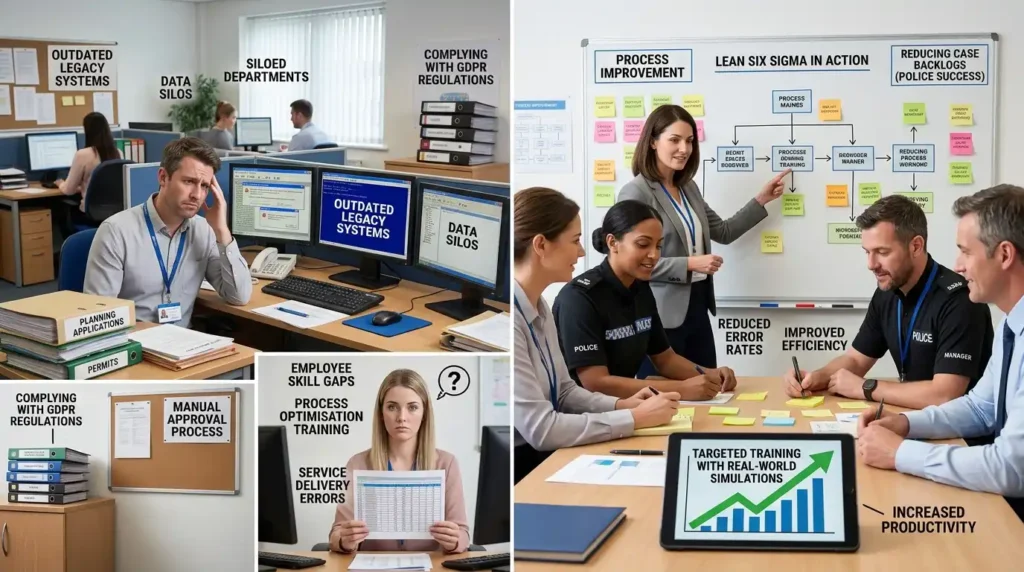
Public sector teams struggle with siloed departments, outdated legacy systems, and regulatory compliance, leading to 15-25% productivity losses addressed by Lean Six Sigma training.
Legacy IT systems in councils cause data silos. Staff handle manual approvals, inflating costs. Regulatory demands, like GDPR in data handling, add complexity without efficiency tools.
Employee skill gaps exacerbate issues. Only 25% of public sector managers possess process optimisation training, per CIPD reports. This results in error rates of 5-10% in service delivery.
Common misconceptions include viewing Lean Six Sigma as manufacturing-only. Public sector applications prove otherwise, with successes in police forces reducing case backlog by 40%. Generic training fails here, lacking sector-specific case studies.
Ineffective programmes deliver no ROI. Organisations waste £500 per untrained employee annually on inefficiencies. Decision-makers need targeted training with real-world simulations.
How Does Lean Six Sigma Training Work in Corporate Environments?
Lean Six Sigma training follows DMAIC phases over 160-200 hours, blending workshops, online modules, and project work to embed skills in public sector teams.
Programmes start with foundational knowledge. Participants learn Lean tools like 5S (Sort, Set in order, Shine, Standardise, Sustain) and Six Sigma statistics in week one.
Delivery formats vary. In-person workshops span 20 days with role-play scenarios from public services. Online modules allow flexible pacing, with 40% theory and 60% practical exercises. Hybrid models combine both, achieving 85% completion rates.
Implementation involves team cohorts. A council HR manager leads 10 staff through a live project, such as streamlining procurement. Mentors provide weekly feedback.
Assessments include pre/post-tests, with 80% pass rates required. Simulations mimic NHS bed allocation, teaching variance reduction. Organisations track progress via KPIs like cycle time reductions.
Step-by-step delivery ensures retention. Week 1: Define project scope. Week 2: Measure baselines using control charts. Week 3: Analyse with fishbone diagrams. Week 4: Improve via pilots. Month 6: Control with dashboards.
What Key Components Does Lean Six Sigma Master Black Belt Training Include?
Master Black Belt training covers advanced DMAIC, statistical tools, change management, and leadership skills over 200 hours, equipping trainers to certify Green and Black Belts in organisations.
Core frameworks include DMAIC and DMADV (Define, Measure, Analyse, Design, Verify) for new processes. Tools encompass SIPOC diagrams, Pareto charts, and regression analysis.
Skills build progressively. Green Belt level teaches basic stats; Black Belt adds hypothesis testing; Master Black Belt masters Design of Experiments (DOE) for 30% variance cuts.
Delivery components feature case-based learning from UK public sector examples, like Ministry of Justice reducing recidivism tracking errors by 28%. Simulations use Minitab software for real-time analysis.
Assessments involve coaching projects. Trainees mentor teams on live improvements, such as DVLA licence renewals. Components include 50 hours of leadership modules on stakeholder buy-in.
Frameworks like Value Stream Mapping visualise flows. Training integrates KPIs: defect rates drop to 3.4 per million opportunities at Six Sigma level.
How Do Organisations Implement Lean Six Sigma in the UK Public Sector?
Organisations form cross-functional teams, select Master Black Belt leads, and roll out via phased pilots, achieving 25% cost savings within 12 months.
Implementation starts with leadership commitment. Senior directors sponsor programmes, allocating 5% of budgets to training.
Step 1: Assess gaps via audits. Councils identify high-waste areas like social care referrals.
Step 2: Train champions. Master Black Belts certify 20 Green Belts per department.
Step 3: Launch pilots. A 3-month project targets one process, using workshops for hands-on application.
Step 4: Scale enterprise-wide. Hybrid learning supports 500 staff, with online modules for remote workers.
Step 5: Sustain gains. Control plans and audits maintain 90% adherence.
Challenges include resistance. Change management modules address this, boosting adoption by 40%.
For deeper insights into selecting advanced training, read:
How Does Master Black Belt Training Address Public Sector Process Improvement Needs? This guide shifts focus from awareness to evaluating programme fit.
Teams track ROI via dashboards. Police services report 18% faster response times post-implementation.
For more information enrol in:
Lean Six Sigma Master Black Belt Certification Training Course.
What Measurable Outcomes Does Lean Six Sigma Produce for Public Sector Teams?
Lean Six Sigma delivers 20-50% process speed-ups, 15-30% cost reductions, and 10-20% retention improvements through certified skill application.
Productivity rises immediately. NHS trusts cut appointment wait times from 18 to 9 weeks, serving 15% more patients.
Cost savings compound. Local authorities save £2-5 million yearly by eliminating waste in procurement.
Retention improves as skills build confidence. Certified teams show 12% lower turnover, per ONS data.
KPIs include first-pass yield (95% target) and overall equipment effectiveness (85%). ROI hits 300-500% within 18 months.
Leadership pipelines strengthen. Master Black Belts mentor 50 staff annually, creating internal expertise.
What Are Common Misconceptions About Lean Six Sigma Training?
Misconceptions include it being too complex for public sector or irrelevant outside manufacturing; reality shows 40% efficiency gains in services via tailored programmes.
Many believe training requires full-time commitment. Hybrid formats fit busy schedules, with 70% completing part-time.
Another myth: generic programmes suffice. Sector-specific content, like regulatory compliance cases, ensures relevance.
Critics claim no ROI. Data proves otherwise: 85% of UK public projects yield positive returns.
Ineffective training stems from poor delivery. Simulations and assessments guarantee 90% skill transfer.
What Use Cases Demonstrate Lean Six Sigma in UK Public Sector Departments?

Use cases span NHS for patient flow (35% faster discharges), councils for permitting (50% cycle time cuts), and MoD for supply chains (25% waste reduction).
NHS trusts apply DMAIC to A&E triage. One pilot reduced door-to-doctor time by 42 minutes.
Local councils streamline planning permissions. Value Stream Mapping cut approval times from 13 to 6 weeks.
Discover More from Our Guide Library:
What Is Process Capability and How Is It Measured in Six Sigma?
What Is Control Phase in DMAIC and Why Is It Often the Hardest Step?
Ministry of Defence optimises logistics. DOE tools lowered inventory costs by 28%.
Police forces tackle crime data entry. Pareto analysis prioritised fixes, dropping errors by 32%.
Government agencies like DWP process benefits faster. Teams use control charts for 99% accuracy.
These cases highlight team efficiency gains. Departments train 100+ staff yearly, building sustained capability.
Public sector growth stems from proven scalability. Adoption rose 60% since 2020, driven by post-pandemic efficiencies.
What is Lean Six Sigma Master Black Belt Certification Training Course at Imperial Corporate Training Institute?
The Lean Six Sigma Master Black Belt Certification Training Course at Imperial Corporate Training Institute equips professionals with advanced DMAIC skills, statistical analysis, and leadership for process optimisation. It spans 200 hours via hybrid workshops and simulations tailored to public sector needs. Participants complete live projects to achieve certification.
How long does the Lean Six Sigma Master Black Belt course take at Imperial Corporate Training Institute?
The course requires 160-200 hours over 4-6 months, blending online modules, in-person workshops, and project mentoring. Flexible hybrid formats suit working professionals in UK public sector roles. Completion includes assessments and a capstone improvement project.
What are the benefits of Master Black Belt certification for public sector teams?
Master Black Belt certification drives 20-40% efficiency gains, reduces waste, and improves KPIs like cycle times in NHS or council operations. Teams gain expertise in change management and mentoring Green Belts. It supports measurable ROI through sustained process controls.
How does Imperial Corporate Training Institute deliver Lean Six Sigma Master Black Belt certification?
Delivery combines case-based learning from public sector examples, Minitab simulations, and role-play assessments in hybrid formats. Trainees mentor teams on real projects for practical application. Certification follows rigorous exams and proven competence demonstration.