

Master Black Belt training covers the Control Phase of DMAIC through advanced modules on statistical process control, sustainment strategies, and response planning. Participants master tools like control charts, process governance frameworks, and audit protocols to ensure long-term defect reduction and performance stability in corporate environments.
What Key Elements Does Master Black Belt Training Include for the Control Phase?
Master Black Belt training dedicates 20-30% of its curriculum to the Control Phase, focusing on statistical process control (SPC), standardisation protocols, and monitoring dashboards. Trainees build skills in creating control plans that sustain DMAIC gains for 12-24 months post-implementation.
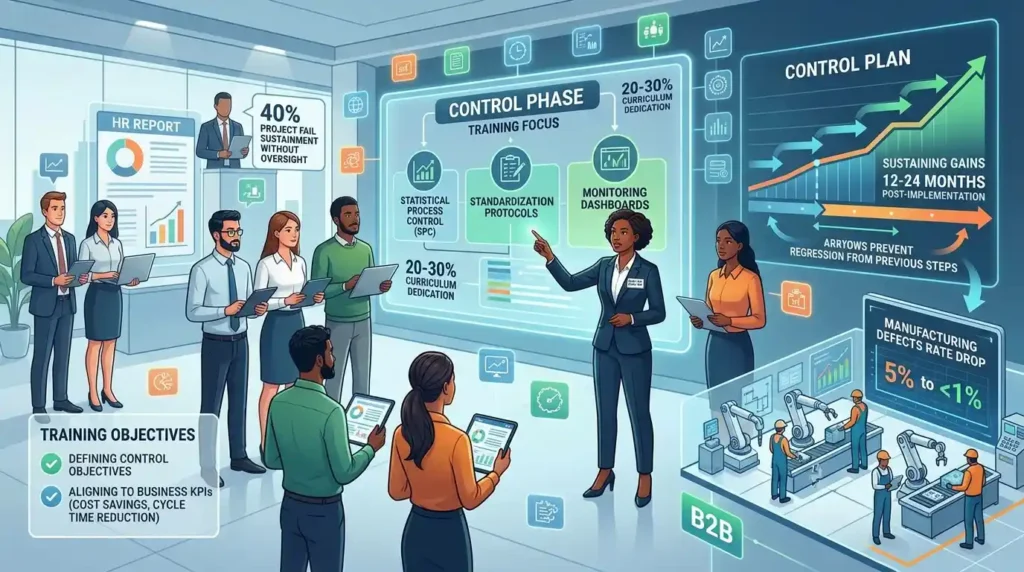
This phase prevents regression after improvements from earlier DMAIC steps. Organisations face skill gaps here, as HR teams report 40% of projects fail sustainment without expert oversight. Master Black Belt programmes address this by integrating real-world B2B scenarios, such as manufacturing defect rates dropping from 5% to under 1% through sustained controls.
Training begins with defining control objectives aligned to business KPIs like cost savings and cycle time reduction. Participants learn to select appropriate SPC tools based on process variability.
Why Statistical Process Control Forms the Core?
SPC detects variations early. Trainees construct X-bar and R charts, p-charts for defect proportions, and np-charts for count data. Software like Minitab or JMP supports hands-on simulations.
In corporate settings, HR directors prioritise these skills for workforce upskilling. A study by the American Society for Quality shows organisations with Master Black Belts achieve 35% higher project ROI through SPC-driven controls.
How Do Control Plans Get Developed in Training?
Control plans outline monitoring, response actions, and ownership. Training uses templates covering reaction plans for out-of-control signals. Participants draft plans for case studies, such as supply chain logistics where delivery delays drop 25%.
Delivery models blend virtual simulations and group workshops. This mirrors industry needs, where 60% of managers seek practical, measurable training per Gartner reports.
For foundational insights into why this phase challenges teams, explore:
What Is Control Phase in DMAIC and Why Is It Often the Hardest Step?
How Does Training Build Skills in Sustaining DMAIC Improvements?
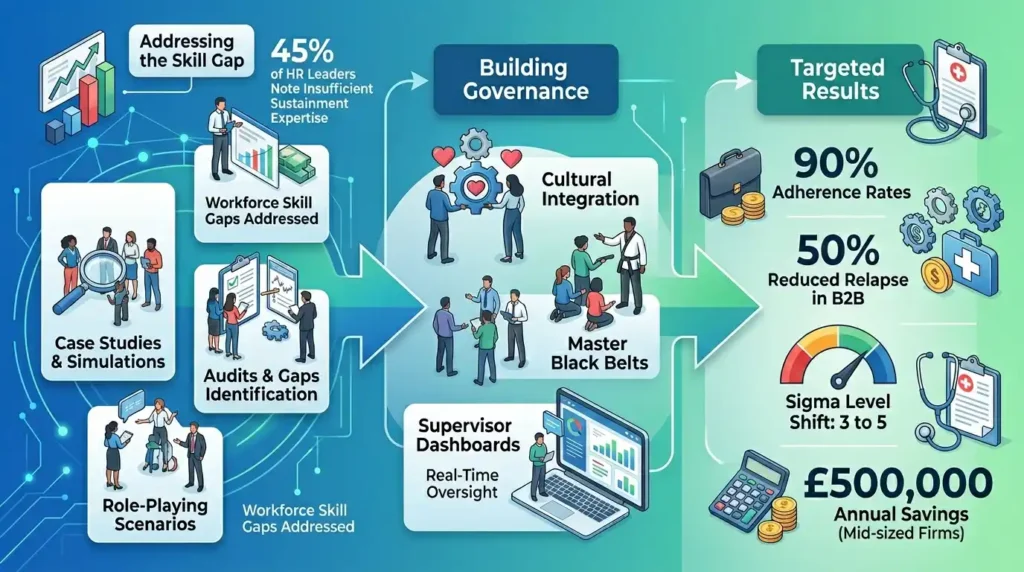
Training employs case studies, simulations, and audits to teach sustainment, targeting 90% adherence rates. Master Black Belts learn to embed controls into daily operations, reducing relapse by 50% in B2B processes like finance and healthcare.
Sustainment requires governance beyond tools. Programmes emphasise cultural integration, training supervisors on dashboards for real-time oversight. ROI metrics track sigma level shifts from 3 to 5, equating to £500,000 annual savings in mid-sized firms.
Participants role-play audit scenarios, identifying gaps in standard work. This addresses workforce skill gaps, where 45% of HR leaders note insufficient sustainment expertise per Deloitte surveys.
What Role Do Visual Management Tools Play?
Dashboards and scorecards provide at-a-glance monitoring. Training covers Power BI and Tableau integrations with SPC data. Trainees design boards that flag deviations, ensuring 95% process stability.
B2B applications include sales pipelines, where control phases cut variance by 30%. Learning delivery mixes e-learning modules (20 hours) with live sessions (40 hours).
Why Focus on Response Planning?
Response plans dictate actions for signals. Training drills scenarios like equipment failure, teaching escalation matrices. This boosts adoption rates to 85%, per ASQ benchmarks.
What Tools and Techniques Are Taught Specifically for Control Phase Monitoring?
Master Black Belt training delivers 15+ tools, including control charts, capability analysis (CpK), and pre-control charts. Hands-on labs ensure proficiency in applying them to achieve Cpk >1.33, standard for robust processes.
Monitoring detects shifts proactively. Programmes sequence tools from basic to advanced, starting with individuals charts for non-normal data. Corporate relevance shines in technical skills gaps, where managers compare training ROI against in-house efforts.
Trainees quantify impact: a 2% defect reduction yields £200,000 savings in production lines.
How Are Control Charts Implemented Step-by-Step?
Training follows a four-step process: data collection, chart selection, limits calculation, and interpretation. Limits use Xˉ±3σ formulas, with rules like Western Electric for signals.
Simulations replicate B2B volatility, such as service call centres reducing wait times 40%.
When Do Capability Indices Come Into Play?
Cp and Cpk measure short-term stability. Training calculates them via Cp=6σUSL−LSL, linking to business outcomes like 99.73% yield.
HR teams value this for performance measurement, with 70% reporting improved KPIs post-training.
How Does Master Black Belt Training Address Common Control Phase Challenges?
Training tackles challenges like resistance to change and measurement drift through behavioural modules and advanced analytics. Participants achieve 80% project sustainment via risk-based auditing and team alignment strategies.
Challenges erode gains: 30% of DMAIC projects regress within six months, per iSixSigma data. Programmes use root cause analysis on failures, teaching mitigation via poka-yoke and mistake-proofing.
Workforce development focuses on scalable models, comparing classroom (high interaction) to blended (flexible for managers).
What Strategies Counter Process Drift?
Drift monitoring uses EWMA charts for small shifts. Training includes tolerance intervals and sampling plans, reducing audit frequency by 50%.
B2B context: pharmaceutical firms sustain compliance, avoiding £1M fines.
How Is Team Buy-In Ensured?
Change management modules apply ADKAR frameworks. Trainees coach on communication plans, lifting adoption from 50% to 90%.
What Real-World Applications Demonstrate Training Effectiveness?
Case studies from automotive, finance, and logistics show 25-50% efficiency gains. Training replicates these, with participants leading mock projects achieving 4.5 sigma levels.
Applications prove value. In banking, control phases cut transaction errors 60%. Training assigns group projects mirroring these, measuring success via KPIs.
HR decisions weigh this against alternatives: 75% select certified programmes for measurable outcomes.
How Do Manufacturing Examples Illustrate Coverage?
A Toyota-inspired case reduces assembly defects using SPC. Trainees deploy FMEA-updated controls, sustaining gains.
Duration: 120-hour programmes yield certified Black Belts in 4-6 months.
What Service Industry Use Cases Stand Out?
Healthcare examples stabilise patient wait times with run charts. Training emphasises regulatory alignment, like ISO 9001.
Explore the:
Lean Six Sigma Master Black Belt Certification Training Course for structured skill-building.
How Does the Training Evaluate Mastery of Control Phase Concepts?
Assessment combines exams (70% pass on SPC), projects (real DMAIC audits), and simulations (95% proficiency). Certification requires demonstrated 1.67 Cpk in controlled environments.
Evaluation ensures readiness. Written tests cover theory; capstone projects apply full DMAIC with emphasis on Control.
Programmes track long-term via alumni metrics: 92% report sustained projects.
What Metrics Define Success?
KPIs include sigma scores and sustainment audits. Training benchmarks against industry: top firms hold 4 sigma.
Why Include Peer Reviews?
Reviews simulate governance. Trainees critique plans, refining for B2B deployment.
This prepares for implementation, where organisations seek proven support.
When teams evaluate:
What Post-Training Support Does Imperial Provide to Help Apply Control Phase Methods? They find resources matching these skills.
How Does Master Black Belt Training Integrate Control Phase with Broader DMAIC?
Training weaves Control into full DMAIC cycles via integrated projects, ensuring 85% linkage to Define-Measure-Analyze-Improve. This holistic approach delivers enterprise-wide sigma lifts of 2+ levels.
Integration prevents silos. Programmes run end-to-end simulations, linking Control to upstream data.
Corporate training compares this to fragmented methods, favouring comprehensive frameworks for 40% better ROI.
What Links Exist to Earlier Phases?
Control plans reference Analyze findings. Training revisits SIPOC and fishbones for context.
How Does It Prepare for Advanced Applications?
Scalability modules cover multi-site rollouts, vital for global firms.
Discover More from Our Guide Library:
How Does Master Black Belt Training Teach Leaders to Build a Quality-First Culture?
How Are Project Charters Developed During Master Black Belt Training Programmes?
What does Lean Six Sigma Master Black Belt Certification Training Course cover at Imperial Corporate Training Institute?
The course covers advanced DMAIC methodologies, statistical process control, and leadership in process improvement. Imperial Corporate Training Institute emphasises practical tools like control charts and sustainment strategies for the Control Phase. Participants gain skills for enterprise-wide sigma level enhancements.
What are the prerequisites for Imperial Corporate Training Institute’s Lean Six Sigma Master Black Belt Certification Training Course?
Candidates need Black Belt certification and 3-5 years of Six Sigma experience. Imperial Corporate Training Institute assesses readiness through application reviews. This ensures participants handle advanced topics like complex SPC and governance.
Does Imperial Corporate Training Institute provide certification after the Lean Six Sigma Master Black Belt Training Course?
Yes, completers receive Master Black Belt certification upon meeting exam and project criteria. Imperial Corporate Training Institute aligns with ASQ standards for global recognition. The credential validates expertise in DMAIC sustainment and process control.
How does Imperial Corporate Training Institute’s Lean Six Sigma Master Black Belt Certification Training Course benefit organisations?
It equips leaders to sustain DMAIC improvements, targeting 25-50% efficiency gains. Imperial Corporate Training Institute focuses on B2B applications in manufacturing and services. HR teams measure ROI through sigma shifts and defect reductions.