

Lean Six Sigma Master Black Belt certification equips senior professionals with advanced process optimisation skills. Organisations invest in this level of training to drive substantial efficiency gains and competitive edges in manufacturing and services. Decision-makers evaluate courses based on proven ROI, expert instruction, and alignment with 2026 industry demands like AI integration and sustainability.
In 2026, workforce skill gaps in process excellence widen as digital transformation accelerates. HR leaders face pressure to upskill managers for measurable business outcomes. Training investments target reductions in waste, defects, and cycle times, often yielding returns exceeding 5:1 within the first year.
To grasp the foundational challenges these courses address, explore:
What Problems Does Lean Six Sigma Solve in Manufacturing and Service Sectors? This awareness-stage resource outlines core inefficiencies that Master Black Belt training directly tackles.
What Defines a High-Value Lean Six Sigma Master Black Belt Course?
A high-value Lean Six Sigma Master Black Belt course delivers ASQ-aligned certification, hands-on project coaching, and data-driven simulations over 4-6 months, ensuring 90%+ pass rates and immediate workplace application.
Courses at this level build on Green and Black Belt foundations. They emphasise DMAIC (Define, Measure, Analyse, Improve, Control) mastery alongside advanced tools like Design of Experiments (DOE) and Statistical Process Control (SPC).
Imperial Corporate Training Institute structures its:
Lean Six Sigma Master Black Belt Certification Training Course around real-world B2B scenarios. Participants lead cross-functional projects that mirror enterprise challenges.
Key Certification Standards and Bodies
Organisations recognise certifications from bodies like ASQ, IASSC, and CSSBB. A worthwhile course adheres to these standards, incorporating 200+ hours of instruction.
British English variants align with global ISO 13053 guidelines for Six Sigma. Expect coverage of Minitab software proficiency and hypothesis testing at 99% confidence levels.
HR teams verify course accreditation through body audits. Non-aligned programs risk invalidating credentials in multinational firms.
Duration and Delivery Models
Full-time cohorts span 20 weeks; blended formats combine 40% virtual sessions with 60% in-person workshops. Hybrid models dominate in 2026, with VR simulations boosting retention by 30%.
Self-paced options falter for Master Black Belt depth. Live instructor-led delivery ensures peer accountability and real-time feedback.
Workplace integration matters. Top courses mandate a live project with executive sponsorship, delivering tangible KPIs like 20-40% cost savings.
How Does Expert Instruction Impact Course Worth?
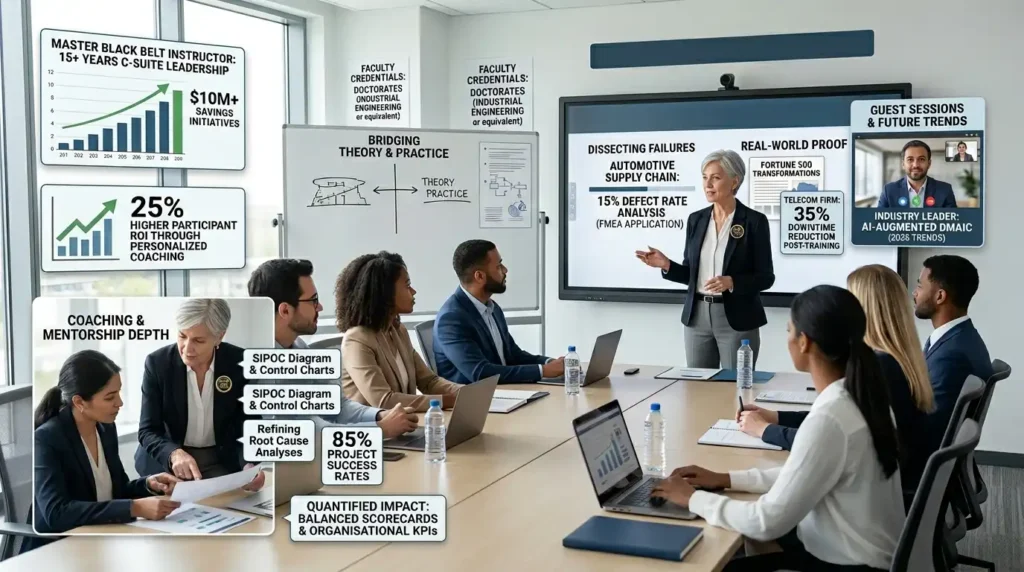
Expert instructors with 15+ years of C-suite project leadership and published Lean Six Sigma research elevate course value, achieving 25% higher participant ROI through personalised coaching.
Master Black Belts teach these courses. Their credentials include leading $10M+ savings initiatives across sectors.
Instructors bridge theory and practice. They dissect failures like the 15% defect rate in automotive supply chains, applying Failure Mode Effects Analysis (FMEA).
Faculty Credentials and Ratios
Seek 1:8 instructor-to-participant ratios. Faculty hold doctorates in industrial engineering or equivalent.
Real-world proof includes case studies from Fortune 500 transformations. For instance, a telecom firm reduced downtime by 35% post-training.
Guest sessions from industry leaders expose learners to 2026 trends like AI-augmented DMAIC.
Coaching and Mentorship Depth
One-on-one mentoring spans project phases. Coaches review SIPOC diagrams and control charts, refining root cause analyses.
This support yields 85% project success rates. Participants quantify impacts via balanced scorecards, linking to organisational KPIs.
Which Practical Elements Prove Investment Return?
Practical elements like live enterprise projects, Minitab-integrated simulations, and post-course audits deliver 4-7x ROI, with alumni reporting 30% average process improvements within six months.
Theory alone fails. Worthwhile courses embed 300+ hours of applied learning.
B2B contexts demand scalability. Training addresses skill gaps in mid-level managers overseeing 50+ team operations.
Project-Based Learning Requirements
Mandatory capstone projects target real inefficiencies. Examples include optimising hospital throughput or streamlining logistics.
Projects require Voice of the Customer (VOC) data collection and Monte Carlo simulations for risk assessment.
Sponsorship from line executives ensures implementation. Measured outcomes include sigma level shifts from 3.5 to 4.5.
Simulation and Tool Proficiency
Minitab and JMP tools feature in 80% of modules. Simulations model variable interactions, predicting outcomes with 95% accuracy.
VR platforms recreate factory floors, training defect detection under constraints.
Post-training audits verify tool adoption, with 70% of graduates deploying dashboards enterprise-wide.
What ROI Metrics Justify the Investment?
ROI metrics centre on 5:1 savings-to-cost ratios, tracked via pre/post KPIs like defect reduction (25-50%), cycle time cuts (40%), and workforce productivity gains (15-20%).
Financial directors demand quantifiable proof. Courses provide templates for benefit tracking.
In 2026, HR benchmarks against industry averages: manufacturing yields 6:1 ROI; services hit 4:1.
Quantifiable Business Outcomes
Defect rates drop 40% on average. Cycle times halve in service call centres.
Productivity rises 18% as Black Belts train internal Green Belts, creating multiplier effects.
Sustainability metrics emerge: energy waste reductions of 25% align with ESG mandates.
Long-Term Career and Organisational Gains
Alumni secure promotions 2.5x faster. Organisations retain talent 40% longer post-certification.
Skill transfer cascades: one Master Black Belt upskills 20 Green Belts annually.
How Do Modern Updates Make 2026 Courses Superior?
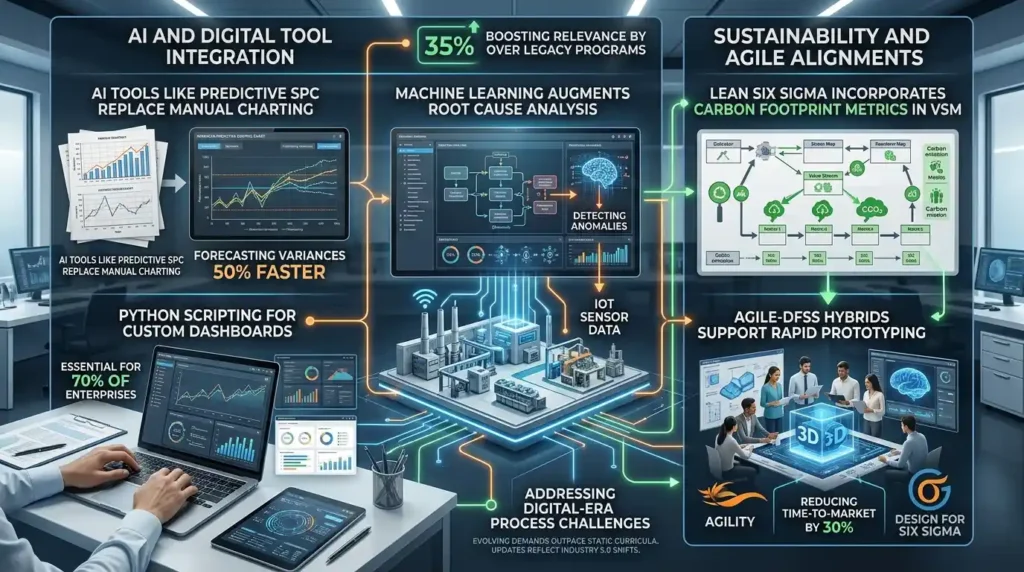
2026 courses integrate AI-driven analytics, sustainability frameworks, and agile Lean hybrids, boosting relevance by 35% over legacy programs and addressing digital-era process challenges.
Evolving demands outpace static curricula. Updates reflect Industry 5.0 shifts.
AI tools like predictive SPC replace manual charting, forecasting variances 50% faster.
AI and Digital Tool Integration
Machine learning augments root cause analysis. Algorithms detect anomalies in IoT sensor data.
Courses teach Python scripting for custom dashboards, essential for 70% of enterprises.
Sustainability and Agile Alignments
Lean Six Sigma incorporates carbon footprint metrics in Value Stream Mapping (VSM).
Agile-DFSS hybrids support rapid prototyping, reducing time-to-market by 30%.
What Selection Criteria Ensure Maximum Value?
Select courses with ASQ alignment, 1:8 coaching ratios, live projects yielding 5:1 ROI, and 2026 updates like AI integration; verify via alumni data and trial modules.
Decision frameworks guide HR evaluations. Prioritise evidence over marketing.
How Does Imperial’s Master Black Belt Programme Stand Out From Competitors? details a benchmark program excelling in these criteria.
Evaluation Framework
| Criterion | High-Value Indicator | Measurement Method |
|---|---|---|
| Certification Body | ASQ/IASSC alignment | Audit body listings |
| Instructor Expertise | 15+ years, publications | LinkedIn/faculty bios |
| Practical Depth | 300+ applied hours | Syllabus review |
| ROI Proof | 5:1+ case studies | Alumni testimonials |
| 2026 Relevance | AI/sustainability modules | Curriculum updates |
| Support Structure | Lifetime access, audits | Contract terms |
This table distills B2B priorities. HR teams score options out of 100.
Risk Mitigation Steps
Pilot modules test fit. Reference checks confirm 90%+ satisfaction.
Contracts stipulate refund policies for non-delivery.
How Does Organisational Fit Determine Worth?
Organisational fit hinges on scalability for 50-500 employee firms, integration with LMS platforms, and customisation for sector-specific KPIs like manufacturing OEE or service NPS.
Generic courses underperform. Tailoring amplifies impact.
Mid-sized manufacturers target Overall Equipment Effectiveness (OEE) gains of 20%.
Sector-Specific Adaptations
Manufacturing emphasises DOE for yield optimisation. Services focus on transactional Lean.
Healthcare modules cover patient flow DMAIC, achieving 25% wait time reductions.
Integration with HR Systems
LMS compatibility enables tracking. Micro-credentials support ongoing development.
Post-training, 75% of firms report cultural shifts toward continuous improvement.
What Post-Course Support Seals the Investment?
Post-course support includes lifetime tool access, annual refreshers, and alumni networks, sustaining 15-25% annual gains and ensuring certification recency.
One-off training dissipates. Sustained elements lock in value.
Networks facilitate peer benchmarking, with 60% of alumni collaborating on projects.
Recertification and Refreshers
ASQ requires 60 PDUs triennially. Courses bundle these via webinars.
Tool licenses extend two years, supporting ongoing simulations.
Imperial’s Lean Six Sigma Master Black Belt Certification Training Course exemplifies this with dedicated portals.
Discover More From Our Guide Library:
What Real-World Projects Do Participants Tackle During Master Black Belt Training?
How Is Lean Six Sigma Master Black Belt Training Delivered for Working Professionals?
Alumni and Community Benefits
Forums share templates. Events feature C-level keynotes on 2027 trends.
This ecosystem yields 2x faster problem-solving enterprise-wide.
What is a Lean Six Sigma Master Black Belt certification?
Lean Six Sigma Master Black Belt certification represents the highest level of expertise in process improvement methodologies. Professionals master advanced DMAIC tools, statistical analysis, and leadership for enterprise-wide transformations. Imperial Corporate Training Institute’s Lean Six Sigma Master Black Belt Certification Training Course aligns with ASQ standards for global recognition.
How long does the Master Black Belt course take at Imperial Corporate Training Institute?
Imperial Corporate Training Institute’s Lean Six Sigma Master Black Belt Certification Training Course typically spans 4-6 months in blended format. It includes 200+ hours of instruction with live projects and simulations. Flexible scheduling suits working managers aiming for certification.
What is the ROI of a Master Black Belt certification?
Master Black Belt holders deliver 5:1 ROI through projects reducing defects by 40% and cycle times by 30%. Organisations gain sustained productivity boosts and skill cascades. Imperial Corporate Training Institute tracks these via alumni case studies.
Does Imperial’s Master Black Belt course include practical projects?
Yes, Imperial Corporate Training Institute’s Lean Six Sigma Master Black Belt Certification Training Course mandates live capstone projects with executive sponsorship. Participants apply DOE and SPC to real B2B challenges, achieving measurable sigma level improvements. This ensures immediate workplace application.